
Spiritual pathways
Remembering the Magick of the Light by Kavasji H. Homji. Published in 2013 by the author; email: homji@sympatico.ca. Pp: xi + 256. Price: Not mentioned.
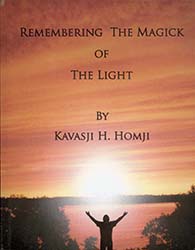 Declaring itself as "the fictionalized story of a soul’s journey... the central character of the story is Spitama Zarathushtra.” This sober re-telling of a momentous turning point in mankind’s spiritual evolution well merits an indulgent appraisal. The sub-titling: "A Story of One Soul’s Journey,” whilst making clear that it is not "a historical treatise,” is highly significant. The extension is relevant for the best of reasons — Kavasji H. Homji’s (pictured) impassioned narrative style parallels his fidelity to the sage’s suprasensory envisionment. This is a serious work.
An unusual approach to Zarathushtra should intrigue and involve the reader by its unfamiliar perspective: it is via the discipline of Reiki, hitherto unknown to this reviewer.
Born into a Karachi priestly family, Homji was navjoted at seven, and became a navar at 11. After obtaining his MBA in the United States, he migrated to Canada and in 1974 married a Protestant Christian. In 1993 both took up Reiki which they have since taught.
One surmises that the sequence of mental exercises are recaps of its essential doctrines: they serve as an introduction to this esoteric science. Doubtless arising from these, a refreshingly calm atmosphere of tranquillity and contentment accompanies Homji’s quest.
Can such journey ever reach an end? Does it have an end? A convincing itinerary draws the hope that it never will, for there is much within a spiritual landscape that impels towards its reflective enjoyment. Robert Louis Stevenson’s dictum: "To travel hopefully is a better thing than to arrive...” holds good also for explorations beyond time and space. The Pahlavi authors knew these well.
 Zarathushtra had taught it as "foremost existence” — being the culmination of a fulfilling earthly spiritual life (Yss.28.2; 43.3, etc) — stressing that it is to be sought through each individual’s clear-minded awareness of Mazda’s good mind and truth (Ys.30.1,2). Yasna 29.4 makes clear that the Mazdaic precepts are to be taught at separate levels: the pairi.chithit, "open; exoteric,” and aipi.chithit, "secret; esoteric.”
Part 1, "The Divine Journey” in usefully sectioned eight chapters, includes the intriguing "Revealed Teachings of the Master.” One skims past these at peril, for Homji’s "fictionalizing” stops, and his edifyingly profound understanding of Zarathushtra’s Gathas unfolds to yield paraphrases as close as any newcomer to these sacrosanct poems could wish. Free seeming, Homji’s insightful commentaries contain sufficiently percipient details which, to this reviewer’s awareness, are unequalled at such populist level.
Using the legends of the sage’s life, the author commences with his murder, whilst in deep communion with the creator Mazda, at the hands of a vengeful Turanian Arejataspa. Thereafter, and crucially, Homji rightly leaps from death to birth, from the black arts of the karaps to the "white magic” (reviewer’s take!) of the Azarbaijani Median Magi to elaborate on the mystico-spiritual advent of the sage himself.
This devotee who revealed himself as a Magus was, by the turn of events, to become young Zarathushtra’s initiator and spiritual guide. The burgeoning of this relationship is recounted with pious zeal and much imagination.
Homji, however, leads the reader further back in time to relive the mysterious visitation by a Brahmin pandit (scholar) who expounded at great length, exaggeratedly and tiresomely, on the beliefs and practices of the elite Indian caste. Recognizing the inner fire of young Zarathushtra’s approaching greatness as ereshi/rishi, he bestowed his blessing and a golden sun disc pendant for the youth before rejoining the Indian trade mission which he had accompanied on his own now fulfilled spiritual quest.
The book under review, generally so well crafted, has missed out on the more challenging "Soul of the Kine” (all domesticated cattle species) which would have enhanced the grandeur of Zarathushtra’s ethical vision of the true symbiosis of man and animal.
Yasna 29 is effectively the first animal rights charter, since the societies of Zarathushtra’s ministry were comprised primarily of pastoralists, and secondarily of agriculturists. Vishtaspa and his immediate advisers Frashaoshtra and Jamaspa would simply not have comprehended the mother earth figuration; they were stock-breeder barons who would have better appreciated the semi-settled pastoralist idiom competing with fiercely adversarial nomadic culture of cattle rustlers and raiders! Besides, did the sage not confer the highest accolade to laud as ahura the right-living pastoralist (Ys. 31.10)?
Homji chooses a credible mystico-cultural path which he treads with sincerity of purpose and great conviction. He tastefully narrates the romantic tale of the future sage’s parents Pourushaspa and Dughdova, of their maturity, and betrothal, with due respect and affection. A very tiny explanatory blip unfortunately jars with its wholly unromantic pseudo-scientific insertion; such is the sweep of Homji’s narrative power that readers will cheerfully overlook it.
The story is convincingly set against the frequently intrusive environment of fear, superstition, witchcraft and sorcery. Even Pourushaspa falls prey to doubts. The divinely gifted child’s birth is recounted with a fittingly hushed reverence. Laughing with his first view of the material world, the babe joyously conveys his future optimistic teachings that repel evil influences and machinations. But beyond this the reader’s anticipation and enjoyment must not be further spoilt.
Homji’s narrative proper ends at pg 228, leaving the remainder to feed in an Epilogue outlining events after Zarathushtra’s demise and the expansion of the historical Persian Empire. This is where an awaited short Part 2, "In the Footsteps of the Master” commences with the author’s evolved conception of the Master’s spiritual legacy and its devolvement upon the Saoshyant.
Part 3, an Appendix, "Understanding the Amesha Spentas”: for Homji they rightly represent "archetypal energies or attributes that collectively comprise the creator,” but thereafter they suffer from an overload of descriptions and overlapping functions. Newcomers will doubtless appreciate these extended definitions; established students will expect their thinning down somewhat.
Far from overloaded is the "Glossary of Terms.” Where are Daena and Urvan? Why are Tevishi and Utayuiti separated? Their celestial counterparts Haurvatat and Amaratat (Hordad and Amardad) are invariably paired. For the puzzled reader, these terms together refer to the divinely bestowed gift of enduring moral power.
But these are minor quibbles and do nothing to diminish the hidden strengths of this modestly described book which does the author proud and elates the reader.
Here and there one sees the distracting karmic influences of benign Buddhist teachings and the Christian New Testament allegories which were to build on certain Zarathushtrian elements. They variously influence Homji’s particular view on the events of the last things leading to the final purgation of evil from this world in which all like-minded people are invited to knowledgeably and purposefully participate (Ys.30.9).
Homji’s impressive "fictionalizing” slips easily out of his very thoughtful evocation of the five Gathas and four Manthras. Just over 60-odd pages are devoted to "The Revealed Teachings of the Master” and they are well worth expending time over. In settling for the author’s percipient unfolding of connected themes guiding the reader along these ancient spiritual pathways to wisdom, the sage’s injunction "Reflect clear-mindedly — each for himself — on the two courses of Life…” And so let it be with each of us. Edun baad! (may it be so/thus).