
Books
Zarathustrian essentials
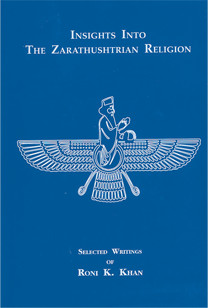
Insights Into The Zarathushtrian Religion: Selected Writings of Roni K. Khan. Published in 2003 by the Traditional Zarathushtrian Trust, 11/B, Sai Niketan, 4th floor, Mazgaon, Bombay 400010. Pp: 210. Price: Not mentioned (book retails at Rs 100).
Roni K. Khan (1947-2002) was indeed a man of many parts and accomplishments. His biography can be summed up in one sentence from the material to the spiritual. A man of varied interests ranging from opera, photography and vintage cars to history and astronomy, this successful corporate executive, who rose to become the vice-president (marketing) with the Richardson Hindustan Limited, voluntarily retired from the "rat-race” of the corporate world in 1986, and shifted to the quiet town of Nashik, to devote the rest of his life to the spiritual pursuit of understanding and explaining the traditional religion of Zarathushtra.
The metamorphosis in Khan’s personal life was sparked by the Roxanne Shah episode and it was only after acquainting himself with all the allegations and counter allegations, that he decided to undertake a deep study of the ancient sacred Zoroastrian literature and writings to determine for himself what could be the true position according to the Zoroastrian scriptures. (Shah died in a road accident and was denied consignment in the Towers of Silence as she had married out of the faith.) He not only self-studied the Avesta (assisted by Avestan scholar Bejon Desai), but also Sanskrit. After such self-study he wrote his first meticulously researched article titled, "No Adultery Please!” Thereafter he went on to write many more articles, which established his name as a Zoroastrian scholar of repute. The Traditional Zarathushtrian Trust (TZT), a religious trust established in 2002, one of whose objectives is "to create and promote enlightened public opinion on various religious issues affecting the Parsi Zoroastrian community and religion” has brought together the scattered writings of Khan into a single volume titled Insights Into The Zarathushtrian Religion.

Khan: explain-ing the religion
Since the book is a compilation of essays written between 1994 to 1998, and addresses different audiences, there tends to be a frequent repetition/restatement of the same facts, history and ideas. Hence the best way to review the book would be to first attempt summarizing the salient ideas contained in the book, and then make a reference to certain debatable/controversial aspects of Khan’s writings.
Salient ideas regarding Parsis and their faith: The author traces the ancestry of the Parsis to "Zarathushtra and his Aryan people.” While most Indian and Western historians have placed the date of birth of Zoroastrianism to between the 6th and 7th centuries BC, Khan on the basis of astronomical data, philological research and testimonies of the ancient Greeks places the year of Zarthushtra’s birth at 8300 BC. The Aryan people lived in Central Asia, moving southwards over the centuries, till they finally settled in what is modern Iran around 1300 BC. In Khan’s account of the history of the Parsis, two significant points emerge. Firstly, that a great Aryan migration took place around 1300 BC, and it was during this great migration that "the Vedic branch” migrated southward along a different route and finally settled in northern India. "Thus,” says Khan, "it will be seen that at one time long ago the Iranian and Vedic branches of the Aryans formed a united people and this is amply corroborated by some striking linguistic and theological similarities between the ancient Zoroastrian and Vedic scriptures.” Secondly, the long period of forced conversion and persecution after the Arab conquest of Iran led to a few hundred Zoroastrians setting sail for India around 700 AC with the sole objective of preserving their faith and "since then the Parsis have remained in India and have become an integral part of the country, going on to make important and pioneering contributions in every field of human endeavour.”
Scattered over the many essays are the philosophies behind the Zoroastrian faith/religion which have been the principal moulder of the Parsi character. Some of the key concepts of the religion that Khan deals with are: First of all, the religion is strictly monotheistic believing in only one Supreme Divine Being that is omnipresent, omniscient and omnipotent. Zarathushtra calls him Ahura Mazda (Brahma would be the Vedic parallel concept, perhaps). Ahura means Lord of the Spirit and Mazda means Lord of Matter. Thus the living universe is a fusion of spirit and matter and its source is Ahura Mazda.
Secondly, though Zoroastrianism postulates that Godhead is monotheistic, it views creation as dualistic. Zoroaster reveals that at the dawn of creation two primeval spirits, forces, called mainyus were simultaneously produced and even today continue to pervade the cosmos. One is Spenta Mainyu or the good spirit; the other is Angra Mainyu or the evil spirit. The two forces in nature are opposites that are ever engaged in a tussle or tug-of-war. All pairs of duality, such as light and darkness, male and female, action and reaction (the law of karma), start from this first pair of Spenta and Angra.
Thirdly, Zoroastrianism believes in free will. Ahura Mazda gave man the free will to choose between the good spirit and the evil spirit. Zarathushtra declares that the freedom to choose between the alternative of good and evil is man’s birthright and also man’s greatest responsibility. The spiritual progress of the world can take place only if human beings exercise their free will correctly by choosing good over evil. Thanks to this gift of free choice, good actions will bring good effects, while evil actions bring evil effects.
Fourthly, this leads one to the concept of "karma” or what Zarathushtra called "Kerdar.” If man has the freedom to choose between good and evil, he must also be ready to bear the good and bad consequences thereof. "Man must therefore always choose to put good thoughts, good words and good deeds into motion so that their good harvest may be reaped throughout the world and evil may be rooted out forever.” It follows, as Khan observes, that Zarathushtra thus freed humans from the shackles of primitive fear and superstition. Man was not a puppet or pawn in the hands of capricious fate but master and architect of his own destiny which he forms through his own free choice between good and evil. In a special essay, written in 1996, devoted to the concept of karma in the Zarathustrian religion, Khan says that there is no such thing as undeserved forgiveness of sin. We have to earn our redemption through the powerful penitential therapy of Patet Pashemani. In the Zarathushtrian concept of karma, it is the Lords of Kerdar, the Yazatic trio of Meher, Sarosh and Rashnu who pronounce divine judgments on each and every soul at the Chinvat bridge. The righteous shall pass through or cross the bridge, says Zarathushtra, while the wicked one "condemned by his own acts and by the activity of his tongue” is denied passage. It is only by living out our karma that we can attain Haurvataat or perfection and Ameretaat or immortality. With regard to the all-important question namely, "Will not the doctrine of karma imply accepting rebirth?” Khan opts to remain silent. All that he observes is, "Although karma and rebirth are treated as twin concepts, the latter has intentionally been by-passed in the present article. Since opinions on rebirth are sharply divided and often generate disproportionate heat in our community, this writer has thought it prudent to avoid this otherwise important topic,” and goes on to add, "Suffice it to say for now, that come what may, these ‘fruits’ will have to be ‘eaten’ — whether ‘down here’ or ‘up there’...”
Fifthly, Zoroastrianism lays great emphasis on the concept of "Asha.” No other word finds such frequent repetition in the Zoroastrian scriptures as the word "Asha,” which means righteousness — absolute, perfect, unchangeable and uncompromising Righteousness. Asha/Asho or righteous life through the active practice of Good Thoughts, Good Words and Good Deeds, is the first and foremost law of creation, the source of all other laws, the fountainhead of all ethics and morality and the principle behind the operation of the law of karma and ultimate salvation. Service to humanity is the most important way of living "Asho.” This is what is emphasized in the final part of the mantra, Yatha Ahu Vairyo deemed to be as sacred to the Parsis as the Gayatri mantra is to the Hindus, or the Lord’s Prayer is to the Christians.
Sixthly, on the centrality of fire worship, Khan opines in a 1997 essay, that fire, is absolutely central to the practice of Zarathushtrian religion. It is the sole authorized medium (marefat) for the channeling of worship to Ahura Mazda — "to the Father (Ahura Mazda) via the Son (fire).” In the Yasht (2:2.1) it is said, "Through the agency of this fire, O most beneficent spirit Ahura Mazda, we first approach thee and thee only.”
The last and seventh key concept in the Zarathushtrian faith, which figures in the book under review and which needs to be mentioned, is the term "Ratu” in the Gathas. The term occurs in the sacred Yatha Ahu Vairyo mantra’s first line which translated reads, "Just as the Sovereign Lord (is) all powerful, so is the spiritual teacher by reason-of-the-store-of-(his)-Asha.” Ratu stands for "God appointed superhuman personage of supernal spiritual stature and angelic attributes.” All the instances pertaining to Ratu in the Gathas, refer, directly or indirectly, to Asho Zarathushtra, who is none other than the Savior and Prophet, purity-perfect, a paragon of holiness and the direct appointee of Ahura Mazda.
The debatable aspects of Khan’s writings: While giving credit to Khan for distilling the essential teachings of Zarathushtra with lucidity, sincerity and conviction, the learned and revered Dastur (Dr) Kaikhusroo M. JamaspAsa has made two significant observations in the Foreword to the book. One is "some readers may differ with his views.” The second is, "Roni’s style of writing is lucid and one often finds him tongue-in-cheek about a serious point, while driving it home.” In this reviewer’s view some aspects of the book, which may be deemed debatable/controversial are the following:
Regarding the Aryan homeland — the view currently propagated by archeologists working on the mythical Saraswati River civilization, and, even in some government text books is that the Aryans are a people who originated in India and then carried the Aryan civilization with them (even to Iran itself) as they moved westward. These scholars also claim to base their conclusion on scientific research, study of archeology, ancient texts and astronomy.
Regarding conversion — Khan opines that Asho Zarathushtra converted nobody because in the year 8300 BC none of the other great world religions had yet been codified/established. He further goes on to say that "our recorded history goes back to roughly 12,000 years starting with Shah Gayomard (or Kayomarz) the first king of the Peshdadian dynasty. This is not the history one may find in many books on the history of world civilizations or in noted encyclopedias. Then of course we have the Hindutva intellectuals (equally quoting their scriptures as also scientific research techniques, astronomy and archeology) who consider Manu the first man and Sanskrit the first human language given by God himself (hence Dev Vani). Christianity (Old and New Testament) proclaims Adam to be the first man and Jesus to be the only Son of God. In short, if all ancient faiths claim absolute superiority for their sacred books, may we not end up with a war among ancient faiths each trying to establish its superiority/antiquity, etc over other faiths?
Regarding dakhmas — Khan argues that using the towers of silence is the best method of disposal of the dead because "the Zoroastrian code of ecology holds that fire, earth, air and water should not be contaminated in the slightest way.” I call it controversial since there are scientists who do not accept the view that cremating or burying the dead "contaminates.” A devout Christian whose faith is that if "Dust thou Art, To Dust thou returneth” cannot be expected to accept that he is "contaminating” the earth. Similarly, a modern human being may want to know how using an electric crematorium contaminates the environment.
Regarding mixed marriages — Khan states that the true Zarathushtrian "who always has, and always will, revere the entire catalog of our sacred Avesta scriptures, ranging all the way from the most abstract, the holy Gathas, to the most specific the Pak Vendidad cannot accept mixed marriages (Chapters 11 to 14 deal elaborately with the theme of mixed marriages).” However, when Khan speaks of our sacred literature as "time-tested, time honored and scientifically-based law book of the ancient Iranians” one is reminded of near identical claims made by sanatani or orthodox Hindus for their sacred texts, especially the Rig Veda and Manusmriti which they deem as the God dictated "scientific” law of right living for all mankind and available in Sanskrit which they regard as originating in India. The Hindu sanatanis claim Bharatvarsha (modern India) to be the blessed land of God precisely because the first scientific laws and the first sacred language were revealed/born on the holy soil of Bharatvarsha.
The dilemma faced by modern humans of all faiths is whether we should allow our lives to be solely governed by ancient faith and sacred books or should we also not attempt to reconcile the ancient faiths with contemporary rationality and the morality contained in such documents as the Universal (U. N.) Declaration of Human Rights and progressive modern constitutions and progressive common civil law codes based on the recognition of equal human rights? Perhaps the contemporary Muslim, living under a theological regime, which in the name of upholding the ancient/true faith, is often found by Western liberals and intellectuals (including Human Rights Commission) to be the biggest offender/violator of human rights and human dignity, faces this dilemma most acutely today.
The best way to conclude this review would be by again citing from the Foreword to the book written by the learned and revered High Priest, who while describing Khan as one of "the foremost scholars of Zarathushtrian religion,” also observes that "even those who may disagree with him should accept the honesty and intellectual conviction with which Roni Khan has attempted to explain complex subjects pertaining to the faith.” I could not agree less with the learned and revered High Priest when he also says, "I offer my homage to the pious soul and righteous Fravashi of late Roni Khan and pray the spirit of his written words may stir the heart of every reader.”
Adi H. Doctor
◆ ◆ ◆
From the archive