
Politics and Policy
'Revival, not survival'
Despite the gloomy prognosis presented by the Census commissioner of India, the all India Federation leaders sought ways to counter the dwindling community numbers
The 2001 census figures for the Parsi community in India will show a decline, hinted India’s census commissioner J. K. Banthia addressing the executive council meeting of the Federation of Parsi Zoroastrian Anju-mans of India (FPZAI).
The much touted and hotly opposed World Body of Zoroastrians has been put on the back burner with Federation president and Bombay Parsi Punchayet (BPP) chairman Minoo Shroff stating that its constitution was yet to be finalized.
Like the proverbial mountain that labored and produced a mouse, the much hyped meet of the executive council of the FPZAI at Bardoli on November 29 and 30, 2003 produced no more than reams of words and a few moments of high blood pressure.
While Banthia confronted the community with the prognosis of demise by the end of the century, the council agreed to eliminate the words ‘survival’ from its vocabulary in the interests of youths who felt confused and fearful of its connotation and to replace it with the words revive/rejuvenate. A sperm bank and fertility clinics are expected to turn the tide.
Faced with a barrage of technicalities, the search for a united calendar was abandoned. Questions of intermarriage and adoption provoked the usual ping-pong match. Status quoists will be happy until time and circumstance make change inevitable.
How much impact a single effective individual can have if he has the moral support of the community elders was evident in the organization of accommodation, transport and superb meals by the small Bardoli Anjuman. The team led by secretary Pervez Mehta with the support of president Jamshed Mohta dispensed old-world hospitality, including a day’s bus trip to outlying Parsi farms.
The official launch of the Bai Maneckbai P. B. Jeejeebhoy Medical Centre by eminent surgeon Dr Tehemton Udwadia was presaged by an address by renowned gynecologist Dr Rustom Soonawala to the doctors in and around Bardoli and Surat. Set up at an estimated cost of Rs 25 lakhs, of which Rs 16 lakhs has been collected so far with the help of the Bai Maneckbai P. B. Jeejeebhoy Trust, the World Zoroastrian Organization and others, it aims to provide free medical treatment to Parsis and the indigent local population, and on a no-profit, no-loss basis to others. Staffed by a general physician, the leading specialists in the area have volunteered free service twice or thrice a week. The Centre is housed in the recently constructed anjuman building where two rooms have been reserved as a dharamshala for poor Parsis from the mofussil who come for treatment.
"The first loan is always the most difficult to disburse,” noted Shroff, announcing the Venture Capital Fund’s 40 percent equity contribution in the Kanha wild life tourism project. Others in the pipeline are a food processing unit and certain service industry ventures.
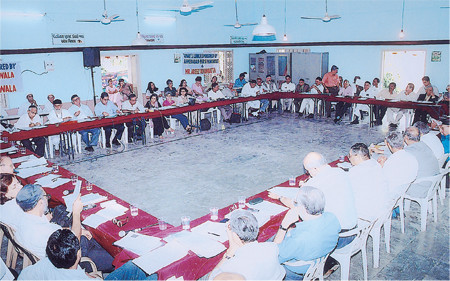
The executive council in session
The profits of the Zoroastrian Co-operative Bank have doubled this year despite the prevailing low interest regime, Noshir Paghdiwalla, president of the Borivli and Suburban Zoroastrian Association (BASZA) informed the delegates. It is all set to open its Thana branch while branches in Dahisar, Santa Cruz, Malad and Parel are in the pipeline. Federation joint honorary secretary Keki Gandhi suggested that a branch in Bardoli would benefit Parsi farmers and Mohta said he was prepared to provide the premises at a very concessional rate. But Paghdiwalla noted their banking license only permitted them to operate in Maharashtra.
Dadabhai Naoroji’s house in Navsari may be up for sale and BPP trustee Burjor Antia urged the community to collect funds to buy the historical property.
Vice president of the Federation and president of the Delhi Parsi Anjuman (DPA) Lt Gen (Retd) Adi Sethna has been interfacing with the Gujarat Government and the Parsis of South Gujarat in his position as member of the National Commission for Minorities. His intercession saved a "large chunk of property” belonging to the Surat Parsi Panchayat. With increasing orders and instructions from government, Sethna felt that every major anjuman needs a professional for such tasks. Sethna also noted that individual families with large tracts of land need the support of anjumans to manage the life threats and economic pressures they face as they become fewer and older.
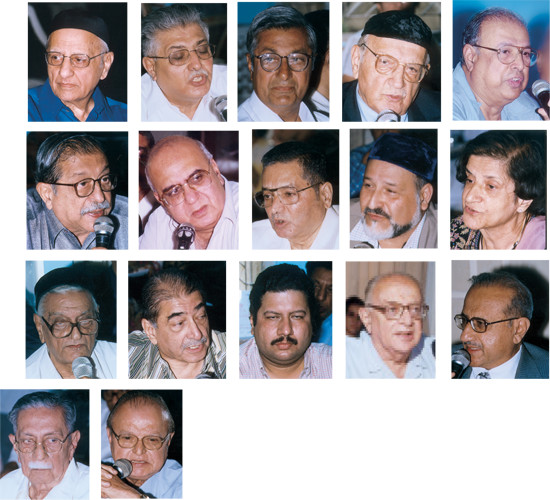
L to R (1st row) Shroff, Gandhi, Mohta, Sethna, Mogrelia (2nd row) Khambatta, Tamboly, Antia, Mistree, Khullar (3rd row) Katpitia, Dastur, Colah, Dotivala, Mullan (4th row) Marshall and Karanjia
While BPP trustee Dinshaw Tamboly said the Udvada Development Trust had been registered, Sethna offered his help to make the whole of South Gujarat including Udvada, Davier, Bardoli and Navsari into a heritage site.
The Baroda punchayet has received a positive response from 73 percent of the anjuman to raise the status of the Umrigar Agiary from a dadgah to an adarian. After the physical renovations, the formalities and ceremonies were expected to be completed by February 2004. (As we go to press we learn that the consecration will be completed on March 26, 2004.)
Though progress has been painfully slow, work on a community mediclaim policy is inching ahead. BPP CEO Behram Dastur noted that a proposal had just been received from ICICI-Lombard.
The Federation membership currently rests at 69. The Fed Newsletter has become self-sufficient thanks to the generous donations received, as noted Gandhi.
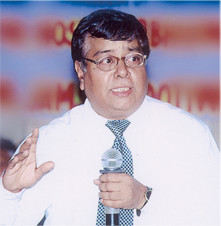
Banthia: "the community must intervene”
The Mehernosh N. Cama Memorial Award was conferred on Shehernaz Rustom Gandhi of Allahabad for the excellence of her performance in the field of education in 2002. A master of English literature from Allahabad University, Gandhi’s 35-year career as teacher and role model molded hundreds of student lives.
Daughter of the illustrious Jamshed K. Mehta who headed the Allahabad University’s Department of Economics and was named professor emeritus, Gandhi has also served human and animal life around her through pranic healing, Kriya yoga and Reiki. She has been honored by local organizations as well as Rotary Allahabad.
The next meeting of the Federation will be held in Bombay on June 12 and 13, 2004. The winter meet will be hosted by Ahmedabad in end November or early December as per the invitation from Ahmedabad Parsi Punchayet president Areez Khambatta.
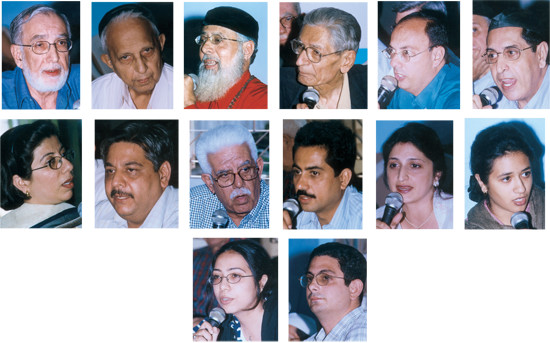
L to R (1st row) Patel, Dandiwalla, Wadia, Masani, Karanjawalla, Paghdiwalla; (2nd row) Sanjana, Daver, Engineer, Palkhiwala, Chichgar, Kapadia; (3rd row) R. Mehta and H. Mohta
Guest speaker Banthia
The depleting Parsi population was
"no longer a matter of concern for the community alone but for India and the world community as a whole,” declared registrar general and census commissioner of India J. K. Banthia. A member of the Maharashtra cadre of the Indian Administrative Service, Banthia has been studying Parsi demography over many years, said Sethna in his introductory remarks.
The census commissioner noted that in the past eight or nine years of record the number of births in Bombay has hovered around 300. Every year 700 on an average have died. "Are we going to hit rock bottom by 2030?... No Parsi woman will deliver? No navjotes to celebrate? If the present rate continues... if the reported figures after 1995 are correct... by the end of this century there may not be a single Parsi left.”
Confusion has prevailed because the 1991 census recorded 76,382 Parsis in India as against 71,630 in 1981. "Were the records wrong? People thought that fertility had increased (or that) mortality had declined.” Banthia predicted that the figure provided by the census of 2001 may be much below 76,000.
Banthia asked the community leaders to examine the Bombay Municipal Corporation (BMC) records of births and if they are incorrect, to rectify them and to maintain their own records to cross-check the municipal figures. He stressed the need to ensure authenticity in Bombay because elsewhere in the country such records are impossible to find: "Even if the community is visible to the eye, it remains invisible to the records.” As there have been no objections raised by the community against the BMC’s published figures Banthia says he is prepared to believe them.
Banthia recalled Shapur Desai’s seminal work on the subject, A Community at the Crossroad, which prompted demographer C. Chandrasekhar to explore the matter further. Citing figures from the latter’s work Banthia noted that up to 1900 there were less than 50,000 Parsis because the smallpox epidemics of the 19th century accounted for one in six Parsi deaths. "In 1802 smallpox vaccination became available in the state of Bombay. The British expected the Parsis would readily accept it because it was an enlightened community. (But) for over 60 years the community resisted it on religious grounds as defiling, impurifying the body. In 1805/1806 the community was told that if you vaccinate, you will be excommunicated.” Banthia said he found these records in the India Office Library in London. Indians perceived the vaccination as a British attack on the Hindu community which had deified smallpox as a visitation from Sheetla Mata for several hundred years. "Parsis had imbibed this culture. Parsi women also prayed to Sheetla Mata. The British were amazed that an educated community was refusing (a scientific advance). Today it is silly to say we’d allow children to die. (But that is) the power of culture and religion. It takes time to overcome.”
Banthia narrated that this situation endured until the epidemic of 1876. But between 1840-70 a group of Parsi doctors worked hard on community attitudes and from 1870 onwards the number of smallpox deaths declined among Parsis although the general population continued to resist vaccination and to die. Those were the days of the cowpox vaccine and a Parsi gentleman donated a cow for the purpose which was carried from door to door in 1870-80 to carry out vaccinations.
"The community eventually responds but if the response is too late, there is a problem. I am telling you the story of smallpox in light of the Parsis’ demographic decline. There is need for increasing fertility, for increasing marriages.”
Banthia demonstrated "death peaks” in the graph: 1878 because of small pox, 1896 because of plague, 1908-10 because of malaria, 1918-19 because of the international influenza pandemic. "After the epidemic diseases were controlled Parsis have been healthy. After 1919 the death figures had plummeted... There were 1,200 births in 1930 but thereafter, rarely more than 800. For the past 50 years there have been more deaths than births.”
When Baroda’s Baman Cama and Dastur pointed out that the number of Parsi deaths in Bombay in recent years has been not 700 but 1,000, Banthia urged them to make the BMC rectify the figures stating, "The community has to intervene.”
Banthia described the situation in Japan where too the number of marriages and of the population has been declining since 1960. About 30 percent of the women are not getting married, "45 to 50-year-old men don’t have wives. Instead of helping their mothers, they expect their mothers to look after them — mama’s boys!” Banthia said that Japan has started getting in Chinese women for Japanese men. "Can the Parsi community import people?” he asked. The dependence ratio, previously accounting for children but now for the increasing number of the elderly, means that the society needs fewer schools, primary health care and toys but more old age homes, pension funds, medical assistance and nurses for the elderly, he noted.
More concerned than the community itself, Banthia declared, "The Parsi civilization is in peril. If we can have a ‘save the tiger’ project why can’t we have a ‘save the Parsis project?’ (You are) not dying because of an epidemic, because of the will of God or the will of nature! (You need to ask) is my freedom, my career more important than the career of the community at large...? The size of the population has to be augmented. There is no other option. The future of a community can be read in its demographic trends. We are in a worse situation than what Chandrasekhar predicted.”
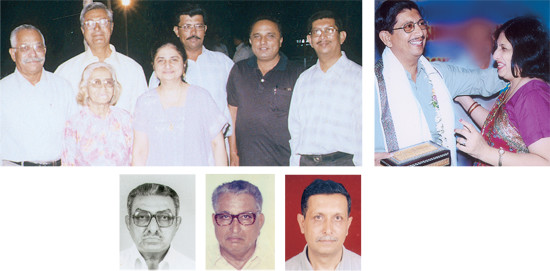
L to R (above) The Bardoli trustees Daulat Mohta, Maharukh Sanjana, Homi Pithawala, Mohta, Viraf Pithawala, Viraf Munshi and Mehta whose effort was lauded by the anjuman, with wife Jaloo. (Alongside) Dhunjisha Dumasia, Jal Kasad and Kersi Sanjana
Zoroastrian Studies founder Khojeste Mistree, an invitee to the meet, faulted Banthia’s figures because he had not taken migration into account. He said migration might account for nearly 20,000 heads at the rate of two to five percent since 1970. The elderly are left behind which leads to skewed figures. He mooted the idea of a "sperm bank to increase our numbers” and suggested that the study of Parsi demography be extended globally. "Migration in our small community is astronomical,” he contended. (As Mistree did not cite his sources for the above statistics at the Federation meet, Parsiana wrote to him on December 23, 2003 asking for details of the studies done. As no response was received, a reminder was sent on February 13, 2004. Till the time of publication, no response has been forthcoming.) BPP PRO Godrej Dotivala pointed out that census enumerators were often unable to understand the Parsi Zoroastrian label.
Soonawala pointed out that the number of children desired by couples was declining all over the world. "My father was one of 14 children. We were four. My children have two and refuse to have more. If each couple produces two kids the community has to decline.” He noted that women are fertile between the ages of 15 and 45 though male fertility can span the years from 15 to death. However marriages are late because of situational pressures resulting in gynecological problems. He cited the rat race, rising property prices, rising costs of education, noting that it takes 15 to 20 lakh rupees for medical education. "We are professionals. Our impact in India has been because of professional achievements... To make ends meet both partners need to work. What can we do?”
According to Banthia what is needed is "the quantity of Parsis rather than the quality of Parsis. What is prosperity going to do for you?... Is my contribution to my community, my country only in terms of professionalism? Can the community decide to excommunicate Parsis who don’t marry, who don’t reproduce? It’s the single biggest disservice if you don’t marry and have children. Whether it’s an ethical issue or a medical issue has to be decided.
"If two, three or four thousand Parsis have migrated, it does not make much difference to my numbers. There will be a year when a single Parsi birth will be a cause for national celebration!”
Responding to Dotivala’s charge regarding failure of recording, Banthia said they had come across 20 different nomenclatures of the religion as used by the community. Casting a brief sidelight on the size of the problems faced by the census he noted that 1,400 man-hours were spent in tabulating the various communities in the country, in reducing its 12,000 dialects to 18 languages.
Sociologist and demographer Ava Khullar observed, "The fact is that when a community is used to comfortable living, it is impossible for any outside authority to change it.” She cited the example of the BPP’s third child scheme (which after 11 years had only 112 takers) as well as the study that demonstrated that there is no correlation between the size of a house and the number of children.
But Banthia was not daunted. Declaring that "the community is very wise, it has responded in the past, it will respond again,” he urged the assembled community leaders "to go on fighting for the good of the community. Better dying for a cause than not taking it up at all!”
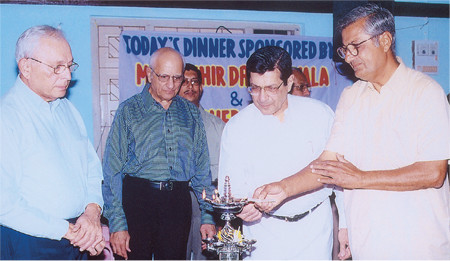
L to R: Udwadia, Shroff, Soonawala and Mohta: lighting the lamp of medical aid
Doctors
A number of doctors of the area had
responded to the invitation of the Bardoli Anjuman to witness the launch of the new Bai Maneckbai P. B. Jeejeebhoy Medical Centre by Drs Rustom Soonawala and Tehemton Udwadia. The day’s master of ceremony Gujarati litterateur Rusi Bhesania waxed eloquent describing them, Shroff, Sethna and Justice Behram Shethna of the Gujarat High Court as "malai no popro” (crème de la crème). Konné kahu chand né konné kahu sitara (who shall I call the moon and who shall I call the stars)?”
With a brief speech and the lighting of a ceremonial lamp Udwadia declared the Centre open. He also launched a souvenir detailing 150 years of Bardoli’s history "convinced that it is only by looking at our past that we can plan for the future. It will give us the vitality to plan and to survive.” He recalled how his father, a general practitioner, had provided medical relief in the poorest quarters of Bombay for 63 years, scoring off accounts maintained by his assistant where patients were too poor to pay. He had been the kindest, gentlest teacher to his sons. "We hope to pass on such values to our children.”
Acknowledging the accolades Soonawala said, "As doctors we never retire. Unless there is an illness, doctors continue to work and die with their boots on. Hope we can do so too!”
"Today I’m a judge only because I’m a Zarthosti. By the grace of God I hope to discharge my duties,” noted Shethna who had made it a point to honor the community’s invitation since attorney general of India Soli Sorabjee and Supreme Court Judge Sam Variava were unable to attend due to official engagements.
Shroff declared a sense of humor and a thick skin as necessary attributes for survival in public life! "It is a pleasure to lead our community in whatever way we can,” he smiled and was sure that with its intellectual abilities the community will emerge stronger from the problems it encounters.
The presentation of beautiful wooden caskets to the dignitaries reminded Sethna of the Pettigaras who originally crafted them, part of a long history of Parsi artisans whose handiwork was legendary. He also urged the gathering to think of themselves not just as citizens of Baroda or Surat but of the world — and behave accordingly: "Your conscience, your character will see you through... The aim must be survival of the community in its restored glory.”
Among others felicitated that day were Antia, Tamboly, Gandhi, Khambatta, Mistree and Gujarati thespian Yezdi Karanjia whose natak, Kutra ni puchhdi vanki, performed gratis at Bardoli’s Rang Upvan Hall on October 11, 2003 had generated Rs 2.25 lakhs towards the cost of the Medical Centre. In contrast to all the speeches Karanjia’s short stand-up act had the audience roaring with laughter.
Earlier that afternoon Soonawala, described as India’s highest individual taxpayer between 1995 and 2000, had addressed the gathered medicos, sharing his well-earned experience in gynecology and obstetrics. One learnt that small quantities of folic acid and zinc in the mother’s diet prevent mental problems in babies, that spotting in early pregnancy needs only bed rest, that progesterone support for shaky pregnancies may not be advisable in certain cases...
Soonawala spoke of how ectopic pregnancies had earlier been fatal because both the tube and the foetus had to be removed because the tube can accommodate only a four or five-week-old foetus. Today, thanks to the scan technology and medication, an injected drug dries up the foetus, obviating the need for surgery.
Earlier, a Down’s (Mongloid) baby was only born to women over the age of 40 but now the condition, said to have an incidence of one in a thousand births, occurs even to 20-year-old mothers, noted Soonawala. There is a 90 percent chance of a very experienced sonographist identifying a Mongloid foetus, giving the patient a choice to end the pregnancy. Other ways include a combination of the triple test and amniocentesis.
In the 1950s and 1960s only 10 percent of births were by caesarian section. Obstetricians were inhibited by the anesthetic available — ether — which proved fatal in two to three percent of the cases. "New anesthetics and antibiotics have made the technique very safe” so that now 60-65 percent of deliveries in city hospitals are caesarian. Soonawala admitted that the public feels that doctors are "knife happy because of the higher charges.” Today however doctors can save a premature baby born even at six months or one that weighs less than a kilogram, he added.
Fired by Banthia’s admonition in the morning to increase the population, Sethna and Shroff sought Soonawala’s advice on employing technology to enhance pregnancies by multiple births. But Soonawala scotched the notion stating that multiple pregnancies are not good for the mother or the babies. "We try to reduce triplets to twins,” he noted.
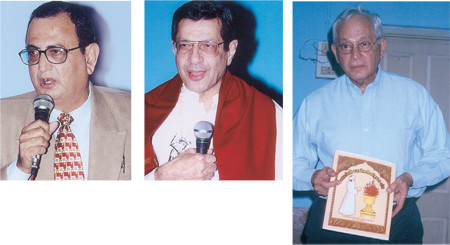
From left, Shethna, Soonawala and Udwadia: passing on values
Open forum
On the second morning the
much awaited, much dreaded, discussion of "controversial issues” began with Shroff inviting Mistree to begin: "You have come all the way so I’m sure you’d like to lead the discussion.”
"Zoroastrianism is a religion that encourages us to think” began Mistree. "It is a good idea to go through the process of scholarship rather than emotion... Scholarship gives us a chance to listen to what others say.” He chose the technical issue of the calendar for his opening salvo explaining that the addition of a day every leap year was unsuited to Zoroastrian religious practices. If a person dies on the leap year day what happens to his (varsi) prayers? he asked. The Fasli calendar is in sync with the seasons but "the intercalation (of a day every four years) is proscribed” by the Dinkard which advocates the addition of one month every 120 years. "Why go against the Dinkard injunction?” asked Mistree. He did not say if there will be any attempt to practice the Dinkard’s prescription of adding the extra month(s) by the Parsi clergy to bring the calendar — and the gahambars that celebrate the seasons — back into harmony with nature. Instead he spoke of the Iranshah as the "spiritual king in exile;” that the Shahenshahi and Kadmi calendars have their alat (sacred "ash and the hair of the white bull”); that "the Fasli calendar has no alat” — only a single agiary in Bombay follows it; that the Parsis intercalated once after coming to India in 1060 and the Iranis did not, hence the disparity between their calendars; that according to the Cambridge History of Iran "during Sasanian times the Navroz never came in March;” that the Fasli calendar works well in North America since there are no agiaries there.
Mistree bombarded the audience with historical details about the evolution of the Gregorian calendar (though he stopped short of telling them that Europe, after the horror and heartburn of the Inquisition accepted the scientific data that the earth goes round the sun — not vice-versa — and changed its calendar to match).
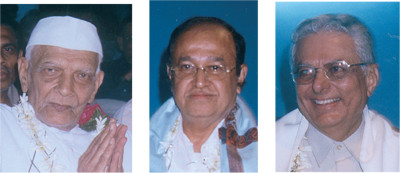
L to R: Freedom fighter Bhagwanti-bhai Parekh, surgeon Dr Ashwinbhai Gandhi and Bhesania at the evening felicitations
The calendar issue was withdrawn from the Federation’s agenda. In Sethna’s words: "(It is) an excellent exposition. Let us leave it. There are other more important issues.”
Hurt by the vituperations and admonitions leveled by the fundamentalists at their public meeting, unwilling to jeopardize his rational objectives, his middle-of-the road religious concerns or community harmony, Shroff walked an anxious tight rope. "This is only a discussion. Nobody wants to change the rules of the game. We never intended that we meet and resolve and go to the community (with a fait accompli). But do we represent the community or is it only Parsi religious scholars and religious heads who do so?” he asked pointedly. Shrugging off the fundamentalists’ overblown concern about the impact of the Zarathushtrian Assembly and its founder, scholar Ali Jafarey who has been spreading the message of Zarathushtra in the West, Shroff emphasized that the constitution of the World Body was yet to be finalized. "We are living in a democracy. Why are you questioning our right to discuss?... If anything comes up we will put it up (to you). It was never our intention of forcing anything down anybody.”
Addressing the traditionalists’ charge that talk about the dwindling number of nassessalars/khandhias was a circuitous route to undermine the system of dakhmenashini, Shroff told the assembled delegates, "We (BPP) are spending Rs 10,000 per corpse. People say (Bombay’s) Doongerwadi is like behest (heaven). Who said we want to change it? But if 15 to 20 years on we don’t have (nassessalars/khandhias), what do we do? We are seeking plausible common sense answers.”
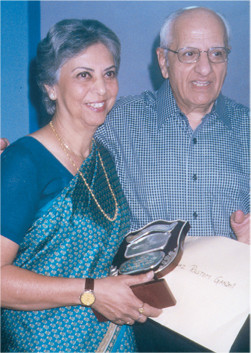
Gandhi (with Shroff): acknowledging the award
Shroff also demonstrated the BPP trustees’ concern for a rational housing policy when a third of the community contracts intercommunal marriage at a time when the total community is shrinking. "Half of our board meetings go into debating what to do about mixed families... who are we building for? Statistically there are two to 2.5 persons per flat in Cusrow Baug. Single ladies occupy 1,800 to 2,000 square feet and they are not prepared to give it back to the Punchayet! Everybody is asking for the demographic profile. What more can we do to get more specific figures of births?” The assembled representatives, to whom this plea for community statistics had been addressed many times before, were silent. "You are castigating a body which is not perfect but doing good work,” asserted Shroff.
To Antia the "real issue was the issue of survival” in its twin facets:
•How are we going to avoid mixed marriages?
•What can be done to increase the numbers of the community? To this Aspi Debara of Secunderabad added, "We cannot afford the high rate of divorce.”
Mistree interpreted Banthia’s message as "preserve the tribe.” Hence he said intermarriage and adoption were out. "Do everything to preserve the race. Ethnicity is crucial to classical religions like Zoroastrianism, Judaism, Hinduism... The World Body talks of Zoroastrianism devoid of ethnicity,” maintained Mistree. (If this raised any questions in peoples’ minds about the common ethnicity of Kashmiri pundits and the Hindus of South India, of the Jews of Norway, Russia and Ethiopia, there was no one who voiced them.) "We are talking of increasing the number of Parsis, not Zoroastrians,” continued Mistree and charged the Federation with the task of tackling the issue of increasing Parsi fertility, changing attitudes. "Create a council of doctors, sociologists, do your homework, create a project report. Until this is done, you are putting the cart before the horse.” Mistree maintained that the norm for Zoroastrian families in Iran was four children. He contrasted their rate of unmarrieds (three percent) to the Parsis’ 30 percent (source of data not cited). (Though Banthia had not cited comparable figures for Iranian Zoroastrians he had noted that his Iranian counterparts had said that the number of Iranian Zoroastrians was dwindling fast.)
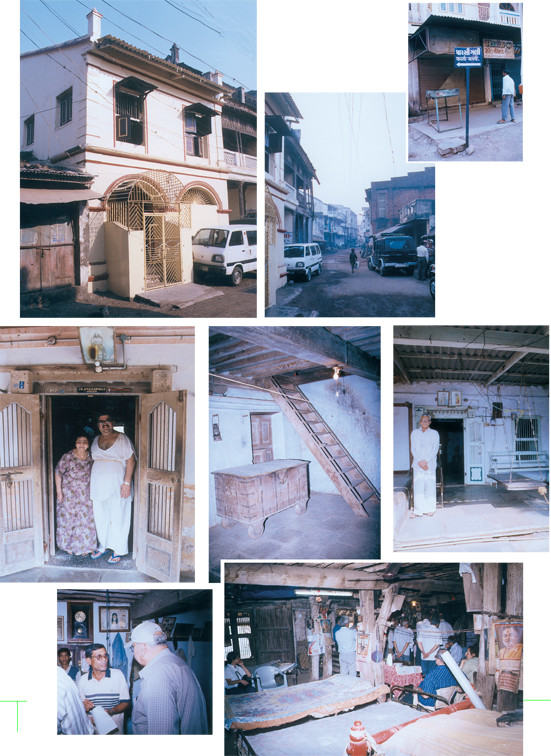
Top left: Bardoli agiary below and right: Parsi Gully; Below: Mofussil Parsis — an impoverished community in a time warp
Tracing a zigzag course through current affairs, politics, anthropology and religion, Mistree maintained that any recognition of Tajik Zoroastrians would lead to a "backlash from Muslims on Iranian Zoroastrians because they are a hostage community;” that Zoroastrianism is sought after in Central Asia because the "next oil reserves are in South Asia... Preserve Parsis and Iranis first... Iran has no tradition of rituals. (Rituals are preserved) nowhere except in India. These issues (intermarriage, adoption, conversion) are not India based. They are put in our minds by North Americans and others. Be politically astute. It is a simplistic idea that children (of Parsi women) should be taken into the fold. Statistics show that only one percent of mixed-married progeny will marry within the fold according to anthropologists. Why then should we change the rules? Look at the research papers. Patrilineality is a part of the Aryan system. Put personal preferences aside. Do not promote individual agendas without proper research.”
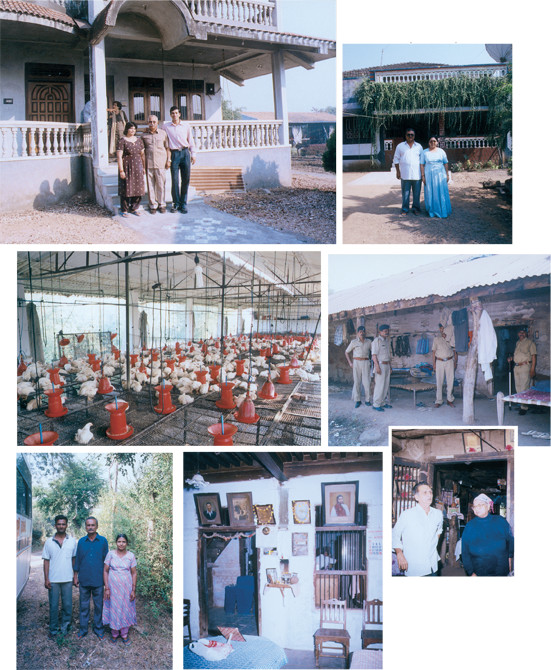
Top (L to R): Hilla Dutia and Homi and Hoshedar Pithawala and their poultry farm Below: Godrej and Nancy Hansotia; Bottom right: Noshir and Zarine Devgadhwala — in fear of Adivasi harassment with police assigned by government Alongside (L to R): Bomi, Keki and Khorshed Gandhi and a rural home
Khullar disputed Mistree’s rendition of Banthia’s message to mean that the latter eliminated mixed marriages as one of possible solutions: "He said there are many ways to handle it. It’s up to the community to decide.” Khullar recalled that her first research on the community in Delhi in 1978 had shown that "exactly 33.3 percent of Parsi families are intermarried.” She recalled that the study had prompted the late Shiavax Nargolwalla, then president of the DPA, to decide to bring such families into the fold. "I am amazed that an intellectual should consider this a non-issue,” she told Mistree, adding, "The value system and ethics is more important than rituals... Parsipanu is the values of the system... My grandfather was the first head priest of the Nagpur agiary. My father was a practising priest in China. He had said that when he died there should be no rituals beyond 10 days...
"Look at the community objectively. The religious and sociological aspects should not be merged because sociological aspects have their own momentum... Intermarriage is not a revolt against the faith... Every Parsi would prefer to marry within the community... None of us consciously thought we’d get a partner from outside but the kind of (social and intellectual) group from which you select a partner is more likely to be non-Parsi.” Khullar noted that when she updated her data in 2000, the percentage of intermarrieds in Delhi had reached 45! "Youths are forced to remain single because they can’t find partners,” she added.
Addressing the "hard task” of increasing fertility, Khullar asked, "Are we going to be able to force our children to marry early and produce four children? These are considered non-issues from the religious point of view but they are not non-issues... One reason for accepting the children of mixed marriages is that it keeps the community together.”
Khullar reminded the audience of the in-depth research of Dr J. V. Undevia on the high incidence of G6PD in the community. Since Undevia has found no G6PD among Iranian Zoroastrians though its incidence among Muslim Iranians and the Warangal tribes of South Gujarat is high, the research demonstrates "a lot of sliding in of other blood into the (Parsi) community,” commented Khullar.
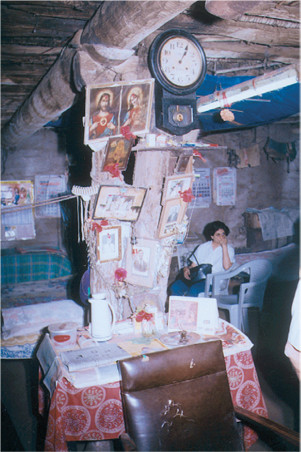
Syncretic Zoroastrian worship
Federation vice president and president of the Madras anjuman Nariman Mogrelia commended Mistree’s idea of a sperm bank. Mistree had also made the delegates aware of the services of the fertility clinic available at the B. D. Petit Parsee General Hospital. [Indeed Shroff told The Times of India (Ahmedabad edition, December 1, 2003) that a sperm bank and fertility centers are being considered as ways of increasing the Parsi population. There was no attempt however to identify the potential ova donors/wombs that would be required for the sperms to fructify into babies or who would rear the resulting children into mentally and physically healthy citizens.] Shroff agreed with Khullar, noting that the "clarity of mind to resolve the problem gets lost when religious ideas cloud the basic idea of survival.”
Nagpur’s Navroze Daver who said he and his colleagues had motored down for the meet because they thought that the religion was in danger felt that a secret ballot would reveal the ideas of the community. "Rituals bind us together (This is) not a social club. Born Zoroastrians should stay that way.”
Mogrelia recounted how a series of referendums over two years had shown that Madras Zarathushtis’ opposition to the acceptance of Parsi women’s children had declined from 50 percent of the population to 30 percent and then to 10. He noted that they were still trying to convince the 10 percent holding back so that the children have a sense of belonging as Parsis. Attempting a historical comparison Mogrelia said, "Akbar did not dilute Mogul strength by marrying a Hindu wife.” Mistree reminded Mogrelia that Emperor Jehangir was not Akbar’s son by his Hindu wife.
The colloquium conducted by BASZA had traced the demographic ills to the breakup of the joint family system. Rifts due to differing educational levels in atomic families and lack of a counseling mechanism leads to the high divorce rate. "Parsi boys are mama’s boys” and the mama instigates the rift with the wife. The low level of tolerance in the community today, the increased income of women, add to the problem, maintained Paghdiwalla.
Mohta noted that even 30 to 40 years ago families in South Gujarat numbered six to eight because "the minds of parents were free of tension. (Real) income has now reduced to such a level that they want fewer children. What will happen if they produce more kids in the villages? Can the middle class pay 20 lakh rupees for accommodation in urban areas? Can they have four to five kids? Girls don’t want to come to the villages. The environment is changing. Parsi boys and girls work in large institutions with non-Parsis. I don’t think there’s a solution, only cross arguments,” concluded Mohta.
Traditionalist Marazban Wadia from Davier struck the superior Parsi stance vis-à-vis other communities: "Gai bi doodh aapé ané gadheri bi doodh aapé (the cow and the donkey both provide milk) and cited a Gujarati song whose message was that a crow decked in peacock feathers does not become a peacock. In a further use of questionable animal analogies the Nagpur delegate suggested that Parsis adopt the behavior of certain animals who, according to him, tend to breed more when confronted with diminishing food stocks! According to him the "conclusion was that mixed marriages were out,” that matrimonial meets be more professionally organized, that religious education classes be made more interesting with picnics and snacks and that fertility clinics be subsidized.
Allahabad anjuman president Capt Homi Dandiwalla asked Mistree, "How many Zoroastrians were there when they landed at Sanjan?” Mistree’s response of five boats with 30 individuals each prompted another query: "150 increased to 1,44,000 (the peak figure for Parsis in India in 1941). They must have intermarried,” concluded Dandiwalla although Mistree launched into a long dissertation about research revealing the XY (male chromosome vs XX female chromosome) accounting for the "fidelity pattern that maintained genetic purity” and the identity of the race.
Cama wanted to know why the population declined after 1941-1951 and was in favor of a law for adoption because "Even if you want to adopt a totally Parsi child you cannot do so.”
Mahrukh (Karanjia) Chichgar of Surat likened the Zoroastrian community to "drunkards rowing a tied boat.” She said the youths of Surat were "totally confused.” She noted that the 18-25 year olds were getting married faster than the 35-40 year olds who kept waiting for the right choice of partner. Should one compromise or not get married? she asked, noting that her generation was becoming opportunistic rather than optimistic, forgetting about the community in the search for individual solutions. She said there were more than 50 boys and only six to eight girls in Surat. "We want to move with the community wave, not against it,” she declared. "Find some solution, give some direction to unmarried people,” she urged.
Responding to Karanjia’s appeal Baroda’s Dara Hakim suggested that the delegates "refrain from using the word ‘survival’” as it may be confusing and frightening the youth. "This community of ours will never be extinct... What we need is an action plan.” "Let’s talk of revival and regeneration,” agreed Shroff and the delegates mentioned various matrimonial institutions and web sites.
"At different forums we have discussed problems of intermarriage. The youth have got fed up since there are no solutions emerging. Yes, religious education is required but what’s happening can’t be stopped,” said Ahmedabad’s Porus Karanjawalla. He suggested that the topic of community revival be addressed to married youths. "Find out what they think. Keep religion out. Tell them ‘Parsi Zarathushti kom né aagal wadharwani chè (You have to propagate the Parsi Zoroastrian community).’”
Dotivala gave a quick recital of all that the BPP is doing to help: the setting up of a committee of religious scholars and lay people headed by Antia; providing more housing than any other ethnic group in the world; organizing various functions; providing religious education indirectly; publishing religious books for laymen, etc.
Sethna referred to the demography and health care module created by UNESCO Parzor whose statistics and research data will soon provide the groundwork for decisions. Sethna flayed the community’s attitudes, specifically its self-assumed superiority that ran counter to reality. "Parents ask, ‘Will the children listen to us?’ They will, but only if we are their role models. Unlike other communities we do not make the children ready for marriage. Do we provide the necessary example of tolerance within the family, within the community?”
Is it education, professionalism that is responsible for eclipsing the love for the religion and the community? asked Antia. "What is required is a change of mindset. Ahura Mazda told Zarathushtra to be married and have children.” Antia did not advocate conversion but he saw "nothing wrong if a Parsi child is adopted by Parsi parents.” Ruing the false twist imparted to whatever the Punchayet tries to do, Antia said he had been "hearing the call ‘religion in danger’ since childhood... If a public meeting can discuss, we can also discuss. Punchayet trustees are being rebuked for nothing. I can speak in court but not here! I had said our trusts are for Parsi Zoroastrians — no one else can come in. The Sarosh Yasht Hadokh does say, ‘Let my religion spread to the seven continents.’ Parsi Zoroastrians will remain what they are. Certain people just want to cut down BPP trustees.” Tamboly seconded Antia in all that he said.
"Adoption of Parsi children? In the last 10 years only seven children have been given in adoption (no source cited for data). Is it worth changing the law for seven children?” demanded Mistree adding, "There are no babies in the community to adopt. Is it not a case of putting the cart before the horse?” He voiced the concern of traditionalists that lack of Parsi children will lead to the adoption of others.
As for "freedom of speech” Mistree noted that issues need to be discussed on a data base. He asked Mogrelia how the questionnaire to the community had been worded. "Only for or against would confuse people. Give them the pros and cons in toto. If I go to Madras and speak to your people, they will have second thoughts.” Mogrelia explained that the questionnaire had been set in simple language by 25 people who comprised the combined committees of the three community organizations in Madras. He said people were asked, ‘Are you willing for the navjote of the children of Parsi mothers? Give reasons.’ They replied that there should be no claims on community property and that the father should give his written consent.
Mistree went on to criticize the minutes of the meeting of religious scholars and laymen chaired by Antia on October 15, 2003 implying they were not fair and correct but quoted selectively.
"No trustee of the BPP has a personal agenda. It is a slant given by a certain section (of the community),” protested Tamboly.
"Where was the data when the public meeting was called?” challenged Antia.
"Dastur JamaspAsa, Adi Doctor and I are scholars,” declared Mistree haughtily. He questioned the politics surrounding the World Body. His words sent tempers soaring... "Everybody has his own utility,” responded Shroff angrily. "There are various shades of opinion... You have a captive audience (among the youth)... You can’t convince an elder to accept what you think is right.”
Fortunately for the mental and physical health of all concerned, a red herring of a question alleging "truck loads of trees, cut and carted away from Doongerwadi” provided a change of tempo as BPP trustees as well as Mistree sought to convince Yasmine Sanjana that only those trees that are infested or fall naturally are removed.
The earlier charged atmosphere having subsided, Sethna suggested that Mistree provide "a summary of the discussions here. Tell them (the traditionalists) we are as concerned as they are... We have discussed; we have not passed any fatwa. We are not the Taliban. Fundamentalists are everywhere. We have to talk to them, change them,” he added. "The Punchayet has several committees so that leading members of the community may be invited to join. Let power go to everyone... Let them do real constructive work, not call meetings and criticize the trustees,” suggested Antia.
Noting that the Public Trust Act provides exemption from the Rent Act in other states Masani suggested that the BPP lobby for the inclusion of such a provision in the Maharashtra Public Trust Act. He also reminded the audience that the restrictive covenant had been enforced by the court in the case of the Dadar Parsi Colony when non-Parsis had sought to occupy those properties. Masani also appealed to the BPP to use the properties of defunct anjumans to set up professional education institutions outside Bombay.
Gujarati litterateur Dr Ratan Marshall made an impassioned plea to Parsis to retain their Gujarati mother tongue, visit Gujarat at least once each year and continue to earn the high respect and affection of other communities.
"Bumpers from Khojeste” notwithstanding, Gandhi declared, "The right of the Federation to discuss is sacrosanct — not only to discuss but to recommend.” Questioning Mistree’s assertion that systematic study should precede discussion, Gandhi noted, "Scholars have not come to any agreement.” He also reminded the audience of the Prophet’s injunction in the Gathas that each individual must do what he thinks is right. "Each anujuman will do what their members want. Kindly study your trust deeds,” he advised the delegates. Taking a jibe at Mistree who had complained that the Federation minutes do not differentiate between personal and official views, Gandhi said that he was expressing his personal view that he was unable to accept that "the religion forbids or debars an innocent child from the religion or society. An orphaned child does not need wealth. He needs to belong, needs love and affection. If the religion denies that, I’m ashamed to be a Parsi Zoroastrian.”
"Tolerance is a basic attribute of our religion. We are tolerant of others — but of ourselves? Let us march together, rejuvenate the community,” urged Shroff as he concluded the two-day talkathon praising the organization of the small Bardoli Anjuman — the sumptuous food, comfortable accommodation, provision of transport. "It’s not your size, it’s your commitment which counts.”
Acknowledging the compliment Mohta requested the departing delegates "be united, be fair, love each other.”
Defunct anjumans
Defunct anjuman properties as a re-
source for programs answering contemporary needs was bandied around by the delegates. Antia referred to the property in Jamnagar whose valuation has risen from six to 15 lakh rupees.
Sorab Katpita of Surat who spearheads the Federation’s defunct anjumans program spoke of the property in Gadag in the state of Karnataka where a surviving trustee is seeking to hand over funds and assets of the anjuman to the Federation. There is already an offer of five lakh rupees for the land from a minister of Karnataka, he noted. At Gulbarga, where a Parsi graveyard is situated, there are only two Parsi families — one of them on official transfer — who are also prepared to cooperate with the Federation. "We have asked for documents but they are probably not able to procure them,” added Katpitia. There is a vast open graveyard in Dharwar which falls within the development site of the city and is free of encroachment but there is no registered trust for the property. A suo moto registration favoring the Federation may be possible, he hazarded.
There are several parties and major complications involved in the matter regarding community property in Harda, the town in Madhya Pradesh which has a big locomotive shed but no Parsis in residence. In response to an advertisement Katpitia placed in Jam-e-Jamshed a Vajifdar responded from Australia who said that he would be willing to provide an affidavit but would not come for cross-examination. "Is the project economical? viable?” wonders Katpitia. An individual named Homi Cooper was known to have moved an application in the Madhya Pradesh High Court which was dismissed with cost. "But who was Cooper? Did he have any locus standi?” are unanswered questions.
A letter from Murzban Bharucha speaks of a century old, heavily encroached property in Gwalior which is not registered under the Public Trusts Act though there are some very old documents. The property was said to have been donated as a burial ground by the Maharaja of Gwalior but has not seen a burial in more than 50 years. If it was given for this particular purpose the land should go back to the government. Otherwise, if it is not a private property, should the Federation proceed to retrieve it? asked Katpitia. On the vast open agricultural and doongerwadi land in Neemuch one Muslim was recently buried.
Strategies regarding other areas of discussion — in Jamnagar where a complaint has been filed in the court of the assistant city commissioner and in Surendranagar where there is a large plot in question — were being formulated with the help of Antia’s legal acumen, said Katpitia.
Shroff, who said he had also fielded many calls from Bombay and Bangalore in the context of the Gadag property, commended Katpitia’s work in a hostile environment.
Youth
The low youth attendance at the Fed-
eration meet was because the youths were holding on to their leave to be able to go to the Third World Zoroastrian Youth Congress next month, noted Karanjawalla. Sarosh Palkhiwala, president of the Federation of Zoroastrian Youth Associations, the organizers of the Congress and Parshana Bhatha of Poona provided a synopsis of the plans for the seven-day meet before the delegates detailed youth activities in their areas.
Bardoli’s Mohta ascribed the initiative to set up their Medical Centre to the youths. Poona’s Armina Kapadia highlighted the personality contest for those between the ages of eight and 14 years at the Khordadsal gathering judged by Mahrukh and Darius Forbes of Forbes Marshall. Mogrelia spoke of the Madras youths’ help in the renovation of the ravan bungli and the planting of trees in the agiary compound. Dinshaw Mistry of Nagpur informed the gathering about the blood donation camp organized at their gymkhana in collaboration with the Rotary Club, their agiary’s 108th salgirah, of cricket matches and bridge competitions.
Mistree recounted the Zoroastrian Children’s Day sponsored by Shihan Vispi Kapadia and jointly organized by the Punchayet and Zoroastrian Studies under the ZOSTA banner at Allbless Baug. The full-day affair incorporated quizzes and religious education and a gift hamper for every participant.
Sethna and Homi Mullan spoke of a Zoroastrian Women’s Network project that enabled four girls aged between 18 and 25 — two each from Bombay and Poona — to spend a month in North America. Sethna acknowledged the help of Pheroza Godrej and Rumi Majoo of the House of Godrej in obtaining passports and visas for them at very short notice.
Noting that if the youths are well educated they will "automatically find good openings,” Khambatta wondered if they fully exploit the "myriad sources of funds open to them.” He said that the Ahmedabad Parsi Punchayet faced with "paucity of funds was thinking in terms of stopping donations for higher education abroad.
WZCC
"We never expected it would take off so successfully!... Cynicism is being transformed into enthusiasm... (The) Chicago (representatives) said you are miles ahead of us,” beamed Shroff, adding, "There a cliché in management: two ideas exchanged double the riches.” Mullan described the growth in membership of the World Zoroastrian Chamber of Commerce (WZCC) in India. "Getting the first 50 members was a big task. Now we are more than 300 and growing.” The short term goal is 1,000 members. In two years they hope to have 3,000 on the roster. A list has been compiled for businesses in Bharuch.
The Poona chapter was launched on November 15 with the support of Thermax and Forbes Marshall. He emphasized its importance to the welfare of the community in networking and mentoring young entrepreneurs. There is a sufficient number of leading brains in various avenues of enterprise, Mullan noted. Promoting electronic marketing, thrusting for qualitative membership, Mullan said their aim is to incorporate computer and website businesses.
With membership requests encouraged on-line, Mullan said queries are also coming in from non-Parsi sources. "We should respond... create a pool of people who want our services.” Not only are meetings being reported on the website, job openings will also be posted there, he noted.
To tap and pool the talent available within the community the Bombay chapter had sought the latest directories from North America and Europe, added Dastur.
Noting that paanwallas are using the web to source materials, Khambatta observed that the internet was a "Godsend for us when we are reducing (in numbers).”
There are calls for publishing a newsletter, said Mullan but it required "people to contribute, form a team.” Though the website team is lively, he spoke of the need for sustained commitment. While the BPP has been supporting the nascent organization with accommodation and services, Shroff emphasized the goal of financial self-sufficiency.
Those attending the Federation meet
ing were: Areez Khambatta, Porus Karanjawalla and Farokh Kavina from Ahmedabad; Capt Homi and Shireen Dandiwalla from Allahabad; Jamshed Mohta, Homi Pithawala, Daulat Mohta, Maharukh Sanjana, Viraf Pithawala, Viraf Munshi, Pervez and Jaloo Mehta, Hoshang Mohta, Hooshidar Mohta, Kersi and Yasmine Sanjana, Zubin Nalladaru, Neveille and Shahazaad Mehta, Behnaz Batliwala, Kersi Dutia, Keki Karkaria, Roomi Sanjana, Porus Pithawalla, Godrej and Zubin Batliwala, Gustasp and Behroz Pastakia, Farida Besania, Rohinton Besania, Gulshan Besania, Sania Patel, Maka Variava, Farokh Daruwala, Aspi Sanjana and Behram Nalladaroo from Bardoli; Jal Patel, Shavak Patel, Baman Cama, Dara Hakim and Jehangir Parabia from Baroda; Minoo Shroff, Dinshaw Tamboly, Burjor Antia, Behram Dastur, Mehli Colah, Homi Mullan, Godrej Dotivala and Gool Kias from Bombay; Sarosh and Pilloo Ginwalla from Bharuch; Noshir Paghdiwalla and Yazdi Motiwala from Borivli; Firdooz Wadia and Hanita Wadia from Daman; Marazban Wadia from Davier; Lt Gen Adi Sethna, Keki Gandhi and Ava Khullar from Delhi; Sarosh Palkhiwala from FOZYA; Ronny and Zerin Dick from Jhansi; Nariman Mogrelia, Keki Munshi from Madras; Behram and Dolly Masani and Hosi Bajina from Mhow; Dinshaw Mistry, Navroze Daver, Adil Bharucha and Shiraz Doongaji from Nagpur; Farroakh Govadia and Hoshang Wania from Nargol; Firoz Jinashar, Vispi Patel, Kersi Patel, Sam Dharampuri and H. Baldawala from Navsari; Hilla Dutia, Zarin Pithawala, Soli and Dhun Elavia, Vispy Pithavala, Firuyish Patel, Aban Patel, M. Pithavala, Aspi Pithavala, Farhad Pithavala, Hoshang Variava and Freny Pithawalla from Pali; Navaz Palkhiwala, Parshana Bhatha, Armina Kapadia and Ruzbeh Mehta from Poona; Darayus and Rukhshan Bhoja, Cyrus and Binaifer Bhoja, Minoo Bhoja and Purvez Bhoja from Ranirajpura; Jehangir Mandiwala and Sarosh Poonawala from Saronda; Aspi Debara and Omim Debara from Secunderabad and Hyderabad; Binayfar Suraliwala from Surali; Darayas Master, Minoo Parabia, Ratan Marshall, Yazdi and Vira Karanjia, Hormazdyar Patel, Rukshad Master, Noshir Dordi, Eruch Lakdawala, K. J. Kasad, Kersi Daruwala, Cyrus Dadabhai, Maharukh Chichgar, Pesi Engineer, Pervez Daruwala, Rumi Kathavala, Noshir Dordee, Y. Dastawala, Meher Dumasia and Jiju Bodhanwala from Surat; Zarir and Benaz Munshi from Umarsadi; Dadi Sanjana from Valsad and Dr Bahadur Jokhi, Viraf Buhariwala and Persis Buhariwala from Vyara. Khojeste Mistree, Dr Tehemton Udwadia, Dr Rustom Soonawala, Rustom and Shehernaz Gandhi were special invitees. The Press was represented by The Bombay Samachar and Parsiana.
◆ ◆ ◆
From the archive