
Politics and Policy
Readying for the Third World Zoroastrian Youth Congress
The Federation of Zoroastrian Youth Associations of India will host youths from around the world in December 2003
"The world is passing through difficult times. It is our small community’s burden to meet these difficulties fairly, in the right manner... We want your opinion to solve problems.” Bombay Parsi Punchayet (BPP) chairman and Federation of Parsi Zoroastrian Anjumans of India (FPZAI) president Jamshed Guzder thus welcomed the delegates to the Federation’s executive council meet hosted by the BPP in the air-conditioned hall of the Indian Merchants’ Chamber on June 15 and 16, 2002.
Announcing that he had willed Rs 30 lakhs to the BPP’s third child scheme for seven years after his death Guzder said he proposed to retire next January. Noting that "My thought, concern and feeling for the community will remain even after I retire,” Guzder promised the community and the Federation whatever aid they may need.
The presence of former BPP chairman and Federation president Dr Aspi Golwalla on the second day of the meet was effusively acknowledged. It was under Golwalla’s chairmanship that the BPP had rejoined the Federation after a lapse of about five years. The BPP, under the chairmanship of B. K. Boman Behram had withdrawn from the Federation after the Third World Zoroastrian Congress because then Delhi Parsi Anjuman (DPA) president and Federation vice president Shiavax Nargolwala had criticized the Punchayet’s constitution and policies.
The 49-member Gathic Anjuman of Bangalore which is the custodian of the Bangalore aramgah had written to the Federation’s joint honorary secretary Keki Gandhi seeking to know the requirements that constituent bodies of the FPZAI should meet. The Federation, said Gandhi seeks the affiliation of representative bodies from the various parts of the country. The orthodox Bangalore anjuman had been a former member of the Federation which quit when the BPP withdrew in 1978. It has remained out of the fold even though the BPP and others have rejoined the all-India body since 1983. The Federation members reiterated their hope that it would rejoin at a future date.
Member of the National Minorities Commission and DPA president Lt Gen (retd) Adi Sethna informed the council that the BPP’s "excellent” artwork for the proposed Rs 5 coin featuring Dadabhai Naoroji had been forwarded to the Government of India.
The Federation of Zoroastrian Youth Associations (FOZYA) will host the Third World Zoroastrian Youth Congress in Poona in December 2003, announced its president Sarosh Palkhiwala.
An All India Directory of Zoroastrian Punchayets, Anjumans, Associations and Local Bodies compiled and edited by BPP public relations officer Godrej Dotivala and published by the Federation was ceremonially released by Guzder.
The tax on donors and donees incorporated in the 2002 Income Tax Act is bedevilling anjuman trustees all over India. Nor has any concrete progress been made in the direction of group mediclaim insurance for the community. A proposal from Tata-AIG offering the facility to a minimal group of 10-12 persons is currently under study at the BPP, according to its chief executive officer Behram Dastur. With half the community over the age of 55, the longevity of the Parsis had to be factored in, as noted BPP senior trustee Minoo Shroff.
The long awaited venture capital scheme promises to be a non-starter as the BPP’s initial investment of Rs 20 lakhs has not been substantially augmented from any other quarter despite the trustees’ best efforts. Apart from that "people want gifts. Our concept is to put people on their feet... expect (them) to share their prosperity if they make good,” noted Shroff.
The Federation secretariat is to write to the winners of its awards for excellence so as to create a data base from which to assess the community’s progress in the national and international arena.
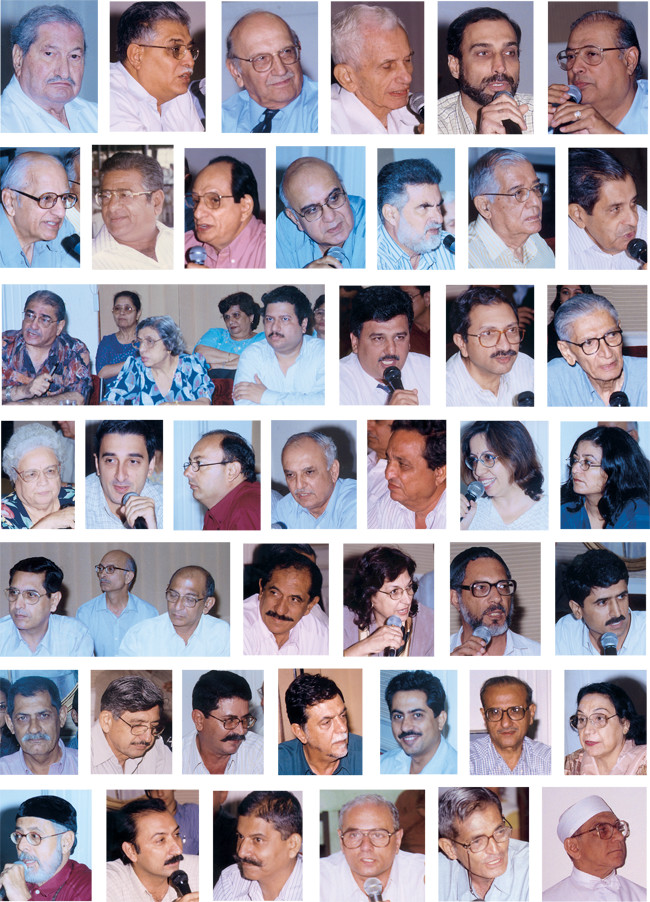
Facing page, L to R (1st row) Guzder, Gandhi, Sethna, Bodhanwalla, E. Irani, Mogrelia; (2nd row) Shroff, D. Mehta, Engineer, Tamboly, Tirandaz, Golwalla, Heerjee; (3rd row) Dastur, Kias, Master, P. Dastur, Colah, D. Irani, Rustomji, Masani; (4th row) Clubwala, Nargolwala, Karanjawalla, Postwalla, M. Irani, F. Master, B. Irani; (5th row) Paghdiwalla, N. Captain, M. Mehta, Udhnawalla, P. Ginwalla, S. Ginwalla, C. Cooper; (6th row) O. Debara, Cama, P. Irani, Behram Irani, Palkhiwala, Homi Mullan, D. Debara; (7th row) Wadia, P. Debara, Allavali, K. Pastakia, Palsetia, Panthaky
In the interests of a more constructive approach BPP trustee Dadi Engineer counselled that a keynote speaker focus on two or three important topics at future executive council meets with the delegates reacting to and debating the propositions.
The Federation mourned the deaths of veteran solicitor and centenarian Rus-tom Gagrat, Calcutta trustee Beji Bulsara who succumbed to a heart attack in the prime of life, BPP’s Piloo Bulsara who for years quietly and unobtrusively translated the Fed Newsletter into Gujarati (Marazban Wadia of Davier has now volunteered for the job) and Parsidom founder-editor Dara Kadva — a Federation critic —who only the previous year had stormed in and out of its meeting at the West End Hotel.
The next meeting of the Federation, to be hosted by the Iranian Zoroastrian Anjuman (IZA), will be held in Bombay on November 23 and 24, 2002.
Youth
The Third World Zoroastrian Youth Congress will be held in Poona in December 2003, announced incoming FOZYA president Sarosh Palkhiwala. About 200-250 foreign delegates are expected to attend, he noted. Palkhiwala has succeeded Porus Karanjawalla who headed the youth body for nine years.
FOZYA’s main object has been to keep Zoroastrian youth together and provide social service where required, notably in the old age homes in Navsari and Surat, stated Karanjawalla. FOZYA’s annual seminars have now been bolstered by international and global trips and the money collected at the time of the seminars have helped the organization fund awards to recognize outstanding achievements in academics, sports and social service, he added.
The Baroda United Zoroastrian Youth (BUZY) not only help their punchayet in the organization of social events — they felicitated Lt Gen (retd) Adi Sethna and former TISCO managing director Jamshed Irani, Kt, arranged the Adar mah parab in the agiary, though the Avan mah parab celebration had to be cancelled because of communal tensions — but helped Dr Shernaz Cama, director of the UNESCO Parzor project to unearth historic material on the community.
The 30 odd youths of Borivli hold antakshari competitions, help organize and attend religious talks and visit widows’ homes at Thakurdwar and Fort in South Bombay, noted Delna Pastakia. The group includes a general practitioner and a dentist, she added.
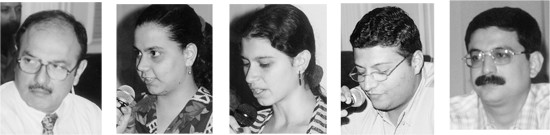
From left: Udhnawala, Dadinath, D. Pastakia, Khushroo Pastakia and Eghlim
According to Shovir Irani, Dahanu youths not only clean their agiary but help consign the dead to the dakhma. Social get togethers and trips to Udvada are other activities.
The Farohars of Delhi, the four to 14 year age-group which gathers at the anjuman premises to learn their prayers and the raison d’être of Parsi culture, got together to remember Adil Tamboly — an ex-Farohar who perished in a car accident in the US, DPA’s Adil Nargolwala infor-med the gathering.
The youths of Poona are in the throes of publishing a revised directory of Poona Parsis. Last edited in 1998, the publication will include the telephone numbers and addresses of Parsis in the city and its periphery as also local institutions plus anjumans and dharamshalas all over India, noted Tehmas Bharucha, treasurer of the youth association who is in charge of the project. Business and professional information will be part of the yellow pages. However only 1,000 families have been covered thus far. About 2,000 families have not filled the form, said Palkhiwala adding that many Parsis were unwilling to give their names.
Disappointed that the total population (variously estimated at 8,000-10,000) of Poona was not being listed, Gandhi wondered if the reluctance of the community resulted from too much information being sought. He was informed that currently there were 1,600 members of the Poona Parsee Panchayat (PPP). A lot of people are migrants and come only for racing, noted PPP president and Federation vice president Eruch Irani. "We want to show genuine membership,” he added.
The BPP’s Holiday Programme for Youth (HPY) won a round of applause as Kaynaz Dadinath told the gathered delegates that their blood collection drive stopped at 184 bottles because "the Red Cross said it couldn’t take any more.” On the other hand a number of potential donors were rejected because of blood pressure and other problems. The month-long program had catered to "every activity that the youth of today is interested in,” as it imparted social skills and confidence to the youths on the threshold of their college careers.
Sethna, who had participated at the 2002 HPY as a resource person after a lapse of 10 years, found the boys and girls looking bigger and better, comparing the phenomenon with the growth in height of Japanese people in the post World War II years due to the change in diet. Commenting on the intelligence, computer savvy, changing attitudes and general support for the elderly evinced by the youths he saw, Sethna recalled that one internet provider had stated, "Bank ma koi jatu nathi (Nobody wants to become bank clerks)!” "We need to take note of the changes,” suggested Sethna. Remarking on the widening interest and interaction, Engineer offered the BPP’s expertise to organize such programs for other anjumans free of charge.
Dadinath also said that the Programme had resulted in 12 marriages over the 16 years of its existence but Dastur was pessimistic about the demographic value of marriages today, noting that the DINKs (double income no kids) phenomenon was now spreading in India. He compared the Parsis to Italians: "We have the same problems of demography. Despite the Roman Catholic Church being anti birth control, they produce much fewer children and live longer than others.”
Individual anjumans
The well-knit Madras community of 275 to 300 individuals meet for monthly get-togethers, noted south zone coopted member Mani Clubwala of Madras. Though they have no formal youth association, the youths play a major part in organizing these functions, she added. Having renovated their "dilapidated old bungli,” thanks to a Rs 14.5 lakh donation from the Mary Clubwala Jadhav Trust the Madras Anjuman is thinking of ways to generate the funds required to repair the very old residential buildings it owns, said Clubwala.
According to Madras Anjuman president and Federation vice president Nariman Mogrelia, the tenants of the 14 odd buildings owned by the Anjuman have agreed to a 10 percent increase every three years in their low rents frozen for 40 to 50 years. This increased amount is credited to a separate repairs account with the worst-off property getting priority.
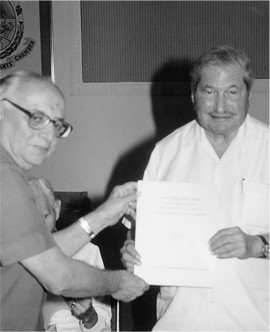
Releasing the Directory: Dotivala with Guzder
Baman Cama of Baroda reported an annual average of four to five births and 14 to 16 deaths. Having completed the renovation of their bungli at a cost of four to five lakh rupees, their next priority is the renovation of the 40-year-old darbe mehr that houses their 150-year-old agiary fire, he noted. Describing the Baroda Parsis as "a happy lot,” Cama said that BUZY, representing the 60-70 youths in a community of 700, had generated and donated Rs 13,11,000 to the Shree Parsi Panchayat Vadodara for the use of Zoroastrian youths. A couple of Parsi families who had problems during the Gujarat riots had been shifted to the dharamshala, he added. Solar concentrators were in the process of installation over one dakhma at Doongerwadi at a cost of Rs 2 lakhs after "74 of the 75 persons (present) at the annual general meeting endorsed (the decision),” said Cama.
When Cyrus Siganporia and his team of volunteers cleared the Indore dakhma after 10 to 15 years, they found a tree growing within whose roots had affected the foundation of the more than 100-year-old structure, said Indore Parsi Anjuman president Bomi Heerjee. The once deserted location of the dakhma "will soon be enveloped by residential areas,” worried Heerjee, as encroachments and trespassing on the property due to breaks in the wall were a frequent occurrence. Estimating the cost of a new boundary wall at more than four lakh rupees, Heerjee sought financial assistance from well-wishers in the all-India community. Stressing the need to preserve community properties of defunct anjumans, Heerjee asked Sethna, "Could it form part of the Minorites Commission Report which comes up for discussion in Parliament?” According to Porus Debara of Agra, the eviction of trespassers on community property in Kanpur had resulted in the trustees facing a criminal charge.
While the DPA reported zero births, deaths and marriages over the past year, the six new rooms on the second floor of the Mengusi Dharamshala had been completed with modern facilities, reported DPA secretary Farrokh Rustomji. The foundation stone was laid on the occasion of their agiary’s 40th anniversary celebrations in December 2001 and the rooms were ready by Jamshedi Navroz in March 2002. Next on their agenda is the renovation of Bhiwandiwala Hall which is the venue of all DPA functions.
With Mhow’s population dwindling due to lack of industrial and commercial opportunities, Mhow Anjuman president Dr Behram Masani reiterated the availability of cheap rental accommodation. A recent, unhappy development in the Mhow community ensued when the priest’s dog killed the bitch of a community member who has since become "anti-anjuman,” said Masani. The man wanted the priest to be sacked and when that demand was not met by the trustees, had lodged complaints about the Mhow Parsi Anjuman with the charity commissioner, the income-tax authorities, etc, informed Masani. He referred to the 14-acre aramgah land in Khandwa where "all that’s left is half the area of this room with Parsi graves,” adding that the Federation’s intervention in a civil suit protesting against the sale of another property had resulted in a compromise in terms of which the Federation had received Rs 2,00,000 from the buyer for withdrawing the suit.
The PPP has allotted 105 flats (of 700 sq ft each) on leave and licence to needy Zoroastrians including newly-weds and has invited objections, reported Dara Irani. "When other anjumans write to us we will try to make sure that their flat is surrendered before we release our flats,” added Irani. Eruch Irani clarified, however, that where a family was splitting up with one brother choosing to remain in the old location, the other opting for Poona, this condition would not apply. All seven trustees of the PPP had interviewed the applicants and are determined to ensure that their flats are not used as holiday homes.
Solar concentrators, installed at a cost of Rs 2,50,000 has "relieved” the PPP trustees of stress, noted Dara Irani, thanking scholar Dr Homi Dhalla and BPP trustee Dinshaw Tamboly for the idea. "Within four days the bodies are totally dry,” Dara Irani described the summer scene. As against 98 deaths in Poona (of which 16 opted for cremation and one body was buried) the PPP could ascertain 58 to 59 births with much difficulty after attempts to check with the Pune Municipal Corporation, stated Dara.
A new multipurpose community hall is expected to be ready by December 2002 and hostel accommodation for outstation boys can be arranged by applying to the PPP. Six lakh rupees from the Zoroastrians of Hongkong has enabled the PPP to provide health care in the form of a free medical camp for Zoroastrians. With free service of machinery and staff from the Ruby Hall Clinic, the PPP was able to offer cardiac, respiratory, diabetic and gynecological checkups, mentioned Dara Irani.
Eruch Irani complimented the Poona youths saying that their taking charge of normal youth activities had enabled the trustees to concentrate on these major projects. He underlined the commitment of his board that led them to sit from morning to evening interviewing flat applicants. All seven trustees also always make the time to be present in court to record documents and pursue sanctions for the projected developments. "This personal contribution (enables) the work to proceed without hiccups,” noted Eruch Irani.
The Poona representatives noted that 100 flats of 700 sq ft and 32 smaller flats are yet to be allotted. An activity that is on hold because of this flurry of projects is the publication of the Poona newsletter, admitted Dara Irani.
Describing the condition of rural Parsis in the Bharuch district as "squalid,” Bharuch’s Pilloo Ginwalla reported that these women and girls have been reduced to doing housework and menial jobs in Moslem homes. She is currently working on restoring her ancestral Jamshed Baug — an old dharamshala building with an attached fire-temple with Bharuch Parsi Punchayet (BhPP) help. Her idea is to rehabilitate these rural Parsis by bringing them to Bharuch and providing them accommodation and support. Currently there are 175 Parsis in Bharuch, she informed the council.
The BPP has sanctioned Rs 20,000 per annum for three years to help the Agra Parsi Anjuman maintain its dharamshala, acknowledged Dolat Debara. To meet the expenses of electricity, water and property taxes, the Agra Anjuman, comprising 13 individuals, has been constrained to rent out the living room on the first floor as well as the prayer hall to generate some income. Emphasizing the antiquity of Parsi settlement in Agra she noted that their aramgah dates back to 1885.
Noting gloomily that Calcutta’s Parsi population had declined from 2,500 to 800 "of which over 50 percent are above the age of 60,” Bahadur Postwalla said, "(We) can’t stem the exodus because of emigration away from city, state and country.” The Calcutta trustee noted that eventually there may be few Parsis left there to enjoy the substantial community assets.
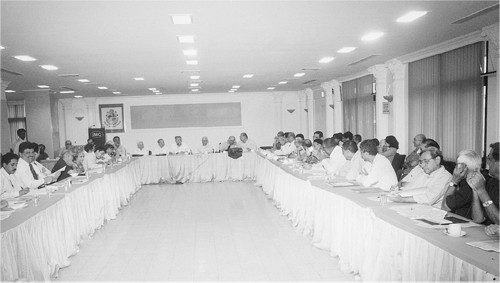
The executive council in session
The Ahmedabad Parsi Panchayat (APP) was not affected by the riots but four Parsi families were, Porus Karanjawalla informed the delegates. None of them were individually targeted, but they suffered because a neighbor was on the hit list. In the process a boy of navjote age has gone missing. Despite scouring hospitals and relief camps, they have not been able to trace him. In another case of an elderly couple when the old man died naturally, their home was ransacked on the day of the uthamna. In response to queries from the delegates Karanjawalla noted that the Parsis had very good relations with the majority and the minority communities: "We had never known or seen such bad days!”
A donation to the APP has enabled it to offer loans to people wishing to buy their own flats. The Panchayat is also trying to buy a new plot on which to build for residential purposes. The normal medical, educational and financial help to the community continues, as noted Karanjawalla.
Referring to the incident of an out-married Parsi denied membership of the Dahanu Zoroastrian Anjuman who had filed an application with the charity commissioner, president Pervez Irani noted that the hearing had been completed and the verdict was due by the end of June. (It had not been delivered at the time this issue of Parsiana went to press.) The case had been originally reported to the Federation by Dahanu’s Zarthost Mubarakai.
Another tricky situation had arisen there as some young environmentalist, in an effect to enforce the Supreme Court verdict on noise pollution, had pulled out the wires of the dandia-raas celebration at 10 p.m., said Pervez Irani. The Shiv Sena (SS) interpreted that act as an attack with statements in Saamna, the SS mouthpiece, denouncing the Zoroastrians as being against Hindu religious practices. Since then the largely horticultural Zoroastrian community has been made to report to the police for pruning trees and bungalows have been served demolition notices. "Zoroastrians are being targeted but we are trying to sort out the matter,” said Pervez Irani.
In a parallel development tenants of the Agiary Anjuman Chawl are challenging the four to five percent permissible increase in rent and the municipality has served demolition notices to the Anjuman for the wooden cabins built on a vacant plot leased for 40 years, added Pervez Irani.
Describing it as a "serious problem, a sign of the times,” Engineer offered legal help with writ petitions if required.
A jubilant Ronny Dick informed the council that Beji Mirza had donated Rs 1,50,000 to the Jhansi Anjuman in memory of his father. The money would help the Anjuman with the repair of the aramgah wall and the dharamshala.
So enthusiastic were the youths of Jamshedpur in their cleaning of the agiary that the mobed had to clean up after the cleaning party departed, laughed Adi Chehna. The Jamshedpur Parsee Association (JPA) and the Stree Mandal had got together to conduct the Mazdayasni Camp where religion is taught to the five to 15-year age group. They were joined by the Calcutta Scouts Club and their sense of reet-rivaaj (rituals and traditions) got a shot in the arm according to Chehna. The JPA’s normal activities include the navjote of underprivileged children and encouragement to youngsters to proceed for higher studies, said Chehna.
There have been five births, 16 marriages and 41 deaths in Hyderabad-Secunderabad since 2000, noted their representative Omim Debara. Of the 1,300 students in the Parsi school in Hyderabad only 23 are Parsis. The school secured 97 percent results in the board examination with one student securing sixth rank in the state of Andhra Pradesh, Debara informed the council. The 16th J. J. Irani Challenge Cup, held in Hyderabad, this year, was won by the Surat cricketers, he added.
Of the six families of Bhopal comprising 16 individuals, three are upper middle class, two are lower middle class. Their representative Col Firoze Allavali noted that the 75,000 sq ft aramgah’s bungli and graves were in bad shape and needed repair. Bhopal has a resolution to place its assets in the custody of the Federation.
Heerjee stated that a stud farm nearby had its eye on the property. He suggested that a public trust be set up and the property registered in its name but Gandhi recalled that the property was already registered in the name of the Parsi Society in the saat baaraa (land) records.
The 30,000 sq ft aramgah of the Benares Parsi Anjuman on the banks of the river Ganga has been badly damaged due to recent floods, said its honorary secretary Kashmira Gundevia. Once a community of 25 to 30 families when established by superintendent of waterworks P. S. Dastur in 1930, the Anjuman is now reduced to 15 individuals ranging in age between 10 and 70 years, comprising five families who can ill afford the estimated Rs 50,000 cost of repair and sought the Federation’s assistance. Gandhi suggested that the Anjuman send a formal appeal of the Federation together with an application for membership and a resolution passed by the general body appointing the all India body as custodian of its assets.
While there are no youngsters in Saronda with its small agiary ("I am the youngest in my village,” noted the middle-aged Homi Palsetia) Marazban Wadia of Davier reported a donation of nine lakh rupees from philanthropist Naryman Dubash toward the Rs 15 lakh rehabilitation of the Davier Dharamshala.
The Borivli and Suburban Zoroastrian Association (BASZA) has doubled its membership fees from Rs 250 to Rs 500 per annum, announced its secretary Khurshed Pastakia. BASZA has been regularly holding religious programs under the Zartoshty Brothers Fund sponsorship which have been successful with old and young members, noted Pastakia.
Zoroastrian occupants of community flats in Thana are pressurizing the trustees to adopt the new bylaws of the Housing Society Regulation Act for their cooperative society. This would enable the present owners, who had bought the flats at the cost price of Rs 550/sq ft, to dispose them of in the open market, averred Zarsis Udhnawala. The trustees are worried that the flats may go out of the community’s hands after all the effort to preserve residential accommodation for the community.
It may be recalled that the anjuman trustees had fought a legal battle to preserve some part of the Agiary land, then being sold off to non-Parsi developers, providing thereby 50 flats to Zoroastrians at this low rate.
With 450 resident Zoroastrians in Thana and 700 to 800 weekenders, the trustees have been noticing that 30 percent of the flats are lying unoccupied. "We are trying to compel people to stay or return the flats to the anjuman,” said Udhnawala. He added that, according to one school of thought, if the model bylaws are not adopted allotment can be restricted to the community, but once these model bylaws are adopted you cannot change back to restrictive allotment. The registrar of cooperative societies has refused to accept the Thana Parsi Zoroastrian Anjuman’s clause that its flats in cooperative societies should remain in Parsi occupation, noted Udhnawala.
While BPP trustee Rustom Tirandaz and Behram Irani of the IZA were of the opinion that the restrictive clause of the land lease would override the cooperative society clauses, Masani noted that the Gujarat High Court had ruled that under the Cooperative Societies Act allottees can’t be restricted to any one community. The matter, be added was now pending in the Supreme Court. Marzban Giara, reporting on the Federation proceedings for The Bombay Samachar, informed the gathering that the clause that the flats in the Shah Behram Baug Society were only for Parsis and no non-Parsi spouses were allowed, was successfully challenged in court by an intermarried Parsi.
The Thana trustees’ other bugbear — the unauthorized occupation of their 6,000 sq ft cottage on the main road in the center of town by the late SS pramukh Anand Dighe — remains unresolved. The Thana representatives now reminded the Federation of its promise to help.
In his response Gandhi noted that the Anjuman had failed to take possession of the property when the court had ruled in its favor and now the matter was time barred (Udhnawala had admitted that Dighe had promised to move out on various dates but did not honor his word and after his death the SS had continued the same policy): "Who will initiate action? Who will go to Thackeray? (Legal luminary and Rajya Sabha member) Fali Nariman who is the counsel for the SS has said that the Thana representatives can meet him. You can’t say the Federation is not moving. If the Thana anjuman is prepared to take the lead, the Federation will support it. But the Federation will not push BPP trustees to expose themselves to dangers that Thana trustees do not want to expose themselves to!”
BPP senior executive Sheroo Master provided a countdown to the BPP’s social activities. Educational outlays including help for general college education to 325 students, vocational and technical scholarship to 114 students, higher education for 55 students going abroad and 10 postgraduate students in India plus financial help for coaching classes for 26 medical and engineering hopefuls and for 12 medical students and 15 engineering students totalled nearly Rs 56.3 lakhs between April ’01 and March ’02, as per the BPP press release. A further Rs 1.18 lakh were given towards school fees. It is noted that six Parsi charitable funds cooperate with the BPP on the higher education committee and seven such charities participate on the vocational and technical education committee.
School counseling and career guidance, reimbursement of daycare center fees, hospitalization and surgeries, marriage help and amelioration of mobeds are other BPP activities. Maintenance assistance for the third and fourth child to 88 parties cost the Punchayet Rs 5,25,000 between October 2001 and March 2002.
Though over Rs 6.17 lakhs were distributed as doles in five months (December 2001 to April 2002) the BPP CEO informed the Council that no able-bodied male who remained unemployed for over two years gets a BPP dole according to the trustees’ decision taken two years ago. He also added that Shroff has been acquiring Australian wool at half the market cost for the benefit of about 150-200 kusti-weaving families.
The cosmopolitan Pestonji Davar Trust administered by the BPP at the behest of the late Davar has contributed Rs 41.24 lakh for educational and medical help in the ratio of 51:49 in favor of cosmopolitan charity to enable the trust to maintain its 80G certificate, noted Dastur.
At Panthaky Baug 104 two-room +kitchen flats and 56 one room+kitchen flats are being constructed in three new buildings while 40 two-room+kitchen flats are proposed to be built at Dhunbai Villa in Vile Parle (W). Three more stories have been added to the existing building at plot no. 786 in Dadar Parsi Colony and are presently being used as a transit camp, notes the BPP write-up. Said Dotivala, "Housing came by default (to the BPP) since the sethias who built colonies found it unfeasible to maintain them.” The 70-80-100-year-old buildings require extensive repairs which cost over 1.5 crore rupees and "We can’t increase the rents,” maintained Dotivala.
Noting that the Punchayet’s loss had been over two crore rupees in the past year of which Rs 92 lakhs was on the Doongerwadi account, Dastur recounted the fate of the BPP’s appeal to tenants one-and-a-half years ago: The responses totaled three of which two pensioned school teachers volunteered to pay a 10 percent increase in rent and social activist Pheroze Amroliwala sent in a donation of Rs 15,000. "We claim to be educated and socially conscious but...” shrugged Dastur.
Providing an answer to his own question, "How do we meet these deficits?” Shroff recounted that the BPP had earned about 14 crore rupees from transfer of development rights at Khareghat Colony and seven crore rupees from Spenta while interest free deposits had contributed Rs 11.5 to 12 crores. Donations like seven crore rupees from the Manekji Sett Charities provided respite in a scenario of falling interest rates and a mere Rs 2.5 crore revenue from the BPP estates as against an annual expenditure of over eight crore rupees.
Remarking that there was scant undeveloped land in BPP custody, Shroff noted that about Rs 15 crores worth of ownership flats developed at Panthaky Baug would be offered to Parsis at a 15 to 16 percent discount. The Rs 20 crore investment in the Nirlon property at Goregaon had also fetched the BPP "enough FSI and development area.” The flats there would be allotted only on rental basis.
"The BPP is running like a medium sized corporation. As we convert our resources to brick and mortar, the liquid assets are diminishing. We are dealing with 76 percent of the community in India. Joint families are breaking up into nuclear families... Everything at the BPP is not hunky-dory but we are trying... The community (is also) not playing fair,” commented Shroff.
Cama observed that despite talk of the community’s declining numbers, the housing problem continues. "Is there any real study about housing vis-a-vis (demography)? What are we going to do in 25 years as the population declines?”
Golwalla attributed the decline to out-marriage and migration. "Every year 24 to 25 students go abroad. Seventy percent of them don’t return. Of these 70 percent, 25 percent marry out. Giving a subsidy for the third and fourth child will not solve the problem.”
Countered Dastur: "Parsis are Parsis everywhere... Most people emigrate because of unfair competition here. We need to gather data on emigrants — their age and education.” He also noted that divorce rates were rising. "What are the causes? Is it domestic strife? Is it housing?... We are a technologically driven community. We need a data base to make sensible decisions.”
Heavy rain has added to the wear and tear of 113 years necessitating immediate repair of the Bai Pirojbai Manekji Ruttonji Patel Adarian at Vesu. As per an appeal circulated at the meet by its trustees — Minoo Patel, Roshan Mehta, Shernaaz Mehta and Sam Mehta — the cost of restoration would amount to well over Rs 75,000.
Also in need of community support is the M. F. Cama Athornan Institute at Andheri. Running low on enrolment as well as funds, the Institute and the M. M. Cama Education Fund which supports it has been facing a rising deficit that over the past four years has reached 12 lakh rupees.
Tax
Under the current Income Tax Act only 15 percent of the current income of a trust can be accumulated tax free, according to Masani. There was no bar on trusts donating to other trusts with similar objects, he noted.
The question of donations by one trust to another being taxable was raised by Sarosh Ginwalla as the BhPP had agreed to give a large donation for the refurbishment of Jamshed Baug, the decrepit agiary-dharamshala complex that is currently under rehabilitation in the interests of impoverished Zoroastrians in the Bharuch district. The BhPP had also given Rs 1.5 lakh for the renovation of the Hamavala Agiary as also to the Vesu anjuman and others.
Masani opined that the recipient of the donation would be taxed if 85 percent of the money received (taken as income) is not spent or if it is accumulated for a specific purpose beyond five years. According to the BPP’s Mehli Colah no tax would accrue to the donor trust if it spends from its current income. But tax would apply if the donation is made from accumulated income.
Accounts
The Federation spends Rs 50,000 each on the day-care and school counseling projects which the BPP runs at its behest, sharing 50 percent of the cost. The newsletter costs Rs 97,000 and the expenses on the Federation’s Awards for Excellence amounted to Rs 28,000 in the year ending March 31, 2002. Gandhi’s call for fresh newsletter sponsorship netted 11 from the anjumans plus two from Guzder at the rate of Rs 5,000 per issue. He noted that each edition costs Rs 8,000 which is financed by the anjuman sponsorship of Rs 5,000 plus Rs 3,000 from individual donors. In addition Beji Mirza of Calcutta, a personal friend, has donated one lakh rupees and the late Beji Shroff, who had been sending donations twice a year, has left a legacy of Rs 1.56 lakh.
Open forum
Recalling that the Federation’s first open forum had been programed in Delhi in 1990, Sethna counseled the delegates to adopt a wide perspective, addressing international, national, state and city concerns. Though the community is justly proud of its educational background "we could be prouder if we were in the forefront of technical education,” he noted. Reiterating Zoroastrian excellence in the field of defense (Air Marshals Teshter Master. Manek Madon and Adi Ghandhi; Air Vice Marshals Ramyar Batha and Fali Major; Lt General Rostum Nanavutty, Major General Arun Nargolwala; Rear Admiral Rustom Contractor) Sethna urged the Federation secretariat to keep abreast with the careers of the other Zoroastrians who had received the Federation’s awards for excellence over the years. Referring to the National Minorities Commission’s deep concern for the unsavory developments in Gujarat, Sethna said, "Make every thinking Indian ask why an element of hate has been allowed to emerge.” Noting that both the antagonist communities tend to woo Parsis, Sethna counselled, "We need to take people about us with us. Our ‘touch-me-not-ism’ may come in the way of our survival.”
On the international front Sethna remarked on the survival of Zoroastrian traditions wherever the old Iranian empire had spread: "Baku has the oldest atash behram in the world, fed by natural gas.” To restore and maintain the complex the Government of Azarbaijan had sought the help of the Government of India who in turn had requested the DPA’s aid, said Sethna. The 31st session of UNESCO has declared 2003 as the year of Zoroastrian culture and a seminar on Zoroastrianism with Asha as the subject has been scheduled in Azarbaijan, he noted. "Our minuscule community is in the forefront... (These developments could be a) unifying factor for the community,” he added.
The usual argument commenced when Karanjawalla voiced the community’s perception that funds for entrepreneurship were difficult to come by and that state facilities for minorities seemed to cater to only the larger minorities. Sethna replied that that the Gujarat State Minorities Finance Commission had helped five Parsis. "Their comment was that not many Parsis come for help.” But Karanjawalla maintained that people in Ahmedabad, Baroda and elsewhere in Gujarat were not aware of the facility leading Gandhi to ask, "Don’t they find out for themselves where the loans can be available?” Referring to an earlier report from the Parsi Youth League of Ahmedabad after researching this field, Gandhi lamented, "How much spoonfeeding (do they need)?
Enunciating his threefold vision of the future of the Zoroastrian creed, of the Zoroastrian community and of Parsis, Tirandaz thundered, "No community rises beyond the level of the leaders it worships. Today there is vicarious charity. The community worships people who dole out the funds. The right people who should be worshipped are left to wither.” He did not specify names at either end of his moral spectrum. "Follow the vision rather than the burden of obligation. We don’t know what to look for so we are not able to find. Our ethos has been sacrificed to materialism. We have begun to admire the likes of Dhirubhai Ambani and forgotten to admire Jamsetji Tata... We are diluting our values,” he rued.
When Wadia questioned the BPP regarding the enhanced charges at the B. D. Petit Parsee General Hospital (PGH), Guzder told him that the founder, Bomanji Petit, had entrusted the corpus and the structure of the PGH to the BPP but had precluded the Punchayet from the Hospital’s managing committee.
Golwalla recounted that during his term on the Punchayet, a request had been made that two BPP trustees be incorporated on the PGH managing committee but the Hospital had decreed that they should be elected. He averred that patients from the Doongerwadi staff and the F. S. Parukh Dharamshalla are sent off to Masina Hospital.
Defending the PGH, Tamboly said, "Not a single Parsi patient is denied proper medical treatment, even by-pass hospitalization... They are doing wonderful work in my estimation.” Added Pervez Bhesania of Thana, whose daughter is a doctor, that the situation at the Sion Hospital where she works is infinitely worse: "Our community is never satisfied.” According to Masani, the daily expenditure of the PGH per patient amounts to Rs 2,000. According to Tamboly Shapoorji Pallonji has offered six to seven crore rupees to the PGH to create an old people’s home.
Golwalla’s comment that there were only two Parsis among the 104 who answered the Masina Hospital’s advertisement for junior doctors while in his day there were 14 to 15 Parsi medical students led Eruch Irani to speak of Dr Keki Grant’s "dream to have a medical college in Poona so that at least 14 to 15 Parsi students could find a berth each year.” He also noted that the high maintenance cost of an old people’s home had led them in Poona to explore the concept of having one contiguous to a hospital and medical college "so that each can look after the other.” He emphasized the need to invest in facilities in other towns to preempt the Zoroastrians from migrating to Bombay. Ginwalla referred to a Zoroastrian property in Bharuch which its legatees may sell off unless the Federation or the WZO could save it and build there to help the rural Parsis in the district.
Participating in the discussion Federation award winner Khushroo Pastakia stated that Zoroastrian youths were not entering the sports arena due to "the belief that one who concentrates on sports can’t do well academically. (And) sports can’t be a vocation in India.”
Refuting the contention Eruch Irani said "sports makes more than a livelihood,” if it is pursued not as a hobby but as a business. Himself a former national level sportsman Irani said that it needed eight to 10 hours of effort to stay on top. He claimed that today’s youth "don’t want to put in the extra effort, want it all on a platter.”
"If you excel, there’s money... For the average sportsman there is little hope,” opined Gandhi, adding that the community lacked the institutions and machinery for sponsoring sports persons. He urged FOZYA to lay aside a percentage of its annual meet income towards generating such a facility.
Behram Irani raised the question of mobed training saying that the boys who do not attend the Dadar Athornan Madressa or the M. F. Cama Madressa in Andheri are trained by priests at agiaries in a scant two to three months just to keep alive the family’s right to practice mobedi. "The community will not have proper athornans to advice it in future,” he worried.
Noting that it is better to have "kuchcha” navars (who do not have the required 72 has (chapters) by rote than no navars, Cama declared that the mofussil mobeds of Navsari, Surat and Baroda are unlikely to send their sons to Bombay.
"If for practical purposes seven has are enough, why insist on 72?” questioned the pragmatic Gandhi.
Eruch Irani suggested that the problem be put to the nascent Council of Dasturs. Pastakia and BASZA president Noshir Paghdiwalla recounted that the seven mobeds in BASZA had refused to accept a young navar who wanted to join in the jashan. "The president and vice president of the Athornan Mandal (AM — when contacted by BASZA) said categorically, ‘We have no executive powers.’ It’s a way of shelving responsibility,” concluded Paghdiwalla.
"It is a major problem to get even a kuchha mobed for small anujumans,” declared Saronda’s Ervad Yezdi Panthaky. Noting that the World Zoroastrian Organization-AM scheme to lure young priests into full-time mobedi was going a-begging, Panthaky said even learned mobeds looked for other pastures. One reason, according to Panthaky, was the difficulty for even a deserving mobed to find a suitable spouse.
Those attending the Federation meeting were: Dolat Debara and Porus Debara from Agra; Porus Karanjawalla and Sarosh and Binaifer Patel from Ahmedabad; Baman Cama from Baroda; Noshir Paghdiwalla, Khurshed Pastakia, Marazban Mehta, Minoo Khan, Delna Pastakia and Zarina Bardi from BASZA; Baman Cama, Bomy Talati, Cyrus Cooper and Hoshedar Patwa from Baroda; Sarosh and Pilloo Ginwalla and Ratan Ginwalla from Bharuch; Jamshed Guzder, Minoo Shroff, Dinshaw Mehta, Dadi Engineer, Rustom Tirandaz Dinshaw Tamboly, Behram Dastur, Sheroo Master, Mehli Colah, Gool Kias, Godrej Dotivala, Homi Mullan, Kaynaz Dadinath and P. R. Mistry from Bombay; Col Firoze Allavali from Bhopal; Bahadur Postwalla from Calcutta; Marazban Wadia from Davier; Pervez Irani and Banoogoshasp Irani from Dahanu; Lt Gen Adi Sethna, Keki Gandhi, Farrokh Rustomji and Adil Nargolwala from Delhi; Sarosh Palkhiwala, Shovir Irani and Farhad Wadia from FOZYA; Bomi Heerjee from Indore; Behram Irani, Mehrwan Irani and Kayzad Eghlim from the Iranian Zoroastrian Anjuman; Homi Bodhanwalla and Adi Chehna from Jamshedpur; Ronny and Zarin Dick, P. Maneckji and M. Maneckji from Jhansi; Nariman Mogrelia from Madras; Behram and Dolly Masani from Mhow; Dolly Desai from Navsari; Eruch Irani, Dara Irani, Porusasp Mehta, Tehmas Bharucha, Khushroo and Farida Master and Kashmira Udachia from Poona; Homi Palsetia, Dinshaw Patel, Sarosh Poonawalla and Yezdi Panthaky from Saronda; Omim Debara and Aspi Debara from Secunderabad and Hyderabad; Mani Clubwala from South Zone; Khushroo Pastakia from Surat; Zarsis Udhnawala and Pervez Bhesania from Thana. The press was represented by The Bombay Samachar and Parsi-ana.
◆ ◆ ◆
From the archive