
Cover Story
Plaudits for Palkhivala
A stamp release by Prime Minister A. B. Vajpayee commemorates Nani Palkhivala's 84th birth anniversary
"How do you describe Nani? It was difficult even when he was alive. Howsoever you describe him you leave out some aspects of his personality.” Prime Minister Atal Behari Vajpayee’s tribute accompanied the release of a five-rupee commemorative postage stamp in honor of the late Nani Palkhivala on January 16, 2004 at the National Centre for the Performing Arts (NCPA). Twelve NGOs (non governmental organizations) jointly organized the function to celebrate the legal doyen’s 84th birth anniversary.
Tight security circumscribed the Tata Theatre. For about a couple of hours the extreme end of Marine Drive was closed to traffic with only those vehicles whose occupants presented the invitation card being allowed to drive up to the Theatre entrance. No bags, parcels, mobiles were permitted. In the event, the large auditorium was but sparsely occupied. There could be no doubt however about the fervent testimonials offered by attorney general Soli Sorabjee, minister of telecommunications Arun Shourie, Governor of Maharashtra Mohammed Fazal, Maharashtra chief minister Sushil Kumar Shinde, Tata scion Ratan Tata or management guru Minoo Shroff who succeeded Palkhivala as president of the Forum of Free Enterprise.
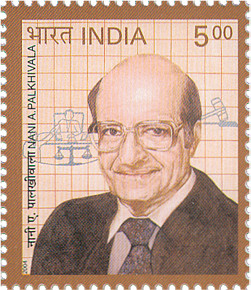
"A great Indian and a towering man of ideas and ideals... he had few parallels in corporate, tax or international law,” said Vajpayee. "It used to be said that he was the best law minister that India never had. It was also said that he was the best finance minister that India never had.” Recalling the prestige of Palkhivala’s post budget analyses Vajpayee noted with a smile, "The finance minister used to reap a barrage of criticism but when Nani spoke he received only bouquets!”
What set Palkhivala apart from other intellectuals was his commitment to democracy and public life. "He had the conviction to stand up and be counted,” acknowledged the Prime Minister. "He mesmerized the nation in the Keshavananda Bharati Case. The landmark judgment laid down once and for all that the basic structure of the Constitution could not be changed by a brute majority (in Parliament). One of the finest battles was fought in the courtrooms by Nani Palkhivala when the government wanted to change (that) judgment (during the Emergency proclaimed by Indira Gandhi).” Vajpayee quoted former Supreme Court Justice H. R. Khanna who had noted, "Nani’s height of eloquence has seldom been equaled and never surpassed in the history of the Supreme Court.”
Palkhivala was Prime Minister Morarji Desai’s first choice as India’s envoy to Washington to mend the strained diplomatic relationship with the US, said Vajpayee. When Palkhivala initially refused the job, the responsibility to get Palkhivala to change his mind devolved on Vajpayee as foreign minister. "I argued that the nuclear nonproliferation treaty discussions were at a crucial stage and needed a lawyer of his caliber. Despite not being a career diplomat he raised India’s prestige in the US. He delivered 120 speeches there including the universities... He was a universal man, rooted in spirituality in the finest traditions of India (who considered it his) major task to create a cohesive society. It is my regret that I could not meet him in his last years. He was too ill to recognize me...”
In his welcome address Tata recalled the warmth, kindness and humility of Palkhivala who had been chairman of such Tata concerns as the Tata Consultancy Services, the Associated Cement Companies, etc.
The law of "income tax was his forte. The Constitution, its preservation and development, its protection from short sighted politicians, was his life’s mission,” noted Sorabjee. He recalled his years in Bombay’s Government Law College where Palkhivala, a part-time professor, enthralled the students. The stalwart’s "generosity, philanthropy, commitment to spiritual values made him a moral force, the voice of conscience of the nation... He exemplified (Rudyard) Kipling’s If, filled the unforgiving minute, walked with kings and lost not the common touch,” noted Sorabjee.
"He never talked about himself... never had an ill word about anybody... you could be certain he’d never harm anyone,” remembered Shourie who had first met Palkhivala at Sorabji’s place during the Emergency. When Shourie had written for Palkhivala’s help when the school for spastic children was being set up in Delhi, Palkhivala had "immediately arranged that steel supplied by TISCO was available at a very substantial discount.”
Referring to Palkhivala’s great moral courage, his unremitting arguments to defend the Constitution which ensured the freedom of the people of India, Shourie maintained that it was Palkhivala’s "core belief that some things can never be thwarted, that some things can never be pursued” and declared, "It is our responsibility to care constantly... nurture institutions, prevent their gradual erosion.”
Shinde described Palkhivala as "a democrat, a patriot and a great humanist” who did his utmost to protect civil "liberties and the rights of citizens along with India’s great heritage.” He noted too that Palkhivala was "disappointed at the country’s failure to raise living standards,” that there was "too much government, too little administration.”
Shroff thanked the galaxy of speakers and especially the Prime Minister for joining in the tribute to "one of our finest citizens” and Shourie for his ministry’s speedy response to the request for a commemorative stamp in honor of a man who had "enriched our national life.”
As the first part of the evening’s program drew to a close, the audience as well as the dignitaries on the stage stood at attention and the Prime Minster could be seen singing the national anthem along with the Paranjoti Choir.
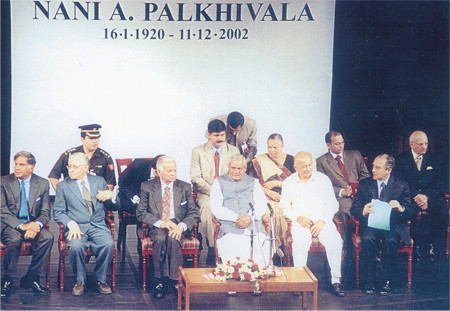
(1st row, from left) Tata, Sorabjee, Fazal, Vajpayee, Shinde and Shourie. (2nd row, from right) Shroff, K. Shivaram and Jaiwantiben Mehta
Memorial lecture
A rendition of hymns by the Paranjoti Academy Chorus set the stage for the second part of the program consisting of the first Nani A. Palkhivala Memorial Lecture on "Quest for Justice” delivered by legal eagle and Rajya Sabha member Fali Nariman. The lecture has been initiated by the recently constituted Nani A. Palkhivala Memorial Trust whose chairman Yezdi Malegam recounted to the full house that had gathered by then some of the fundamental causes to which Palkhivala remained committed all his life — a free Press, a society with just, fair and equitable laws, the nurturing of democratic institutions, the preservation of India’s priceless heritage — even though he was "disillusioned by the steady decline in values.” Malegam said that the Trust’s mission is to ensure that Nani’s message is kept alive for future generations and acknowledged the help of the House of Tata for sponsoring the function. Referring to Palkhivala’s crusading zeal that impelled him to address audiences all over the country, Malegam remarked that the country’s "youth was his special target.” He hoped that young readers of Palkhivala’s books are inspired to carry forward his crusade for a clean and just society.
Nariman’s lecture, sparkling with humorous anecdotes, began with an acknowledgement of the eloquent tributes paid to "a great man and a dear friend. Palkhivala was my professor. The bond of friendship developed despite his meteoric success,” noted Nariman in a snide reference to professional jealousies that beleaguer the legal profession — a blemish of which Palkhivala was known to be totally innocent. "Not only forensic eloquence, budget speeches or forthright criticism (of government policies), Nani loved individual freedom and fought for it against great odds... He saved our Constitution when it needed saving. That’s why we are particularly grateful.”
Addressing the subject of his discourse Nariman continued, "It is a known fact that every kingdom based on justice will stand. However 50 years after Independence we have a plenitude of laws but there are cracks in the edifice of justice.”
The Supreme Court came into existence in 1950 along with the Constitution which empowers it "to ensure justice.” The Supreme Court and the High Court are charged with the duty to dispense "justice in accordance with the law and justice in spite of the law when necessary,” stated Nariman. The trust of the founding fathers has been largely requited, especially up to 1967, by the judges of the Supreme Court who are "trusted above all other judges... They are not expected to do wrong.”
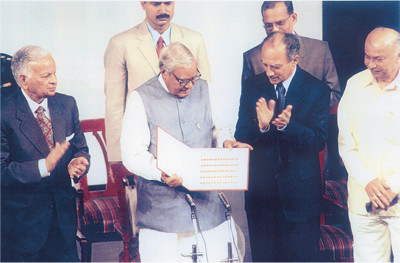
L to R: Fazal and Shourie applaud, Shinde looks on as the Prime Minister releases the stamp
It was Nariman’s argument that while "our courts have tried to steer the law in the path of justice” the nation has stumbled because of the "inherent inadequacy” of a citizenry that demands rights without duties. "The all-pervading rights culture, (with its) different sets of rights, fragments society, causing profound discontent.” He recalled that when the International Declaration of Human Rights was on the anvil after World War II, Mahatma Gandhi was one of those whose views had been solicited by UNESCO. In a letter to UNESCO director-general Julian Huxley, Gandhi had held that "all rights come from duty well done.” The Fundamental Rights chapter of our Constitution has ensured rights but not stressed the duties and responsibilities that exist between citizens and between citizens and the state. "Justice must flow from all sections of society,” noted Nariman. Describing "litigation as an evil... a concession to follies,” Nariman said, "Courts could act more swiftly if everyone was sensitive to the needs of society.”
Much of the litigation (90 percent according to Nariman) is due to state action or inaction. However, injustice continues, especially gender injustice due to inadequate provision for women and children: The Hindu law continues to rule against women; the divorced Muslim woman is not able to move court for maintenance, were some examples he provided.
The government is out of touch with the common man, asserted Nariman. "There’s an enormous division between those who govern from those governed,” he noted, attributing the antecedents of that division to the British country clubs. The separation of the British administrators from those they ruled was however tempered by certain ideals. The old public servants "kept their promises. They took no bribes.” In contrast, "we started with promises and did not even keep those in the Constitution!... Corruption is endemic in the body politic. It floods the entire state apparatus. Every government has promised a clean administration but it has become murkier!”
When leaders and officers take bribes, the poison seeps downward through society because "people see what (the nétas) do and do likewise.”
Nariman noted sarcastically that the Central Vigilance Commission Bill of August 2003 was promoted "to staunch corruption in public life but treated the equal unequally... The small print in the third sub-clause of the sixth section” noted that while the officers at the level of the joint secretary and below can be investigated by the CBI (Central Bureau of Investigation) all those above that level were immune from enquiry except by the previous approval of the Central Government. "The government says it is essential to protect decision makers. When I suggested that the previous approval of the Central Government be substituted by previous approval of the Central Vigilance Commission, the law minister declined.”
However, Nariman asserted that it was a "flawed perception that all government servants are corrupt. There are still high levels of integrity among some bureaucrats. [Retired member of the Indian Administrative Service (IAS) and former Governor of Maharashtra] Dr P. C. Alexander spoke in anguish. He could never imagine that senior officers could be corrupt... "What is disturbing is the polity in which we live. It hurts that the opposition in the Rajya Sabha also approved the bill. The quest for justice? We must keep striving... The fault lies not in our stars but in ourselves...”
In the course of his vote of thanks N. A. Palkhivala Trust trustee Bansi Mehta noted that the concepts of freedom and justice were interlinked because "justice can grow only in the soil of freedom... Nani said that anything that controls freedom breeds injustice.”
Mehta added that Palkhivala’s quest for freedom included freedom from dogma: "He was never imprisoned in any way of thinking except for moral values. He looked at each problem from the other side, reduced everything to simple statements...”
◆ ◆ ◆
From the archive