
Politics and Policy
The conservative voice
Orthodox members of the community questioned the right of the Federation of Parsi Zoroastrian Associations of India to discuss four socio-religious issues
"The points raised by the Bombay Parsi Punchayet’s (BPP) Chief Executive Officer (CEO) are surprising. (These are) politically motivated issues when the nation is passing through a difficult period. (We) cannot support the issues raised. In the context of the community and the country (they) will bring us in direct conflict with the people of India (as the) situation in the nation on issues of conversion (is) very hot... We should not add to the government’s problems (by raising) inflammable issues at Bardoli which is in the heart of a very tense Gujarat.”
The above quote notwithstanding, Dastur (Dr) Kaikhusroo JamaspAsa’s objection to the BPP’s invitation to member anjumans of the Federation of Parsi Zoroastrian Anjumans of India (FPZAI) to debate 10 socio-economic issues at Bardoli on November 29 and 30, 2003 was not on pragmatic grounds alone. His broadside was principally aimed at the increasing intermarriages in the community and their tacit acceptance as also against the liberals’ concern for the children of intermarried Zoroastrian women who are not officially accepted into the faith though the children of Parsi men are considered Zoroastrian. Rethinking on the issue of adoption was similarly dismissed as ultra vires the Zoroastrian faith as practised in India.
JamaspAsa castigated the "lack of religiosity and lack of respect for the opinions of parents and high priests” and predicted that "the downfall of the community will be total” unless it increased the importance of religion in home life and sent children to religious education classes. "BPP trustees should encourage youths to marry within the community... It is the beholden and sacred duty of the youth if they want the community to survive till frasho kereti...(This) tacit sanction of intermarriage is dangerous...”
As the flag-bearer of orthodoxy in India, JamaspAsa’s words were heard with jubilation by Parsis of the traditionalist mold who had answered the summons of The Parsee Voice to register their displeasure with the BPP for having initiated a debate on topics they considered sacrosanct.
All available seats on both levels of the Framjee Cawasjee Hall were occupied on November 21, 2003, with chief organizer and main speaker Adi Doctor profuse in his apologies to those who had to stand.
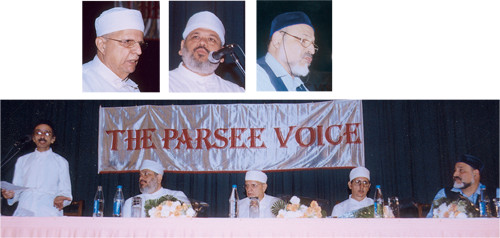
Above: JamaspAsa, Dastoor and Mistree Photo: Adi Suder; Bottom left: Doctor, Dastoor,JamaspAsa, Peer and Mistree: voicing the orthodox stand
The protest had been triggered by an official letter from the BPP CEO Behram Dastur to other anjumans wherein the rising divorce rate among Parsis, the increasing number of marriages with members of other faiths, the discrimination against children of Parsi mothers and the need for a law on adoption were suggested for a full day’s discussion at the forthcoming Federation meet. The need for a single calendar instead of the three currently in the community’s use, a conscious concern for its landed assets as well as intellectual heritage in the form of precious books and manuscripts, the promotion of self-employment and spirit of enterprise via membership of the World Zoroastrian Chamber of Commerce and the creation of a data bank on population statistics in all parts of the country to enable efficient planning and utilization of resources were other points raised by Dastur. At the earlier Federation meet in Bombay BPP chairman Minoo Shroff had felt that these issues deserved a full-day discussion. The letter also suggested that the "reservoir of barely educated men from South and Central Gujarat” who serve the doongerwadi as khandhias and nassessalars was likely to dry up in the coming decade with youths becoming better educated. The BPP letter described it as a "social crisis looming on our horizon,” and suggested that our "technology driven community” search for a solution in advance.
While such intractable problems as a rising divorce rate, mounting repair bills of aging community properties, the need for better planning as the community becomes smaller and older, etc were considered debatable by the Federation, the status-quoists castigated Shroff, trustee Dinshaw Tamboly, Dastur and all those who sought a more realistic approach on other social developments of the past four decades. "One in three Parsis marries outside. Published data reveal that as many boys as girls marry out. Gradually non-Parsi spouses will ‘seep’ into our baugs and colonies. Do we throw them out, and further dilute the Zoroastrian ethos? (as we all know, the covenants concerning the lands, and buildings thereon, stipulate the paramountcy of Parsi ethnicity),” wrote Dastur. Though the letter does not mention it, the situation is leading to legal tangles.
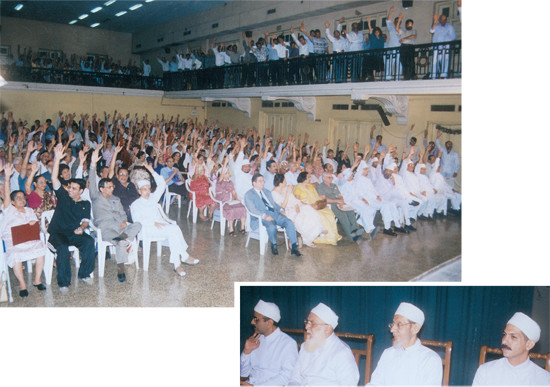
Members of the audience endorsing the resolution Photo: Adi Suder (Bottom) Priests on the dais
Instead, Doctor referred to the history of the Federation, specifically when the BPP under chairman B. K. Boman-Behram had withdrawn from the Federation in 1978 (in a huff against Delhi Parsi Anjuman Shia-vax Nargolwala’s criticism of the BPP’s election scheme) and when it rejoined the all-India body in 1981 with chairman Dr Aspi Golwalla "giving assurances that no controversial issues would be dealt with by the Federation (The Parsee Voice, November 16-30, 2003).” He noted that the question of adoption had been resolved when then Prime Minister Indira Gandhi had exempted Parsis from the provisions of the proposed adoption bill in 1982. He averred that there was no case law regarding the religious rights of the children of intermarried women and that the expressions in their favor attributed to former Chief Justice of India Sam Bharucha and incumbent attorney general Soli Sorabjee were their personal beliefs and not a considered legal opinion. Doctor recalled that the BPP had sent a questionnaire to 23 scholars including high priests in 1967 and 20 of them had opined that such progeny could not be considered Parsis. As for the acceptance of the Fasli calendar as advocated by liberal thinkers, Doctor predicted "it would lead to violent disorders in nature.”
According to Doctor it was the interdiction against intermarriage and conversion as well as the upholding of the system of dakhmenashini that differentiated Parsi Zoroastrians from others. He alleged that it was the liberal game plan to undermine these defenses so that India could be integrated into the proposed World Body on par with "pseudo Zoroastrians” from the emerging regions like Eurasia and South America — an unacceptable scenario: "Ten to 12 persons should come forward and tell the Punchayet trustees to allow the status quo — Pak Iranshah is taking care of us, not the BPP trustees or the World Body.”
JamaspAsa dismissed the Fasli calendar as having "neither religious sanctity nor alat.” He disputed Dastur’s contention of social discrimination against khandhias and nassessalars saying "we have the greatest respect for those who perform their job with religiosity.” Disregarding published scientific opinion that the vultures were dying because of the painkilling drug diclofenac used in human as well as veterinary practice, the High Priest demanded to know "Why are trustees still stalling the aviary project?” and declared that "solar concentrators are not the final answer. (They are) a backdoor entry to cremation.” As for adoption, "the Constitution of India has given us rights and the Government of India has bent over backward to accommodate us.” There was absolutely no need to revisit this issue, he declared. Criticizing the BPP for its "desire to join the World Body,” JamaspAsa contended that the "role of the Punchayet is to safeguard the value system of the community... preserve and uphold our ancient faith.”
Udvada High Priest Dastur Khurshed Dastoor upheld the Achaemenian kings for not converting the peoples they conquered. According to him it is "nature’s law that numbers do decline whether it is of communities or animals. The Panda was supposed to be extinct. Why was it not mated with a cat or a dog? Are we going to form a zoo?” asked Dastoor, "Keep the community small like the lota (jar) of milk presented to Neriosang Dhaval,” he advised, adding, "Jaraabi ghabhraavaani jarur nathi. Muthi bhar tolu rahésu pun hamésh né varé rahésu (No need to panic. We may remain a very small community, but we shall survive to the end of time).”
"What is it that has enabled such a small community to create so much? It is khoreh, the ethereal and spiritual elements of existence built up over generations and centuries,” said Ervad (Dr) Rooyintan Peer, former principal of the M. F. Cama Athornan Institute at Andheri. Contending that each community and nation has its own khoreh he argued that intermarriage would lead to the loss of the Parsi khoreh in three generations. He referred appreciatively to the Jews who disapprove of intermarriage and the tribes of the Andoman and Nicobar Islands who have preserved their genes for thousands of years and have remained untouched by modern civilization because they have not been allowed to mingle with the mainland community!
Zoroastrian Studies founder Khojeste Mistree was said to have cancelled lectures in Dubai to participate in the meet. He referred to the "machinations of the (BPP) CEO” and "Machiavellian minds working in the Punchayet” and the "anti-religious agenda being pushed by the liberal lobby for some time now. The BPP trustees are ignorant of history and even more of religion, so why are they dabbling (in it)?” he asked and wondered why they were not present that evening to learn from the speakers.
Mistree argued that the proposed World Body was a "Trojan horse” which would destroy the traditions and practices of Indian Zarathushtis. "The issues of adoption and intermarriage have already been resolved in North America... Already the rot has set in in Iran. (It has) gone the North American way. (There they) take the Gatha line, forgetting all the practices we have followed in Mother India for hundreds of years.” Without agiaries or dakhmas there are "no ritual precincts in North America... The BPP is the premier body worldwide. Why should it play second fiddle, become equal to the rest? Our 45,000 Parsis are being equaled to a few in Belarus... There is only one Fasli agiary in India... Yet they are telling us to form a common calendar and give up Shahenshahi and Kadmi alat, rationalize rituals!” Mistree was appalled that "middle-of-the-road Zoroastrians” were saying that the nirangdin and vendidad ceremonies were "rubbish.” He claimed that a study by SOAS (School of Oriental and African Studies) showing differences between Parsi and Muslim genes was due to be published in the scientific journal Nature.
Stating that minutes of a meeting convened by the BPP to discuss these issues with the high priests, scholars and community members had omitted solicitor Rusy Sethna’s suggestion that an expert committee be formed and its opinion placed before the anjumans of India, Mistree accused the BPP of "intellectual dishonesty,” adding, "Individually the BPP trustees are good people but God knows what happens when they come together.”
Dr Mehroo Bengalee, Dr Nelie Noble and Rustom Tirandaz all former BPP trustees, and erstwhile chairman Eruch Desai were special invitees at the meet. Only Bengalee however read out and circulated her message stating, "I am totally disgusted and agitated at the behavior of the board of trustees and CEO of the Bombay Parsi Punchayet, for continuously bringing up the contentious religious issues in spite of the clear diktat from the high priests and religious scholars. The Bombay Parsi Anjuman cannot and shall not tolerate this slant (sic) behavior towards our religious leaders whom we revere and seek religious guidance (sic).
"Who do they owe allegiance to? The Bombay Parsi Anjuman or the anjumans of different parts of the country or the world Zoroastrian bodies of mixed breed? For once let them know, in no uncertain words, that we shall not permit any children of intermarriage in our Mazdiysne (sic) faith, which stands on purity and cannot be besmirched. We shall retain our ‘tokham’ and ‘genes’ till the last breath of our lives and keep our identity untainted.”
The resolution, read out by Hanoz Mistry, that the "Parsi/Irani Zoroastrian community strongly disapproves of the attempt by the Federation of Parsi Zoroastrian Anjumans of India /Bombay Parsi Punchayet to table, discuss and debate” these four issues was carried without dissent. The BPP trustees were told to confine themselves to managing the Punchayet’s funds and properties and to keep away from any existing or proposed World Body with the meeting’s organizers undertaking to ensure implementation of the resolution.
◆ ◆ ◆
From the archive