
Politics and Policy
A world body by end 2003?
Fruitful talks with the World Zoroastrian Organisation may result in a charter being signed for the formation of a Zoroastrian world body before the next meeting of the Federation of Parsi Zoroastrian Anjumans of India
Incoming Bombay Parsi Punchayet (BPP) chairman and Federation of Parsi Zoroastrian Anjumans of India president Minoo Shroff’s desire to make the meet "more proactive,” and instructions to the anjumans to focus on current events in their reports, made for a slight change in the tempo of the proceedings of the Federation’s executive council meet at the Banaji Atash Behram Hall in Bombay on June 7 and 8, 2003.
In camera discussions between the various anjumans, associations, federations and the World Zoroastrian Organisation (WZO) may result in a charter of the new ly proposed world Zoroastrian body being signed, announced Federation joint honorary secretary Keki Gandhi. While details are sketchy, the consensus appears to be on the creation of a two-tier body comprising individuals and associations with certain safeguards.
The expected launch of the Rs 5 Dadabhai Naoroji coin (subsequently scheduled for October 2, 2003) sat well with the international celebration coordinated by UNESCO, of the year as the 3000th year of Zoroastrian culture, both announced by Delhi Parsi Anjuman (DPA) president and Federation vice president Lt Gen (retd) Adi Sethna.
The idea of the coin, conceived by BPP chief executive Behram Dastur has been pursued by Sethna and BPP public relations officer Godrej Dotivala who have respectively liaised with the central government and the Government of India (GOI) mint.
Well-known solicitor and BPP trustee Ervad Burjor Antia who heads the Punchayet’s newly formed religious committee made a strong plea for pragmatism and a catholicity of approach towards Zoroastrians of all origins and persuasions and advocated the creation of a community tribunal to address internal disputes.
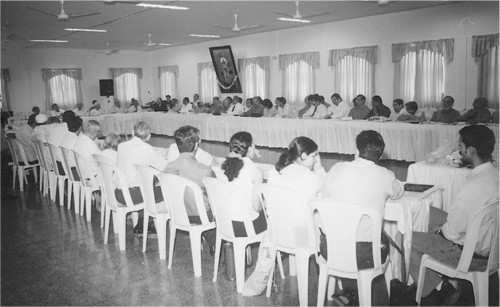
The executive council in session
In light of the current national controversy over the presentation of history in school textbooks ex-Indian Administrative Service officer and president of the Indore Parsi Zoroastrian Anjuman Bomi Heerjee felt that references to Zarathushtra, his religion and his people should be critically assessed by the community.
Ahmedabad Parsi Panchayat president and Rasna honcho Areez Khambatta has succeeded Dr Sam Bhacca and Poona Parsi Panchayat (PPP) president Dara Irani has succeeded former PPP president Eruch Irani as zonal vice presidents of the Federation. The BPP’s senior trustee Silloo Kavarana takes over as ex-officio joint honorary secretary of the Federation. All other office bearers were reelected and the Federation’s accounts endorsed. Shovir Irani of Dahanu has been nominated by Federation of Zoroastrian Youth Associations (FOZYA) as its representative on the Federation’s executive council.
Gujarati litterateur Dr Ratan Marshall of Surat is translating the Fed Newsletter into Gujarati and the Karanjia brothers of Surat have undertaken its printing and distribution, noted Gandhi adding that the newsletter’s position vide sponsorship and advertising was comfortable.
The Borivali and Suburban Zoroastrian Anjuman (BASZA) president and Zoroastrian Co-operative Bank executive Noshir Paghdiwalla announced the Bank’s new "scheduled” status and full-fledged money changer’s licence acquired over the past six months. In the same period the BPP’s venture capital project has been grounded on the shoals of community perception of any help from the Punchayet as a dole or easy money, indicated Shroff. The venture capital project is conceived on the basis of equity participation in viable projects which on maturity can be rolled over to aid newer enterprises.
The Foundation for the Development of Udvada has been established with Rs 1.25 crores contributed by the GOI and the Government of Gujarat (GOG). Its board of trustees comprising Dastur Khurshed Dastoor, High Priest of Udvada, hotelier Jehangir Cama of Ahmedabad, P. K. Laheri, chief secretary to the GOG, Shroff, Antia, social activist Homai Modi of the Save Udwada Committee and scholar Dr Homi Dhalla, founder of the World Zarathushti Cultural Foundation, will be chaired by BPP trustee Dinshaw Tamboly. Its three main planks according to Tamboly will be the establishment of a proper cultural museum, the organizing of an annual festival day for Zoroastrians from across the world and a tourist circuit based on the wanderings of the Iranshah.
Even as the BPP awaited a major dossier from Tata AIG who were said to be amenable to absorb the administrative burden of a mediclaim scheme for the community, Dastur sketched in a few demographic details: Heart disease accounts for about 50 percent of deaths in Bombay, cancer a low three percent. In the past year only two children were lost under the age of one year indicating good child care though there were four stillbirths. On the emigration front, according to Dastur’s figures a family of four leaves India every week from Bombay and every month from Calcutta. In reverse, Shroff maintained that youths of both sexes were opting to return in pursuit of job security.
BPP trustee Dadi Engineer advised the community to ensure that a proper death certificate is issued. The BPP aims to review procedures at Doongerwadi in light of the murder of Adi Cursetjee where police investigations began after the body had been consigned to the dakhma. The retrieved body, demanded by the police for a postmortem examination, had to be placed in the recently installed air-conditioned morgue at Doongerwadi, he noted.
The next meet of the Federation will be hosted by Bardoli on November 29 and 30, 2003. Sanctioning a full day discussion of controversial topics, Shroff abandoned the Federation’s hitherto open-doors policy by decreeing that it would be an "in camera discussion, not for reportage in the media.”
Anjumans
"Mhow is under the Federation’s custodianship (but) the Federation has taken Mhow for granted,” complained its president Dr Behram Masani. Though the average age of the community there is said to be over 65 years, recalcitrant tenant members are allegedly seeking to privatize the anjuman properties they occupy.
Masani had voiced his anguish to the Federation’s executive council last November but the problem continues to simmer. He once again sought an active Federation involvement to support his stand against such a move: "(Let) the Federation make its presence felt, attend the (managing committee) meetings. If the BPP trustees come, they can make the community aware that other Zoroastrians are interested in Mhow.”
"Get local Zoroastrians to ostracize such people,” suggested Gandhi and requested Heerjee to act as Federation representative and attend Mhow anjuman meetings. "If the Mhow anjuman wants to divest its properties, the Federation can object. However, if 75 percent of the general body agrees (with the original proposition) the objection can be overruled,” noted Gandhi who nonetheless appreciated Masani’s need for the "Federation’s presence when such knotty proposals come up.”
Heerjee however was unwilling to be a party to "shift responsibility” from Mhow’s managing committee to the Federation. "If there is litigation, the Federation can be one of the litigants. But be very clear about what assistance you are going to provide,” he told the assembled delegates. "Mhow and Indore are very close. We don’t want the relationship to tarnish.” Seeking "circumspect, careful, precise parameters,” Heerjee referred to allegations about Mhow anjuman funds going to non-Parsis. "It is their property, but the Federation representative’s presence (at their managing committee meetings) will make the Federation a party to every resolution.” He endorsed a suggestion that Shroff and Tamboly "come once in a while and give words of advice.”
Denying the allegation referred to by Heerjee, Masani explained that the money had been provided to a non-Parsi employee of the anjuman at the time of the Gujarat earthquake. Harking back to one of the terms of the Federation’s custodianship — to take charge of the anjuman when only 15 individuals remain — Masani predicted, "No one then will call the Federation!”
Tacitly accepting the responsibility Shroff noted, "My experience of intervening is very awkward. Can we discuss informally rather than coming and getting garlanded?”
The Mhow anjuman has acquired a second mobed. "We should be able to spare him for neighboring anjumans when required,” said Masani. They have begun water harvesting on the anjuman properties and planted bawal trees on the 12 acres of dakhma land. Masani was grateful to Cyrus Siganporia and his band of volunteers who not only cleaned the dakhma but "donated to the anjuman whatever we gifted them.” One couple has been aided from the special trust managed by the Mhow anjuman to help young couples with bridal expenses. They are also "inundated” with appeals for educational aid. Masani said he and his co-trustees give preference to appeals from smaller anjumans rather than from areas like Bharuch or Surat where funds are available.
With about 15 Parsis left in Neemuch, eight or nine of whom live in Punchayet houses, as per Noshir Jal, the anjuman has invited the Federation to take over as custodian. Gandhi called upon Heerjee, Katpitia, Masani and Tehemton Anklesaria of Ratlam to take on the job of administrator, but no appointment was finalized.
The government wants to take over nine acres from the nearly 20 acres of doongerwadi land belonging to the Ahmednagar anjuman, Col K. G. Jalnawala told the assembled delegates. The less than 70-member anjuman has written to Sethna and Rajya Sabha member Fali Nariman but "if the land is not utilized by the community the government can take it over,” he feared. He urged the gathering to develop a colony on their 15 acres along the Nagar-Aurangabad highway.
The Thana anjuman faces a problem similar to Mhow, according to its president Rustom Cursetji. The Zoroastrian occupants of community housing, who got their flats at cost price thanks to a protracted legal battle fought by the Thana trustees, the BPP and the Federation against the Divecha trust and the non-Zoroastrian developer who took over its land, are pressurizing the trustees to adopt standard cooperative society by-laws so that they can resell their flats at a higher price in the open market. "I am afraid they might get the upper hand and we might get marginalized,” noted Cursetji. "The problem is that donations are received as a birthright. Do we have the moral authority to combat that attitude?” he queried.
As for their 3,000 sq ft cottage in Thana, allegedly illegally occupied by the Shiv Sena, whose fate has been repeatedly debated at earlier Federation meetings, Cursetji noted that they were working on its legal and political angles: "We want the moral support and backing of the Federation, not (its) actual (involvement) in the battle.”
Cursetji acquainted the delegates with his local community’s desire to establish an air-conditioned hall at the Thana agiary similar to the venue of the meet in the Banaji Atash Behram compound. The Thana community is also supporting the Jeejeebhoy trust and the alumni of the Byramji Jeejeebhoy School there to revive the moribund institution.
A clause in the settlement of the Iranian Zoroastrian Anjuman (IZA) — Maharashtra Government dispute over their Palghar land requires that 40 percent of the income from this land be spent in the Thana district. "Write to our president,” IZA representative Behram Irani told Cursetji. "We might be able to help with funds for the Byramji Jeejeebhoy School.”
Their over 20 lakh rupees annual income from the sale of grass from Palghar and interest on fixed deposits was used for the relief of poverty and educational and medical aid among more than 1,000 applicants, added Sohrab Dahmubed. He noted that due to the illness and retirement of IZA’s long serving secretary Sohrab Elavia, Darayush Irani had taken over the work.
His application for an 80G exemption from the Income Tax (IT) department for the Indore anjuman has been turned down until he can furnish the original trust deed of the anjuman’s properties for the IT commissioner’s inspection, reported Heerjee. Considering that the Indore anjuman was founded more than 100 years ago when Indore was part of the Holkar State, Heerjee has not been successful in his search for the document. The only coeval item on the file, according to Heerjee, is a letter dated January 21, 1889 addressed to the BPP covering the transfer of money collected by Sir Jamsetji Jejeebhoy and requesting the BPP to look after the interests of the Indore anjuman. Ten years ago a Declaration of Trust had been registered with the Registrar of Public Trusts but when he asked them for a copy they found only an unsigned draft and no schedule of properties. "Is it possible to have another Declaration of Trust when an earlier one existed? How do we move legally in the matter?” asked Heerjee.
Terming it an "uphill task” Dadi Engineer suggested he apply with references and copies of old documents. BPP senior executive Sheroo Master referred to a letter of administration dating back to 1889 or thereabouts and Masani recommended that if Heerjee focuses on records of the dakhma property, the IT authorities may accept his application.
Faced with financial stringency the Indore anjuman is looking forward to visiting Parsis donating towards its programs. On the agenda is the construction of a boundary wall and the renovation of the bungli at the dakhma. Water shortage during the summer was another obstacle to construction activity, according to Heerjee.
BASZA had its usual range of events in the preceding six months noted its secretary Khurshed Pastakia dwelling on their colloquium on intermarriage. "It was a live discussion to increase awareness (regarding) the survival of our ethnic community,” he noted and the social and religious consequences of intermarriage were underlined at what he called "this unique learning experience.” Pastakia said that "the overall consensus was that intermarriage is tearing our community apart.”
The Allahabad Parsee Zoroastrian Anjuman (APZA) celebrated the wedding of Khushnum Rohinton Framjee with Vikas Saxena on January 15 and three days later laid their 82-year-old paramobed Nariman Framroze Marshall to rest in their aramgah, the anjuman’s president Capt Homi Dandiwalla informed the gathering. There being no priest available, Dandiwalla said he recited the preliminary prayer followed by the playing of an audio cassette of geh sarna prayers recorded by Ervad Kersi Bhada of Bombay’s Cama Baug Agiary. The mourners were greatly aided by the Christian community whose members lifted the coffin, transported it to the cemetery and lowered it into the grave as the 22 Parsis in Allahabad are all quite aged, noted Dandiwalla.
At the APZA’s AGM on April 19, the focus of attention was on the community seven years hence. The exercise was called by Dandiwalla where he urged a change in the three-member managing committee. The trustees — himself (77), his wife Shireen (71) and vice president Dossabhai Gandhi (79) — all suffer from physical handicaps and ill health. However, no change was reported in the membership of the board. A source of concern is the declining income of the anjuman as interest rates decline. If they could get two lakh rupees, they could renovate the Bazam Hall in the Jalejar S. Ghandhi Dare Meher compound and generate income by renting it out for wedding functions, Dandiwalla noted.
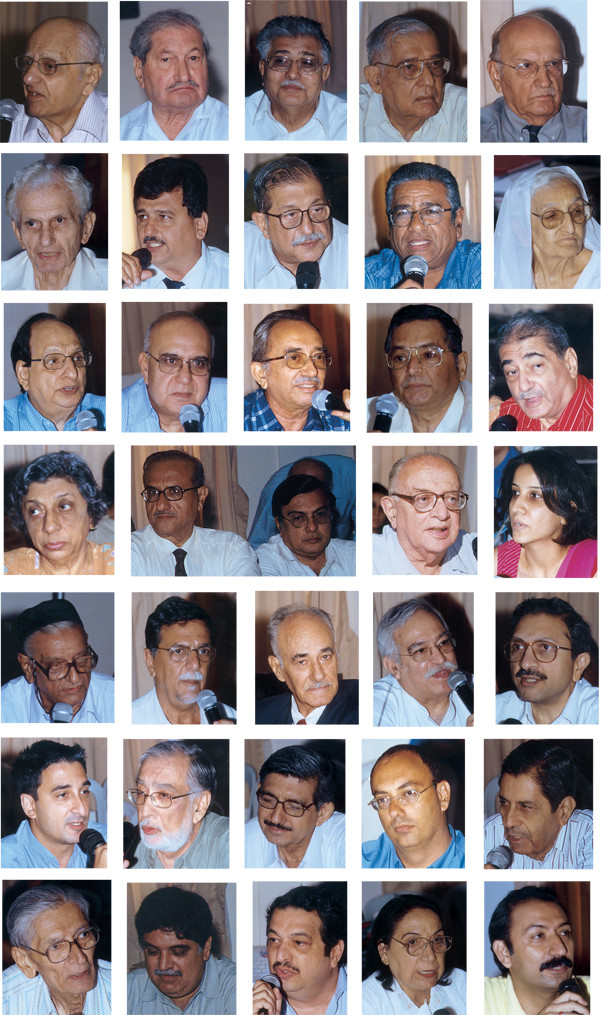
L to R (1st row): Shroff, Guzder, Gandhi, Golwalla, Sethna; (2nd row): Bodhanwalla, D. Irani, Khambatta, D. Mehta, Kavarana ; (3rd row): D. Engineer, Tamboly, M. Engineer, Antia, Dastur; (4th row): Master, Mullan, Crawford, Dotivala, Daviervala ; (5th row): Katpitia, B. Irani, Dahmubed, Dadi Mistry, Rustomji ;(6th row): Nargolwalla, J. Patel, Cama, Karanjawalla, Heerjee; (7th row): Masani, Kayani, P. Mehta, D. Debara, P. Debara
After the repair of the Davier agiary the contiguous dharamshala has also been repaired from donated funds, noted Marazban Wadia, acknowledging a gift of 100 copies of the Khordeh Avesta from the WZO and nine cupboards from Godrej and Boyce. They are now looking for nine beds, he added.
Speaking on behalf of Sanjan, Wadia said that half the estimated cost of four lakh rupees to maintain the wall surrounding the Stambh was in the kitty. For the rest "the BPP has no objection to receiving donations,” he noted.
The Jhansi dharamshala has been renovated thanks to a two lakh rupee donation from the late Baji Mirza and may be contacted on 0517-2361364 for reservations, noted the anjuman president Ronny Dick. A lady in the vicinity supplies food to dharamshala residents, he added.
More than 25 young people visited Agra during the 16th All-India Youth Seminar, noted Dolat Debara. The dharamshala and the aramgah are maintained from the Rs 7,000 monthly rent of the prayer hall and one room, she added.
DPA secretary Farrokh Rustomji spoke of the launch of the film In War and Peace on Field Marshal Sam Manekshaw’s 89th birthday on April 3 by UNESCO Parzor (see "A hero for heroic times,” page 74).
Sethna offered "comfortable, affordable” accommodation in the Mengusi Dharamshala to any couple who wants to live and work in Delhi for a reasonable time. A couple of self-contained flats within the dharamshala can even be booked by institutions as a guest house for their Parsi employees/clients, he noted.
In Ahmedabad they celebrate no less than 20 jashans and three gahambars, noted Khambatta. A pukka road and a borewell at the Doongerwadi and the renovation of the city-based bungli has been effected and a solar concentrator has been installed. They hope to expand the dharamshala and provide hostel accommodation depending on the donations they receive. Talks on subjects as varied as entrepreneurship, fashion designing and management benefit the local community. Vocational guidance, a matrimonial meet which yielded two unions, computer classes for housewives and a medical camp have been other recent activities.
The 26-member Bhopal anjuman is awaiting the appointment of a custodian trustee by the Federation, noted Gev Dhunjibhoy. Though their vast aramgah land dates back to 1914, they have no mobed and the 36 graves are dilapidated. Repairs have been estimated at seven to eight lakh rupees of which Rs 1.2 lakhs have been collected. Though their nine families each contribute Rs 50 per month, the anjuman’s income is low.
Of the 223 families in Nagpur (comprising a total population of 615) 60 are housed in Tata Baug, the complex adjoining the agiary and dharamshala, noted Dinshaw Mistry, a trustee of the Nagpur and Kamptee Parsi Zarthosti Anjuman. The annual water problem at the colony has been solved by creating an underground tank with a capacity of 100,000 litres. The rest of the community is well settled in other parts of this city, 2,000 ft above sea level, that won an award as one of the most beautiful cities of India, he added.
With two mobeds officiating at its floodlit agiary a concretized road at the aramgah where architect Percy Nazir oversees working and beautification funded by Rooshad Patel, the community is "by and large like a united family,” noted Mistry.
About 31 percent of the 1,244 Zoroastrians in Secunderabad and Hyderabad are aged 60 and over, 16.5 percent of them being unmarried. Those under 20 make up 18 percent of the total and the median group (21-59 yrs) account for marginally over 50 percent with 30.5 percent of them being unmarried. The demographic data was presented by Omim Debara. The relative figures of births and deaths in the years 2000 to 2003 were respectively eight and 26, one and 10, three and 16, two and eight (14 births and 60 deaths). There have been no interfaith marriages in this period.
With three dar-e-mehers, two dakhmas, and a nine-room dharamshala with catering available, the anjuman’s finances were reported as "satisfactory.”
There has been no progress on their case pending with the deputy commissioner of the Endowment Department, noted Debara.
The renovation and extension of the Baroda agiary is expected to be completed by the end of November this year, noted Baroda Parsi Panchayet president Jal Patel. A residential building for mobeds and low income families is planned in the agiary compound and a directory with detailed demographic profile is under preparation. When their young scholars were presented merit awards on Jamshedi Nav-roz, the anjuman hosted ICICI Bank’s erstwhile joint managing director Hosang Sinor and Ervad Peshotan Mirza as guests of honor.
There were 27 births and 76 deaths in Poona in 2002, Dara Irani informed the council. The corresponding figures for the first five months of 2003 were nine and 29 respectively plus three deaths where the bodies were not consigned to the dakhma. Irani noted that five divorce suits had been filed in 2002 and two, to date, in 2003 among the reported 8,500 Poona community.
PPP flats have been available for use as shared hostel accommodation for individuals working in Poona. Now that Phase II of their housing complex has been completed, 175 allotments have been made. Irani said that the PPP give preference to those whose applications had been recommended by their local anjuman. He was happy to announce that four marriages are expected to result in the new colony.
Eight medical students received Rs 2.38 lakhs and 26 engineering students Rs 6.67 lakhs from the BPP for their coaching classes for the academic year 2002-03, mentioned the report presented by Master. This was in addition to Rs 10,72,900 for college education sanctioned to 366 students comprising all streams. Gift scholarships totalling Rs 7,14,600 were also awarded to 117 vocational and technical students by the BPP in cooperation with five other Parsi charities. The higher education committee comprising the BPP and seven other trusts provided gift scholarships totalling Rs 16.55 lakh and loans totalling Rs 10 lakh to 54 students going abroad. Another eight students received Rs 2.60 lakh as a gift for postgraduate study in India.
During the same period Rs 2,89,629 were provided to cover school tuition, term and lunch fees, transport charges and the cost of uniforms.
Rs 79,500 helped 18 parties defray the cost of day care centers while three applicants shared Rs 10,000 provided for marriage expenses.
There are currently 21 mobeds receiving monetary help every month from the Punchayet. Between November 2002 to April 2003 this amounted to Rs 12,800. Doles to widows and aged males in the same period added up to Rs 6,95,497.
Noting that Nargol and Saronda had shared a dakhma since 1767 Saronda’s Ervad Yezdi Panthaky denounced Nargol for claiming sole ownership and asked the Federation to mediate. On his part Nargol’s Farroak Govadia spoke of 26 acres of land belonging to Nargol, adding, "We allow Saronda to consign their dead in our dakhma.” Gandhi advised them to get the BPP to broker the dispute.
Youth
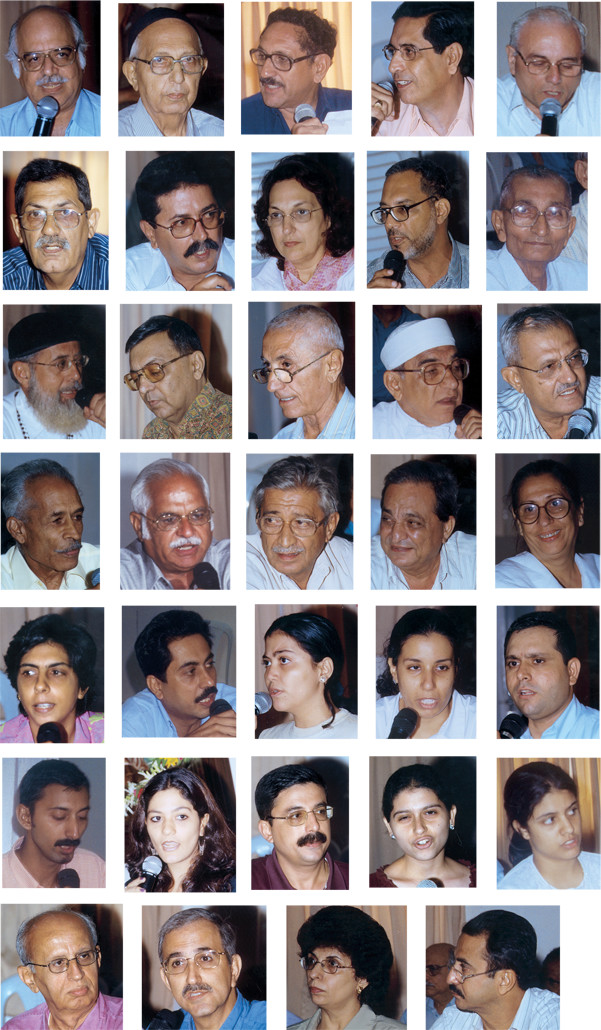
L to R (1st row): Cursetji, Dandiwalla, Noshir Jal, Paghdiwalla, K. Pastakia; (2nd row): O. Debara, P. Irani, P. Ginwalla, S. Ginwalla, Dinshaw Mistry; (3rd row): Wadia, Wania, Govadia, Panthaky, Dhunjibhoy; (4th row): Jalnawala, Dick, D. Patel, M. Irani, Niloufer Jal; (5th row): Billimoria, Palkhiwala, Gazder, Vajifdar, Talati ; (6th row): Rao, P. Mistry, Eghlim, D. Pastakia, B. Patel; (7th row): Mody, Limathwalla, Z. Commissariat, K. Commissariat
FOZYA president Sarosh Palkhiwala reported on the 16th All-India Youth Seminar organized by the DPA under FOZYA aegis in Delhi over the Republic Day weekend in January 2003. The seminar had been inaugurated by Sethna and the high point of the meet was the delegates’ visit to Rashtrapati Bhavan and their meeting with the President of India Dr A P J Kalam.
Delhi youth trustee Adil Nargolwala, who had been one of the prime organizers, registered his disappointment that less than 40 youths from the rest of India attended the meet. He also noted that the President "was shocked to see over 50- year-olds in the group. He was expecting youths about the age of my son (about 12 years).”
"Disappointed” at the absence of youths at this Federation meet Shroff requested anjuman presidents from across India to help the youths participate at the Congress and at the Federation events.
Behafrid Patel of Poona, secretary of the Third World Zoroastrian Youth Congress (3WZYC) acknowledged BPP support in their "huge task (which) started pretty late.” Appeals for funds for the Congress had been circulated to various agencies, she said, and urged the assembled anjuman delegates to sponsor youths from their cities.
The ensuing discussion between Dara Irani and other delegates with a few inputs from Palkhiwala revealed that preparations for the Congress were in low gear. The PPP had provided only "moral support” according to Palkhiwala. Irani however explained that the Panchayat had "given them assurance and all kinds of support except financial support.” The PPP had even agreed to place "a few flats” at the organizers’ convenience during the Congress, he noted. The PPP’s financial stringency apart, Irani noted that there were several very wealthy businessmen in Poona and it was up to the youth to approach them. Gandhi suggested the staging of events such as plays and the publishing of souvenirs to raise funds.
In the context of the poor turnout at the youth seminar at Delhi ("Previously at youth seminars we used to get anywhere between 150 and 300 delegates”) Rustomji sought to know what marketing FOZYA had done overseas to generate interest in the 3WZYC. Palkhiwala noted that they expected about 100 to 150 overseas delegates.
Former FOZYA president Porus Karanjawalla and Nargolwala found the Congress registration fees, pegged at Rs 3,500, "fairly steep” and urged the organizers to reconsider the amount. When Palkhiwala remonstrated that the cost of food alone (meals are included in the package) amounts to Rs 4,500, Karanjawalla suggested that the required funds be collected from the public. "Don’t burden the delegates or anjumans,” he advised.
Noting that delegate fees at the First WZYC in Los Angeles and the second in London had been about £ 350, Patel said, "We came to this figure (Rs 3,500) after asking around as to what delegates would be willing to pay.”
Recalling that even Bombay delegates had refused dormitory accommodation in Poona at the Third All-India Youth Seminar in 1990 Gandhi opined that delegates from abroad would expect a certain standard in meals and living conditions. A certain level of expenditure would be necessary, he said, but "instead of depending on charity, try to earn for yourselves.” He suggested advertisement banners, sponsored meals, etc to raise 50 percent of the money.
"We will make the Congress a success,” Tamboly smilingly braced the crestfallen organizers. Noting that venues in Poona are hard to find over the Xmas week Tamboly opined that the Indian rates quoted were low by US and UK standards. "There is no question now of reviewing pricing or venue,” he stated adding that the BPP has sanctioned five lakh rupees for the Congress inclulding Rs 1,500 as individual subsidy to student delegates facing economic stringency.
"We are slow on economic calculations,” Dastur pinpointed the organizational lacuna. He referred to the "sound economic performance” of the Seventh World Zoroastrian Congress at Houston because they started their preparations "two years ahead — not six months in advance like us!”
Porus Debara, one of two youth trustees on the board of the Agra Parsi Anjuman, noted that the total number of Zarathushtis there was down to 13. The earlier count had been 20 but the families belonging to the hospitality industry had since been transferred out. Debara corrected a mistake in the Federation’s minutes (and in "A Gesture for Guzder,” Parsiana, March 2003) where Hosang Debara’s recount of floods and a death in Mathura were reported as having occurred in Agra.
Zenia Vajifdar of Poona spoke of their Navroz fashion show and function to honor heart specialist Dr Keki Grant. Their annual 15-day summer camp had the usual combination of trips to various establishments, learning crafts and listening to scholars from different streams.
Raika Gazder and Pearl Mistry of the BPP’s Holiday Programme for Youth referred to highlights of its 17th edition in April 2003 when 99 girls and 129 boys participated. Noted photographer and theater personality Boman Irani’s theater workshop had led to the full-fledged presentation of four house-full shows of Black Comedy. A fashion show staged by the participants was witnessed by a 250-strong audience. Their social service program, which included a navjote and a blood collection drive, also embraced the participation of all senior citizens at the Parukh Dharamshala in an antakshari.
PYLA — the Parsi Youth League of Ahmedabad, where the population according to Karanjawalla is between 1900 and 2000, has published a directory titled Kaleidoscope of Careers. The book, priced at Rs 40, provides information on careers, universities, trusts, funds, etc. Other activities organized under the PYLA banner included volleyball and cricket matches, icecream making, elocution competitions, etc.
While Bomi Talati of the Baroda United Zoroastrian Youth (BUZY) spoke of the maintenance and cleaning of the Contractor Agiary by the youth, Patel referred to the 14.5 lakh rupee donation by BUZY towards a talent search project. A committee has been formed and two BUZY scholars have been selected, he noted, adding that a team of mentors has been set up to guide these students through their academic life.
Paghdiwalla urged the BPP to form a parent body of the youths in Bombay to weave together the disparate baug associations and was informed by Tamboly that the concept was on the Punchayet’s agenda.
Delna Pastakia of Borivli spoke of their Udvada pilgrimage, gahambar, religious talks and dumb charades with religious subjects.
Volleyball, cricket and indoor games like table-tennis and carrom tournaments keep the youths of Thana, Mulund, Bhandup and Vikhroli occupied, as per the report of Thana’s Havovi Billimoria. Trips to Deolali and Karjat, cleaning agiaries, producing the three issues of their magazine Youth Vision a year, have been some of their other activities.
The Nagpur Parsi Gymkhana is the focus of youth activities, cricket and bridge tournaments and indoor sports being interspersed with a blood collection drive, a bone density camp, work on the publication of the local community directory and organizing of Navroz, Khordadsal and agiary anniversary celebrations, according to the report filed by Gymkhana president Shiraz Gimi. Having hosted the teams from Surat, Jamshedpur, Secunderabad and Calcutta for the 17th Jiji Irani Challenge Cup Cricket Tournament in Nagpur, the event entailed four days of entertainment followed by a grand dinner in honor of Daisy and Tata Teleservices chairman Dr Jamshed Irani.
Defunct Anjumans
Happy with the successful completion of the task of recovering and liquidating encroached community properties in Cambay, Junagadh and Nadiad, Surat’s Sorab Katpitia, coordinator and pillar of the Federation’s defunct anjumans subcommittee since its inception nearly 20 years ago, announced that the Amroli problem had also been solved. With the help of solicitor Burjor Antia the long drawn case had been concluded with Rs 42 lakhs in an escrow account, he noted.
The case of the Gadag anjuman property in Karnataka was also close to completion, said Katpitia. Acknowledging that it was the first time that a trustee had extended full cooperation, Katpitia thanked Kekobad Pudumjee of Poona.
Speaking about the valuable but dangerously encroached property in Harda, Katpitia said he invited the cooperation of those whose forefathers had hailed from Harda. People were willing to file affidavits and a Parsi in Australia is willing to come and depose before the court, said Katpitia.
At Nanded the names of Tamboly and Antia were to be included as trustees — a procedure which may have to be completed at the Aurangabad Bench of the Bombay High Court. In Jamnagar, whose trustees now reside in Porbunder and have allegedly entered into undesirable transactions, a lawyer has been appointed by Katpitia on behalf of the Federation. He and the lawyer have been receiving threats from antisocial persons, reported Katpitia.
In places where the Parsi community is dwindling there is a "misunderstanding that the Federation wants to take over their properties.” In this context, Katpitia lauded Neemuch trustee Jal for opting for the Federation’s custodianship. Acknowledging that only two Parsi families remain in Neemuch, Jal urged the BPP and the Federation to help dispose of their property worth anywhere between Rs 2 to 3 crores while preserving the agiary and the dakhma.
Shroff, who said he has been involved with the defunct anjumans subcommittee for the last three years, commended Katpitia’s initiative and the cooperation of "our friend from Neemuch.” Describing the community as obstructionist rather than cooperative, Shroff clarified, "The Federation can only step in when there is fear that Zoroastrian properties cannot be maintained locally. Katpitia could have better results with local support.”
Plans for salvaging nearly a dozen aramgahs in India in various stages of dilapidation were demanded by some of the delegates. Acknowledging the sentiment involved, Gandhi reminded them that a working arrangement existed in several cases. He advocated pragmatic restraint in the light of the financial and supervisory liabilities they entail. "Resources once raised can help with other ideas,” said Shroff implying a step by step approach.
World Body
After years of debate, denunciations and dithering, voluminous reports on structuring and restructuring, a world body of Zoroastrians may be "in place by the next Federation meeting” as per Gandhi. After the headaches generated by the thunder and lightning of previous debates what is promised now is birth by stealth.
At a caucus in Bombay in January 2003 (sandwiched between the launch of the Bombay chapter of the World Zarathushti Chamber of Commerce and a meeting of community leaders from around the world) when the Press was expressly excluded, "the Federations of North America, Europe (the UK based Zoroastrian Trust Funds of Europe) and India discussed and wrote the sense of the meeting” Gandhi now told the Federation delegates, crediting Tamboly for getting the WZO’s acceptance "with one or two reservations.” Gandhi then urged Shroff "to liaise with other Federations and sign the charter of the world body so that it is in place by the next Federation meet.”
Shroff, who had been appointed to chair the liaison group at an in camera meeting at the Seventh WZC in Houston in 2000, spoke about a "surprising convergence of views on both sides,” meaning the WZO and the federations who had hitherto been its detractors. "It is a constructive move forward to have one body instead of two... It augurs well for our small community.”
A high profile economist, Shroff has succeeded the late Sohrab Godrej on the steering committee of the Alliance for Religion and Conservation chaired by the Duke of Edinburgh which aims, he says, to direct trillions of dollars worldwide into ethical investments. He is keen that the community appreciate its own high credibility in the wider world. "It is a matter of prestige that we can stand up and be counted,” he said. It also means that we must "stop arguing on non-consequential issues.”
WZCC
"How the World Zarathushti Chamber of Commerce (WZCC) progresses will depend on how far and how fast we spread,” noted Kersi Limathwalla, coordinator of the Bombay chapter. The chapters in Bombay and Delhi need to be replicated all over India, he added.
Though the WZCC is the direct result of the global community’s desire to remain in touch, especially as manifested by its founders in North America, it would largely benefit the Zoroastrians of India by providing interaction from well placed Zoroastrians "at pivotal levels in large organizations” in hubs of commerce and industry everywhere.
Eight to 10 areas of business activity have been identified by the Bombay body, according to Limathwalla. Plans were on to hold a workshop and divide members into groups according to their interest to provide the required service. A coordinating committee to link the Zoroastrian Co-operative Bank, the BPP’s venture capital body and the WZCC was on the cards. An annual award to recognize an outstanding local businessman/professional was also being planned.
Shroff, who had visited Dubai at the invitation of the Bhesania family while Gulf War II was raging, appreciated the 1,600 venturesome Parsis of the UAE, many of whom had been residents of the baugs of Bombay. They proved that the community’s "risk-taking capacity was not dead,” he noted.
Open forum
As Shroff decreed that topics discussed the last time would not be repeated again in the open forum, a new gamut of subjects came to the fore.
The opening salvo was fired by Dastur with his observation that the 10 percent divorce rate among intracommunal marriages was very high. He informed the gathering that the BPP had formed a committee comprising of an educationist, a psychologist and a retired judge with Antia in the chair to tackle the issue. Shroff, Tamboly, Antia and Meher Guzder were also negotiating the establishment of a management college on the Cama Athornan Institute’s land. The BPP building repair cost is over two crore rupees per annum. "Our community is not concerned about the state of disrepair of the buildings (which) are depreciating and deteriorating at an accelerating rate,” he fumed. With one in three marriages being intercommunal, the BPP CEO wondered, "What do we do with non-Parsi spouses in Parsi estates? Throw them out of the colonies?” The BPP’s housing advisory committee had suggested that the housing stock should go to intramarried families and if anything remains, to intermarried families, he noted. "Should there be a national referendum on this issue?” he asked the delegates. The need for a single calendar in a community of 75,000, for statutory adoption procedures, for a reasoned approach to the inheritance rights of the children of mixed marriages are topics that have agitated Dastur since some time.
Terming them as "problems largely concerning Mumbai,” Shroff recommended that they be put "under the carpet” until the next Federation meet in Bardoli when he suggested a "more structured discussion” for a full day. He then added an undemocratic rider: "It will be an in camera discussion, not for the media.”
Gandhi was amenable to a full-day discussion if the delegates came with a mandate from their respective communities. When this suggestion did not find favor he suggested that Dastur work out a note with pragmatic suggestions, then formulate a committee on each subject.
Rustomji related their experience in Delhi when a circular with five specific questions demanding a yes/no response provided a clear understanding of what the community wants.
In response to Baroda trustee Baman Cama’s request for "a clarification from the chair” on the high priests’ fatwa, Shroff noted that the "three most respected” high priests had restored the status quo. He quoted Nadir Modi, vice president of the Athornan Mandal, to the effect that "there’s nothing like a fatwa; it’s up to the community to accept or reject their statement.” Shroff noted that meeting the high priests once in a month or two in the Punchayet had established a rapport which had helped the trustees through the hurdles associated with the murder investigation at Doongerwadi. According to the orthodox lobby the last word belongs to the high priests. The saner elements in the priestly clan could prevail if you don’t humiliate them, he added.
Former BPP chairman Dr Aspi Golwalla opined that "46 agiaries in Bombay was an absolute waste.” He also suggested that the community forget about setting up a medical college because it would not be able to generate even 20 percent students to maintain its minority rights.
The current national preoccupation with rewriting school history textbooks led Heerjee to suggest that the community inspect what kind of role is assigned to Zarathushtra, his religion and his people.
Sethna noted that these texts denigrate "religions of the book” (viz Judaism, Islam, Zoroastrianism, Christianity) in a subtle way. The information may not be incorrect but the insinuations suggest ideas to childish minds which become difficult to remove, he noted.
Golwalla expressed doubts about the solar reflectors dehydrating the body in four days. "What about solid organs like heart, kidneys, etc?” he challenged. Tamboly offered to show him pictures and added that even the National Geographic had sought the Parsi experience for their story on the effectiveness of solar energy.
India will be hosting the "Dialog of Civilisations” in connection with UNESCO’s declaration of 2003 as the 3000th anniversary of Zoroastrian culture. Zoroastrianism is being recognized as the "mother religion of the world,” declared Sethna. Azarbaijan has sought Indian support to restore its fire-temple in Baku, he added.
The new Rs 5 Dadabhai Naoroji coins were expected to be launched on September 4 being Naoroji’s birth anniversary. The program has subsequently been fixed for October 2, 2003. A biography by the late Dr Sarosh Wadia is also being updated, noted Sethna. It has been confirmed that Rs 1.25 crore from the GOI and the GOG will be used for the town of Udvada as a heritage precinct.
"Our religion is universal,” stated Antia. Drawing an analogy with the different sects of Christianity he continued, "We have to adopt and welcome the Zoroastrians who come from Tajikistan...help them start an agiary in Tajikistan, have a dynamic program, a universal approach.”
According to Golwalla, the supply of accommodation in old age homes is outstripping demand. To the home in the Masina Hosptal compound and the BPP’s Parukh Dharamshalla is being added a facility at the B. D. Petit Parsee General Hospital where Shapurji Pallonji has donated seven crore rupees, he said.
Maintaining that the problem of ageing is increasing all over the world, Sethna sought a grant of seven lakh rupees to enable sociologist Dr Armaity Desai to proceed with her study on ageing "so that facts and figures are before us.”
Antia endorsed the need to care for 60 percent of the community who are over 60 years old, though they may not all need to be housed in old age homes. He also felt the need for a corpus for education that would generate 40 lakh rupees per annum to pay fees for four medical students.
Golwalla was unhappy that an overwhelming number of beneficiaries of the BPP’s educational grants do not return to India after qualifying in their respective fields and that 50 percent of them marry out. It appeared to him as a waste of resources. Noting that even in the past we had gone everywhere, Dastur countered, "A Parsi is a Parsi anywhere.” The only worry is that they lose contact with the culture.” "We see brilliant Parsis in Parsiana and the Fed Newsletter. How many of them know about Parsipanu?” asked Sethna adding that nonetheless recognition is coming to the community nationally and internationally.
"Is the environment conducive to the advancement of liberal attitudes?” Shroff joined the debate. "Nobody owes anything to you today. Even Parsi (business) houses are not employing Parsis unless you are comparable. Those who are determined to go abroad find the money. By helping them there is a better chance they will come back. But not by holding them back.”
Antia believed "we should not prevent anyone from improving his future.” Those who do not return should return the money spent on them. If they return, they should be provided amenities like residential accommodation, clinical premises, etc, he noted.
Dastur assured the gathering that the money given as loan is almost always returned. Some like Cobra’s Karan Bilimoria has given much more so that others can get the break. Money comes in in response to BPP appeals every two to three years, he noted.
Rainwater harvesting in Parsi colonies, vermiculture, solar energy generation were other topics discussed in the light of new civic rules and impending shortfalls in established lines of supply. According to BPP trustee Maneck Engineer, who is vice president in charge of construction and property management at Godredj and Boyce, the rocky terrain at Doongerwadi and Godrej Baug would render rainwater harvesting very difficult. He reminded the BPP that he had suggested the institution of a water recycling facility at Godrej Baug when he was the Godrej engineer/architect supervising its construction.
The encouragement of athornan boys to complete their navar-maratab education, preferably at either of the two institutions in Bombay was discussed. Behram Irani told the delegates that Govadia and Antia had gone from village to village in Gujarat to persuade athornan families to send their sons to be educated as sampurna mobeds. Tamboly spoke of a fund donated to the WZO by Ervad (Dr) Kersey Antia of Chicago for the use of financing navar-maratab ceremonies for those who could not afford to do so.
When the question of full-time or part-time mobedi was raised Antia noted that only 30 to 40 percent of the priests are full-time mobeds. Others work part-time but assume full time mobedi on retiring from their careers. Panthaky noted candidly that one "can’t afford to maintain a family on mobedi alone.”
Dotivala pointed out that often there is not enough work to keep a full-time priest occupied. A panthaky at one of the agiaries does not have any panthaks to look after so he goes to the Doongerwadi and performs ceremonies there, he noted.
When delegates referred to priests (and nassessalars) who threaten to quit at the least dissatisfaction, Antia suggested that such priests be reported to the Athornan Mandal and/or the Jashan Committee. When told that the officials of those two bodies claim they cannot enforce the law, Antia volunteered to use his moral authority to get such individuals "to behave as good Zoroastrians if not as good priests.”
On the cost of encouraging/creating sports superstars, new entrepreneurial ventures and provision of kathi for the sacred fires the post lunch debate pursued the usual long bumpy road to nowhere. However Shroff had wound up the meet before the meal, noting that the "tremendous interest... shows the community is alive and kicking.”
School counseling
Marital, interpersonal and family conflicts dog school students who grow up in emotionally insecure environments. The impact of such situations results in learning disabilities and lack of interest in studies as also behavioral problems as per the BPP’s school counsellor Pareecheher Daviervala who is associated with the Cowasjee Jehangir (CJ) and Girton Schools. Of the CJ’s 1,500 students she needed to counsel 92, many of them from a low economic status. At Girton where the students belong to upper middle class families, she said the parents have no time for the children.
Daviervala found she needed to counsel parents and siblings as well as teachers. Scholastic backwardness had to be checked against physical learning disabilities and the children so diagnosed were sent to Sion Hospital for remedial treatment as its prescriptions are accepted by schools as well as government bodies, said Daviervala.
Group work, exam study tips, techniques of time management were imparted to the students at both institutions. Though the number of students counseled at Girton totaled 48, only 17 were Parsis. The corresponding figure at CJ were 92 and three. By and large the Parsi students showed greater cooperation and the will to improve, she said.
Dhunjibhoy referred to "approaches through which even normal performance can be enhanced,” but the discussion did not proceed.
Those attending the Federation meeting were: Dolat Debara and Porus Debara from Agra; Areez and Persis Khambatta, Porus Karanjawalla and Xerxes Rao from Ahmedabad; Col K. G. and Yasmine Jalnawala from Ahmednagar; Capt Homi Dandiwalla from Allahabad; Pervez Mehta from Bardoli; Jal Patel, Baman Cama, Shavak Patel, Cyrus Cooper and Bomi Talati from Baroda; Sarosh and Pilloo Ginwalla from Bharuch; Gev Dhunjibhoy from Bhopal; Jamshed Guzder, Minoo Shroff, Silloo Kavarana, Dinshaw Mehta, Dadi Engineer, Dinshaw Tamboly, Maneck Engineer, Burjor Antia, Behram Dastur, Sheroo Master, Godrej Dotivala, Homi Mullan, Adil Crawford, Gool Kias, Pareecheher Daviervala, Pearl Mistry and Raika Gazder from Bombay; Noshir Paghdiwalla, Khurshed Pas- takia and Delna Pastakia, Marzban Mehta and Minoo Khan from Borivli; Sam Medora from Calcutta; Marazban Wadia from Davier; Lt Gen Adi Sethna, Dadi Mistry, Keki Gandhi, Farrokh Rustom- ji and Adil Nargolwala from Delhi; Sarosh Palkhiwala and Shovir Irani from FOZYA; Bomi Heerjee from Indore; Sohrab Dahmubed, Behram Irani, Kayzad Eghlim, Pervez Irani and Mehrwan Irani from Iranian Zoroastrian Anjuman; Homi Bodhanwalla from Jamshedpur; Ronny Dick from Jhansi; Behram and Dolly Masani from Mhow; Dinshaw Mistry from Nagpur; Hoshang Wania and Farroakh Govadia from Nargol; Noshir and Niloufer Jal from Neemuch; Dara Irani, Firdous Kayani, Porusasp Mehta, Zenia Vajifdar, Behafrid Patel and Tehmasp Bharucha from Poona; Yezdi Panthaky, Mahiar Panthaki, Sarosh Poonawalla and Dinshaw Patel from Saronda; Omim Debara and Aspi Debara from Secunderabad and Hyderabad; Sorab Katpitia from Surat; Rustom Cursetji, Pervez Bhesania and Kaizad and Havovi Billimoria from Thana; Kersi Limathwalla, Kersi and Zarine Com-missariat and Minoo Mody from WZCC. Dr Aspi Golwalla was a special invitee. The Press was represented by The Bombay Samachar and Parsi-ana.
◆ ◆ ◆
From the archive