
Zoroastrians Abroad
"What are the youths thinking?"
FEZANA president Firdosh Mehta attended the Third World Zoroastrian Youth Congress in India to learn what the youths want
"I was here to find out for myself what the youths are thinking, understand what they’d like to see in the community so that at any future deliberations at our level we could try to incorporate their needs,” Firdosh Mehta, president of the Federation of Zoroastrian Associations of North America (FEZANA), explained to Parsiana his reason for attending the Third World Zoroastrian Youth Congress in Poona in December 2003.
Complimenting the organizers on the management of the event including logistics, food, etc Mehta noted, "The evening programs and outings, plays, visit to the stud farm were excellent ways to make the youths mingle socially, provide the necessary exposure.” However, observing that the session chairs, moderators, speakers were all older people, he echoed the opinion of North American (NA) youths who he said were "wondering why the youths were not doing it all.” Mehta believed that "the youngsters ended up feeling inhibited because all the chairpersons were elders.” When suggestions to the Congress committee percolated into action on the last day, American youths took over from the stage. "In that session there was an exchange of ideas, (even a) suggestion from the floor that North American and Indian cities twin up (for mutual advantage).” The presence of the cochairs of the Zoroastrian Youth of North America at the Congress made it relatively easy for NA youths to organize entertainment and presentations and the team from California won the talent contest, Mehta noted.
Mehta was disappointed that there was no discussion about the proposed world body where an autonomy clause is in the process of being introduced so that every region will have the right to define its members as it thinks fit. Instead, there was more concern about local issues like intermarriage and the acceptance of the children of Parsi mothers. He stated FEZANA’s official hands-off policy: "FEZANA does not accept or reject. It is the properly ordained mobeds from India who carry out the navjotes.”
Instead, at FEZANA annual general meets more time and support is being allocated to other community projects all over the world which did not happen in the past, says Mehta citing the example of funds being earmarked for the rehabilitation of the Meherjirana Library in Navsari.
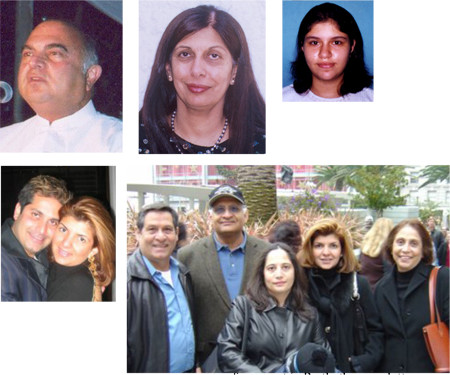
L to R: Mehta, Daver and Dubash; The DadyBurjors: Kaizad and Ayesha; Rusi, N. Aga, Nitash, Ayesha and Zenobia
"The biggest bone of contention, what we are always hung up on, is the question, ‘Are you a Zarathushti by choice or by birth?’” admits Mehta, adding that North America’s two mobed councils — the North American Mobed Council (NAMC) and the Council of Iranian Mobeds of North America — have different ideas and definitions. "The Iranian council is more open to acceptance if the mother, father, either grandfather or grandmother is a Zarathushti or if the child is adopted by a Zarathushti family. Even in adoption they stress the Iranian linkage though it need not be a continuous linkage unlike the Indian concept which demands continuous paternal lineage, Mehta differentiates between the two positions. The NAMC has also reached a wider understanding, he adds, but there are some Indian mobeds who will not pray if non-Zoroastrians are present. Also both councils have adopted the mobedyar program where the laity can perform restricted priestly functions. They can do jashans and perform funerary rites but cannot perform navjotes or weddings where the definition of who is a Zoroastrian is involved. The Iranian mobedyars include women; NAMC mobedyars do not.
"There are fundamentalists even in NA,” admits Mehta. "The majority of us want atash behrams and agiaries to be protected and to flourish, want ceremonies and rituals. (But) we are never going to agree to be racist even in the name of religion. We don’t believe any racism is good... Because of our history in India of over 1,000 years, because the ideology of religion by birth has prevented us from being assimilated for over 1,000 years, now they are saying this 1,000-year tradition is our religion! (What we are saying is) don’t transpose it into other geographical milieux. The Hindu ideology (of caste) enabled us to survive as a unit. Not having this fortress from outside in NA, how do we protect our children? (You must) understand that there will be a higher incidence of intermarriage. So as not to lose children, we have accepted the children of Parsi mothers. Even so, we are not actively proselytizing.” Refering to Kshnoomist, Sufi and Theosophical forms of Zoroastrianism all of which have their votaries in North America, Mehta says, "Our concern is not to lose mainstream members.”
Dismissing the frenzied denunciations of the projected world body by fundamentalists in Bombay who raise the spectre of neo-Zoroastrians becoming its president and leaders as "hypothetical fear mongering,” Mehta shares his personal conviction that "Ethically, Zoroastrianism will survive very well because of its principles of good governance, justice, etc which have permeated the western system (of thought). Ethnicity will survive in India and parts of the world that subscribe to it (but) acceptance will also come.”
Life in Sydney
"We’re a harmonious and well-knit community... a community of which our children can be proud!” affirms Mithi Daver, editor of Manashni, the newsletter of the Australian Zoroastrian Association (AZA) of New South Wales. Democratic problem solving by leaders whose priority is unity and peace seems to have produced the happy result of a community at ease with itself.
A long-standing (16 years) administrative officer of the Commonwealth Scientific and Industrial Research Organization, Daver entered "semi-retirement” last year and says she is "now busier than ever.” An intensive one-year basic course in floristry needs her to drive 50 km each way to acquire the professional qualifications to set up as a florist. "It’s worse than a university degree,” she says. A two-year advance course will follow.
The florists in India who provide the fragrant ambience at functions concentrate on quantity, in Australia one needs to provide quality, Daver observes the differences between the functioning of the profession in the two countries. Hitherto she had put her love of flowers into providing decorations at Zoroastrian functions. "Parsis are a close-knit community. We, six or seven friends, would sit together to do the flowers,” she notes. Now that she is qualified to work in a florist shop or set up her own business Daver hopes to undertake corporate events. In an industry where the minimum wage is $ 15 per hour, she would prefer to work part-time, even at her own business.
For her first love is to potter around her big garden. She has even sown sandalwood seeds at home just as the committee has done at the AZA’s Annangrove property. According to Manashni (November 2003), the harvest may take 20 years in coming. Though Daver says that sandalwood is grown commercially for export in Perth, the newsletter urges community members to bring sticks and shavings when returning from India.
For two years (2001-03) Daver was vice president on the AZA management committee as well as editor of Manashni. "Two years are enough for anyone on the committee,” she notes. Planning and executing events and functions, maintaining the property, overseeing investments, etc almost add up to a second job, she elaborates. The directory has just been revised as a spate of people from Dubai have joined the community and a Zoroastrian solicitor has drafted amendments to the constitution, she notes.
Daver estimates the Zoroastrian population in the area at around 1,200, with 35 percent being under 30 years of age, 50 percent in the 30-60 age group and 15 percent being 60 and above. In most cases there are two children per family.
The "working bee,” a band of volunteers led by Tim Desai — a chartered accountant who is currently president of AZA — devotes the entire last Sunday of every month to clean and maintain their Darbe Mehr in Annangrove. They fully tiled the extended patio of AZA House. The property contains a playground with swings, a volley ball court, a vegetable patch with chillies, fudina (mint), lemon grass, pumpkin, etc. The volunteers regularly water the garden even though Sydney, with its Mediterranean climate, gets rain throughout the year, says Daver. Parsi restaurateurs of Sydney donate the lunch, Daver informs us.
"Even non-Parsi spouses come and do a lot of work. We have no qualms about welcoming everyone at jashans... Non-Parsi spouses have done much more for the community than Parsis.” Daver cites the names of the late Ernani Giambuzzi, Shirley Mahableshwarwalla, Shernaz Katrak and the late Helga Sachinwala. An Italian who grew up in Calcutta, Giambuzzi was the first editor of Manashni, secretary of the management committee for many years, a pioneering member and chairman of the foundation committee and a trustee of the Association in the 1980s. Just six weeks prior to his death on May 9, 2002 the grateful community had presented a plaque and a scroll of honor at the Navroz function when "he was so overcome with emotion that, for once, Ernani was lost for words,” noted Daver’s personal tribute in Manashni (June 2002). Mahableshwarwalla had also served as the newsletter’s editor for many years.
Though AZA "cannot afford an agiary and full-time mobed,” there are eight young priests who sit for the prayers with the veterans — Ervads Desai, Dr Pesho-tan Katrak and Marzban Katila.
There are a lot of Iranian Zoroastrians settled in Sydney and though cultural differences exist, current vice president Fariborz Jamshidi deftly brings the two communities together with his patience and tolerance, says Daver. "The Iranians are very large-hearted. The Ostowaris are big donors. They are more religious (minded) while Parsis are more for enjoyment,” she adds. Anywhere between 20 to 40 senior citizens attend the bi- annual AZA picnics. "We have built up our own band,” Daver informs us, with thanks to Mehernosh Seervai, the musician turned retailer who had once played in some of India’s leading clubs and hotels with his uncle Goody Seervai (see "From song to spices,” Zoroastrians Abroad, Parsiana November 2003). Zarir Reporter sings, jokes, dances and comperes the evening, says Daver. The community enjoys the old-time numbers and elderly Parsi ladies join with Chhaiyé Hamé Zarthosti.
Sheriar and Sharon Pestonji, a young couple in their early twenties maintain the AZA website www.aza.org.au
The original intention of opting for a larger property or extending the present building is currently on hold. "The price of property declines when a community center comes into the neighborhood,” explains Daver. And though the Zoroastrians are "now quite friendly with the neighbors,” a recent public uproar when the Moslems succeeded in establishing a place of worship in the area, has given the community pause. While 40 to 50 children in various age groups attend religion and Gujarati classes at Sunday School, what the community needs desperately is accommodation for a resident caretaker on the five-acre property as the burglar alarm goes off even when a dog or bird breaches the cordon and somebody has to rush there in the middle of the night, says Daver.
Mithi, Meher, Farida and Perses are the children of Hilla and the late Jehangir Banaji. Coincidentally, Meher has also been interviewed by Parsiana (see pg 86). An alumnus of Bombay’s Queen Mary School and Sydenham College, Mithi is married to chartered accountant Jehangir Daver. Their daughter Meher has just graduated from university, having specialized in media and communications.
"The younger generation is ready to take over at AZA,” notes Daver. They take care of some of the social events like discos, parties, picnics. "The older generation has to lead by example. If they show it’s worth doing, the youngsters will want to do it.”
Sigma’s DadyBurjor
When Sigma Systems, Inc was adjudged winner of the 2003 Small Business of the Year Award by the Greater Dallas Asian Chamber of Commerce, it endorsed Kaizad DadyBurjor’s ability to set a goal and reach it. As a novice in the field of information technology (IT), he was working in a small enterprise which received a similar honor when he made a mental note to repeat the event on his own turf.
Today DadyBurjor’s Sigma with estimated revenues for 2003 at $ 23 million, is on its way towards another landmark year. An e-mail from the company notes that in the first quarter of 2004 it will have deployed 5,000 systems and embarked on new client relationships which are likely to boost sales anywhere between 50 and 100 percent in the course of the year. And so, DadyBurjor informs Parsiana on e-mail, "we’ve commenced expansion of our office facilities adding more space to our warehouse, production, operations and sales floors to accommodate the growth.”
These projected increases are best understood in light of standing achievements. The business, incorporated in Texas in December 1993 with headquarters in Carrollton, now has a corporate office in Germantown, Maryland and sales offices in Florida and Nevada. It doubled its three and a half million dollar revenue of 2000 the next year and raised it to 12 million in 2002 with 30 employees on its payroll, according to a write-up titled "Pride and Glory” forwarded to Parsiana by DadyBurjor’s father-in-law Naozer Aga of Bombay, a director of the concern.

K. DadyBurjor
DadyBurjor, who is now Sigma’s president and CEO, describes the company as a systems integrator and IT solutions provider — "a one-stop shop for all your IT needs.” Partnering with manufacturers like Intel, Compaq, HP, Dell and other equally prestigious suppliers, Sigma offers solutions, ready-made or customized, to suit client needs. It has its own website (www.sigmapc.com).
The company is designated a "small disadvantaged business” by the US Small Business Administration. DadyBurjor explains that this certification helps provide greater leeway into the US federal government business opportunities. They are now engaged in acquiring the esteemed industry certification ISO 9002 by the end of 2004. It is a recognition that very few small businesses receive, he notes.
The son of Rusi and Zenobia, Dady-Burjor is an alumnus of St Mary’s School, Bombay. After a year at St Xavier’s College he branched into computer hardware design and business management, earning a diploma. He also completed the Dale Carnegie Extensive Business Management and Execution Courses. DadyBurjor’s motivational ability must be substantial — he writes that his "entire family (including wife Ayesha, née Aga, and sister Nitash Vakil) is engaged in working with ‘The Sigma’ conglomerate of companies.”
The DadyBurjors make time for art, culture and philanthrophy, collect art and fine automobiles, travel extensively — "our recent excursions include trips to Brazil and Thailand” and support various events through the year. Though "a devoted Zoroastrian,” DadyBurjor finds that work commitments preclude active community involvement. A professed liberal "in both religious and political respects” DadyBurjor notes that he is happy supporting the project for a darbe mehr in Dallas as well as local publications with advertisements and sponsorships.
Youthful achievements
Young Jerastin Dubash has proved herself a record setter in her native Colombo when she obtained the highest marks among all the students in computer science at the London Advance Level 2002 examination. She was awarded a trophy and a medal at the hands of Sharon Evans, the wife of the British High Commissioner in Sri Lanka while an audience of over 500 at the glittering ceremony at Colombo Plaza gave her a standing ovation. The report in The Sunday Leader (September 28, 2003) adds that since then Jerastin has enrolled for a degree course at Stanford University in California — the first to enter those prestigious portals from Sri Lanka in the past four years.
To David Sanders, principal of the Colombo International School, Jerastin’s alma mater, it was evident that computing was her forte although she was equally good at other subjects. He described her as a very able and disciplined student who always gave her best when she was in school. She had helped design the school website and was a delegate at the Colombo Model United Nations. She was also a representative at the Future World Leaders’ Summit and President’s Class Room held in Washington DC in July 2001.
The daughter of Saroshi of Colombo and Aspi Dubash of Bombay — and granddaughter of Pesi and Aban Pestonjee who head Sri Lanka’s Aban Group of Companies — is holding her own during her second year at Stanford where she has been appointed peer advisor to freshmen. She is also committed to helping Sri Lankan refugees by obtaining assistance from the university societies.
◆ ◆ ◆
From the archive