
Zoroastrians Abroad
Expanding ZSO facilities
The increasing Zoroastrian community in Ontario has made a bigger Darbe-Meher necessary, explain Moti and Dr Russi Balsara, past presidents of the Zoroastrian Society of Ontario
"Because of large numbers it is extremely difficult to use the present premises. There are too many cars, too many people. The facilities are strained,” say Dr Russi Balsara and his wife Moti, each of whom has been a past president of the Zoroastrian Society of Ontario (ZSO).
An idea initially hatched by incumbent president Sam Vesuna and endorsed by 78 percent of those who voted on the issue, according to their newsletter (July 2002), there are plans to demolish the old mansion which houses the Mehraban Guiv Darbe-Meher and build a bigger, more functional structure appropriate for the needs of the Toronto community. During their visit to Bombay in February-March 2003 the Balsaras were also seeking funds to help meet the $ 2.2 million target of the ZSO fundraising committee headed by Dr Dhun Noria. The community mandate is to begin the project only after the money is in hand, avoiding bank loans and mortgages. "We’re not all rich there. We’re on fixed pension incomes,” Russi explains their thinking.
Before the community center was acquired, the Zoroastrians there used to meet at different church or university halls which were then provided free of charge, says Russi. It was during his two-year term as president of the ZSO in 1976-77 that Dr Rostam Sarfeh, Arbab Rustam Guiv’s friend and confidante who eventually headed the Guiv Trust, phoned from New York to say that Arbab Rustam Guiv had heard of the Toronto community’s desire for a place of worship and wanted to meet them. Russi recalls Guiv, "a short man, very perceptive, with sharp eyes, who could gauge you in a short time.”
Guiv offered the Zoroastrians of Ontario US $ 600,000 to buy an appropriate property to be named after his demised nephew Mehraban. The unmarried young man had been a florist who was always ready to help people. When he died, "a lot of people whom he had helped came to Arbab with money (ostensibly returning loans from Mehraban) which eventually made it into what he gave us,” recalled Russi. The ownership of the property, leased to the ZSO for 999 years at one cent a year, vests with the Rustam Guiv Foundation of Ontario, Russi informs us.
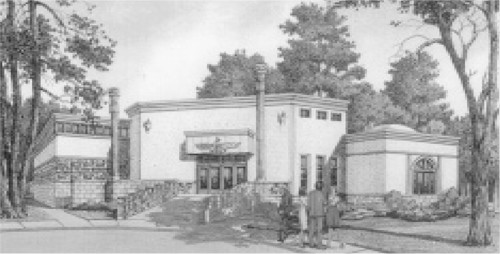
A conceptual sketch of the exterior of the new Darbe-Meher
The area is full of churches. The local residents, had tried to stop the deal, recalls Moti. Hence the ZSO committees have tried to ensure that "nobody inconveniences the neighbors, have a policeman on duty when there are major functions,” to avoid a backlash.
At the time when ZSO accepted the property, the converted prayer room and community hall was adequate for their restricted numbers and few children — a pattern that endured for nearly 30 years. However, the last three to four years have seen a steady influx of young families from India, Africa, Pakistan, the Middle East and even New Zealand. And the increased Zoroastrian population has lured others as there is "some connection, somewhere,” say the Balsaras. These young people want to attend a lot of functions, meet new people. The New Year jashan witnessed a turnout of 450. "People could get frustrated” with the restricted area, they admit.
A small nucleus has never favored this site, notes Russi. "They are frustrated with the ZSO, wanted us to sell and purchase land with larger parking space, etc. Things didn’t go their way in the annual general meetings. Yes, they have (created) a split in the community,” he adds.
Another advantage of the present community site has been easy access via public transport, they add.
"We don’t have a mortgage, we don’t pay tax because it’s a church. There are no encumbrances — we owe nobody,” declares Russi. Until his health deteriorated — he has undergone open heart surgery and been operated for an abdominal aneurism — Russi himself climbed the roof of the Darbe-Meher to repair when required, added Moti.
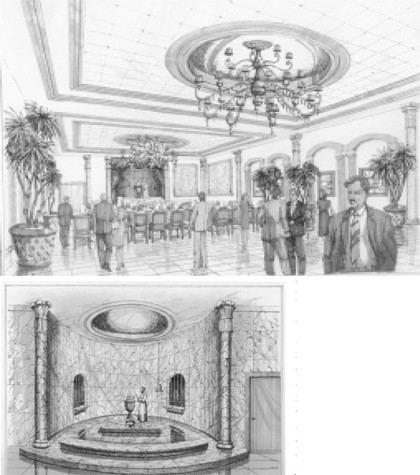
Conceptual sketches of the new assembly hall and prayer room
Moti was chair of the committee set up by then president Homi Homji which helped receive and settle some 40 to 50 Iranian Zoroastrian refugees fleeing the Iran-Iraq war of the 1980s. In this task, as they worked with the Canadian government, they say they received substantial support from a nucleus of Iranian Zoroastrian families in Toronto who helped vet the applications.
The couple is particularly pleased with the success of their program to get the elderly of the community together twice a month. They prevailed on the younger members of the community to pair up with the seniors and bring them every second Friday to the Darbe-Meher. For four hours, from 11 a.m. to 3 p.m. the seniors enjoy cooking demonstrations, listen to lectures on health care, fire hazards, police help and personal safety, etc. "What they like best is to chit-chat,” adds Moti.
"The seniors feel well looked after, make it a point to be there. And it gives others a purpose, a sense of service,” notes Russi.
A long standing subcommittee that exists within the ZSO is the Iranian Zoroastrian Cultural Kanoun, catering to the needs and festivities of Iranian Zarathushtis and its activities are announced and reported in the monthly bilingual ZSO newsletter. The Kanoun also runs a program for elders which the present committee is hoping to integrate with its own program for seniors, the Balsaras inform us.
The annual Iranian New Year celebrations were boosted by greetings from Ernie Eves, premier of Ontario, to "everyone attending the Navroz celebrations hosted by the Zoroastrian Society of Ontario.” Prayers, recitals from the Gathas, a short skit, Iranian food and live music with traditional instruments marked the celebration of Jashn-e-Sadeh, the ancient Zoroastrian mid-winter festival at the University of Toronto. Spearheaded by Armita Azari and her team of dedicated helpers, the 2003 event on January 31 at the huge Science Auditorium, packed with students and professors, will now be an annual event, states the newsletter. At the Darbe-Meher the Jashn-e-Sadeh was organized by the Kanoun when Parsis and Iranians celebrated the event together, notes the newsletter.
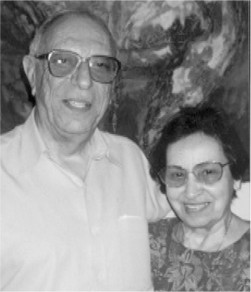
Russi and Moti Balsara: looking after the seniors
With growth in the population of Toronto there have been problems with housing. Earlier on the Balsaras say they were able to accommodate several Zoroastrian seniors in an apartment complex of two buildings with a nursing home in the neighborhood of the Darbe-Meher where they pay 30 percent of income as rent. "We had the contacts (then). But now the government has closed the doors to people like us,” Russi notes the changing policies in local administration.
A practising dentist from Bombay, Russi took two years to requalify in Canada before he could start his own practice in Toronto in 1969. Till then he functioned as "short order cook, wardboy and supply officer,” he laughs. He retired last year. Moti, who was dean of the College of Nursing at Bombay’s J. J. Hospital with a master’s degree in nursing from Columbia University found a job as a staff nurse within a few days of arrival in Ontario. "It was an easier time, you could change jobs,” they recall and Moti eventually retired as a staff nurse in a home for the aged.
Their daughter Khorshed Balsara Tooth is a veterinarian, their son Navroze, an audiologist, both of whom have settled in Toronto. Between them they have five girls for the grandparents to dote on.
◆ ◆ ◆
From the archive