
Zoroastrians Abroad
Infrastructure for Zoroastrians
The Ontario Zoroastrian Cultural Foundation needs funds to build for the future of the community
One of the youngest Zoroastrian associations in the world is demonstrating that the fabled Zoroastrian vision and verve remain a part of life in North America. The five-year-old Ontario Zoroastrian Cultural Foundation (OZCF) in Toronto has not only acquired a beautiful 10.1 acre plot of land in Oakville — the most extensive of any community holding in North America — from self-generated funds, it is pursuing the developmental phase with plans for a dadgah (to start with) and a self-sustaining community center to cater to the needs of a growing community but is looking ahead to creating a retirement complex for seniors as well as temporary accommodation for new immigrants, on the site.
"We took count of the priorities and chose the property on the basis of what it offered — its size and its proximity to members,” OZCF president Niloufer Bhesania had told Parsiana in the course of an interview on the site in July 2007, adding that they had taken a scatter diagram of members’ homes, choosing a midpoint. "We tried to keep the decision at a rational level,” she had emphasized.
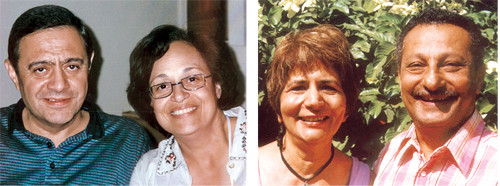
L to R: Mehernosh and Niloufer Bhesania, Meher and Jal Panthaky
"The old property [Zoroastrian Society of Ontario’s (ZSO) Mehraban Guiv Darbe Mehr on Toronto’s Bayview Avenue] used to get so congested at functions, the youths got turned off,” Ervad Jal Panthaky mentioned to Parsiana in the course of an interview in Bombay last December. A founding member of OZCF, Panthaky, like most of its members continues to remain a ZSO member. He and his wife Meher (née Dastoor) have used their histrionic talents to mount nataks patronized by Toronto’s estimated 150,000 Gujarati speaking residents, to raise funds with which they bought the land for Cdn $ 1.3 million two years ago.
Originally a part of the ZSO team working on the Darbe Mehr’s redevelopment, Panthaky says there were a number of proposals for a community center that could accommodate the town’s growing Zoroastrian population viz to sell the place and buy a bigger plot in a central locality, to buy a readymade building, to have two centers in different localities both run under the ZSO banner or to renovate and rebuild the existing structure on the site. It was the last option that the community accepted.
"The only drawback was that the land was restricted…Some of us felt, let us buy a piece of land, regardless. The land price was escalating. It shot up from $ 600,000 to one million. We started with 13 of us and generated 1.5 million dollars. When we got our public charity status, the ZSO got upset. Even the youths gave their pocket money,” Panthaky remembers the last ditch raising of 120,000 dollars by which their funds fell short of the required price. The money was raised in a matter of 20 minutes by all those who had gathered for the meeting, he recalls the energy and enthusiasm that marked the event. The land is now valued at $ 3.5 million as assessed by the city for tax purposes, he notes.
The two organizations — OZCF and ZSO — are now trying to work together by avoiding conflicting events on the same day, says Panthaky.
The Panthakys are now involved in the second round of funds generation to address the immediate and medium term plans of the Foundation. Initially OZCF plans to enlarge the existing structure to create a congregation hall at a cost of $ 275,000, according to their publication. In the medium term is projected a place of worship — initially a dadgah — where regular boi ceremonies would be conducted. "We have 30-32 mobeds in the Toronto area,” he says, noting that the number in North America is now over 72. Panthaky, the youngest brother of the late revered Ervad Rustomji Panthaky, the man who put the languishing Athornan Boarding Madressa at Dadar back on its feet, is particularly happy that they have produced nearly 15 navars in North America in recent years.
The projected OZCF dadgah is not meant to be a replica of any existing fire temple. As designed by architect Navroze Daboo, grandson of the late venerated Dastur Khurshed Daboo of Bombay’s H. B.Wadia Atas Bahram, it is "a building that expresses technology, adaptive religious brief and reinterpreted ancient traditions. Though the building displays modernism, its spirit and soul has much in common with the simplicity of fire temples in ancient Iran,” notes the description in the official OZCF presentation. "The agiary’s circular floor plan springs from the most fundamental physical element of a Zoroastrian fire temple — the afargan,” it further notes.
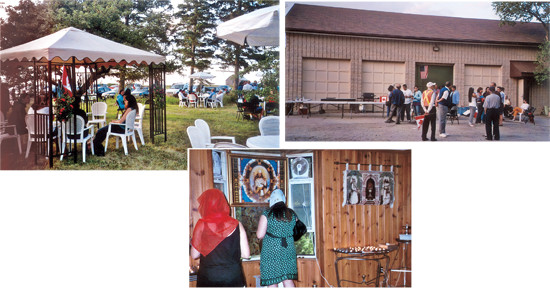
Clockwise from top left: Gazeboes for open air events; old garage awaiting a make-over; makeshift prayer room in the existing cottage
"A lot of our members are from East Africa, especially Zanzibar. They have a very strong desire and motivation (to see the agiary come up)... A lot of them are aging. They want to see it happen,” Bhesania, daughter of Fali and Silloo Dubash who had lived diagonally opposite Dadar’s Rustam Framna Agiary, had noted. In fact, this reporter had seen many of the implements from the Zanzibar agiary awaiting proper placement at the OZCF facility.
A community center with recreational, cultural and sports facilities; library and learning center; large banquet facilities for navjotes, weddings, gahanbars, etc is next on the priority list. The main hall is envisaged to be fully equipped with audio visual facilities to make it into a convention center and, hopefully, will become self-supporting. The cost of these projects is estimated at over $ 2.5 million. "The City of Oakville is excited and happy to have OZCF as a buffer between its residential and commercial zones,” says Panthaky. The organization has its own website: www.ozcf.com
But even before bricks and mortar can be deployed, a welcoming committee of volunteers is in place to provide assistance to new arrivals, as notes a press release from the OZCF Welcoming Committee comprising Panthaky, Havovi Bharda, Sam Bharda, Sahavir Bharucha, Sherry Bharucha and Aspi Illava under chairperson Meher Panthaky. Having experienced the rigors of migration in 1967, Meher says, "I know exactly how everybody feels about it.”
Describing the advantages of migrating to Canada their press release notes, "You will leverage a western lifestyle, and yet keep up your religious beliefs, rituals, customs and traditions…At OZCF, we understand that hope means different things to different people. By filling people’s lives with hope, we’re helping build a strong and prosperous community. OZCF provides the means to a brighter future. The primary objective of our committee is to make every effort to ensure that individuals from every corner of the world are provided support and assistance to help them settle down into Canadian society with equal access to our services.”
The committee, inviting enquiries on welcomer@ozcf.com, offers airport reception and aid in identifying affordable housing. Where possible, it will identify Zoroastrians willing to rent out their basements or apartments at affordable rates. For those seeking to rent apartments, information will be provided from those Zoroastrians already living in apartment buildings.
One of the most stressful aspects of life in new surroundings — finding a job — would be aided by the committee linking the new arrival to employment networks, teaching them skills in résumé writing and interviewing techniques.
"A lot of people have difficulty knowing how to look for a job, especially if it’s their first time in the new environment. The Committee will guide them and link them with (networks) that can help them to connect to employers. It is important to be current with the latest methods of preparing résumés and cover letters that increase your chance to be shortlisted for the interview,” notes the release, adding that the employment seeker would be helped to access Employment Resource Centres which are located at various centralized locations with all the information and tools needed to undertake a successful job search. Also, knowing what employers are looking for, the committee would assist and prepare the newcomer properly to apply this information in anticipation of an actual interview.
To learn about what employers expect from a prospective employee and practice interviewing techniques through mock interviews, the volunteers promise one-on-one coaching, and instant feedback. "Knowing about cultural norms and practices in the Canadian workplace will assist you to present yourself as a valuable contributor to the workplace team. We can provide you with the knowledge and skills you need to find meaningful employment in your chosen profession or trade,” states the write-up adding, "Statistics show that 80 percent of the jobs currently available are not advertised and are in the hidden market, which can be tapped into only through networking. Being new to Canada means not knowing a lot of people. The primary task should be to get the new immigrants introduced to the Zoroastrian community at events and provide contact information for follow-ups, feedback, advice and guidance. These networks will, in turn, introduce their own network contacts, thereby increasing their potential.” Over and above all else, the newcomers are promised help in transportation to various community functions.
A mechanical engineer who retired two years ago, Panthaky schooled at the N. M. Wadia High School in Nargol, coming to Bombay’s K. C. College to work for his Inter Science before joining the VJTI. The rest of his professional training was completed in England. He worked in Voltas and Glaxo, married Meher and migrated to Montreal. The couple have a son Khushnoom, 37, who works as a TV reporter and three daughters — Rahnuma, 34, a stage and TV actor, Pearl, 27, a youth and child care professional who specializes in behavioural problems and Farishte, 23, who is in the last year of her BEd course majoring in music.
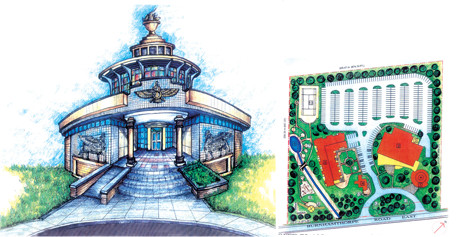
Right: A plan of how the land will be used Far left: The artist’s visualization of the agiary facade
Hailing as he does from a mobed family Panthaky initially refrained from conducting mixed marriages or the navjotes of the progeny of such couples. "Now I do,” he notes simply. Explaining the genesis of the change he recalls the navjote of a couple of Parsi children he performed 10 years ago, explaining the significance of the ceremony and of the sudreh kusti. So he was taken aback when the kids shed the vestments within weeks. In contrast he learnt that the child of an interfaith marriage continued wearing the sudreh-kusti and performing the prayers as taught. Panthaky says it changed his perception on the issue. It also helped him accept Rahnuma’s marriage to a Spanish Jamaican.
Involved with theater, the couple had been instrumental in directing and producing a natak, Temuljinu Time Table, based on an old Tony Curtis film as a fundraiser. Nearly 800 people enjoyed the show and the play was nominated as one of the entries for best stage production. They have now begun practising for Gustadjino Ghotalo, scheduled for 2009, as notes Meher.
◆ ◆ ◆
From the archive