
Zoroastrians Abroad
The OZCF triumph
The Ontario Zoroastrian Community Foundation voted to acquire a 10-acre property for $ 1.5 million
When 211 members of the Ontario Zoroastrian Community Foundation (OZCF), present at a meeting on June 4, 2005, voted in favor of acquiring a 10.1 acre property, they created history. In a rare gesture of solidarity for any Zoroastrian group anywhere in the world, they voted unanimously. And then, dug deep into personal pockets to provide the C$ 150,000 still outstanding to meet the C$ 1.5 million cost of the land, all in a matter of 30 minutes, notes an e-mail message from Roshan Davar to Parsiana.
"There is no doubt, that this unprecedented 100 percent support vote, is a milestone for Zoroastrians in Canada and it echoed a loud, strong message from the membership for a far-sighted approach towards the sustainable welfare of our community,” noted jubilant OZCF president Phil Sidhwa, adding, "This property belongs to all Zoroastrians, Iranians and Parsis, and their families around the world — it offers an opportunity to build on our deeply rooted foundations and once again secure our place in the pantheons of great religions.”
As the stunning vote of confidence was displayed, everybody stood up and broke into a full throated rendition of Chhaiyé Hamé Zarathoshti, writes Davar.
Being in Toronto shortly after the event, this reporter had an eyefilling and lung expanding visit to the newly acquired site, so delightfully green, clean and expansive that the family dog, a part of the visiting group, careened rapturously, her gay abandon impossible to restrain! We also took the opportunity to quiz Sidhwa, a biology graduate from the University of Toronto who served as president and CEO (chief executive officer) of an environmental company for 11 years which was subsequently absorbed by the American Water Canada Corporation where he is vice president, business development. American Water, with a 25,000 workforce, designs and operates water and wastewater treatment infrastructure for municipalities around the world.
The land is next to major highways for easy access, says Sidhwa. It is on the urban/rural fringe and the area surrounding the land has been designated for residential and commercial developments by the town of Oakville, a suburb of Toronto. It is currently designated agricultural in the town’s official plan on which places of worship can be built. He anticipates that the value of the land will rise steeply in line with rising commercial and residential real estate prices. Currently there is electricity, a well for water and a septic tank for drainage. All of these systems are said to be useable since the residence is occupied by the current owner. When the new development starts, water and sewer pipes will be brought in. Till then, Sidhwa expects that they will be able to use the current facilities for medium sized functions and, by bringing in portable water and disposal facilities, for large events.
The existing house of about 2,600 square feet with an adjoining 1,200 square foot building facility is what Sidhwa is counting on to enable the OZCF membership to congregate and have jashans and social activities. And of course, there is plenty of parking space, he points out.
The OZCF’s 13-member board of directors which includes Ervad Nozer Kotwal, Ervad Kobad Zarolia, Xerxes Wania (secretary), Thrity Bamji, Marzi Byramjee, Jamshed Irani, Jehaangir Engineer, Bahram Parsi, Gul Patel, Nozer Kotwal (treasurer), Khurshid Engineer, Niloufer Bhesania (vice president) and a bevy of ready assistants and volunteers who help Sidhwa, plan to build its facilities on a modular basis to accommodate the community’s needs. "There is currently a rapid growth trend occurring in the Zoroastrian community in our area due to increased immigration and births,” says Sidhwa, estimating the growth rate at an enviable 15 percent.
"We also have an invigorated and revitalized youth generation that is keen to participate and preserve our heritage,” he continues. "We will consult with the community to determine future uses. It is envisaged that the property will include a place of worship and community center to set our foundation. We will ensure that as the community grows we can expand and enlarge the facilities to include an agiary with Ahura Mazda’s blessings, as well as seniors’ residences, health and medical facilities, a library, a religious center of excellence for Zoroastrianism, transportation and immigration services as well as recreational and sporting facilities. It will be an all encompassing facility built by Zoroastrians, for all Zoroastrians and their families,” Sidhwa describes the infrastructure that the OZCF leadership envisages for the future 25-year horizon of increased Zoroastrian growth. He is optimistic that it will provide the youth and the next generation with a place to set their foundations and develop it as they feel best. Hence, "the youth will be engaged in these decisions constantly since they are the ones we are all building this for,” he notes.
With a goal of US$ 2,000,000 to build a place of worship and center meant to accommodate 1,000-1,500 people, a fund drive has already started with the assistance and support of the entire membership and the leadership of the board of directors, Sidhwa tells us. "But we don’t have to wait to get all the money before we start, since we are planning to build this on a modular basis as the community grows. Again, that is the advantage of our large 10-acre footprint that provides us the flexibility to achieve our ultimate goals on an as-needed basis and when affordable. We hope to complete this part of our vision within the next two-three years,” he adds. A long-term master plan to build the seniors’ homes, medical centers and other service buildings will be formulated thereafter. "What is really gratifying to see is the enthusiasm and energy that this project has brought forth in our community. The many professionals within our community are offering their time and effort at no charge; our enthusiastic volunteers are busily working to make the organization function every day; our youth are taking interest once again in community affairs and the leadership is guiding the ship. We could have never dreamed this possible. What more could anyone ask for in a young organization that started about three years ago?”
Though the membership has dug deep within its own pockets to buy the land, Sidhwa is mindful of "a wonderful philanthropic donation of US$ 100,000 that we received when we started the project — such is the generosity of Zoroastrians everywhere, within and outside our local communities. Through the annals of time Zoroastrians have always come through for a worthy cause.”
Canada, and specifically the province of Ontario, has the largest Zoroastrian population outside of India, says Sidhwa who counts 500 Parsi and Iranian Zoroastrians as members of OZCF. "The membership is comprised of both young and older families but predominantly the younger families who tend to gravitate to the West. The western Toronto area is developing very fast and is more affordable from a housing viewpoint. For the most part our families are young professionals that have children that are in schools and universities. We also have an older population that immigrated here in the 1960s and 70s, that has set firm roots for us and constantly guide us.”
Zoroastrians are said to be migrating from places like India, Iran, Pakistan, Europe and Africa. "We work pro-actively to integrate the Parsi and Iranian cultures for we are Zoroastrians after all and share deep and common roots. With a total population of 14 million, Ontario has a strong economic base and is home to many of the largest companies and institutions in North America. We have a large professional and business community, with some of the best research universities, which is what tends to attract Zoroastrian and other immigrants here. Our vast cultural diversity, religious freedom, democratic human rights policies and government operated social and medical systems in Canada, enable immigrant families to start a new life and fit in very comfortably within the Canadian mosaic. Besides, Canada is a beautiful country that has given all of us the opportunity to live healthy and well and be able to set down roots for our children. Zoroastrians have achieved major accomplishments in Canada in the scientific, medical, government, academic, literary, high-tech and business fields.”
In large part parents have sacrificed and taken risks when they left their motherlands for the sake of their children and came to a strange land with no community infrastructure, no local experience and of course the proverbial Canadian winters. "It is something we always appreciate and have to bear in mind so that we can pass on the values we were taught to our next generation. To accommodate this fast growth rate we need to build the infrastructure to support it, much like we did in India, Iran and Pakistan,” says Sidhwa.
"Gender neutral” OZCF membership comprises of people of the Zoroastrian faith, their spouses and their children. "We are conservative as far as the doctrines of the religion preached by our Prophet Zarathushtra. We adapt a few of the social and cultural aspects we picked up in India, to our local conditions and needs, more out of necessity and not just convenience. We treasure the roots of our noble religion and are proud of its teachings and our heritage,” states Sidhwa. However, they have been so focused on the job of land purchase, they have never debated the virtues of a world body. "Perhaps as we evolve and grow…” they may venture into that hot spot, he implies.
As for the acceptance of those who voluntarily seek the Zoroastrian faith, Sidhwa says, "such major decisions can only be made after extensive discussion among the community at large. We have always appreciated and encouraged non-Zoroastrians studying and learning about us and helping to analyze our doctrines. Some of the world’s greatest scholars on Zoroastrianism are non-Zoroastrians. But to allow access into the faith is a much larger and complex issue that is best determined after much thought by the larger community... I think that we as Zoroastrians sometimes spend too much time and energy analyzing conditions that either don’t exist, may never exist, occur in miniscule amounts or are mostly only in our imagination. We would be far better off spending our efforts and resources on improving our own community from within and resolving issues of poverty and destitution among Zoroastrians worldwide.”
Due to economic and political turbulence in many parts of the world, Sidhwa sees Zoroastrian immigration to North America increasing. "I see a new era of Zoroastrian proliferation and success worldwide. In North America we are blessed with opportunities here that are second to none, provided we maintain a high moral standard, encourage education to our youth and strive for success in our workplaces. These will be the cornerstones of our success. We are already making a greater presence in all walks of North American society. As the community grows we will need the religious and cultural infrastructure to support it, which is of course the primary purpose of our project. But with growth will also come the issues of integration within our local communities. We will also need to educate our surrounding communities on who we are and how we maintain a peaceful and professional disposition in our lives. As we become more identifiable within the general community our kids will gain a greater sense of identity and pride in our heritage which in turn will result in a greater interest in community affairs. The challenge will be to maintain the beauty of our heritage while adapting to the new world demands. In the eye of a storm at sea, the pessimist sailor imagines only doom and gloom, the optimist doesn’t pay any attention to the approaching danger, but the realist adjusts his sails. And so we must adjust to these demands through rational thinking and community consensus. The tides of change are inevitable and to minimize their impact on the doctrines of our good religion will be critical in how we adapt. Like the saying goes, a bend in the road is only dangerous if you fail to make the turn. So adjustments will be necessary, but I am convinced that we will use our collective wisdom, intelligence and experience to make the right decisions to lead us on the proper path. We will also openly communicate with other organizations and communities worldwide to share their wealth of experience, such as Hong Kong, Australia and India.”
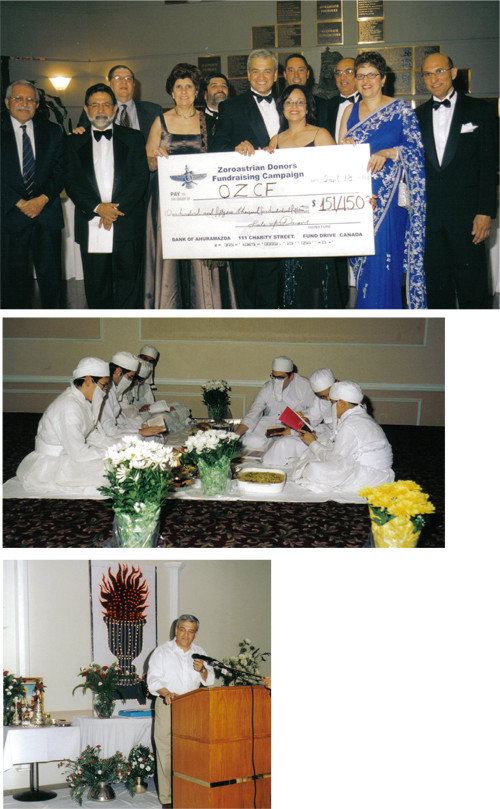
Top: OZCF board of directors holding a cheque of $ 150,000 proceeds from a gala event. Above: Navroz jashan conducted by the junior mobeds Alongside: Sidhwa addressing the community
The Sidhwas arrived in Canada in 1972 from Tanzania, East Africa after spending a couple of years in London, England. Sidhwa, then 15, remembers Tanzania as a beautiful country thriving in economic success but with political instability. There was really no future for education and business so his parents, though fairly well established in Africa, uprooted themselves, with three kids in tow, for a new start to life in a strange land. Father Bejan was the managing director of a pharmaceutical company in Africa and dealt in hospital supplies. Mother Dinoo had a business in Africa and worked in the insurance industry in Canada. Both, now retired, enjoy life socially with the close Zoroastrian community. Sidhwa says, "My dad is a fitness buff and works out daily, putting us kids to shame and my mum loves her gardening.” Elder brother Dinshaw is a doctor practicing in the USA who flies planes for fun. Younger brother Shahroukh has a successful global import/export business.
Wife Marook, an environmental planner by profession who gave up her career to look after their three children — Farokh, 12, Lila, 9, and Danny, 8 — is a yoga teacher and teaches part-time at a local college and recreation center. The children are all involved in soccer, swimming and skiing, while Lila also enjoys tap dancing. Sidhwa himself has a passion for soccer and has spent a number of years coaching the kids’ leagues. He also likes to golf and bike when he gets the chance, between the kids’ activities, masonic involvement, OZCF and other voluntary activities.
A member of various professional organizations and a number of government and industry committees, Sidhwa is involved with a non-profit group, ‘Water For People,’ that provides free professional water systems expertise to poor and developing communities across the world. "We don’t realize how lucky we are when one considers that every eight seconds a child dies of a waterborne disease, over two billion people have no access to clean water and three billion people have no access to sanitation systems. Having grown up in Africa and having heard of the experiences in India and Pakistan from my parents, it is personally a sensitive cause for me to be able to help share my expertise where I can,” he notes.
With both parents from priestly families, "prayers and religious education were part of our daily lives. There was a history of Zoroastrian presence in Africa and we were a very closely knit group. As a 15-year-old arriving in Canada, I always felt a need to interact with our community members. The small group of recent immigrants to this new world became very close and everybody helped each other. The few youths identified with each other in this strange new land and a chemistry developed among them. We came together informally at first and then formally as a committee under the parent organization. The youth organization grew and many friendships formed which developed into long lasting relationships and eventually many of us got married with each other in the group (Marook and I included). This was wonderful — to see all the relationships forming through this little youth group that we started in our basements with parties and picnics. Today our kids are involved with each other and a new generation of relationships is forming, that will hopefully result in the same marriage hit rate as ours.”
The closeness of our worldwide Zoroastrian community came home to Phil and Marook when they were involved in a plane crash in Bangalore in 1990. The local community ensured their comfort, did a jashan for them, fed them, kept them and treated them like family. "And we had never met them before! As a matter of fact, the local non-Zoroastrian community also welcomed us by buying and delivering personal items to us in hospital, as we had lost our belongings. Such is the nature of our community and the Indian culture, that in our hour of need humanity will give what precious little they have from their hearts. Such experiences make us proud of our heritage and culture and make us want to give something back somewhere, somehow...”
◆ ◆ ◆
From the archive