
Media
The orthodox and liberal voices
The Jam-e-Jamshed favored the orthodox point of view while the Kaiser-E-Hind advocated liberalism
The Parsi contribution to the Gujarati language, journalism and printing is legendary. The first Gujarati types were cut by a Parsi, the first Gujarati newspaper and the first Gujarati almanac were published by a Parsi.
Dr Ratan R. Marshall of Surat, a giant in the field of Gujarati literature, over 55 years ago submitted a dissertation on the "History of Gujarati Journalism.” He notes that this was the first dissertation accepted for a PhD in the Gujarati department of Bombay University.
Two years ago Marshall prepared a paper on the contribution of Parsis to Gujarati journalism for a seminar on Irani-Parsi culture. The paper was translated into English by Prof Ashok N. Desai, head of the English department, Z. F. Wadia Women’s College and N. K. Jhota College of Commerce.
An edited and abridged version of Marshall’s paper is being serialized in five parts in Parsiana.
The first installment dealt with the founding of the first Gujarati printing press in India and the launch of the Mumbai Samachar, the oldest newspaper in Asia. The present section deals with the establishment of the Jam-e-Jamshed and the Kaiser-E-Hind.
•••
Almost all newspapers published during the first era of Gujarati journalism (1822-1880), barring a few examples, were read chiefly by the Parsi community. The language used was laden with Persian words. The very names of the journals bespeak of the Persian influence — Jam-e-Jamshed, Shamsher Bahadur, Rast Goftar, Navroz, Akhbare Saudagar, Yazadan Parsat, etc.
When it comes to Gujarati journalism amongst Parsis a mention of the Jam-e-Jamshed, Sanj Vartaman, Kaiser-E-Hind, and RastGoftar must inevitably be made. The Mumbai Samachar, established by Fardunji Marazban, was critical of the activities of the Bombay Parsi Punchayet (BPP). Sir Jamsetjee Jejeebhoy, then leader of the BPP felt it necessary to give a rejoinder to the charges leveled by the Press and he started the publication of the Jamé.
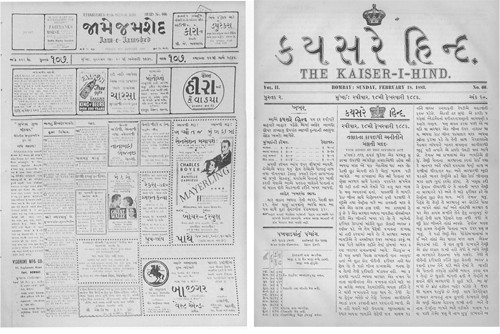
Jamé issue of January 20, 1939 (Courtesy: Zoroastrian Tapestry) and Kaiser issue of February 18, 1883
According to legend, the emperor of Iran, Jamshed, had a mysterious bowl. It was believed that a look into it would divulge information regarding worldly events. Similarly, a reading of the Jam-e-Jamshed would give an insight into the activities of the BPP under the leadership of Jejeebhoy. Ironically enough Jam-e-Jamshed, which was initially started to counter Marazban’s journal, ultimately came to be headed by Marazban himself who nurtured it with care and made it a true mouthpiece of the Parsis.
The Jam-e-Jamshed revolted against the reformative zeal that was sweeping the community. It fought several legal battles. The Jamé protested against the prohibition policy of the first Congress government of Bombay. According to some, it even crossed all boundaries of decency in doing so. As a result of communal riots in Bombay, Jamé was banned from releasing any news regarding prohibition or property tax without prior permission of the government. The Jamé filed a petition in court to lift the ban. The court held that the decision of the Bombay government was illegal and undesirable. As such, it was a brilliant victory for the Jam-e-Jamshed. It also proved to be of great service to the realm of journalism.
In the bygone years, the Jam-e-Jamshed was popular among the Gujarati speaking Parsis. For many years, the Gujarati used in it was crude. But a welcome change has been brought about over the years. The Parsi community of Bombay became apathetic to the Gujarati language. Gujarati was fast losing ground as a medium of educational instruction. English medium schools and colleges were established. As a result, English became dominant among Parsis, barring a few sections of society. Parsis opted for English as a medium of instruction, so much so that English came to be used even in their day-to-day conversations. A stage came when only the elderly members of the family read Gujarati newspapers whereas the younger generation read English papers. As a result the Gujarati newspapers read chiefly by the Parsis, had a hard time. The publication of the Sanj Vartaman and Kaiser-E-Hind were discontinued. Even Jam-e-Jamshed was adversely affected. Once a voluminous daily it is now being published as a weekly tabloid with almost (half) of it in English. Whatever Gujarati is used pertains to miscellaneous news such as Parsi deaths, donations to Parsi religious funds, etc. The journal is wedded to English to such an extent that the recent controversy as regards the disposal rites of the dead was discussed at length in English.
The owners of the Jam-e-Jamshed previously claimed that they adopt the middle line. It cannot be said that the approach adapted by the Jamé to the problems arising in the Parsi community has always been neutral. It has been advocating the age-old beliefs, customs and traditions of the Parsis. The Parsis, by and large, are known to be progressive, but in certain areas they have remained static. Its role as a sociopolitical defender has come to be criticized by the reformists. It seems that the impact of that criticism and the change in the milieu has presently come to be felt.
Another journal that followed a trend different from that of the Jam-e-Jamshed was Kaiser-E-Hind. The Jamé was a daily, while Kaiser-E-Hind was a weekly with a wide circulation in the community. Faramji Kavasji Mehta established it on January 1, 1882. His views gained respect for its owner. ‘Always speak the truth, think of the public welfare, side the truth, be a champion of truth and freedom, sacrifice (one’s) self for others,’ was its ideology. The editor advised people to resort to reason in religious matters. His words are worth noting: "We will prove to be the enemy of superstition and fanaticism; we will strike a balance between the head and the heart.”
Mehta had a soft corner for the Hindi Rashtriya Mahasabha, viz the Congress. The English columns that supported the Congress party were entrusted to people like Dinsha Edaljee Wacha. The English articles penned by that diplomat and economist drew attention not only of the average readers but also of scholars. Because of the English articles, the circulation of the journal widened beyond Bombay. Later on, Sir Rustom Masani succeeded Wacha in editing the English section.
In the year 1914, Erachshaw Rustamji Heerjibehedin took over Kaiser-E-Hind. He made it a lively, community weekly. In social, religious and political fronts, Heerjibehedin exhibited progressive zeal and used the weekly as a vehicle for spreading his ideology. He bitterly criticized orthodoxy but crossed all boundaries of decency. In his column "Chalani Rupiyo” he mocked the leaders and workers of the orthodox school. This resulted in bitterness in the community.
Among the Gujarati periodicals, Kaiser-E-Hind had the maximum number of pages. Miscellaneous columns, appealing chiefly to the Parsi readers, were published besides news. In the year 1937, Heerjibehedin started the Kaiser-E-Hind Weekly as an independent English periodical. Its publication came to a stop shortly after his demise. However, an English section of the same name came to be published in the Gujarati edition and it was often found superior to the Gujarati section. Heerjibehedin introduced novel sections in the journal, published attractive pictures and even caricatures, presented supplements on trade and commerce. He sent a special correspondent to England at the Weekly’s expense to cover the Round Table Conference. Never before had any local journal ventured to do so.
Following Heerjibehedin’s death in 1940, his son Jal succeeded him. He retained the policy of the journal but added more seriousness and maturity. Shallowness of thought was no longer seen in the journal. Occasionally, he even seemed to be favoring old doctrines. The reading public that had been fed with sensational news and controversies obviously rejected such a sober and mild weekly. The daily Jam-e-Jamshed, which echoed the voice of the orthodoxy, was transformed into a weekly and the publication of the weekly Kaiser-E-Hind was stopped. It was a tremendous blow to Parsi journalism but it still had to withstand one more similar blow.
To be continued
◆ ◆ ◆
From the archive