
Events & Personalities
Master’s memorial
"She helped to heal when there was a cross connection between mind, body and soul. Going into the field of psychiatry when girls were only taught to cook, Roshen Master was a path breaker, an anchor, a life line,” stated Pune Times editor Farida Master, speaking at the Sardar Dastur School Hall in Poona on November 10, 2002. Farida’s introductory remarks were a prelude to the first of the Roshen Master memorial lectures to be held annually in memory of Poona’s noted psychiatrist who passed away suddenly in an accident in Poona in 2001.
‘"She was an amazing lady. She carried herself ramrod straight, hardly ever wore a sari, and her party dresses were stunning!” recalled Dr Keki B. Grant who was a friend and colleague for several decades. Chairman and managing trustee of Ruby Hall Clinic (RHC), Grant touched upon the time when in 1959 Roshen, her sister Jaloo Kanga (his secretary for several years) and a ward boy assisted him in a new and unknown venture — setting up RHC — with very little money in the pocket. "Roshen stood by me. If anyone mentioned an ill word about me, it would infuriate her,” he remarked. Their afternoon discussions over a cup of tea at the RHC became a ritual. "Being somewhat headstrong, the arguments were sometimes heated, but she believed as I do that every human being is a good person,” asserted Grant.
Among the first batch to graduate from Poona’s B. J. Medical College in the 1950s, Roshen was at first the assistant honorary psychiatrist at the Sassoon General Hospital. She retired in 1981 as professor of psychiatry and was later honored by the Government of Maharashtra with the designation of professor emeritus (see "Master honored,” Events and Personalities, Parsiana, August 2000). Roshen was instrumental in gradually upgrading the Hospital’s psychiatry department from an outpatients clinic to a 30-bed ward, with a teaching staff and library. Presenting more than 150 scientific papers, Roshen’s text book in psychiatry went into two editions.
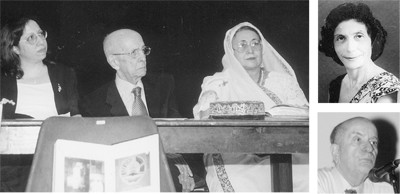
From left: Farida Master, Grant, Master-Moos, Roshen and Soli Master Photos: Vinayak Bogam
Involving herself wholeheartedly in the Kamayani Movement for the education and rehabilitation of the mentally challenged, Roshen’s pioneering zeal saw the establishment of a diploma level teachers’ training college. "What started as a hobby became a mission,” stated Roshen’s husband Soli himself a clinical psychologist who worked with her "from the beginning to the end.” Kamayani is akin to manashni (good thoughts), he explained, adding that the diploma course has been gradually converted into a degree course awaiting government recognition.
"Roshen was an exceptionally humane lady. Only I know how anxious she was when a depressed patient was threatening suicide or a delinquent child was in danger of being picked up by the police,” Soli recalled. She set up child guidance clinics in the boys’ remand home to treat children in conflict with the law — young boys arrested for bootlegging or for gathering coal from the railway yards at the behest of their elders. She would sit with the boys for hours, not across a table but on the floor with the boy standing in front of her. A child is not happy looking up at the doctor, she believed.
Her special empathy was for the retarded. "All my degrees are useless if I cannot cure a child of retardation,” she would say. Under her guidance and assistance, alumni of the teachers’ training college have set up 29 schools all over Maharashtra, teaching the mentally challenged in the local language Marathi, using methods of sound, sight, touch and taste to get their message across. "Sheltered workshops have provided gainful employment to at least 500 mentally challenged people. Engaged in stitching bedsheets for hospitals or weaving on handlooms or making exercise books or envelopes, the income generated ensures that the retarded individual is no longer a burden to his family,” noted Soli.
Pioneering psychological testing in aviation medicine, Roshen also taught at Poona’s prestigious Armed Forces Medical College, holding lectures at nine at night after her day’s duties were over. Roshen’s students, who were majors or colonels then, are brigadiers or air commodores now, said Soli.
In brief recollections of their association with Roshen, friends and colleagues etched word pictures of her personality — her nurturing, challenging and mentoring her psychiatry students, her encouragement to the principal and staff of the Sardar Dastur Girls School, her adventurousness which saw her in her young days astride a red 500 cc bike, out racing many a young man all the way to Katraj and back!
"As the first to start this series of memorial lectures, I feel this a homecoming. My parents and grandparents were from Poona,” stated Dr Meher Master-Moos, founder president of Mazdayasnie Monasterie and the Zoroastrian College at Sanjan, narrating how she had once approached Roshen to help an Iranian doctor with his research thesis on psychiatry. "It was very courageous of her — teaching long distance through e-mail a doctor practising in Tehran. But then she was always ready to do something new, something different.” Gracing the stage was Zoroastrians Worldwide at the Millennium, Master-Moos’ book co-authored with Ruby Lilaowala, which incorporates a picture and life-sketch of Roshen.
In a detailed discourse, Master-Moos traced the history of Aryana Vejya (the Aryan abode of the ancient Persians and the homeland of the Zoroastrian religion). She touched upon the historical highlights of dynasties, Kayanian, Achaemenian, Parthian, Sasanian; the spread of the Iranian empire; of foot soldiers of the religion who traversed the forbidding Hindu Kush mountains from India to Khorasan to bring back the alaat from the atash behram at Nishapur and the long three-year journey back; of Yazdegird establishing Zoroastrian kingdoms in the provinces of China, bordering central Asia; of the revival of the faith particularly in Tajikistan and the efforts to translate the Avesta into Cyrillic Tajik script.
Illustrating her talk with a video presentation of her trips to Tajikistan Master-Moos made a passionate plea for Zoroastrians in India to "help revive the religion in our own original homeland.”
Hilla P. Guzder
◆ ◆ ◆
From the archive