
Medicine/Health
Granting care centers
Ruby Hall Clinic's new, ultramodern cancer center is to open this year
Its progressive practices have marked many a milestone in medicine in Poona for over four decades. A new salve on Ruby Hall Clinic’s (RHC) patient chart is the Cancer Care Centre, expected to be ready within a year’s time. "It will be one of the best cancer centers in the country, rivaling even the Tata Memorial (Bombay’s renowned Tata Memorial Centre),” states 85-year-old Dr Keki Grant, RHC’s founder and managing trustee, as his keen eyes watch the construction of the Rs 42 crore project proceeding apace in the RHC complex. "We have already dug 30 feet down for the linear accelerator,” he observes.
With a handsome donation from the Poonawalla brothers, Cyrus and Zavaray, it is to be named the Poonawalla Cancer Centre. Its Image Guided Radiation Therapy (IGRT) will be the first of its kind in India and in Asia, with only Japan having recently opened an IGRT center, says Bomi Bhote, RHC’s chief executive officer (CEO). With radiation facilities ensconced within eight feet thick concrete walls, the highly accurate delivery system will enable the hospital to treat different types of cancer which are closely surrounded by critical structures, with the sparing of normal tissues. Stereotactic Radiosurgery or X-knife will be an added state of the art feature for precise treatment of tumors of the brain, head, neck and spine, say hospital sources.
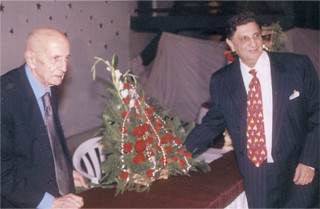
Keki Grant (left) with Cyrus Poonawalla
The Tehmi Grant Institute of Nursing Education (TGINE) stands nearby on Tadiwalla Road, a seven-storied concrete testimonial to Grant’s late wife Tehmi who passed away in February 2003 after a brave battle with cancer (see "What the doctor ordered,” Parsiana, June 1999 and "Grant’s grit,” June 2003). Guiding Parsiana on a tour of the nursing college, Grant negotiates the steps unaided, stooped with age, frail in form, but every footfall proclaiming steely determination. He halts briefly in front of Tehmi’s bust to pay homage to the dynamic, extroverted, intelligent lady who was his balm, balsam and first aide for 50 years.
There are but few nursing schools in Maharashtra, Grant informs us. Set up in 1999, the nursing institute initially functioned from the sixth floor of RHC and was shifted to the new building in 2003. The TGINE is being upgraded from a diploma to a graduate level program offering the BSc Nursing degree from the Maharashtra University of Health Sciences from the academic year which began in June 2004, states the June edition of RubyPulse, the hospital’s publication. Within the TGINE building is the urban health center which looks after poor patients of nearby areas. "These patients are treated free at Ruby Hall if required,” the good doctor informs us.
"We are into a steady expansion phase, with the opening of new departments and peripheral centers all over Maharashtra,” stated UK-trained cardiologist Purvez Grant, Keki’s son, at a well-attended function on the third floor terrace of RHC on November 27, 2004 in celebration of his father’s 85th birthday. With RHC a 500 bed, multi specialty hospital renowned particularly for cardiology, neurology, nephrology, cancer, trauma, critical care, IVF (in vitro fertilization) and imaging, as per hospital sources, Purvez touched upon the possibilities in India of what is called "medical tourism” — the treatment of patients from abroad at a fraction of what similar facilities would cost in western countries.
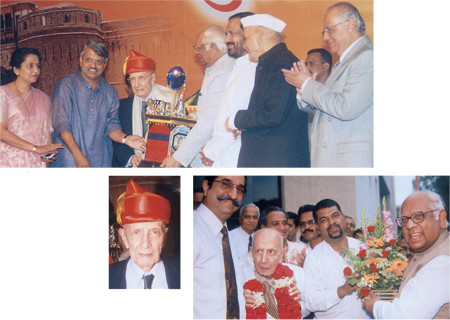
Above: Grant (third from left) receiving Punyabhooshan Award from Chatterjee as (from left) Chaudhari, Desai, Kalmadi, Mohan Dhariya and Dr H. V. Sardesai applaud; (below) in Maharashtrian headgear and with Bhote (left) and Chatterjee (far right)
RHC has taken over the management of the Terna Medical College’s 500-bedded hospital at Nerul in New Bombay, says Bhote and the hospital is looking at running on lease the Al-Hayat Hospital in Bahrain. A concept approved at the Poona Parsee Panchayat’s (PPP) annual general meeting in November 2004 is for the setting up of medical facilities on the Panchayat land at Lullanagar, though the nitty-gritties are still to be worked out by both parties.
Full-fledged diagnostic centers which offer services such as CT scan, color doppler, etc already function on a franchisee basis at Karad, Satara, Sholapur, etc, with a trained staff that works under Ruby Hall’s supervision and management, Bhote remarks. Unknown to many, RHC’s IVF center was officially inaugurated in March 2003 and the first baby born from a frozen embryo was a ‘first’ for Poona as well, as per the hospital’s literature. Inaugurated in November 2004 was the foetal medicine department with the latest Sono CT scan which can pick up foetal abnormalities within the first trimester of pregnancy, the first of its kind in Poona. Seeking to take the hospital to the patient as much as the other way around, RHC’s emergency and casualty services in collaboration with the West Midlands Ambulance Service (UK) and other associates gives urgent paramedic specialty treatment via its emergency phone number 1099/1059999. In the new year, cardiac surgical procedures conducted at RHC will be beamed live via satellite to an audience in Singapore during an international conference on cardiology, elaborates Bhote.
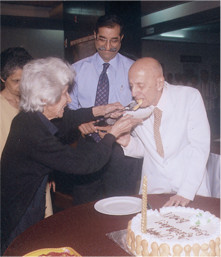
Kanga proffers Grant a birthday bite as Zareen (partly hidden) and Bhote watch
Professor emeritus in medicine and cardiology at the B. J. Medical College and Sassoon Hospitals and one of Poona’s leading citizens, Keki Grant was honored with the prestigious Punyabhooshan Award on November 9, 2004. The audience at the Balgandharva Rangamandir was predominantly Maharashtrian, the speeches were mainly in Marathi, the rounds of applause were robust and repeated as speaker after speaker extolled the soft-spoken Grant’s contribution, courage and compassion. Satish Desai, president of Tridal Foundation, Poona, which presented the Award, referred to him as "the pride of Poona;” for Member of Parliament Suresh Kalmadi, Grant was "the grand young man of Poona” who has kept himself fit with disciplined living, a frugal diet and kilometers of walking every day between his home in Kondhwa and RHC and who participated last year in the Poona international marathon at the age of 84! Somnath Chatterjee, Speaker of the Lok Sabha who was the chief guest, referred to the "respect and regard” people have for Grant. The Punyabhooshan Award has been presented in the last 15 years to achievers in various fields such as Pandit Bhimsen Joshi, Dr Jayant Narlikar, Rahul Bajaj, Shantanurao Kirloskar and the late Dr Banoo Coyaji who won it in 1992.
With the long white scarf of honor draped over his suit and a red Maharashtrian pugree on his head, Grant drew a round of appreciation from the audience with his namaskar (salutation) and first sentence in Marathi! Referring to himself as "an ordinary man who has tried to do extraordinary things” to relieve suffering, Grant paid his tribute, among others, to his middle class parents Byram and Freny who "had to struggle very hard” to make him a doctor. Prescribing stronger doses of the spirit of nationalism, Grant regretted that India had not progressed to potential despite having "great talent, friendly people, excellent climate and good resources.” New and changing lifestyles, the aping of the West in terms of junk food and stressful living had increased the incidence of heart disease and diabetes, even among young people and in the rural population as well. In another 25 years, a fourth of India’s population will be diabetic, he warned.
Grant handed over the cheque of one lakh rupees (received as part of the Award) to Poona mayor Deepti Chaudhari with a therapeutic exhortation to make Poona cleaner! As Grant made his way to his car, he was surrounded by well-wishers and admirers, several of whom bent down to touch his feet.
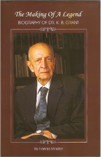
The Making Of A Legend, a biography of Grant by Farida Master, former editor of Stardust, Pune Citadel and Pune Times, narrates the story of Grant’s professional and personal life — of the man whose pulse bespeaks change, whose pill and potion is obsessive hard work, who jogs and plays a round of golf despite being shot through the knee while caught in crossfire during a hijack attempt in 1986, when he and Tehmi were on a flight from Bom-bay to Karachi.
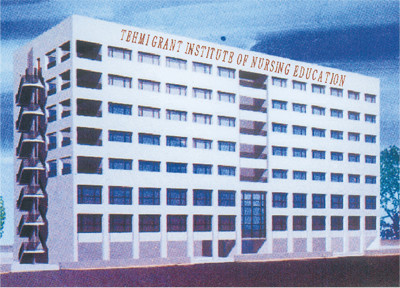
The new nursing college and hostel building on Tadiwalla Road
With a foreword by Sharad Pawar, union minister of agriculture and consumer affairs, food and public distribution, the book published by Multimedia Marketing Services in November 2004 is marked "for private circulation.” A half-hour film on Grant, popularly known in Poona as Hector (named after Hector Kothawalla, a family friend), has been produced by the Grant Medical Foundation.
Age may have slowed his speed; the steadfastness remains despite the trauma of Tehmi’s painful illness and death. Daughter Zareen, he says, watches over him like a hawk and is constantly by his side. Doctors and nurses can still set their clocks by his morning rounds; patients gather outside his consulting room where secretary Jaloo Kanga — aged 93, hard of hearing but going strong after 60 years of uninterrupted service — clackety-clacks on an aged typewriter, simultaneously issuing instructions to patients on how to take the prescribed medicines! Soft-spoken Nargis Pallonji has been Grant’s personal assistant for a year.
Says the doctor who inspires loyalty among patients and peers: "When I hire a new employee I assess him carefully. He must be hardworking and honest. Then I give him the department and trust him fully... Half-hearted methods don’t please me. If anything needs to be done, I go for the best.”
◆ ◆ ◆
From the archive