
Readers' Forum
“A soldier called Sam”
Sam Manekshaw — India’s first field marshal/A nonagenarian now and doing his community proud/Most ably conducting himself in all he does.
My salutes to a man who has served the country/And also served the community in a way/Nothing that he has done so far has/Evidently created a stir or even a whimper/Kindness personified, this gentle giant of a personality/Seeks no publicity and lives a simple quiet life./Humility being his "middle” name, he is/Amiable by nature but of stern disposition./We say "Long live Manekshaw” — go on to a ton.
ADI M. TARMASTER
Your August 2003 cover story prompted me to write a short piece on the army career of my late uncle Brig Jamshed Dadabhoy Nadirshaw (Jimmy to everyone) who passed away peacefully at the age of 88 at his home in Poona on September 13, 2002. He joined the British Indian Army as a junior officer shortly after graduating from college. His entire army career was spent in the thick of action.
During World War II, the British Indian Army fought alongside allied forces in many theaters and as a young officer, Jimmy served with distinction in Burma and North Africa.
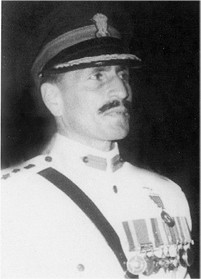
Nadirshaw: outstanding leadership and courage
After Independence, in 1948, by then a seasoned, battle-hardened lieutenant colonel, Jimmy was given the responsibility of creating the 6th Battalion/8th Gurkha Rifles from the personnel of two other battalions. He raised the 6th/8th Gurkha Rifles on February 4, 1948 in Clement Town, Dehra-dun and as father and first commanding officer of the battalion, turned his men into a potent fighting force in a short span of just nine months. The first war with Pakistan over Kashmir had already begun. In October 1948, the 6th/8th Gurkhas were inducted into battle in Jammu and Kashmir. The battalion was ill equipped, had no snow clothing, no signal equipment and was also short of arms and ammunition. In his characteristic style, Jimmy personally led his young battalion into battle. His outstanding leadership and courage resulted in the battalion defeating the enemy and capturing the heights of Naghun, thereby keeping the crucial lines to Poonch open. They were also credited with winning the battles of Ramgarh and Kagani Gali and cleared enemy forces from several other ridges. For these victories, the 6th/8th Gurkhas won the battle honor "Naghun” and theater honor "Jammu and Kashmir,” the first in their continuing and illustrious history. For his courage, dash and leadership, their commanding officer Nadirshaw was decorated with the coveted Vir Chakra. To this day, Jimmy is revered by men of the Gurkha regiments and is part of their regimental folklore. His portrait hangs in the mess at the 8th Gurkha Training Center at Dehradun.
During the 1950s and 1960s Jimmy spent many exciting years in active stations in NEFA (North Eastern Frontier Agency), Assam, Nagaland and other north-eastern states, and on the Chinese border. In 1959 he was decorated again with the Ashoka Chakra. His exceptional leadership qualities resulted in him being chosen for several special international assignments — In 1959 he was assigned to the Indian Military Training Group in Nepal. In 1960, just prior to the Vietnam war, he was posted to Saigon, as one of the commanding officers of the Indian Army contingent with the UN peacekeeping force in Vietnam known as the United Nations International Commission on Indo-China. On his return to India, by then promoted to the rank of brigadier, he was given command of an elite independent infantry brigade.
On his retirement in 1964, Jimmy was immediately recalled and once again given a special assignment. He was appointed deputy inspector general in the then fledgling Border Security Force (BSF), with the responsibility of raising the force in Gujarat. Jimmy literally created the BSF from scratch in Kutch and other border areas of Gujarat. To a very large extent, it is thanks to him and the force he created, that our Gujarat borders with Pakistan are secure.
In 1971 Jimmy retired to private life in Poona. Ram-rod straight, with his upturned handlebar moustache, grey-blue eyes, ready smile and hearty laugh, he became a well-known sight on his twice-daily walks or riding his moped. He had a wide circle of friends whom he regaled — with his wit, with his inimitable magic tricks and with his exciting stories of his experiences in the army. If he had any fault, it was being too generous. Jimmy remained a bachelor all his life but was a much beloved favorite brother, uncle, grand uncle and great-grand uncle.
KAVAS N. PETIGARA
◆ ◆ ◆
From the archive