
Politics and Policy
Ethnicity: an electoral issue?
Challenger Yazdi Desai could not change the community’s perception of Dinshaw Tamboly as one of its most dedicated social workers
"Please do not have any apprehensions. Our religion is not in danger!” the garlanded and tilaked Bombay Parsi Punchayet (BPP) trustee Dinshaw Tamboly, assured the community on the threshold of his second seven-year term. He was preaching to the converted however. The firecrackers had exploded even before the final count was in (Tamboly: 490; challenger Yazdi Desai: 146; invalid: three). There had never been any doubt about who would win this election.
Unlike Tamboly’s first election against sitting trustee and former vice chancellor of Bombay University Mehroo Bengalee when too "virtually every orthodox-liberal controversy was referred to and laid at his door (see ‘A clean election,’ Parsiana, September 1996),” this time there was a mindlessness and negativity in the charges made by Desai and his camp.
At the first (and only) public meeting addressed by Desai at Dadar on September 20, 2003 as per orthodox spokesman Adi Doctor who was in the chair, Desai was introduced as a "total newcomer” whose qualifications according to Doctor were that he was over 30 years old as required by clause 53 of the electoral scheme and, citing Tamboly’s first manifesto of 1996, had the "time, interest and dedication to be of service to the community.” Doctor said that he had known Desai for less than a year. As per Desai’s speech his only effort on behalf of the community was that he had collected 10,000 signatures and opinions from priests and high priests against the BPP resolution allowing the use of Doon-gerwadi bunglis for the funerary rites of those who opt for cremation or burial.
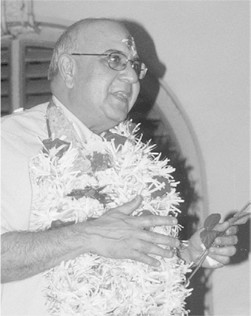
Tamboly: grateful for "faith and confidence”
This comparative newcomer to community affairs started by describing himself thus: "I’m not orthodox like [BPP trustee and World Zoroastrian Organisation (WZO) India president] Dadi Engineer: I don’t go to the agiary every day. I’m not religious like (Dadar’s renowned social worker and chief organizer of Tamboly’s election campaign) Mithoo Jesia: I don’t do muktads at home. I’m not a pragmatist like Tamboly but a practitioner of Parsi-Zarathushti tarikats. I’m not a visionary like Minoo Shroff: I cannot create a world body. I’m not a priest though my father and grandfather were priests.”
Desai said he had grown up in a Christian colony where "friends teased (but there was) awe and admiration in the way they treated me.” He says he discovered in early childhood that he "loved being a Parsi,” is turned on by jingles such as "Minoo makori, ghadialni takori!” and the sight of "a priest praying before a crackling fire in a dark agiary.” "It broke my heart to hear of intermarriages... I watched cherished institutions fall apart but I was impotent; just a middle class Parsi with no money and no position.”
Now a professional chartered accountant, a director of Writer and Company and a trustee of the Kripa Foundation which fights drug abuse and the HIV-AIDs affliction, says, "Today I have the money, the resources, the willingness to go after anyone who tries to mess around with our religion and our customs.” Having wholeheartedly supported Noshir Dadrawala, Desai declaimed against the "vicious attack in the Jamé” against Dadrawala and alleged, "Noshir Dadrawala could have died that day;” he almost had a "nervous breakdown.”
In his attempt to prevent issues being "swept under the carpet,” Desai referred to "contradictions” regarding Punchayet housing and the solar concentrators at Doongerwadi accredited to Tamboly’s support: "Who gave him the mandate? There were 2,000 people at the Samast Anjuman meeting; 98 percent wanted the aviary. Tamboly could have raised three crore rupees in minutes but he wanted to enforce his pragmatism!” (According to the Punchayet no money has so far come in for the aviary project estimated to cost over two crore rupees. The solar concentrators have all been funded by the community).
Conservative BPP trustee Burjor Antia was faulted for his statement at a meeting of the Federation of Parsi Zoroastrian Anjumans of India that "we should help Tajiks start an agiary.” BPP chief executive officer Behram Dastur was castigated for his views on accepting the children of mixed marriages and permitting non-Zoroastrians to view the Parsi dead even after the ceremonies. He rebuked Tamboly for "misrepresenting and distorting facts” because at his Rustom Baug meet on September 18, Tamboly had presented an outline of the move for a world body since 1960.
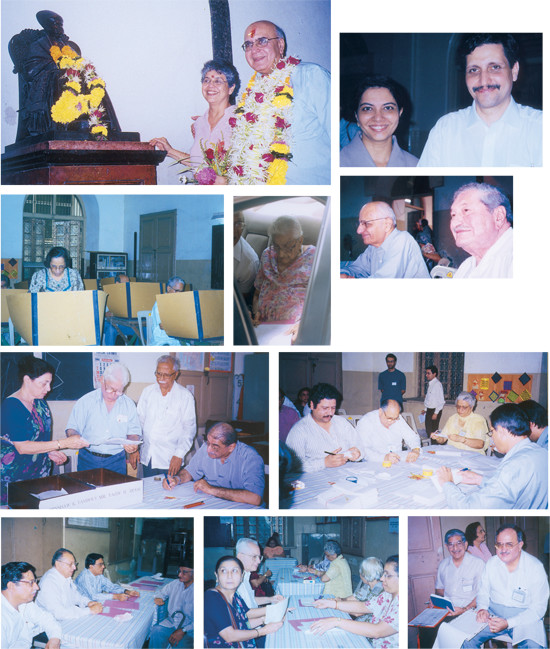
L to R (1st row): Bachi and Dinshaw Tamboly; Anahita and Yazdi Desai; (2nd row): voters marking their ballot; 102-year-old voter, Tehmina Sholapurwala; Minoo Shroff and Jamshed Guzder
"Ali Jafarey (scholar of Zoroastrianism and founder of the Zarathushtrian Assembly) will scuttle our religion but Tamboly says the World Body is a necessity of our times.” (Desai and his supporters believe the world body should be restricted to Parsi-Zoroastrians. The draft agreement of the world body defines a Zoroastrian as one professing the faith and envisages a place for the emerging Zoroastrians of Russia, Tajikistan, Uzbekistan, etc whose forefathers had been Zoroastrians prior to Muslim and Soviet conquest of their countries and who now seek to revert to their ancient religion.)
Desai even alleged that Dasturs (Drs) Kaikhusroo JamaspAsa and Firoze Kotwal and Ervad (Dr) Pervez Bajan have opted out of the Athornan Mandal because of pressures generated by the WZO financed scheme for the betterment of working mobeds. (On checking with JamaspAsa Parsiana learnt that he had indeed left the organization but it was due to internal problems and had nothing to do with the WZO. Bajan continues to be a trustee of the Athornan Mandal.)
When Desai spoke of Tamboly and Engineer actively opposing the Punchayet’s leadership of the world body, Tamboly supporter Viraf Doctor from the audience demanded to know the source of the "data you are feeding the electorate” and Desai had to admit that it was "private data” whose source he was unable to attribute.
Desai cited the establishment of the WZO sanatorium at Sanjan as evidence of the conflict of interest between the WZO and the BPP. Why didn’t Tamboly renovate the old dharamshala instead? asked Desai. Viraf Doctor informed him that at another meet Tamboly had explained that the Maneckbai Jeejeebhoy Sanatorium had been instituted by the WZO to prevent that extensive Zoroastrian property from falling into the hands of another community which aimed to set up a madressa next to the Stambh. When Desai, in his turn challenged the authenticity of that statement, this Parsiana reporter pointed out that the genesis of the Sanatorium had been documented in the magazine two years ago. Dropping all reference to the Sanjan sanatorium Desai charged that Dastur had written "on the BPP letterhead” to a community member seeking funds for Parsiana. When members of the audience stood up to defend Dastur’s use of the Punchayet’s good offices to garner support for Parsiana or any Parsi organization seen as doing good work Desai retorted, "Is it on (the) BPP’s trust deed?” He claimed he would stop such activity if he got on the BPP board. He said he would run the Punchayet "as the settlors wanted it to be run. If I can’t do my job I’ll quit in the first year!”
Viraf Doctor asked Desai, who said he would intervene in the High Court hearings on the proposed changes in the BPP electoral scheme to seek universal adult franchise (UAF), "Isn’t that going against the wishes of the settlors?” He was referring obliquely to the pre-1908 judgement of the High Court which introduced a 100-member electoral college to the Punchayet. Until then BPP trustees had been nominated for life. In answer to a question Desai stated that his UAF scheme would include all Parsis of Greater Bombay. V. Doctor challenged, "The BPP manages and controls properties outside Bombay. Don’t the people of those areas have the right?”
"You’re going into details” fumed Desai. Responded V. Doctor, "I’m just asking technical questions which show that UAF could be difficult, almost impossible to implement.”
Desai dismissed a question on reservation with "It encourages inefficiency.” Somebody asked how he had acquired his Rustom Baug flat and Desai stated that it had been a straightforward deal with him paying 60 percent of the price of the flat to the outgoing tenant and 40 percent to the Punchayet. "I swear on Ahura Mazda I never paid a pai (extra) to anyone to get the flat.”
Other Desai-isms: "Why is Dinshaw Tamboly so frugal in his use of the word Parsi? Is he ashamed to be a Parsi?” "If Tamboly is not a reformist why are all reformists and DDD-AG (Disposal of the Dead with Dignity-Action Group) members supporting him?” And in contrast, "What work Khojeste is doing is wonderful! The youths are in awe of (him).”
At Tamboly’s meet at Rustom Baug Beroze Guzder first raised the issue of UAF by stating "very few people elect BPP trustees. It is wrong to assume that they are the voice of the community.” When Tamboly explained that "it is not in our hands to expand the electorate” and that a revised scheme has been submitted to the Bombay High Court and was overdue for a hearing, Guzder insisted, "Our community has 100 percent educational levels. Why doesn’t the BPP push (UAF) forward?”
Admitting to the "integrity and work of the WZO — the shift (in emphasis) from provision of doles to work (tools) is excellent,” Guzder nonetheless maintained that "WZO ideologies do not match those of India.” She also voiced apprehension about Indian Zoroastrians being "swamped by Zoroastrians of the western world... our atash behrams/agiaries being swamped by converts.”
Tamboly tried to set such apprehensions at rest by emphasizing that the world body aims at networking and contacts for the betterment of Zarathushtis everywhere and did not focus on religious issues. "Each zone would have its own definition of Zoroastrian.” He also drew attention to the trust deed of each agairy/atash behram that protects it. "(We) respect the views of people who are traditionalists but we have to have open minds.” Tamboly’s sentiment met with general applause.
Anahita Desai, wife of the challenger Yazdi, cited an old article in the BPP Review in which she said Tamboly had argued in favor of status quo as against UAF and said "leave the system alone.” Her second charge was that the draft of the world body, for which she held Tamboly responsible, spoke only of "Zoroastrians” not of "Parsi Zoroastrians.” Describing herself as "an ordinary Zoroastrian,” the 63-year-old Jesia said, "I am always proud to be a Zoroastrian. I know I’m a Parsi (but) I never had to qualify this.”
Wellknown stage personality Dinyar Contractor noted, "When a man has done so much for the community... you criticize him for not adding one word — ‘Parsi!?’ What have you done for the community? When you want to win an election tell us who you are and what you have done.”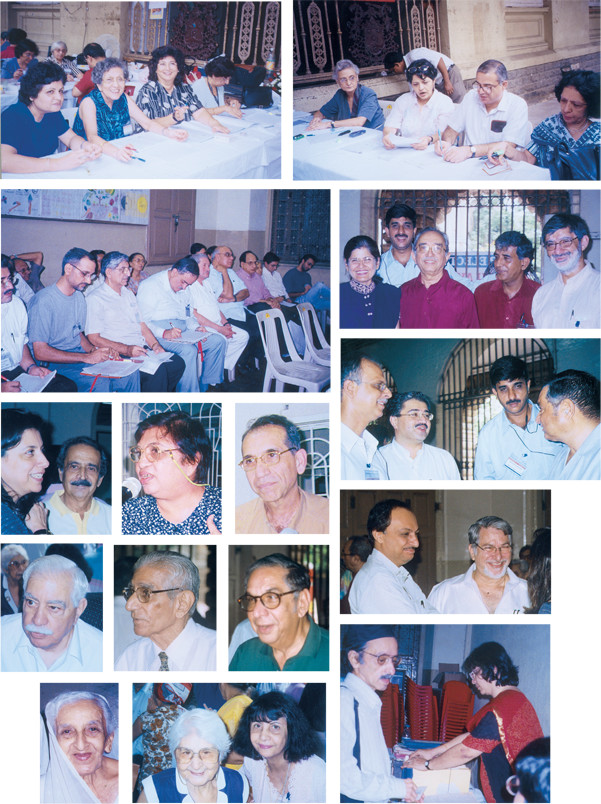
L to R (1st row): Tamboly supporters and Desai supporters (2nd row): Keeping count of the voters (left); Arnavaz Mistry, Nozer Tantra, Maneck Engineer, Kersi Randeria and Zaree Jehangirji (3rd row): Tanaz Parakh and Homi Lord; Jesia; Dr Porus Turner; Sarosh Daruwalla, Mahiyar Das-toor, Tantra and Burjor Antia (4th row): Kersey Gherda; Fredie Mehta; Rusi Sethna; Yezdi Bhagwagar and Noshir Talati (5th row): Silloo Kavarana; Jeroo Khurshedji and Soonu Andhyarujina; Adi Doctor collecting his duplicate certificate
According to The Bombay Samachar ("Parsi Tari Arsi,” October 19, 2003) Desai "has filed an election petition to set aside the election of Dinshaw Tamboly and to be himself declared a trustee.” The appeal has been made to the BPP trustees, notes The Samachar. It alleges unfair practices adopted by Tamboly viz the (old) cheque of four lakh rupees given to Jam-e-Jamshed editor Rusi Dhondy; Tamboly’s refusal to participate in a debate with Desai and providing free transportation to voters and the Jamé’s attack on the Parsi Voice (which had been revived to give the challengers a forum) and on Desai’s wife Anahita.
The Jamé had castigated her for threatening legal action against the weekly as well as against Mancher Daruwalla whose infant daughter Jennifer had benefitted by an expensive operation financed by donations through Tamboly.
In the earlier phase of the election Noshir Dadrawala and his supporter Perzon Zend had visited Tamboly on August 4, 2003 with a legal affidavit they wanted him to sign as a price for an uncontested reelection. The affidavit’s seven clauses included affirmation of the definition of Zoroastrian as being Parsi Zoroastrian, one who is born of both Parsi Zoroastrian parents and whose navjote had been performed by a Parsi Zoroastrian priest. Other clauses required Tamboly to oppose intermarriages and the navjote of their offspring; the adoption of children from secular adoption centers; cremation or burial where dakhmas exist. He was required to state that he refused to recognize Jafarey as a Zoroastrian or as a ratu (leader) and that converts from Central and South America would never be accepted/recognized as Zoroastrians by the BPP/WZO or any other Parsi Zoroastrian organization. Strangely, this clause was thrust on Tamboly when an earlier clause demanded his resignation as officer and member of the WZO!
Unlike the vituperation in the Press, specifically the Jamé (see "An acrimonious election,” Parsiana, September 2003) the election day (September 27, 2003) was peaceful enough to be dull. Just about 50 percent of the total electorate of approximately 1,300 live members of the Anjuman Committee came to vote — a few in their 90s and one who was 102! A rueful Dastur estimated the direct cost of the election at two lakh rupees, the indirect cost at three lakhs and the empirical cost of all those man hours lost at two million rupees!
Again, 41 duplicate certificates were issued — 25 to elected members, Desai supporter Adi Doctor among them, and 16 to donors.
Rustom Hormuzdiar presided over the proceedings as he has been doing over the past two decades and more except when abroad. With a bow to propriety Rusi Bhumgara, joint honorary secretary of the WZO, who normally functions as a scrutineer at these elections, opted out this time. Hence Homai Modi, the other well established scrutineer, was joined by Ratan Lalkaka, former CEO of the Petit Trust.
The sound of popping champagne and a spirited rendition of Chhaiyé Hamé Zarathoshti marked the curtain closure on yet another BPP trustee election by an electoral college that had outlived its statutory existence by nearly four years. Hopefully, by the time of the next election in 2007, a new Anjuman Committee will be in place. No matter which way the High Court mandates it, Dastur’s cost estimates will be left far behind.
◆ ◆ ◆
From the archive