
Cover Story
A hero for heroic times
A film on Field Marshal Sam Manekshaw recaptures the legend of a victor
"The safety, honor and welfare of your country come first, always and every time. The honor, welfare and comfort of the men you command come next. Your own ease, comfort and safety come last, always and every time.”
This memorable injunction delivered by Sir Philip Chetwode in his address to the first batch of cadets at the Indian Military Academy at Dehra Dun in 1932 had been internalized by at least one Gentleman Cadet there. Seventy years later Field Marshal (FM) Sam H. J. F. Manekshaw, taking the salute of the graduating cadets in 2002, reminded them of the respect they owed to the professional Indian army.
It is at this juncture that filmmaker Jessica Gupta begins In War and Peace, the life of Field Marshal Manekshaw, MC — her beautiful paean on a personality of legendary joie de vivre, created at the behest of UNESCO-Parzor as part of their project aimed at documenting and preserving the vulnerable heritage of humanity.
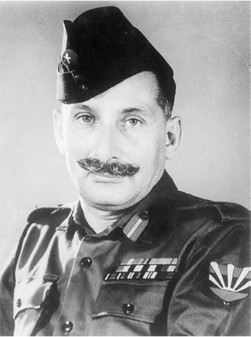
Manekshaw: he fought to win
Criss-crossing past and present, Gupta has succeeded in conveying Manekshaw’s lifelong concern for the Army’s morale, dignity and pride. Weaving his own memories with archival records and attestations from others who also played their part, center stage, in securing the integrity of India, Gupta’s 40-minute tribute recreates the post-Independence history of India — "terra incognita to the vast majority of today’s Indian youth,” as Lt Gen (retd) Adi Sethna noted sadly. In the process she recalls to life a commander’s flamboyance and charisma of iconic proportions for the troops he led.
The film was premiered at the Air Force Auditorium at New Delhi’s Subroto Park on April 3, 2003, the onset of Manekshaw’s 90th year, in the presence of defence minister George Fernandes, tourism and culture minister Jagmohan, Governor of Punjab Lt General (retd) Jack Jacob, the chiefs of the Army, Navy and Air Force and former president of India K. R. Narayanan.
Speaking of Manekshaw’s "courage, character, integrity... a man who has created history — in fact you created a new nation, Bangladesh” Fernandes said he had told the media that Manekshaw’s life "provided the kind of inspiration that today’s youth needs.” According to Jagmohan the Field Marshal "personalizes qualities of a great leader and commander.”
In her welcome address Parzor director Dr Shernaz Cama explained the birth of the Parzor project as a product of UNESCO’s concern for the demographic decline of Parsi Zoroastrians and recalled her life as ‘Army daughter:’ "It was during our childhood in the Army that we learnt about the value of traditions. We also learnt that you do not have to be the same to be one. We started and still start our day with the regimental greeting ‘Ram-Ram.’ We prayed at gurdwaras, temples, dargahs and churches and of course — when one could be near them — at agiaries. We celebrated every festival, enjoyed every food of our country.
"Soldiers, sailors and airmen are the protectors of the most valuable human traditions: courage, integrity, justice and compassion. They are present not only at national borders but at floods and earthquakes, whenever there is a need to help or to save. Because of their profession, soldiers cherish life in all its beauty and diversity. They know only too tragically well, how fragile human life can be.
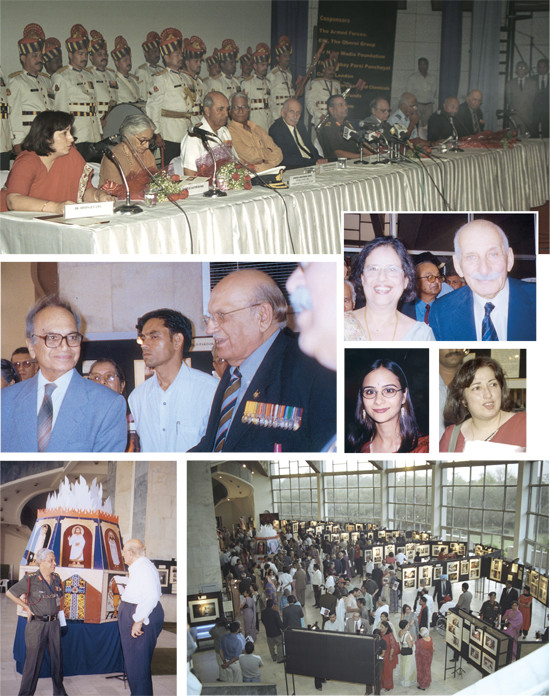
Top (L to R): Cama, Vatsyayan, Navy Chief Admiral Madhvendra Singh, Fernandes, Manekshaw, Army Chief General N. C. Vij, Jagmohan, Air Force Chief Air Chief Marshal Krishnaswamy, Perera and Sethna Centre panel (from left): Jagmohan with Sethna (R); Sherry and father; Gupta and Cama. Below (left): Sethna with an army officer and ‘Vision of Unity;’ (right) Exhibition in the foyer
"Perhaps the greatest soldier India has produced is Field Marshal Sam Manekshaw. It is because of Sam’s pride in the dignity of the Army and his total professionalism that we can be so proud of the Indian Army today.”
Cama spoke of how Sam and his wife Silloo "motivated us all.” As school girls in Calcutta during the Bangladesh War (their father Adi, then Brigadier General, was a part of the general staff of the Eastern Army commanded by Lt Gen Jagjit Singh Arora) they had helped pack food parcels, visited the wounded every evening at the Command Hospital and "in a fit of patriotism even donated every comic we possessed to the officers’ ward because the young officers wanted to read them!”
"War and peace are closely linked. They begin in the mind,” remarked UNESCO’s R. P. Perera, praising the Field Marshal’s role in preserving the integrity of India. Noting that "cultural diversity is as important to humankind as bio diversity is to the environment,” Perera, who has been supporting Parzor since its inception, referred to the Parsis’ uniqueness and contribution to the development of modern India. The Parzor project on the concept of Asha aims to preserve "one of the masterpieces of humanity,” and was supported by several members of the UNESCO family of nations, he maintained. But the highpoint of Perera’s speech was his public announcement of the decision of UNESCO’s executive board and 190 member states who voted in favor of Tajikistan’s request to celebrate 3,000 years of Zoroastrian culture in 2003.
"The communication of man and man, woman and woman, culture and culture is the most abiding bond of this globe we call our world,” noted historian and cultural activist Dr Kapila Vatsyayan who is a leading member of the Parzor project team. Alluding to current environmental depredations in the context of the ancient Zoroastrian injunctions Vatsyayan said, "The Yasna reminds man that he is one (factor) in an interconnected universe... From the basic five elements of this world if you take away water, fire or earth, will we survive?” Commending Cama’s dedication to the Parzor project she spoke of its work in trying to "interconnect the world, not only the Parsi community,” through research on the impact of Iran and other civilizations to show that "every little community has played a part in plural societies” as they integrated into multicultural modern states.
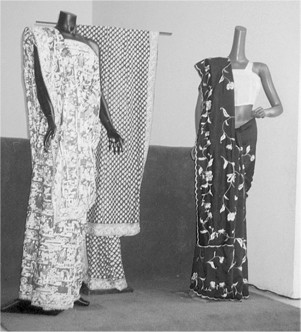
Parzor exhibition in the foyer
In his vote of thanks Sethna, chairman of the Parzor executive committee, thanked the Government of India, the armed forces, their many establishments and training centers as also the innumerable individuals, NGOs and commercial establishments who had cosponsored the event. "Archival photos have come from many sources, anecdotes and recollections from many others,” he noted. Some of this material saw the light of print, thanks to the Oberoi Group, in a well-documented souvenir on the occasion. Much more, along with Parzor’s work on the Parsis as well as the wider, intercommunal heritage, had been painstakingly mounted into an exhibition in the foyer of the auditorium which was inaugurated by Jagmohan lighting up the model ‘Vision of Unity.’ "May it be transformed into the reality of a building where the seven major faiths of India are housed under one roof with the wonderful jewel-hued stained glass of Katayun Saklat acting as a strong magnet to bring together scholars and tourists to Delhi, a revival in modern form of the ancient Nalanda University,” noted Sethna fervently, thanking the dedication and administrative skill of his colleague Tirlochan Singh (comember with Sethna of the National Minorities Commission) for having already applied to Government for land where "we can translate our dream into reality.”
The unspooling of the film was preceded by two young Farohars from the Delhi Parsi Anjuman auspiciously dabbing vermillion on Manekshaw’s forehead and popping sakar into his mouth. Gupta and Brig Adi Sahukar, who had done much of the research, presented the eldest member of the defence community with a 90-rose basket. For the ceremonial cutting of a massive birthday cake the first Indian officer to command the Gorkhas and the Colonel of the Eighth Gorkha Rifles used a cherished silver khukri as the audience joined in to sing Happy Birthday to Sam.
How did you get this very private man to come on camera?” was a question put to him by industrialist Keshab Mahindra, said Sethna who was largely responsible for masterminding the movie documentation of Manekshaw’s unique contribution to the winning of the Bangladesh War in 1971. The FM’s reticence, at what would amount to beating his own drum, can be discerned on screen in his short, dismissive phrases and self-deprecatory humor. For the kudos, filmmaker Gupta had to find other tongues — and there are several.
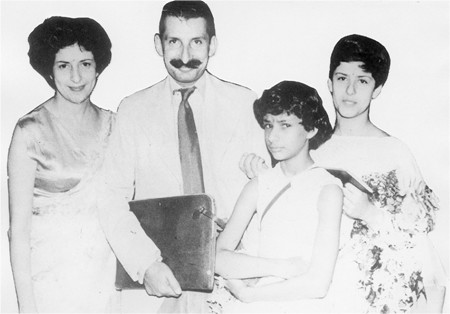
With wife Silloo, daughters Maja and Sherry in earlier days
Gupta, who had heard of the Parzor desire to create Manekshaw’s film biography from a friend, had happily embraced the project. The team sent Manekshaw a couple of ideas which met with initial hesitation on his part, Gupta mentioned to Parsiana. When the project began to roll it took her 10 days to shoot 11 hours worth of film. Five of these days were spent with the FM, she notes. She found that the FM "remembers the time, place, date, day” of certain events and speaks willingly on particular topics which he knows. And he doesn’t speak about what he doesn’t remember.
Gupta takes the viewer to Stavka, the verdant Manekshaw residence in Coonoor where his artist wife Silloo, left alone on Sam’s sudden transfer to NEFA (North East Frontier Agency) to head the demoralized Indian army after the Chinese aggression, had bought up 3 acres of a rolling hillside for all of Rs 18,500 in 1962. The bungalow she designed was built as their family abode after he relinquished active service in 1973. "Why did you call it Stavka?” asks his grandson Jehan. That was the name of the headquarters of the commander-in-chief of the Russian forces in Tolstoy’s War and Peace, he is told. "Have you read the book?” asks Jehan. "No,” replies the doughty grandfather but the glint in his eye should dissuade a viewer from accepting the statement at face value. Indeed, Sam’s sense of humor, his tongue-in-cheek remarks and irrepressible wit added an extra dimension to his multihued personality — one that in the humorless official Indian context led to the derailment of his career.
As Manekshaw speaks to Jehan in a series of little tête-à-têtes we see the elegance as well as the human warmth that percolates through the life of the family as well as its Gorkha dependents. The topics they discuss in various scenes are amplified by interviews with some of the key personnel who had been involved with Manekshaw through his life. Glimpses of Sherwood College where he schooled in Nainital, the many military institutions he passed through as student, instructor, commandant, film footage of World War II in Burma, and the Indo-Pak engagements from 1949 onward. It was in Burma that he nearly died in 1945 from an overdose of Japanese bullets leading the commanding major general to whip off his own Military Cross and pin it on the wounded major. For the Military Cross — Britain’s top award for exceptional gallantry in battle — is given only to the living.
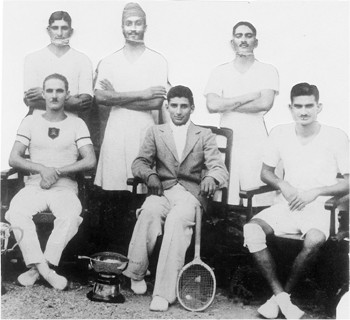
Seated centre with regimental sportsmen
Sam was already a brigadier by the time he went to Kashmir at the Indian Government’s bidding to receive the deed of accession to India signed by its Maharaja in 1949. As he notes in the film, he had an excellent rapport with Sardar Vallabhbhai Patel who used him as a troubleshooter in Baroda and Calcutta during the post Independence riots.
But his steady rise had its detractors. Among these was India’s Defence Minister Krishna Menon and Lt Gen B. M. Kaul. While he was commandant of the Defence Services Staff College in Wellington Manekshaw faced a court of inquiry. The trumped up charges alleged that Manekshaw was pro-British, wouldn’t appoint instructors at the College whose wives did not meet with his approval and such like trivia. As Jacob, Manek-shaw’s general staff officer, notes, "He (Sam) came out with outrageous remarks but there was nothing in it.”
Before his official exoneration could come, however, fate intervened in the shape of the Chinese invasion. The unprepared Indian army, which had been victorious in battlefields across the world under British command, was shamefully routed. Manekshaw tells Jehan in the film, "Nehru called me and asked would I go to NEFA? I told him I had been waiting for that order for 18 months!” When Sam got there he studied the maps and gave his first order ("We start advancing”) though he wasn’t sure if it was correct or not. But the very fact that there was at last a commander who was willing to command became a source of jubilation.
He recalls the stormy onset of the Bangladesh War. Summoned by the Prime Minister to a cabinet meeting in April 1971 he found Indira Gandhi in "an awful temper.” She read out messages from the chief ministers of West Bengal, Assam, Tripura anguished by an estimated 10 million refugees pouring in from East Pakistan. "What are you doing about it?” she demanded. When he asked in return "What can I do about it?” she said "I want you to march into East Pakistan!”
In reply she got a lesson in geography. Summer was approaching: the Himalayan passes would be open to Chinese interference. The approaching monsoon would turn the rivers of Bengal into oceans: lines of communication and supply would be difficult to maintain. Also, the heavy downpours would affect visibility and hence there would be little support from the air force. He urged that war must be deferred until December to enable the services to be fully prepared.
The cabinet meeting was adjourned until 4 p.m. While the others exited Indira told Sam to stay. He asked her, "Prime Minister, shall I send in my resignation on grounds of health — mental or physical?” She brushed his offer aside, trying to assimilate all that he had said. He convinced her, "My job is to fight to win, not to lose,” and estimated 15 days from the start of operations for the fall of Dacca. As it happened, War began on December 3, 1971 with the strafing of Indian airfields by Pakistani aircraft in the western sector. On December 16, 1971 Lt Gen Niazi, commander of the Pak forces in East Pakistan surrendered to Arora, commander of India’s Eastern Army. India’s political leadership did not accept the services’ advice to continue the war in the west and settle the Kashmir issue once and for all. Instead Indira chose to meet Pakistan Prime Minister Zulfikar Bhutto in Shimla. Bhutto "promised to settle everything in six months. I told her he’s made a monkey out of you!” Sam relates to Jehan.
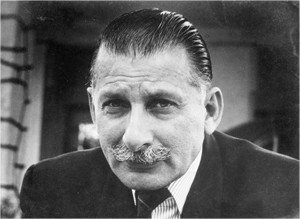
In Coonoor in 1993, awaiting the building of Stavka
An ensuing problem was to move the hated West Pakistani prisoners of war (POWs), now under Indian protection, out of Bangladesh almost overnight and they were moved into the vacant army peace time cantonments (hurriedly turned into POW camps) which they continued to occupy for one-and-a-half years while the Indian troops returning from the front had to live in tents. A poignant reward for Sam’s concern for all men in his care was a line-up of the governor’s staff when he went to Lahore two months after the conflict. They wanted to shake his hand and one man took off his turban, placed it at Sam’s feet noting he had five sons among the POWs in India who kept him informed how well they were being looked after. He would never again believe any nasty descriptions of Hindus. Such statements from the ‘enemy’ contrasted oddly with the complaints which began to be aired against Sam by members of Indira’s cabinet and it hurt him that she did nothing to squelch them.
At the peak of his populari- ty Manekshaw couldn’t go anywhere without people asking him, "General when are you taking over (the country)?” Summoned to meet the Prime Minister he found an upset Indira sitting at her kidney-shaped table. When he asked if she had a problem, she looked him "straight in the face and said ‘You are my problem. Everybody says you are going to take over from me.’” Though he assured her that he had "no intention or thought of getting involved in politics,” it appears that Indira never quite overcame her sense of insecurity. Apart from conferring the Vishist Seva Medal and promoting Sam to be India’s first Field Marshal, the Government made no use of Sam’s immense abilities after he relinquished office as Chief of Army Staff in January 1973.
The slack was filled by the corporate world who saw in him an excellent organizer and man manager. On the board of 14 companies and chairman of six he jets his way to and fro spending time en route with his daughters Sherry and Maja in Madras and Delhi respectively.
At one stage he had taken to the pastoral set up, keeping milch cattle, growing tea. Artifacts, presents, professional and personal papers are already in the Manekshaw museum in Shillong, the regimental home of the Gorkhas. Much else will follow there in the fullness of time he had told Parsiana 10 years ago.
Though the demise of his beloved wife a year ago has deprived him of his anchor and solace, complaints form no part of his psyche. He is "quite happy” with the way things went in his professional life and "very happy” with his children his grandchildren and his Gorkhas.
[A VCD (video compact disc) copy of In War and Peace: the life of Field Marshal Sam Manekshaw, MC is available from the Parzor Founda- tion, F-17 Hauz Khas Enclave, New Delhi 110016 against a donationof Rs 350. E-mail: sethnaadi@hotmail.com or shernazcama@unescoparzor.com]
◆ ◆ ◆
From the archive