
Books
Manekshaw, the man
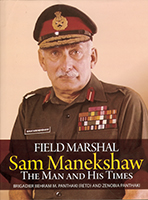 Field Marshal Sam Manekshaw — The Man and his Times by Brigadier Behram M. Panthaki (Retd) and Zenobia Panthaki. Published in 2014 by Niyogi Books, D-78, Okhla Industrial Area, Phase-I, New Delhi 110020; email: niyogibooks@gmail.com; website: niyogibooksindia.com. Pp: 214. Price: Rs 1,495.
The story of Field Marshal Sam Manekshaw has been brilliantly brought to center stage by Brig Behram Panthaki and his wife Zenobia. Nobody could be better qualified to write this story because nobody could have been closer to him than this young couple during an eventful period of the Field Marshal’s life. Behram, like the true soldier that he is, left Manekshaw to join his battalion during the Indo-Pak war of 1971 otherwise we would perhaps have got a more colorful account of how the latter conducted the war.
When Manekshaw was appointed Chief of the Indian Army, the third largest army in the world, the news spread like wildfire because everyone knew that they now had a chief who would stand up for the Army and ensure that it would get the treatment it deserved. One of his first tasks was to apprise the Government of the shortages of manpower, weapons and equipment that bedevilled the Army. Although, the Government, as usual, took no action, Manekshaw’s frank appraisal stood him and the country in good stead prior to the Indo-Pak war of 1971 when he was told to march into East Pakistan. His plain speaking, forthrightness and honesty got him what was required for an outstanding victory in that war.
When Manekshaw was appointed Chief of the Indian Army, the third largest army in the world, the news spread like wildfire because everyone knew that they now had a chief who would stand up for the Army and ensure that it would get the treatment it deserved. One of his first tasks was to apprise the Government of the shortages of manpower, weapons and equipment that bedevilled the Army. Although, the Government, as usual, took no action, Manekshaw’s frank appraisal stood him and the country in good stead prior to the Indo-Pak war of 1971 when he was told to march into East Pakistan. His plain speaking, forthrightness and honesty got him what was required for an outstanding victory in that war.

Authors Zenobia and Brig (Retd) Behram Panthak
The Parsi community has done the country proud. Considering its size, its contribution to India has been outstanding. It has produced chiefs for the Army, Navy and Airforce, top class industrialists and business entrepreneurs, chief justices, philanthropists, doctors, lawyers, engineers and persons of brilliance in every field of human endeavor. It also gave India a person like Manekshaw who was not only an outstanding strategist but also an Army chief who changed the map of the Indian sub-continent.
The community is also known for its ethics and the manner in which its members conduct themselves. Manekshaw had imbibed these values from the upbringing that he received from his family and he made good conduct, integrity, courage and consideration for others fundamental to his approach to his life in the service. Most importantly, he believed in doing what is right irrespective of the consequences on his professional and personal life.
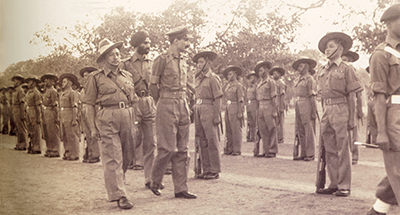
Field Marshal Sam Manekshaw inspecting troops of 5/8 GR during a ceremonial parade
Courtesy: 58 Gorkha Training Centre
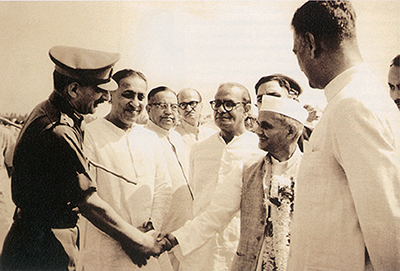
Manekshaw receiving Prime Minister Lal Bahadur Shastri at Calcutta Airport
Courtesy: 58 Gorkha Training Centre
The anecdotes that the Panthakis have narrated bring out Manekshaw’s love for the country, the Army, its officers and its soldiers. He cherished the Army and all it stood for and enjoyed every bit of service life at every level and in every capacity. His sense of humor, his friendly approach, professional competence, forthrightness and moral courage gave a new meaning to the word "integrity.” He faced each situation fearlessly without compromising on the values of honesty, integrity, loyalty and courage. His approach and behavior was the same whether he was dealing with his Prime Minister or his beloved Gorkha soldiers who called him "Sam Bahadur.” The nickname stuck and Manekshaw loved it.
Sam was ably assisted by Silloo Manekshaw who was not only a source of strength but who also brought him down to earth so that success never went to his head. She never interfered with his professional life, devoting herself to the welfare of the men’s families, war widows and battle casualties. During the war she would visit the Base Hospital every day without fail, that too without an entourage of staff and the paraphernalia that one sees these days. She was interested in the treatment received by the war wounded and not in the trappings of the chief’s offiice. When ill herself, she would drive to the hospital in her own car and take her place in the queue like anybody else.
Being professionally competent and morally upright allowed Manekshaw to be at ease with himself and with those who he had to deal with. He never felt the need to be "reverent” to his superiors. This attitude found grudging acceptance in the Army but earned for him the disapprobation of politicians and bureaucrats who thrive on flattery, sycophancy, obsequiousness and servility. The defence minister at that time was a supercilious, virulent and arrogant person who brooked no argument from anyone. He was engaged in a running battle with Gen Thimayya, the Army chief. On a visit to Manekshaw’s headquarters, he tried to get the officer to criticize the chief. Manekshaw not only refused but also let the defence minister know that what he was doing was wrong. The minister never forgave Manekshaw for this and instituted an inquiry against him in a frivolous matter. Manekshaw was lucky to have a strong and honorable general to conduct the inquiry and was exonorated of all the charges. The unforgiving minister however held up Manekshaw’s promotion for a year. Once again, Manekshaw was lucky because the minister met his own nemesis and had to resign following the debacle of the Sino-Indian war of 1962. Manekshaw was promoted and placed in command of a corps in the east that had taken a severe beating. His first message was: "Gentlemen, there will be no more retreats. We will stand and fight wherever we are and with whatever we have,” proving the adage that "a man of character in peace is a man of courage in war.”
At the end of his tenure the then Prime Minister Indira Gandhi was keen to give Manekshaw an extension. Unlike those, who tend to cling on to power, Manekshaw requested the Prime Minister to relieve him as Army chief, explaining that this could set a wrong precedent. The Prime Minister then offered him the position of governor of Maharashtra or High Commisioner to the United Kingdom. Manekshaw told her that when he took over as chief he had stated that he would not accept any government job after retirement, lest it affect his performance as Army chief. How different he was from the chiefs of today. More than one Army chief has tried to get an extension in recent times.
The Government however never forgave Manekshaw for his irreverence. Though he was made a Field Marshal, he never received a Field Marshal’s salary. They were so petty minded they increased his pension by a mere 100 rupees! Manekshaw however never took up the matter with the Government as he considered it undignified.
Faced with public approbation, the Government finally relented and granted him a salary commensurate with his rank as a Field Marshal. However, Manekshaw could never use this money as it came too late. He was in hospital at that time and died a few months later. Even in death, the Government failed to give Manekshaw his due. No senior Government servant was allowed to attend his funeral; not even the three service chiefs! A junior functionary from the ministry was sent to represent the Ministry of Defence. Nor did it end there. When Manekshaw’s birth centenary was commemorated this year, orders went out to cut down the scale and the list of invitees to serving officers in the rank of Lieutenant General only. It appears that "Babudom” ultimately does triumph in the end.
However, what comes out quite clearly in the book is that India was lucky to have Manekshaw as chief of the Indian Army at the right time. His ability to stand up to the Government and ensure that the Army had the necessary resources in manpower, weapons and equipment resulted in a scintillating victory that saw the defeat of the enemy, capture of 93,000 prisoners, liberation of a people and birth of a new nation — Bangladesh. This victory not only changed the geography of South Asia but also the power dynamics in the region.
Manekshaw’s life and the example he set embodies all that is honorable in the Army, something we all need to follow.
The book is excellent not only in the written word but also because the many photographs bring Manekshaw’s story alive.
◆ ◆ ◆
From the archive