
Services
A soldier called Sam
Sam Manekshaw’s term as Chief of Army Staff as seen through the eyes of an admirer
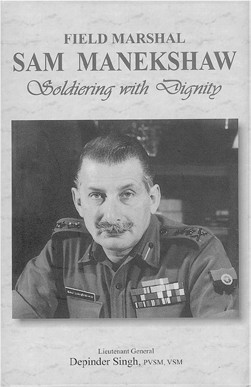
Manekshaw lore got a kickstart last year with the publication of Field Marshal Sam Manekshaw, MC: Soldiering with Dignity by Lt Gen (retd) Depinder Singh. The erstwhile Military Assistant to the Chief Of Army Staff was witness from the wings (and occasionally prompter) to the high drama of 1969-73.
In an amalgam of description, narration and anecdotal highlights Singh sets out to document the General’s "prodigious capacity for work... an irreverence towards red tape, an iron determination, an eye for detail (as well as grand strategy)... a shrewd, sympathetic and sincere ability in management that came naturally.”
"The Chief” as Singh refers to him most of the time, functioned from a simple, austere office: "Wood panelled walls with a simple pencil sketch of Gandhi on the wall, and the remainder bare. Behind his chair were two bronze statues of Victoria Cross winners, Havildars Lachhman Gurung of the 4th Battalion of his Regiment, the 8th Gorkha Rifles, and Agan Singh Rai of 2nd Battalion, the 5th Gorkha Rifles. After the Pakistani surrender in East Bengal (now Bangladesh) one of the original copies of the surrender document also adorned the wall. There was a maroon wall-to-wall carpet and simple brown curtains. In one corner was his table with an impressive array of telephones towards his right and behind these, trays, for the various papers that went in towards his left and, no matter how high the bundle, went out very quickly indeed to his right.”
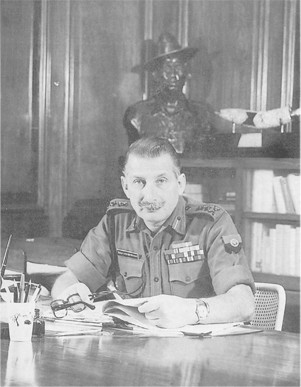
The Government of India’s Pay Commission had once asked the fastidous Manekshaw, for whom ‘informal’ dress meant no less than a lounge suit, why the Army needed its kit maintenance allowance. In reply the General requested one of the Commission’s bureaucrat members to step out and stand beside him. He then addressed the Commission, "Gentlemen, behold my dress: See my shirt, see my trousers, see the starch, the perfect ironing, the shine on my belt and shoes, see my haircut, and feel my chin. Now look at this gentleman. See his crumpled bush shirt, the creases in his trousers, look at his shoes: I beg your pardon, he hasn’t any shoes, he has chappals and no socks!
"At lunch time, I will go home, take off my uniform for my batman to straighten out, have a wash and then, after lunch relax by reading a book or listening to music; after this I will put on my uniform, brush my hair and come here for the afternoon session. Now take this gentleman: he will sit on one of these sofas, eat from a tiffin box he is carrying. After we finish for the day, I will go home, have a bath, have a whiskey, put on a lounge suit and go to a party. This gentleman will also probably be at the same party, having gone to it straight from here, and wearing the same clothes as now.” The kit maintenance allowance continues, notes Singh.
When Manekshaw assumed office as Army Chief in 1969 his first preoccupation was to "better the lot of all ranks by constructing new and more comfortable accommodation, improving existing amenities and introducing new ones and, to quote his words, ‘to instill in the officer cadre that quality so lacking now — dignity.’ Second: reorganization, re-equipping and regrouping of the Army to make it more responsive to the threats the country faced.”
Singh reports two instances of Sam’s obsession with being "polite and correct.” Leaving his residence, Army House, one morning Sam’s driver, "used to the flag and stars giving him right of way,” charged headlong into the traffic causing the car of the scientific adviser to the defence minister to swerve and stop. An angry Manekshaw "rocketted” his assistant for providing such a poor driver. But first he dictated a note of apology to the scientific adviser. On another occasion at a defence ministry conference on a hot day, the defence secretary peremptorily called to one of the attending colonels: "You there, open that window.” "Before the officer could get up came a sharp ‘sit down’ from the Chief who had entered through another door at almost the same time. Then, in the silence following his bellow, he turned to the Secretary and said "Mr Secretary don’t you ever again address one of my officers in that tone of voice. You may say, ‘Sam, would you please open that window?’ and I will open the window for you. That officer is a colonel and not, ‘you there.’ Harish Sarin, a very powerful civil servant, mumbled some explanation on the lines that he had meant no offence to which the reply was, ‘I don’t care what you meant, I heard what you said and did not like it.’”
It seems to have been the custom in the Army to save on its construction budget and return a fair portion of the allocation at the end of the year. The junior officers jested that the more money a senior commander surrendered, the better became his chances for promotion, recounts Singh. Manekshaw pursued the contrary path, ensuring new constructions, better amenities and proper maintenance. When he noticed signs of water seepage on the walls of the newly constructed officers’ quarters in Delhi, he sent the quartermaster general and the engineer-in-chief, neither of whom were even aware of the seepage, to inspect it and report within the hour. "Some may question the propriety of sending two general officers on a job such as this, but the Chief was quite clear in his mind that, unless such lapses were checked and someone came down with a heavy hand, officers and men would continue to suffer in silence.”
In tune with the requirements of modern warfare, Manekshaw advocated a series of changes in the tradition-bound army, demanding more sophisticated equipment and better education among the officers and the jawans. He urged government to affiliate the Defence Services’ educational institutions with the Jawaharlal Nehru University. The idea was to equate graduation from the National Defence Academy to a bachelor’s degree, from the Defence Services Staff College to a master’s degree and successful completion of the course at the National Defence College with a PhD. Lower examinations could be equated with the corresponding school certificates. This, he believed, would enable a retired serviceman to hold a civil degree, so necessary for a civilian job. The proposal had not yet been accepted by the end of Sam’s term in office but has since been implemented. He had also envisaged giving selected officers study leave for higher education for the benefit of the service and the individual.
Another change, on a mundane level, has been documented by Singh: "Over the years the standard of cooks in officers’ messes had deteriorated sharply. This could be attributed to a variety of reasons the principal one possibly being the rising cost of living and inability of an underpaid officer to afford good, rich and varied fare. Consequently, when one was invited to a party in an officers’ mess one could forcast the cuisine with a reasonable degree of accuracy. It would usually consist of roast chicken, vegetables in some form, and caramel custard. ‘And not well cooked either,’ the Chief used to remark. So orders went out to the quartermaster general to organize special training for mess cooks under highly qualified instructors (‘Get them from the Oberoi Intercontinental if need be,’ he was told) to teach the cooks the finer points of the culinary art. The requirement was for variety which should be well cooked. Rich food was not required and, therefore, need not be taught. So the training started and there was a noticeable improvement within a year; at least it became difficult to forecast what one was likely to get.”
The concern for the officers and jawans ran concurrently with concern for the operational efficiency of the army as a whole. Additional battalions were raised; the role of some of the older ones transformed; firing ranges were electrified saving time and manpower as manually moved targets became electronically operated; light regiments of the artillery with lighter caliber and longer range guns and smaller manpower "increased the Army’s hitting power without undue burden on the exchequer,” notes Singh.
He carried his Army Commanders and Principal Staff Officers (PSOs) with him, soliciting and carefully considering their views before executing changes. "(So that) when I leave, the next Chief will not start changing everything we have done. This will happen if he is not consulted; if he is consulted then he will spend his time and energy on improving things, not in lesser matters,” Sam explained the reasoning behind it. As for defence procurement — the lucrative business of "gun-running” with its astronomical figures that has dogged and blurred the reputation and integrity of many a man, the Chief had declared that "he could not care less which country a particular item belonged to or whose pockets were lined in the process, ‘the principle is and always will be, that the Army will get the best equipment’” — along with the requisite spares, an innovation. However some weapons systems were failures and the Chief confessed his mistakes to the Prime Minister and accepted full responsibility.
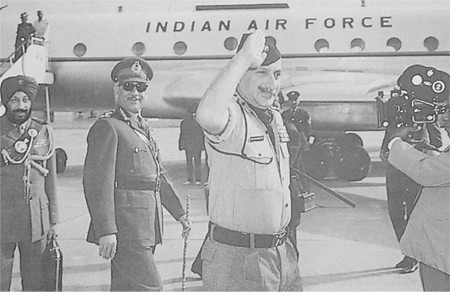
L to R: author Depinder Singh, Pakistan’s General Tikka Khan and Sam at Lahore Airport
Visiting formations/units regularly, Singh describes how Manekshaw "would invite problems by persisting: ‘Look, sweetheart, you must have problems. Even I have problems, so how can I believe you do not have any?’ Finally the officer concerned would open up and tell him his problems and those of his command. These points were then condensed on return to Delhi and raised at the next PSOs conference. Then, knowing that from the following day he would start checking, a veritable commotion would occur at Army Headquarters. As far as the formation or unit visited was concerned, its problems were resolved and deficiencies made up, leaving the officers there in a happy daze.” Even his PSOs were made to undertake such visits "not to enjoy their hospitality, but to ask them what their problems are and then to sort them out. I don’t want any witch hunts: the aim is quite simple — help the troops!”
This attitude was exhibited by Manekshaw even when he was Army Commander in the West, writes Singh, recalling his experience as a brigade major in the winter of 1964 at Palampur. A hill station in the Kangra Valley popular enough in summer with commanders and staff officers, it was shunned in the winter. Visiting the unit just then, Manekshaw went about on his inspection rounds, and asked when the chief engineer had visited to be told about six to seven months ago. Coming upon a barrack whose roof had blown off during a storm three months earlier, he wanted to know and was told that some married other ranks (junior commissioned officers) who used to live there are now housed in tents. "He turned to me and said, ‘You are going to get such a rush of visitors that you will be sick of them. But don’t let them browbeat you as they are all coming to help, even if their tempers, ruffled after I have had a word with them, indicate otherwise.’ So it transpired that, in the next few weeks of the middle of winter, Palampur was the silent and startled witness to a constant stream of high-ranking visitors, each vying with the other to be helpful,” writes Singh.
On one such visit to the 6th Battalion of the 8th Gorkha Rifles Sam asked the Commanding Officer’s stick orderly if he knew who he was. "Sam Bahadur” came the response and Sam Bahadur it has always remained among the troops. Even a marching tune was composed in his honor and so named by a bandmaster of the 8th Gorkha Rifles.
Between April and November 1971, during the feverish preparations for war, he visited all formations. Addressing the officers and men he would say, "‘There will be no scavenging. My Army has soldiers in it, not thieves. Secondly, no womanizing. I have been all over the world,’ he would remark with a naughty smile, ‘and I can say with authority that we have the most beautiful women in the world. Why go to lesser women? Furthermore, our fight is not with their women, it is with their Army. Therefore, when you feel tempted, put your hands in your pockets and think of Sam Manekshaw.’ This invariably brought the house down. The third point was an exhortation to all ranks to display valor and aggressiveness. With this, he would also tell the troops about what other preparations were afoot, what equipment was being procured, and when they would get it to meet their requirements and to make up for their deficiencies. Here his fantastic memory used to have free rein as he reeled off facts and figures of imports, of dates when ships carrying our requirements left various ports, when these were expected in home ports, and so on.
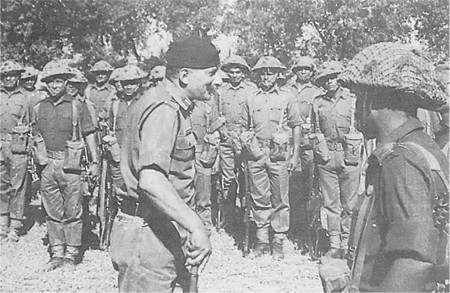
Talking to troops in the Chhamb Sector
"When he addressed officers separately, a little more bluntness would creep in. He would tell them of the crisis of confidence that was creeping in between subordinates and superiors at practically all levels. He would emphasize the need for developing mutual trust, of telling the truth, irrespective of what the consequence may be, of inculcating the quality of ‘sharam’ by which he implied the facing up to one’s obligations and discharging them to the best of one’s ability. He would tell them of the incorrect, untruthful and often exaggerated reports he was continuously getting from areas where troops were actively engaged, and how these reports stretched his incredulity and tested his patience, how wrong assessments could be made if one relied on them and the great harm that would inevitably follow if this was done.”
The Indo-Pak War of 1965 had seen a large number of senior officers sacked, some undeservedly. This time, Manekshaw told his more senior officers, "There will be no sacking. We are all doing the present job for the first time and people are bound to make mistakes. It is the senior’s job to correct and to teach and, most important, to tolerate. So, don’t come to me asking for a subordinate to be sacked, because, if you do, I shall ask what part you played in helping him, and heaven help you if you cannot give me a satisfactory reply.”
As presiding officer of the Chiefs of Staff Committee, Manekshaw welcomed the Navy’s role in the ensuing war. By November 30, 1971 all preparations were complete. It had been decided to commence operations on December 4, 1971. As it happened, Pakistani aircraft attacked Indian airfields in the western sector on the evening of December 3, 1971. The news was personally delivered by the defence secretary K. B. Lal at 5 p.m. to the top brass assembled in the Operations Room (OR) which didn’t have a telephone! The Western Army Commander, was thus unable to contact the services directly. Before leaving the OR Manekshaw instructed the director of military operations to get the OR a telephone. This was done within the hour, states Singh.
Personal security was never high on Manekshaw’s agenda. "My Gorkhas and my dogs are more than adequate to look after me,” he said. "A day or so later, L. N. Mishra, then minister of foreign trade and a very close personal friend of the Chief, drove into Army House at about 11p.m. The guard, recognizing the familiar car, saluted and waved it on without bothering to check who was inside. Arriving in the porch the minister dismounted and walked into the master bedroom through the open doors, stepping over six peaceful sleeping dogs. The Chief was asleep, so the horrified minister woke him up and told him how secure he was. I learnt about this the following day; thereafter an additional military policemen guard was added to the ‘Gorkhas and dogs.’”
Singh attributes the victory of 1971 to the "great rapport that existed at all levels: between the politicians and the services, among the three services, and finally, in each service itself... What would have happened if hostilities had commenced in April-May 1971?... It took a very brave man indeed to stand up to Indira Gandhi and get her to see his point of view despite the enormous political pressure she was subjected to. Fortunately for the country, such a man was there. We were equally fortunate in having a Prime Minister who took the advice of the professional and, unlike latter day politicians, subordinated political exigencies to national interests.”
Though the Prime Minister wished that Manekshaw receive the surrender, he refused, stating, "it was Jagjit (Singh) Arora’s show and he must bask in the limelight.” He was busy ensuring the safety of the POWs, the settlement of war widows and the medals and awards earned by his officers and men. He also helped the Indian government with diplomatically ironing out the glitches on the Indo-Pak frontier. He was awarded the Vishist Seva Medal and promoted to Field Marshal and relegated to history.
This is no attempt at an objective biography. Sloshed by Manekshaw’s ability and charm Singh admits, "The respect, affection and admiration I had for him has risen to a degree where I came to regard him as nothing short of infallible.”
Because of this and the plethora of anecdotes at Singh’s command there are occasions when he tends to digress. For the lay reader it nonetheless provides gleanings of information on how the Army functions (or functioned) in a light, readable style. And a racy pen picture of a commander of vitality, verve and a twinkle in his eye — a man with whom all of India identified in the heady days of the birth of Bangladesh, now a distant memory to the few who knew, unknown and unsung for the rest.
◆ ◆ ◆
From the archive