
In Memoriam
Welfare visionary
Died: Meher C. Nanavatty, 85, former advisor, social welfare to the Government of India (GOI) and the United Nations (UN) on August 12, 2002 at the M. P. Heart Centre, New Delhi following pulmonary complications.
"Over the years I came to value his insight and experience very much, and his resulting mature, realistic judgment on social welfare policy and practice as well as social work education. His affability and sense of humor also contributed to his being an effective colleague,” noted a condolence letter from Herman Stein, dean emeritus of the Columbia University, USA, who had known Nanavatty for five decades.
Yet another long-standing colleague Prof V. Gopalan, erstwhile joint director of the GOI Planning Commission conveyed, "He had impressed me as a disciplined, devoted, dedicated and empathetic social worker. He was a source of inspiration to many of us.” For two terms Nanavatty had served as president of the Indian Association of Trained Social Workers and was vice president (Asian region) of the International Federation of Social Workers.
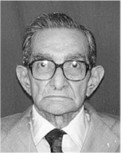
Nanavatty: expertise valued
For 14 years, from 1958 to 1972, Nanavatty worked as an employee of the GOI, first as director, social education, and later as advisor, social welfare in the then ministry of social welfare, now known as the ministry of social justice and empowerment, mentions his curriculum vitae. He was then deputed by the GOI as regional advisor, social welfare and family planning at the Economic and Social Commission for Asia and Pacific. Functioning from Bangkok, Thailand he was involved in providing technical assistance to 15 developing countries in the region, coordinating social development activities with those of family planning and population. His next appointment was as social welfare expert at the United Nations’ Social Welfare and Development Centre for Asia and the Pacific, based in Manila, Philippines from where he retired in 1980. On his return to India he worked as consultant with the National Institute of Child Development and the UN High Commissioner for Refugees at Geneva, preparing guidelines for services to special groups like children, women and the aged, notes his life profile.
"Till the last days he remained committed to his profession. He inspired and prodded us all along. His concern for the profession and affection for colleagues had drawn some of us close to him. I will continue to cherish his memory,” acknowledged Prof R. R. Singh, director of the Tata Institute of Social Sciences (TISS), referring to Nanavatty as "a distinguished alumnus of TISS.”
Bombay born Nanavatty had schooled in Surat after which he returned to Bombay to graduate in science from St Xavier’s College. After obtaining his diploma in social science administration from TISS, he started his career as the first secretary of the Liaison Committee for Charity Organisations (functioning under the aegis of the Bombay Parsi Punchayet), coordinating 18 Parsi charity trusts and providing community based services to members of the families receiving charity assistance in Bombay, states his wife Dolat.
At the age of 31 he joined the Case Western Reserve University, School of Applied Social Sciences at Cleveland, Ohio, USA for a postgraduate degree in social science administration. As noted the dean of the University Dr Grover C. Gilmore in his condolence letter, "We had the pleasure of meeting Nanavatty when he visited Cleveland last summer. He was most interested in meeting with our faculty and with the staff of the Federation for Community Planning where he was placed as a student in 1949-50. All these people were fascinated to... learn about his career since he left Cleveland. He was truly a remarkable person.”
Armed with a postgraduate degree Nanavatty returned to India to join the Baroda School of Social Work as a reader in community organization. Thereafter he joined the Delhi Municipality as advisor, social education. Adult education with civic responsibilities was his main thrust. Subsequently as chief education officer he organized and supervised the primary education in Delhi city. His love for teaching made him join the Delhi University’s Delhi School of Social Work as director, field work and reader, community organization. Later he was made a member of the managing committee of the Inter-University Consortium for International Social Development. Ever keen to share his knowledge, he wrote innumerable articles in professional magazines and journals and authored two publications jointly with Prof P. D. Kulkarni: Social Issues in Development and NGOs in the changing scenarios.
His outstanding leadership in promoting the United Way movement in India had won him an award. Along with Girdhar Vaswani, executive director of the Baroda Citizens’ Council he was actively involved in setting up United Way of Baroda, a fund raising agency which met the financial needs of nearly 35 to 40 non-governmental organizations of Gujarat. "A fatherly figure, friend and mentor,” noted Vaswani of Nanavatty, "I shall always remember his smile, bright eyes and an alert mind.” Their dream of expanding United Way Baroda to United Way Gujarat had remained unfulfilled as Vaswani migrated to USA and macular degeneration of the eyes restricted Nanavatty’s activities in the last few years. He benefited though from student readers who spent time with him and from news and intellectual programs aired on television.
Known to take "keen interest in community matters and civic issues,” the Senior Citizens’ Forum recalled how he had made voluntary contributions to good causes like the maintenance of a rock garden and to Sadhana Trust. Yet another developmental effort, Prayatn, where he had served as trustee and chairperson of the program advisory committee, gave him credit for being "a visionary and a guiding force.”
Referring to Nanavatty as "a thorough gentleman, indeed a rare commodity these days,” World Bank consultant Dinshaw Joshi of Washington noted that he was "a highly respected intellectual and a great Zarathushti who did honor to his community.” Actively interested in the activities of the Delhi Parsi Anjuman (DPA), until the end he remained a keen supporter and a critic at its annual general meetings, mentions Dolat. Despite being an ardent admirer of the late Shiavax Nargolwala, the far-sighted DPA president who had held the post for nearly 26 years, Nanavatty firmly believed that there should be a change in office bearers after two terms. Transparency, accountability and participation of the members should be the keystone of any successful anjuman, believed Nanavatty who preferred to step down after serving one term on the DPA board of management. Although he was not a very ritualistic Zoroastrian and opted for cremation, he practised the basic tenets of the religion in his life, notes his wife.
"To me, he was like a father, an uncle and a friend all rolled into one,” acknowledged Zenobia Panthaky, a budget analyst with the World Bank at Washington, adding, "He lived life to the full and was a caring and intuitive person. He meant so much to so many and he touched many lives...”
The social welfare expert is survived by his wife Dolat and daughter Meherangez.
◆ ◆ ◆
From the archive