
In Memoriam
“Conscience of the nation”
"When a republic comes to birth, it is the leaders who produce the institutions. Later, it is the institutions which produce the leaders. The question — where are the leaders of tomorrow? — can only be answered by the other question — where are the nation-building institutions which can produce the leaders of tomorrow?...
"What we need today more than anything else is moral leadership at all levels. It is particularly essential in the field of education — moral leadership founded on courage, intellectual integrity and a sense of values.”
Nani Palkhivala’s comments, read out on his behalf, were a part of his response to the chancellor, vice-chancellor and senate of the University of Bombay conferring on him the honorary degree of Doctor of Laws on January 19, 1998.
The citation documented his many achievements: "You have, as India’s leading jurist, through your scholarly writings, not merely articulated the definitive treatise of our tax system and laws, but through myriad essays, articles and speeches on subjects ranging from the rich cultural heritage of this ancient land, the invaluable democratic institutions and traditions we have inherited, the necessity for an independent judiciary, economics, literature, incisive analyses of India’s annual budget and various aspects of nation building, succeeded in educating the people and making them realize and appreciate their unique legacy. You have stood tall in the business world and have executed with distinction your role as India’s Ambassador to the United States of America. You have done all this with rare intellectual integrity, simplicity and sincerity, with devotion and dedication, with courage and conviction and above all frankness so that our democracy remains vibrant and alive. You, Mr Palkhivala, have extensively, inexhaustibly and explicitly argued many landmark cases which are benchmarks against which later generations will be judged. Barring some exceptions, these cases were all fought by you without charging any fees as a matter of service to the nation.”
The US universities of Princeton and Lawrence had similarly endowed him, earlier, with their honorary degree of Doctor of Laws.
But the celebrated public speaker’s once great capacity for speech was muted and the growing materialism of Indian society cast a pall of despondency that increased his depression.
In an interview with rediff.com in 1996 [reprinted in the Afternoon Despatch and Courier (ADC), December 12, 2002 ] he had noted, "We are reaping the fruit of neglect. You cannot have a democracy with adult franchise when half the people are illiterate... I think we are headed for a disastrous future... We are misleading the people. It is not that the nation is left to fend for itself. It is positively misled. And it is positively misled by those who come to power on adult franchise.” In 1993 he had told the ADC editor Behram Contractor, "The Singapore budget has allocated 18 percent on education; we have allocated three percent. In France, the second most important person in the cabinet after the prime minister, is the education minister. I am ashamed to admit, I do not know who our education minister is. Do you?” As noted T. J. S. George in The Indian Express (The IE), December 16, 2002 "Nani Palkhivala, one of the few Indians in India, was a depressed man towards the end. The loss of moral decencies in public life and the rise of scoundrels to political power seemed to hurt him personally.”
In the year 2000, 40 public organizations joined the Bharatiya Vidya Bhavan (BVB), which Palkhivala served as vice president and trustee over three decades, to form the 80th Birthday Felicitation Committee chaired by then Governor of Maharashtra Dr P. C. Alexander. Capping the tributes from a number of dignitaries Alexander had then said, "We respect you for all the great achievements in your life but we love you and respect you for being a Moral Man.” The governor attributed this "growth of the soul in search of truth and goodness (to) the abiding influence of the teachings of the great prophet Zarathushtra.”
The man whom C. Rajagopalachari, free India’s first governor-general, had described as "the gift of God to modern India,” had stated in an interview published in The Times of India (The TOI — August 5, 1998), "I believe that the basic pattern of an individual’s life is predetermined... Life has taught me to have deep faith in the existence of a force that works. You may call it chance or accident, destiny or God or higher intelligence... I acknowledge this force because my intellectual mind says so. Religion is one of the ways to seek God... I try to imbibe Prophet Zarathushtra’s teachings in my personal as well as professional life.”
When the recent twilight years flashed to an end with a massive heart attack on December 11, 2002 love and admiration for the man who epitomized the nation’s conscience welled forth in condolence meetings, comments, articles and letters in the Press.
A full court reference of 32 judges of the Bombay High Court paid rich tribute to the eminent jurist, reported The IE (December 20, 2002). "He was one of the earliest advocates to be offered a seat in the supreme court directly from the bar, but he chose to continue at the bar,” former attorney general Ashok Desai told The TOI (December 12, 2002). He had earlier refused the office of attorney general of India. Nationalist Congress Party president Sharad Pawar described Palkhivala as "a titan in the field of economics, constitutional law, diplomacy and public administration who had enriched India’s public life with his erudition, eminence and grace,” reported that newspaper.
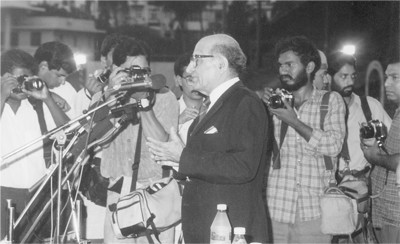
Photo flashes before a budget speech and (below) in 1999, paying homage on Mahatma Gandhi’s death anniversary
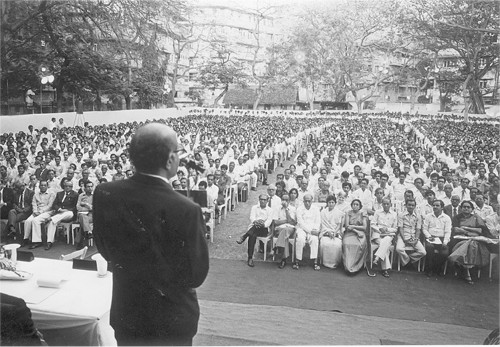
Two aspects of Palkhivala’s career placed him in the legendary category. As Lakshman Sundar wrote in ADC (December 17, 2002), "Nobody could explain the fiscal jargon as simply as Palkhivala.” Within a couple of days of the budget being presented by the union finance minister, Palkhivala dissected it, projected its socioeconomic repercussions in the country, compared it to the exercise in other major democracies, all in simple English injected with his own cocktail of humor, statistics, anecdotes and examples to highlight his arguments. So enthralled were his listeners that the annual exercise, held under the banner of the Forum of Free Enterprise (FFE), which began at the Green’s Hotel in 1957 with some 600 attending, swelled to 100,000 people thronging the Brabourne Stadium from early afternoon. Some offices closed half day to enable its employees to find a place to sit. And, by the time Palkhivala called it off in 1995, the annual exercise was repeated in Calcutta and Madras.
Cusrow Irani, editor and managing director of The Statesman who is Palkhivala’s cousin, recalled how, the day after the first such event, his cheque of Rs 25,000, in payment for Calcutta’s Indoor Stadium which seats 12,000 people, was returned to him with a letter from Chief Minister Jyoti Basu’s secretary "conveying that what Nani Pal-khivala had to say was in the nature of pubic service. The West Bengal government does not wish to charge for the stadium.”
"He gave his last lecture in 1994. He was struggling with Alzheimer’s and Parkinson’s. He felt he could not go on. The last telecast was shown on TV four times because of requests from the audience,” Palkhiwala’s friend, biographer and longstanding Forum secretary M. R. Pai told Manoj Nair of Mid-Day (December 12, 2002).
"The art of argument by reducio ad absurdum was his hallmark. His arguments in the High Court were so focussed, his sense of timing and emphasis (unbeatable),” commented Bansi Mehta, former president of the Institute of Chartered Accountants of India.
ACC director and company secretary P. K. Sinor described the annual general meetings Palkhivala chaired as chairman of the company’s board of directors. "Presiding over shareholders’ meetings, Mr Palkhivala’s conduct was an object lesson in the art of chairmanship and it was a treat for the shareholders. He understood their psyche and respected their views/sentiments. He was a great proponent of constructive dissent and gave freedom to all speakers to voice their views.” Speaking of the ethical practices Palkhivala incorporated in ACC, managing director M. L. Narula told The Economic Times (December 12, 2003), "He would take decisions based on whether they are in the interests of the company and the nation.”
"It was always a punishment to speak after Nani had spoken,” said Tata Sons director Fredie Mehta. He recalled his astonishment when Palkhivala made a passionate plea for moral values to an audience of international bankers, enumerating the spiritual splendors of India’s great rishis.
Palkhivala’s "involvement with the BVB was total. We could walk into his cabin (any time) for guidance,” noted fellow vice president of the Bhavan Pravinchandra Gandhi as he recalled the spiritual power of this deeply religious man whose compassion and love enveloped all suffering human beings.
His probity added to his legal acumen made Palkhivala the bulwark for democracy in India. When, in the heyday of socialism, Indira Gandhi nationalized about 14 major banks in 1969 Palkhivala fought for the rights of their shareholders — "hundreds of thousands of middle class citizens whose hard earned savings were invested in the banks,” as he wrote in We, the People. The Supreme Court struck down the action nationalizing the banks without payment of what the law regarded as compensation. The Government brought in the 25th amendment of the Constitution to supersede the Court’s decision.
When Gandhi sought to abolish the Maharajas’ privy purses, guaranteed by the Constitution of India, in 1970, Palkhivala argued, "If privy purses could be stopped by mere executive action, the most unsafe investment in the world would be the securities of the Indian Government in which the funds of charities and trusts for widows and orphans, and provident funds of millions of workers, are invested. If privy purses could be repudiated, so could the Govern-ment’s obligation to pay the principal and the interest in respect of Government paper, because the Constitution used exactly the same words in gua-ranteeing privy purses as for guaranteeing the Government’s obligation in respect of securities (arts. 112(3) and 291). What was at stake was nothing less than the nation’s honor and its reputation for financial integrity in the eyes of the world” (We, the People).
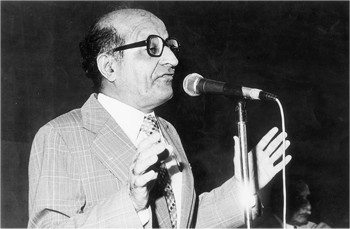
Dissecting the budget: reducio ad absurdum
After the five-month deliberations in the Kesavananda Bharati Case the majority judgment of a bench of 13 Supreme Court judges upheld Palkhivala’s contention that Parliament’s power to amend the Constitution is limited so that its basic structure and the rule of law are preserved. These ‘basic’ features of the Constitution include the supremacy of the Constitution, the rule of law, its democratic, republican structure, the freedom and dignity of the individual, the principle of equality, the independence of the judiciary and its right to strike down laws that contravene the provisions of the Constitution, etc.
When the Allahabad High Court ruled against Indira Gandhi as having been elected by unfair means, she turned to Palkhivala to pursue her appeal in the Supreme Court and he managed to get her a conditional stay on the High Court order. Then she proclaimed the Emergency and prevention detentions, the suspension of civil liberties and censorship became the order of the day. His moral courage never in question, Palkhivala returned the brief, maintaining that his decision was "not negotiable.” When the TOI said they couldn’t carry the news because of press censorship, "Nani phoned and said we’d move the court to ensure it was,” noted former president of the Bombay Bar Iqbal Chagla. He led 144 lawyers with a writ petition in the High Court in defense of the fundamental right to freedom of expression, added Chagla.
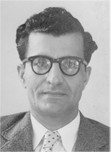
The youthful lawyer, a career ahead
Former Chief Justice of India Yash-want Chandrachud was Palkhivala’s contemporary. Both were born, graduated, married in the same years and started practice on the same day at the Bombay High Court. Chandrachud who was one of the 13 judges hearing Palkhivala in the Kesavananda Bharati case, noted, "My colleagues were amazed and dazed with his arguments. (They were) worried that carried away by his arguments they’d give a wrong judgement!” Speaking of Palkhivala’s "unparalleled forensic skills” Chandrachud declared, "Nani could lighten dark corners of the law, make intricate points of law so easy... He was clear, simple, logical and a master of ingenuity.” Chandrachud said he had ruled against Palkhivala in one case during the Emergency. "He never held it against me; the others did.”
When the Congress party was defeated at the hustings after the Emergency was lifted and the Janata party came to power, finance minister H. M. Patel wanted to make Palkhivala a member of the tax committee, noted Bombay Parsi Punchayet chairman Minoo Shroff. Prime minister Morarji Desai wanted to mend India’s poor relationship with the US and chose Palkhivala for the job of Ambassador to the US, said Shroff. Palkhivala’s commitment and passion for public causes led him to be an active president of the FFE and the Leslie Sawhney Programme for Training in Democracy. He was "often critical that people did not look beyond their nose. We citizens need to give time and talent (to the country) along with taxes,” Shroff added.
Palkhivala never forgot that he had received his first brief from the eminent solicitor, the late Rustom Gagrat and it was Gagrat who had martialled the case for Palkhivala when the latter’s seminal treatise, The Law and Practice of Income Tax, was attacked for plagiarism in the Madras High Court. Though he was defended by such prominent lawyers as R. J. Kolah and Hormusjee Seervai, the judge observed that he had "never witnessed a cross-examination so destructive of the case for the petitioner.” In the witness box Palkhivala cited from memory some of the 2,000 cases on which he had based his book and how they had affected the law and practice of income tax, noted Gagrat’s son and senior solicitor Jangoo. The book went into several editions. A copy from each edition was autographed with a suitable inscription and presented to Rustom Gagrat. "Palkhivala was the only lawyer with a (mere) four-year standing to appear before the Supreme Court and the youngest member of the Law Commission,” added Jangoo.
"Envy, the besetting sin which cannot countenance the fame and success of others, never consumed him. The holier than thou attitude was alien to him. He was not the one to smile and shake your hand and thereafter stab you in the back,” wrote attorney general Soli Sorabjee who had been Palkhivala’s junior at the time of the Kesavananda Bharati case. Former director general of police, Arvind Inamdar told The IE, "His love for his country and his countrymen was tremendous. He was a man with a razor sharp brain and a golden heart.”
Chairman of BVB’s UK center Manek Dalal recalled Palkhivala’s "quiet spoken, unassuming presence (and) concern for justice for the lesser man.” Former legal assistant Dinesh Vyas described the two phases of Palkhivala’s life: the mundane with the lectures, the legal profession, as industrialist, diplomat and "para political figure” who never joined a party or faced elections. And his real life: "a journey for a spiritual quest, (using) BVB to come in contact with virtually every inspiring spiritual leader of the country viz Mother and Aurobindo (he was legal advisor to the Pondicherry Ashram), the Swami of Kanchi who regarded Palkhivala as a true Brahmin.”
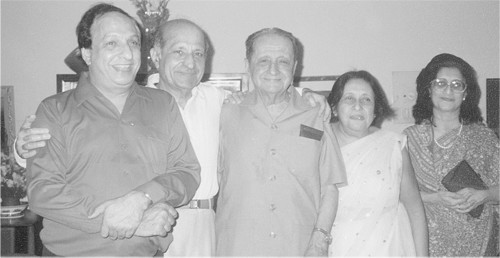
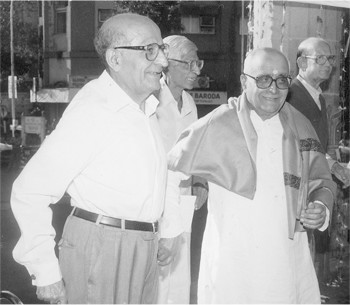
Birthday celebration 1989: Palkhivala (2nd from left) with Engineer, Rustom Gagrat, wife Nergesh and Maneck J. Gagrat
Vyas said that Palkhivala loved and studied all religions but what he practised — the Satya Sai Baba’s message — consisted of five words: satya — truth/intellectual integrity; dharma — follow your own religion but respect the religion of others; shanti — peace/inner calm; prem — compassion/understanding; ahimsa — non-violence/oneness with everything precious in life. "He implemented this religion as a Parsi... When he was felicitated on being appointed Ambassador to the US he had said that he would like to be born again as a Parsi,” recalled Vyas.
Thanking the eight anjumans of Gujarat who felicitated him on his 75th birthday at Bombay’s Patkar Hall, Palkhivala had declared, "If I had to choose a religion voluntarily, one which appeals most to my soul and my mind, I’d choose unhesitatingly the religion of Zoroaster... (It) transcends limitations of race and gathers together all human beings in one circle of union. Zoroaster’s was the first religion that rescued religion from a tribal god and gave it to all mankind. Zoroaster was the greatest of the pioneer prophets who showed the path of freedom to man. (Unfortunately there are those who) think they’re Zoroastrians because they belong to certain schools of thought. (There is) no tolerance for thoughts not their own. I am deeply distressed by what I see happening to my own community as I come to the end of my life... Everywhere dogma is put in place of truth, trappings in place of essence. We number barely 100,000 throughout the world. We can’t afford dissensions. I beg of you, bear in mind the real message of the Prophet... It is not a religion meant for 100,000 human beings. It is meant for the entire human race. It is a message we need to relearn.” At the second International Congress covened by the K. R. Cama Oriental Institute in 1989 Palkhivala had noted succinctly: "Zoroastrianism had been tried and failed. The religion of Zoroaster is yet to be tried.”
"Palkhivala was to the 20th century what Dadabhai Naoroji was to the 19th century... He was the conscience of the nation, a trustee of all good human values. He practiced them and it showed,” noted Pai.
He was compared to Demosthenes because like that famous Greek democrat and orator he had conquered his stammer to rise to great heights of eloquence. A first class first through his BA, MA and Law exams, he was afflicted with writer’s cramp and had to have someone else write his papers for him. His speed of thought made him dictate like the Rajdhani Express, his last secretary T. Dolikuka told ADC. M. R. Narayan, his first secretary at Tata’s recalled that Palkhivala "never took any carbon copies and often said that he had everything stored in his head.” "You were always given a fair and complete hearing and the contribution you could make was generously acknowledged,” notes Shirin Bharucha, Tata’s legal officer and Palkhivala’s junior colleague.
"No one ever saw him in an idle moment... He once said time was the only enemy in his life,” noted former solicitor general Tehmtan Andhyarujina. He was "over-emersed in his work — a fault with him,” rued friend and physician Dr Farokh Udwadia. "I advised a break, a holiday. It was constant advice that he constantly refused,” he added.
Senior solicitor and BPP trustee Dadi Engineer recalled how Nani limped into the room, apparently in pain, when it was his wife Nergesh who was supposed to have returned from an operation abroad after a nasty fall. "He explained that since he had to be with Nergesh in hospital, he decided, in order to save time, to get himself operated for his hernia!” wrote Engineer in the ADC in a tribute on Nani’s 83rd birthday — a month after his death.
In the latter years he was persuaded to stay over for the FFE programs held outside Bombay. "I discovered that he liked to visit zoos... and expressed wonderment and humility at nature’s marvellous creations,” noted Engineer.
To make ends meet he helped his parents by playing the violin in the band at weddings and navjotes as also by giving tuitions, Irani had noted. One reason why Palkhivala did not accept the offer of judgeship of the Supreme Court was because he actively looked after his aged parents and wanted to be by their side, noted Andhyarujina. He had also worked at the Royal Western India Truf Club’s tote window for a time and greeted his former boss with all the respect due to a senior when the twain met unexpectedly after Palkhivala had become a national celebrity.
Palkhivala’s first choice of vocation had been teaching. When the appointment he sought at Sydenham College went to a lady competitor because she had the experience he lacked, Palkhivala took to the practice of law, he had told The Bombay Samachar. As a busy young advocate he shared his enthusiasm for the subject with aspiring laywers at the Government Law College. Many a leading member of the bar recalled packed classrooms when Nani lectured. His zest for sharing his knowledge with others contributed to the historic budget speeches as much as to his other public speeches and articles in the press. We, the People, We, the Nation were selected items reprinted in book form. He also wrote Our Constitution: Defaced and Defiled and in 1967, The Highest Taxed Nation.
The proceeds of the last edition of his income tax compendium went towards setting up a memorial for his friend the veteran Gandhian Jayaprakash Narayan who had battled the Emergency, his health deteriorating during the months in jail, noted Pai. The earnings from the privy purses case were constituted into a trust, said Udwadia who had received a donation to start a lung research laboratory at the J. J. Hospital. Palkhivala "was unaware that he was responsible for the research that won praise,” noted the physician. Many a cause, public and private, found in him a munificent contributor.
To Goolam Vahanvati, advocate general of Maharashtra, "He was larger than life. He was everything you looked up to. Everything you aspired to be. Everything you admired and idolized... He mesmerised people. He hypnotized an audience. And he cast such a spell over the court that judges felt they had to take time after Nani had finished arguing to give their judgement, because they had to allow the effect to wear off...
"This was the man you went to meet in Bombay House, on the top floor, for a major opinion. You were a trembling junior, but he made you comfortable with the warmth of his smile and the generosity of his person... And when the conference was over, and you were still completely dazzled, he personally led you out, opened the door and accompanied you to the lift. You were simply overwhelmed. Humility and greatness is an unbeatable combination.”
Palkhivala is survived by his brother Behram and sister Amy Ranina.
◆ ◆ ◆
From the archive