
In Memoriam
Lala, the leveler
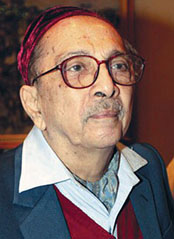 Died: Russi Manecksha Lala, 84, co- founder and former chairman of the Centre for Advancement of Philanthropy (CAP), and author of several inspirational books including those chronicling the accomplishments of Tatas, on October 19, 2012 in Bombay.
"The outstanding strands of my life have been faith and a purpose… A man needs both – a faith, an anchor to hold on to; and a purpose, a compass to steer by,” summed up Lala in The Thread of God in My Life: An Autobiography with a Difference, released three years prior to his demise.
Afflicted by cancer of the lymph nodes 23 years ago, he soldiered on believing that any crisis can be confronted if we "marshal our inner resources of strength.” "Always frail in body but sharp and strong in wit is how I will remember him,” observed Noshir Dadrawala, editor of Philanthropy, the CAP newsletter, in a tribute to his mentor in the September-October issue. Chairman of CAP for 15 years, Lala impressed on his colleagues that in the field of philanthropy one needed to think through their head but give through their heart. He also advocated that besides being trustworthy it was essential to trust the inherent goodness that all human beings possess.
He realized that "challenges are there to make you better and not bitter,” Dadrawala commended Lala’s resilience when officiating as the master of ceremonies at the memorial meeting in his honor at the Happy Home and School for the Blind on November 20, 2012. His book Celebration of Cells: Letters from a Cancer Survivor "has benefitted a lot of people,” attested Vandana Gupta of V Care, who was inspired by him "to form a support group for cancer patients.” Valuing the confidence she got from him when she was battling cancer, she urged him to write a book that could allay the misapprehensions of other cancer victims.
Of the 11 books that he authored, The Creation of Wealth – The Tata Story and Beyond the Last Blue Mountain – A life of J. R. D. Tata went on to become bestsellers. His books were translated into different languages including Japanese. In The Heartbeat of a Trust, JRD had commended "his rare and felicitous ability to write simple, honest and lucid English.”
"He lived life in a most principled way,” admired Armaity Desai, former director of the Tata Institute of Social Sciences (TISS) that received financial support from the Sir Dorabji Tata Trust where Lala was director for 18 years. Since Lala was on the governing board of TISS they would often interact making her observe, "With the courage of his convictions he made proactive use of the worst problems in life, never seeking special privileges or concessions.” Describing him as a "great humanitarian,” Desai added that he was "simple, straightforward, open, reaching out.” As a "people’s person he understood the needs of people and institutions.”
"He understood that philanthropy is not only giving with the mind but with the heart,” remarked Roda Billimoria, founder of Sir Shapurji Billimoria Foundation. Before committing funds from Sir Dorabji Tata Trust he made it a point to understand the "passion with which a program would be followed.” She referred to her first interaction with him at his office when compelled to cut short the meeting he subsequently called to apologize and fix another appointment. Thereafter she had many opportunities to exchange views and recalled their discussion on prayers. When she told him that she tended to get distracted whilst saying her prayers, he responded, "You must not say your prayers, you must mean your prayers.”
"Legendary, full of wisdom,” Lala shared his insights on philanthropy quite different from what she had learnt as a business management student, stated Pushpa Aman Singh from GuideStar India that maintains an online database of over 3,000 nongovernmental organizations in India. When he asked her to write a chapter in his book, foreseeing his end he told her, "I have very little time. Time is of the essence.” Always seeking to give a new dimension to philanthropy, at their last interface he urged, "The next time we meet, tell me how to use social media.”
A trustee of The Bombay Community Public Trust (BCPT), Lala would not miss any meeting and had "a sympathetic, practical approach, always guiding us,” remarked BCPT chairman Dr B. R. Barwale. Giving him credit for explaining to her the objective and philosophy of giving, BCPT executive trustee Harsha Parekh related how he would ask the most penetrating questions: "What is it that makes you happy from within?” "What is the purpose of your life?”
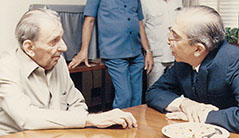 When an appeal was sent for a gymnasium and physiotherapy center at the Happy Home and School for the Blind, Lala came personally to assess their needs before sanctioning the equipment, appreciated the School principal Snehal Joshi. His wife Freny (who predeceased him) would often visit the School and help students needing assistance with reading and English. The visually impaired students of the School lent a special charm to the memorial meeting with their melodious singing of Hindi bhajans like Itni shakti hamé déna daataa, Hé maalik téré bandé ham, Raghu pati raaghav, and English hymns Amazing grace, What a wonderful world and Lala’s favorite, Abide with me.
"He was very fond of reading the Psalms and was deeply inspired by the Dalai Lama but at heart he was always a proud and true Zoroastrian. He looked rather cute in the red Parsi skull cap that he used to wear… He assimilated the best values from every faith into his life. What he liked most about Christianity was the concept of love and forgiveness. From Buddhism he drew compassion and from Zoroastrianism, truth and righteous conduct,” appreciated Dadrawala. From Mother Teresa he learnt, "Try not to judge people. If you judge people you cannot love them.”
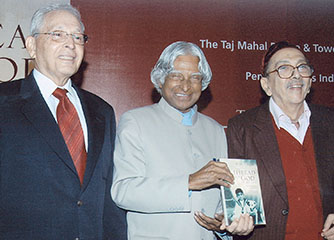 After his graduation with history honors from the Bombay University, he took to journalism in 1948 at the age of 19. As a freelance writer his articles featured in The Times, London, The Times of India, The Canberra Times and The Sunday Standard. In 1951 he entered book publishing and from 1959-63 managed the UK division of Asia Publishing House. In 1964 he co-founded Himmat weekly which he edited for a decade. Very active in the Moral Re-Armament movement (now known as Initiatives of Change) he was instrumental in founding their center in Panchgani. As wrote Anne Wolrige Gordon of their UK chapter in a condolence letter, "He instilled in all my children a great love of India and was the living example of the truth that the Indians write better English than the English.” It was thanks to his vision, with the support of J. R. D. Tata and Jamshed Bhabha, that the Tata Central Archives was launched and today has a building dedicated to it in the campus of the Tata Management Training Centre in Poona.
 Always impeccably attired in a jacket, with a scarf or a tie, Lala’s observant eye for detail would neither miss unpolished shoes nor ill-kempt hair. He liked to start his days with contemplative thought in the stillness of the early morning. As he mentioned in his autobiography, "In my morning quiet times I seek not only correction but day-to-day direction through the inner voice. I begin with a brief prayer or inspirational reading from the scriptures or elsewhere.”
Commending his sense of humor, his personal assistant for 30 years, Villoo Karkaria mentioned that he ensured that anyone entering his cabin would walk out smiling. When selecting employees he made his final decision, not on the basis of the candidate’s qualification but his/her cheerful disposition! "Very endearing, spreading a lot of love and affection, more than a boss he was a very precious friend,” appreciated Karkaria, adding, "We did not work for him but with him. He helped so many of us to grow.”
Large-hearted and charitable, he willed his entire estate to charity, not forgetting his staff members whom he considered as family. In his book The Art of Effective Giving, Lala had noted in his preface, "Daan is an integral part of the Parsi ethos too. People built wells and rest places for tired travelers and provided drinking water to men and animals alike… There is something everyone can do in their own small way and find great satisfaction in it.”
Although physically frail he remained mentally alert until the end ensuring that no mail was left unanswered and in fact dictated his last two books from his bed, recalls Karkaria. His final work, Counting Your Blessings: Inspiring Ways to Cope with Old Age was released a week after his demise. Believed Lala: "Age is a time for discovery… the art of aging is the art of adaptation… another advantage of age is that you think more of others and less of yourself.”
◆ ◆ ◆
From the archive