
Zoroastrians Abroad
Giving back
Despite bureaucratic hurdles, expatriate Dr Phiroze Hansotia is determined to establish the Nagpur Medical Alumni Association for his alma mater
The story of Phil Hansotia could be the story of any one of the hundreds of young, intelligent Parsi boys who go to the USA every year for higher studies. They usually excel in academics, adapt easily to an American lifestyle, meet and marry an American girl and make a success of life over there, with occasional bouts of nostalgia for Dadar Parsi Colony, dhansak and dar ni pori.
His story has many parallels to this, but Han-sotia wants to give back to the college, the community and the country of his origin, a measure of what he took out of it in terms of values, education and expertise.
A Bombay boy, Phiroze Hansotia completed his early education from St Mary’s High School and later St Xavier’s College. Opting for medicine like most brilliant students do, he got admission in the Nagpur Government Medical College. "I have always thanked my stars that I got admission in Nagpur,” said the now handsomely graying and bearded Hansotia. "Growing up in a Parsi colony in Bombay was a very insular experience. I was never exposed to the real India of Hindus, Muslims and Sikhs. My six years at the medical school in Nagpur added a whole new dimension to my understanding and appreciation of our multicultural country.”
Hansotia came to Nagpur in 1956 as a freshman and left in 1962 with an MBBS degree in hand and a stethoscope around his neck. "The Medical College was young and vibrant, the faculty was excellent,” said Hansotia, reminiscing. "Some of the best names and brains in medicine, like Drs Berry, Dubey, Shridevi, Nargis Dalal were our teachers. Whatever I might have achieved today in the field of neurology, the foundation for it was laid in Nagpur.” Hansotia, MD, FAA, FAEEGS (now retired), is a neurologist of international fame, with many professional papers and presentations to his credit.
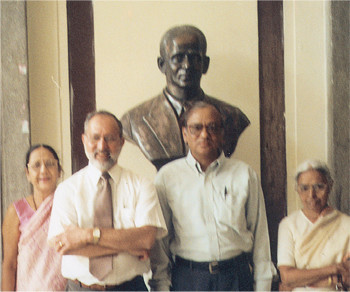
(L to R): Dr Hema Mankeshwar, previous dean of the Medical College, Hansotia, current dean Ram Ayachid and Hansotia’s classmate Dr Mukta Kherdekar
Forty years after having left Nagpur Medical College (he has been back in between), Hansotia returned to Nagpur in January 2002, this time with a fervent desire backed by the ability to give back something to his alma mater. "Experience, equipment, money, it can all be harnessed and ploughed back to the institution for helping today’s students,” says Hansotia with visible enthusiasm. "Networking” is his mantra and "ploughing back” his mission. "Most of my batch mates are highly successful doctors scattered across USA, Europe and India. I have been able to establish a network to contact and motivate many of them.”
Hansotia’s biggest hurdle, believe it or not, is not in getting the money but in giving it to government run institutions like the Government Medical College in Nagpur. There is so much red tape and bureaucracy involved that a less motivated person would have thrown his hands up in despair. "Money or equipment cannot be given to the Medical College of your choice,” he was told by officialdom. "It must be given to the State Government, which will decide where it is needed.” Meetings with the dean or concerned ministry were delayed or cancelled arbitrarily when he or one of his colleagues had made a special effort to be present for them. After battling with bureaucracy for years, Hansotia has finally on this trip to India been able to lay down the framework for setting up a Nagpur Medical Alumni Association, with the authority to give money, equipment, books and the sharing of experience and expertise with his alma mater.
Hansotia has now retired from active hospital work. Recalling his rise up the medical ladder, he says it was very hard work but it was a labor of love. After his MBBS, he went to Wisconsin, USA to study general internal medicine and neuropathology. He did more than complete his residency at the University of Wisconsin. He met and married Marilyn, an American fellow student. The distinguished doctor actually blushed in describing how he met Marilyn! "A friend and I went on a double date, which is a common thing to do. I found Marilyn more interesting and enjoyable than my own date. Then on, things took their own natural course!”
From USA the young couple moved to London. As registrar of the National Hospital at Queens Square, one of the most prestigious teaching hospitals for neurology, Hansotia immersed himself in some hard and satisfying work. He participated in many training programs for Commonwealth students.
During this time the Indian High Commission in London approached Hansotia to come to India and conduct similar programs. In spite of having an American wife and a four-month-old son, Hansotia was fired with enthusiasm to return to his roots: "I saw myself as a bridge, transferring technology and know-how to young, enquiring minds.”
With the assurance of a position at the department of neurology at Grant Medical College, the Hansotia family came to Bombay, the doctor brimming over with ideals, the wife mildly apprehensive of a new country, culture and baby to cope with. Hansotia worked at a manic pace — four days at Grant Medical College, two days at Bombay Hospital and weekends at Ruby Hall, Poona. "To present a young Indian medical student the opportunity to grow was a challenge to me as a teacher.”
At the end of a year however, Hansotia was a disillusioned man. Because of the red tape and obstacles at every step, his interest and desire to work in India, took a sad hammering. Hansotia accepted a position at Marshfield Clinic, Wisconsin and returned to the USA to resume a career in teaching, research and hospital work.
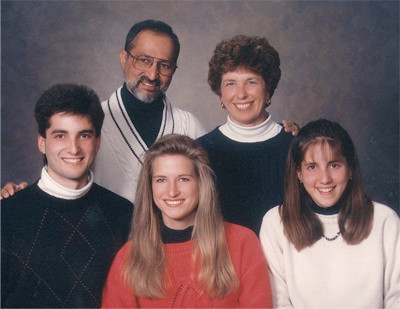
The Hansotia family: Phil and Marilyn (standing) with Eric, daughter-in-law Karrie (center) and Shirene
Recalling all of this, Hansotia said, "I have been totally happy in my 30 years at Marshfield and have no regrets.” Elaborating upon the success of his present visit, he said, "I am delighted that on this trip to Nagpur, my colleagues and I got some great ideas and good support from the dean’s office. I am optimistic that by year end, we will have the Nagpur Medical Alumni Association turn from a long-held dream to reality.” When this happens, it will open up endless possibilities for an exchange of ideas, an enriching of minds and a ploughing back of money, books and equipment to the Nagpur Medical College.
Even a half hour meeting with Hansotia leaves one impressed with the wide and varied range of his interests. "Our family is very tuned to the outdoors. Hiking, biking, camping and horse riding are favorite pastimes.” He is absorbed in literature and poetry and collects folktales from around the world. The birds and the bees, the shrubs and the trees are all studied by Hansotia, not as an academic pursuit but to make them more interesting and enjoyable. "Travelling with like minded friends is another thing we enjoy and can do more of, now that I have retired.” This October, they are going to Iran.
When asked if being a Parsi meant something special to him or if community and religion were of scant importance, Hansotia asserted, "I am very proud to be a Zoroastrian. My pride stems from our traditions of honesty, generosity and pursuit of excellence. I honor the essential creed of good thoughts, good words and good deeds. I admire the leadership qualities our community has shown in industry, the professions and in social life.” On the negative side, he said, "We as a community do have difficulty in accepting others into our fold, our religion. I am not sure I like that. I would hope that our young are focused on values rather than ritual and have a generous, inclusive view of life.”
Marilyn and Phil have a married son Eric, who is the director of the forestry division of the John Deere Corporation and a daughter Shirene who is a policy analyst for the US State Department and an officer at the American Embassy in Ethiopia. Talking of how they brought up the children in an interfaith alliance, Hansotia said, "Both Marilyn and I are very moderate in our views on religion. Our emphasis has always been on human goodness. The children were taught the essentials of both Zoroastrianism and Christianity. They were also exposed to other faiths and taught to respect people’s right to choose their own creed.”
Hansotia’s own early life was greatly influenced by his maternal grandmother Shereen, from whom he imbibed the bedrock values of life. His uncle, Adi Bhathena, with a passion for excellence and a lively interest in everything, also impressed his formative years. In Hansotia’s professional career, his role model was a senior doctor he interned with in Erie. "He is dead now but he was the most compassionate and giving person I have known. It pleased him to give his juniors every opportunity to learn and to excel. His encouragement would even extend to paying for students to present a professional paper.”
With so many positive influences it is no wonder that Hansotia comes across as a person with a generosity of spirit and a gentleness of being. His world view is summed up thus: "Having gone to a Jesuit school and college in Bombay, then to the Medical College in Nagpur where I learned to appreciate the beauty and depth of both Hindu and Muslim philosophy and then having worked in different continents, I’ve seen human beings of every stripe. What comes through is, one likes and admires people for what they are as individuals and not for the community or religion they belong to.”
◆ ◆ ◆
From the archive