
Zoroastrians Abroad
Felicitating Kaikhosrov Irani
"Among the Hasidic Jews there is a traditional belief that in this world there are at any moment in history 36 just men. It is because of these 36 just men and the web of their ongoing goodness that God has not annihilated the world. The 36 are, in a quite literal sense, the salvation of us all. I should I suppose confess to a long held suspicion that K. D. Irani might be one of these 36,” academician and Irani’s colleague Dr Jacob Stern said when the Zoroastrian Association of Greater New York (ZAGNY) honored its philosopher-in-residence Prof Kaikhosrov Irani at New York’s Pomona Darbe Mehr on November 20, 2004. The place brimmed with colleagues, students, past and present, and admirers from all walks of life. The impressive roll call attested to a life of dedication, humility and love spent in the service of knowledge and in shaping young minds in its pursuit as head of the department of philosophy at City College, New York. With characteristic astonishment and a gentle shake of his head, Irani said, "What is all this? I never expected so many people...” reports Shazneen Rabadi Gandhi in Hamazor (Issue 4, 2004). The following is culled from her story, "Snapshots of a Good Life.”
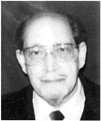
Irani: "civilizing”
The evening of "reminiscences, good wishes and gratitude” began with the chanting in benediction a Gathic verse by Ervads Pervez Patel, Darius Antia, Kersey Antia and Rohinton Madon which had been selected by Irani, followed by an English rendition by Kersey Antia. Former students and seasoned colleagues then took the stage, proffering personal perspectives on how Irani affected their lives.
"Philosophy now, and what K. D. Irani taught me then,” was the burden of the message of Professor Emeritus at the State University of New York Dr Kenneth Stern. He credited Irani with "civilizing” him with a taste for the opera and Indian cuisine as sampled at the hands of Irani’s charming wife Piroja. Most of all he recalled Irani’s advice, setting his priorities when he first started to teach: "Remember you’re not teaching a course, you are teaching students.”
Voicing "An archeologist’s involvement with Zoroastrianism,” Dr Oscar Muscarella of the Metropolitan Museum of Art noted that Irani was the first Zoroastrian he had ever met. He claimed it was his curiosity about his favorite professor at City College that set him to learn about the man’s religion. Describing his work with Zoroastrian artifacts, "Dr Muscarella mused that he had never expected when he first met Kaikhosrov that his career would involve him with Zoroastrian culture as much as it had,” notes Gandhi.
Irani’s former student and later colleague Dr Martin Tamny described a luncheon meet he had arranged with another former student. The unnamed admirer, delighted to be reacquainted with his favorite professor, donated US$ 2,000,000 to the City College Fund to establish the Prof K.D. Irani Professorship in Philosophy at the College. "Along the way he has taught me through his own actions the importance of good thoughts, good words and, most of all, good deeds,” Tamny added.
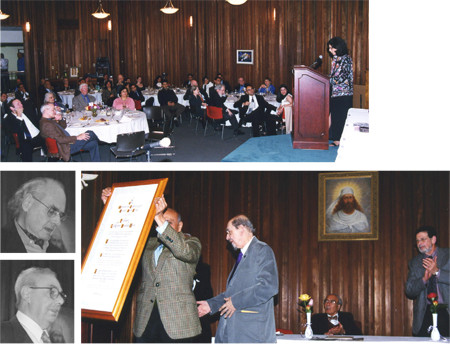
Clockwise from top: Weil addressing the distinguished gathering, Tamny, Mehr, Irani, Munshi, Stern and Muscarella
"There is only a thin line which separates Prof Irani from Don Quixote,” observed Jacob Stern. "Both men have carefully trimmed chin beards, both wear slightly bizarre clothes — though I admit I’ve never seen KD in armor — but most importantly, both men set out to act as just men should act in a world whose most outstanding characteristic is its injustice. Don Quixote does not exactly understand this fact about the world and, therefore, we think him mad. KD, on the other hand, understands well that the world in which he attempts to act justly is itself an unjust place. Yet, he seems to me constantly astonished at that knowledge. This, I think, accounts for what seems to me a notable feature of his personality: that he is totally without cynicism and without any mocking sarcasm.” J. Stern spoke of Irani’s depth of knowledge, his intellectual honesty, his wisdom, "and most importantly, the profound influence he has had on the lives of his students,” adding, "If ever there was a man whose good thoughts and deeds give us hope for the world’s renewal, that man is K. D. Irani.”
Zarine Weil, the Iranis’ niece, recalled her childhood impression of KD and Piroja as the "bright eyed man with the pointy beard who seemed to have an endless supply of stories to tell and a sweet lady who took such delight in every joke her husband told,” adding, "But what struck me about them then remains true even now.”
Former chancellor of Shiraz University Dr Farhang Mehr extolled Irani’s Zoroastrian scholarship: "Nobody, as much as Prof Irani has discerned the true meaning of the philosophy of Zarathushtra.” Dr Ali Jafarey with whom the Iranis along with several other born Zarathushtis have founded the Zarathushtrian Assembly, attributed the organization’s success to the couple. ZAGNY’s dean of religious studies Dr Lovji Cama appreciated the Iranis’ help over the years in arranging religious seminars and classes and serving as members of ZAGNY’s board. He particularly commended Irani’s "wit, his sense of humor, and his ability to tailor his discourse to the level of his audience (which) made him an engaging speaker and a great teacher for the youth.”
Former president of the Federation of Zoroastrian Associations of North America (FEZANA) Framroze Patel gratefully recalled how Irani had dispelled his disillusionment with Zoroastrianism; Shahriar Shahriari spoke of his experience of making the documentary Domains of Belief with Irani as an amazing and exciting intellectual adventure; psychiatrist and Chicago high priest Kersey Antia thanked the couple for standing by him in the troubled times following the navjote of American engineer Joseph Peterson; former FEZANA treasurer Rustom Kevala spoke of his experiences as he worked with the Iranis compiling the professor’s papers for publication; Ayesha Ghadiali read messages from all over the world communicated through the Creatingawareness network which were offered as a compilation to the genial couple. On behalf of a grateful community Zareen Austin and Shiraz Unvala conferred garlands created by Sheroo Kanga on these "grandparents to ZAGNY youth,” as Arnavaz Patel called them, and former ZAGNY president Erach Munshi presented the philosopher with a framed manpatra.
Thanking the community with characteristic wit and humility, appreciating the thought, word and deed of the occasion, Irani noted, "You must realize, this is a slightly embarrassing situation for me. I have been praised beyond my conception...These are the kinds of things that happen at memorial meetings. Fortunately, I’m alive and I have the opportunity to hear them and I do appreciate that. And you must realize that if I were dead, I couldn’t have been requested to speak. But now I shall speak, because I rather like that.”
Concluding his remarks on philosophy and Zoroastrianism ere he left the stage to a resounding standing ovation, Irani noted, "Religion without vision is blind. Religion without a way of life is empty. But there are people who think that if we perform these rituals and those rituals and so on and join in them, then that is religion. That is certainly something one should do, because that’s part of the social structure of religious life, but if you think that is religion, you are missing something.”
◆ ◆ ◆
From the archive