
Cover Story
Refurbishing the Parsee General Hospital
International Zarathushti philanthropists pour in their donations to help the B. D. Petit Parsee General Hospital meet its community obligations in the 21st century
"The special need of the hour is a corpus for the welfare of poor patients. (Let me) start with a humble beginning with a contribution of Rs 15 million towards a corpus for medicines supplied free to in-patients,” declared Hongkong philanthropist Keki Jokhi. The surprise gift brought the audience, invited by president Homa Petit and the executive committee of the Bomanjee Dinshaw Petit Parsee General Hospital (PGH) to witness the inauguration of its refurbished Extension A (popularly referred to as the nursing home), to its feet in a standing ovation on January 3, 2002.
Jokhi’s largesse capped his earlier Rs 2.7 crore donation which, together with two similar amounts from Mehraban and the late Faridoon Zartoshty of Iran and Canada, and the Incorporated Trustees of the Zoroastrian Charity Funds of Hongkong, Canton and Macau, had enabled the PGH management to completely restructure the two-storied building endowed in 1910 as the Avabai Framji Petit Obstetric Hospital.
Within the overall confines of the Hospital building’s heritage status architect Rusi Khambatta has created a spanking new layout comprising 22 rooms on the second floor, 19 rooms plus a delivery suite on the first floor and 19 rooms plus one with four beds for daycare (i.e. for a day’s admission for tests and diagnostic requirements or short surgical procedures) on the ground floor. Though the rooms are of varying sizes and orientations as the load bearing internal partition walls have not been disturbed, every room now has an attached bath and toilet plus piped oxygen and suction facility. The sleek modern decor is offset by familiar pieces of antique furniture repaired and polished beyond recognition to reflect the graciousness of the precinct.
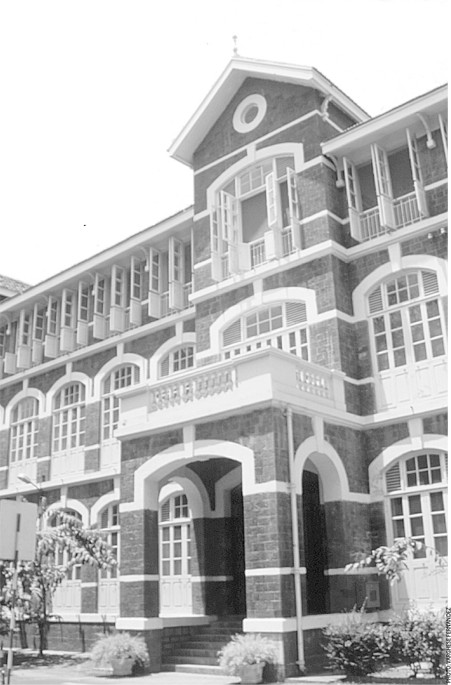
The building’s advanced age had necessitated structural repairs which the managing committee saw as an opportunity to modernize, noted vice president Aban Petit to Parsiana. Hence the sleek beige, brown and white decor and polished granite tiled corridors meticulously crafted by civil contractor Cyrus Unwalla reflect Aban’s and committee member Dr Dina Hakim’s eye for detail even as they attest to the management’s desire to provide the community with a state of the art facility that can hold its own with other private hospitals in the city.
Well appointed support areas like nursing stations, pantry, sluice rooms, staff rooms, storage areas, etc on each floor have cleared the passages of old eyesores like wayward wheelchairs, stretchers and mattresses. Central air conditioning with individual room thermostats, TV and telephone on the first and second floors, separate bells for nurses and lower staff, a plastic chair for the use of the patient in every shower bay, au courant menus and food trays are additional thoughtful comforts which the PGH hopes will lead affluent members of the community to patronize it substantially. The tariffs ranging from Rs 2,700 to Rs 3,300 for the air conditioned rooms on the first and second floors are said to be considerably lower as compared to equivalent facilities available in south Bombay. Moreover, these room rentals are aimed at subsidizing the cost of rooms in other parts of the Hospital available to less affluent co-religionists, notes the vice president. Tariffs for the non-air conditioned rooms on the ground floor range between Rs 1,500-1,600.
The ceremonial inauguration witnessed Keki Jokhi, social worker Homai Modi on behalf of the Zartoshty family and Rustom Jokhi representing the Hongkong anjuman at the request of its president Jal Shroff, simultaneously cutting the ceremonial ribbon at the garden gate (thereafter embellished with the Hospital’s coat of arms). Then Javer Keki Jokhi, Modi and Roxy Rustom Jokhi cracked the auspicious coconuts ere the group proceeded to unveil the plaques on each floor.
Modi unveiled the plaque on the ground floor which the Zartoshtys have dedicated to the memory of Manekji Limji Hataria whom the Zoroastrians of Iran revere as their savior. The redoubtable agent was appointed by the Society for the Amelioration of Conditions of Zoroastrians in Persia in 1854. Hataria’s original brief had been to investigate and report on the conditions of life of Zoroastrian Iranians. The appalling conditions Hataria saw had so moved him that with the Amelioration Society’s support, he spent a lifetime in Iran engineering the international diplomatic pressure that led the Shah of Iran to ultimately (in 1882) rescind the jazia tax that had impoverished the Zoroastrian community, leading many to embrace Islam in self preservation. (It was Sir Dinshaw Petit, 1st Bart, in his capacity as president of the Amelioration Society who received the farman from the British ambassador in Persia). In the interim period the Amelioration Society had intervened through Hataria to pay the tax on behalf of the poorest section of the Iranian Zoroastrian community. Hataria’s 36 years of labor in Iran had bequeathed the local communities with schools, agiaries and dakhmas financed by Indian Parsis (see "Manekji Limji Hataria: Redeeming a community,” Parsiana, May 1990). Now, with Zartoshty’s benefaction, the wheel of community support had come full circle.
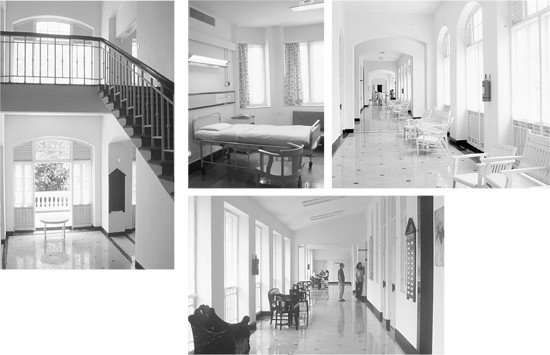
Elegant lobbies, heritage stairwells, evening sitouts for patients over the gracious porches and a vignette of the well-appointed rooms
(Photos: Varghese Fernandez)
While the first floor plaque commemorating the donation of the Hongkong community was unveiled by Rustom Jokhi in his capacity as one of the Incorporated Trustees, the second floor plaque commemorating the late Shapoorji and Manijeh Jokhi, Fakirji and Avanbai Jokhi, Sorabji and Dhunjishaw Fakirji Jokhi was unveiled by Keki Jokhi in conjunction with his late brother Sorabji’s wife, Coomi. The strong support to the PGH from the Jokhi family ever since the late Shapoorji’s initial offer of rupees one-and-a-half crore in 1989 to the late Dinshaw H. Petit has been sustained by his youngest brother Keki in ever-increasing endowments. The Hospital’s two-storied Shapoorji and Manijeh Jokhi Wing housing the new Intensive Care Unit, operation theaters, pathology and x-ray departments was completed in 1995 at a cost of over four-and-a-half crore rupees (see "The gift from Hongkong,” Parsiana, February-March 1995).
After the inaugural ceremony and a tour of the new building which has also been equipped with an additional elevator, the guests congregated on the plinth outside the cafeteria, which in former years had been the venue of rib-tickling Parsi burlesque productions directed and performed by Parsi doctors, led by radiologist Dr Jimmy Sidhva. The inauguration however witnessed the president welcoming and thanking the donors and recalling the vision of his forebears Bomanjee and his son Jehangir who established the institution and the devoted services of those who had passed over including the late presidents Maneckji Petit and Dinshaw Petit and the late honorary secretary Dr Homi Mehta who had all galvanized community support to keep the Hospital afloat through its perennial deficits.
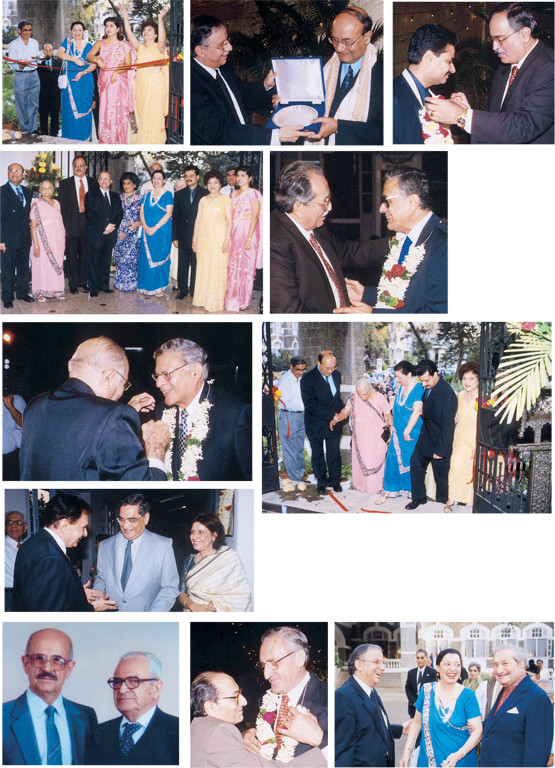
L to R (1st row) Modi, R. and J. Jokhi; H. Petit and K. Jokhi, R. Jokhi and Bhathena (2nd row) K. Jokhi, C. Jokhi, Bhathena, H. and A. Petit, Modi, R. J and R. Jokhi; Gagrat and Khambatta; (3rd row) Parekh and Watchmaker, the donors enter; (alongside) Farokh and Vera Udwadia with Justice Sam Variawa (center); (below) file photo of M. and F. Zartoshty; Jagus and Unwalla; Petit, Modi and Jamshed Guzder (Photos: Spectravision)
Describing the just completed renovation as "part of a revitalization process,” Homa Petit noted its importance in the prevailing scenario of hospital acquisitions and mergers and the setting up of corporate hospitals with professional marketing. This commercialization of medical care has increased patients’ expectations of quality care at affordable rates, their demand for a variety of services under one roof and emphasis on high technology with its inbuilt obsolescence, said the president.
Detailing the magnitude of the Hospital’s charitable services, Homa noted that 71.5 percent of the total bed days were accounted for by free or highly subsidized patients. "Last year the Hospital spent a total of 10.16 crore rupees of which Rs 7.27 crore were spent on charity care,” he added. The Hospital spends Rs 18 lakh per month on medicines for the poor which includes those treated in the outpatients department and an additional two lakh rupees per month on pathology and x-rays. PGH patients go to Jaslok Hospital for CT scans/MRI etc, the cost of poor patients being absorbed by the PGH, Homa informed Parsiana. In this context the current government emphasis on cheap money means a fall in the interest income of the Hospital’s corpus. The only answer is to enlarge this corpus to generate the working capital that the Hospital so desperately needs, both for charity purposes as well as to replace depreciated or obsolete equipment. "If this cannot be done, the only other alternative would be to ration the volume of charity care to the extent that it can be supported by the funds available,” declared Homa Petit, even as he appealed, to the gathering "with folded hands” to ensure that no such rationing is ever imposed on those whose need for medical care outstrips their resources.
Each of the donors was presented a shawl, a silver salver and flowers. Also publicly honored were Khambatta, Unwalla and RCC specialist Cyrus Watchmaker.
A man of few words, Keki Jokhi acknowledged the great professionalism of the team that has recreated the nursing home, announced his unexpected gift and offered his good wishes to all the institution’s future endeavors.
On behalf of Mehraban Zartoshty, Modi enlightened the audience on the immensity of Hataria’s work: "But for him, it is believed that Zoroastrianism would have died in the country of its birth.” She also noted that apart from Rs 30 million donated to the PGH over the years, the Zartoshty Brothers had helped to resuscitate the Parsee Ward at the J. J. Hospital, provided financial support to the K. R. Cama Oriental Institute enabling it to republish outstanding works on Zoroastrianism which have been out of print, contributed Rs 90 lakh to the University of Bombay to help establish the Pherozeshah Mehta Bhavan at its Kalina Campus and enabled the Bel Air TB Sanatorium at Panchgani, which was on its way to closing down, to be revived and revitalized to extend its services to include HIV patients. Modi noted that Zartoshty in his message and throughout his own life, had practiced and stressed the importance of unity in the family and the community. Alluding to site visits while the work was underway, Modi recalled Aban Petit’s insistence that the shade of color, the alignment of tiles was just so. "These minute details have resulted in the beautiful building that has been redone,” she added.
Rustom Jokhi, wearing "two hats” as Hongkong trustee and Keki Jokhi’s son, registered his joy on the occasion. "It is no secret that Hongkong has a soft spot for this Hospital. This relationship will continue to develop,” he assured the Petits and their band of coworkers including joint secretaries Hector Mehta and Zarir Bhathena, treasurer Ardeshir Vazifdar and committee members Sir Dinshaw Petit, 4th Bart, Sir Jamsetjee Jejeebhoy, Bomi Bulsara, Khushrooh Byramjee, Aderbad Deboo, Maneck Gagrat, Jehangir Gagrat, Hakim, Pesi Jagus, Khambatta, Yezdi Malegam, Noshir Parekh, Homi Ranina, Noshir Kasad, Dr Framroze Shroff and Dr K. P. Bulsara.
Aban Petit and Hector Mehta told Parsiana how "spontaneous and generous” had been the response from the donors when the PGH committee broached the need to refurbish the old building. Their biggest hurdle was to design and engineer the welcoming infrastructure without jeopardizing the heritage character of the building.
Next on the committee’s agenda is the relocation of the Blood Bank on the first floor above the outpatients department and the refurbishing of the main building comprising 24,000 sq feet, an area twice as large as the nursing home building. Thinking on the major restoration venture has begun. Hopefully, by the time the 90+ Hospital reaches its centenary, the magnificent edifice, whose floors are now sagging, will have been shored up for a new generation. In the meanwhile, the beautiful garden, Aban Petit’s first love, will reclaim her attention.
As Bhathena had assured the audience in his vote of thanks "We live for those who love us.”
◆ ◆ ◆
From the archive