
ART
The Gallery’s golden glow
Since its inception 50 years ago the Jehangir Art Gallery has continued to serve as an art haven for the common man
"The entrance had the first cantilevered portico in India — considered an architectural feat at that time... The hall and the gallery were designed to together accommodate over 1,700 people and the acoustics and lighting arrangement, both natural and artificial, were carefully considered. The plan of the Jehangir Art Gallery is a wonderful fusion of classical planning and space conception with the plasticity of modernism... The building itself, at the time of its conception, was the epitome of architectural innovation,” notes a book by Rahul Mehrotra and Sharada Dwivedi published on the occasion of the Gallery’s golden jubilee this year. It was exactly what the vibrant city, bursting with new artistic fervor, needed. Until the gaining of Independence, art in India seemed the prerogative of the Europeans; with the fortunate introduction of the Jehangir Art Gallery (JAG), it marched out of these exclusive confines into a public and more socially accessible domain. An indigenous contemporary art movement was an idea whose time had come. With a surging vitality it could now proudly claim its own. The transition was effective, exciting, inspiring.
At a function earlier in the year attended by painters, writers and art collectors, columnist Shobha De who ceremoniously switched on the new lights (sponsored by Hutchison Telecom, the building which ranks among Bombay’s outstanding landmarks will be illuminated throughout 2002) remarked what set the JAG apart is that it has always stood for art as a cause rather than art as commerce. It ushers in the highest volume of pedestrian traffic, with more than 2,000 visitors strolling in daily paying no admission fee.
As current chairman of the Gallery Adi Jehangir stresses, "An industrialist can feel as much at home here as can his peon.” Adding reassuringly that major renovation plans and upgradation of existing facilities are unlikely to result in stopping the common man from entering the familiar art haven which has a four-year waiting list for artists and already over a thousand applications from them for shows in 2006.
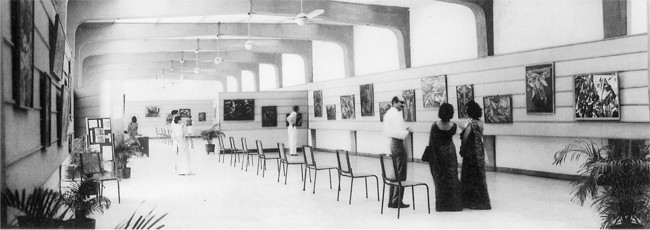
The Gallery before renovations (Photos courtesy: Jehangir Art Gallery)
The Gallery owes its very existence to the sagacious vision of businessman, but above all philanthropist and art lover Sir Cowasji Jehangir, Second Baronet. Presenting the building to furrowed young artists of the post-1940s who yearned to paint a dynamic free India but lacked adequate space to hang their offerings, Sir Cowasji named the new gallery after his son Jehangir, tragically killed in a road accident in 1944 wartime London by a military truck running out of control during a German air raid. Before discussing the interesting turn of events mid-century that led to the establishment of the Gallery, it is fitting to examine how both charity and an avid interest in art were integral to the illustrious ancestry Sir Cowasji so worthily took his place in.
Over 150 years ago, his grandfather Sir Cowasji Jehangir Readymoney, Knight (1812-1878) embarked on the family’s abiding philanthropic journey with contributions towards a variety of public causes and institutions exceeding £ 150,000. In fact, the Readymoneys — among the pioneers of the Indo-China trade that brought prosperity to the then Bombay Presidency — are believed to have earned their last name from their consistent readiness to advance money. Nicknamed "The Peabody of the East” after the American philanthropist George Peabody, Sir Cowasji’s notable projects funded in Bombay were the Convocation Hall in the Fort University complex, the Elphinstone College, the beautiful fountain seen at the west entrance of St Thomas’ Cathedral and even the gift of a drinking fountain to Regent’s Park, London, marking the gratitude of the Parsis in India for the protection they received under British rule. The last gesture made Punch humorously note: "Parsi money... better far than parsimony” on Princess Teck’s opening the fountain!
Sir Cowasji’s adopted son (grandson of his elder brother Hirji) — Sir Cowasji Jehangir, First Baronet (1853-1934) — founded the Bank of India, promoted and acted as one of the first directors of the Tata Iron and Steel Company as well as financed the Sir Cowasji Jehangir Hall (presently the National Gallery of Modern Art) adjacent to the Royal Institute of Science. It was his son and successor Sir Cowasji Jehangir, Second Baronet (1879-1962, October this year will mark his 40th death anniversary), who was the benefactor of the Jehangir Art Gallery. While other Parsis of the day invariably collected European paintings or antiques, Sir Cowasji possessed a magnificent collection of rare Indian miniatures and Chola bronzes.
His grandsons, the present Sir Cowasji Jehangir, Fourth Baronet, along with his younger brother Adi, share a telling anecdote indicative of their grandfather’s early affinity to art. When, at little more than five years old in 1884, he was taken to a fair in England, all he wanted to buy with the single shilling his father had given him for shopping was a bust of Queen Victoria rather than any toy that a child would naturally be attracted to. Sir Jamsetji Tata, accompanying the boy with his father, added another shilling (the statue cost two shillings) and the piece was his! To his parents’ surprise he played with it for days on end, altogether unusual for a child of that age.
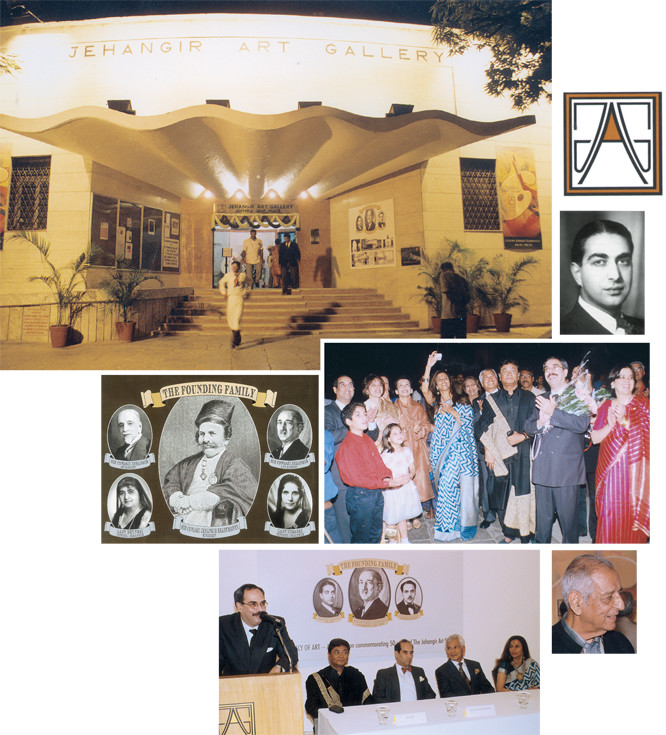
Top: The lit Gallery and Jehangir Jehangir Alongside: The founding family and the crowd cheering the lighting. ;K. Gandhy (bottom right); Along-side (from left): Adi, Dilip De, Jehangir, Asim Ghosh and Shobha
Born to such a heritage, then, it was the most natural thing for the aesthete in the Second Baronet to reconcile with the philanthropist in him. So that when, in the euphoria following Independence, he was approached as president of the Bombay Art Society to consider the crying need for a larger place for struggling talents to display their work in than what the Bombay Art Society could provide, he stepped in to the rescue. Among the personalities who mooted the idea were nuclear physicist and art collector Dr Homi Bhabha, with Walter Langhammer, the von Leyden brothers Rudy and Albert, and painter Krishna Hebbar.
A three-party agreement was drawn up between Sir Cowasji, chief minister of Bombay B. G. Kher and the then Prince of Wales Museum (POWM) chairman Dewan Bhadur Krishnalal M. Jhaveri. An initial donation of Rs 2,50,000 was extended in 1946 from Sir Cowasji to the government on condition that a suitable plot of land would be provided to construct the gallery. The architects assigned to the project came to be Massachusetts Institute of Technology trained Durga Shankar Bajpai and G. M. Bhuta. Sir Cowasji who had personally supervised every detail concerning the building process ultimately contributed Rs 7,04,112 towards its cost and Kher formally declared open the Jehangir Art Gallery on the evening of January 21, 1952 in the historic Kala Ghoda district before a glittering gathering of distinguished scholars, lawyers, established artists, aesthetes, critics, connoisseurs and social thinkers. Ten days later the Governor of Bombay, Raja Maharaj Singh, presided over the inaugural show — the 61st annual exhibition of the Bombay Art Society.
Ten years later when Sir Cowasji died, The Times of India carried a glowing editorial: "... As a patron of art he had few equals in the country... No man has done more to encourage art and artists, and his decades-long assocation with the Bombay Art Society will be remembered wherever Indian artists turn to an easel and whenever they open a one-man show at the Jehangir Art Gallery.”
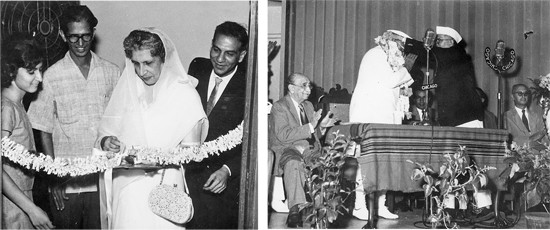
(Far left) At the inauguration of Gallery Chemould (L to R): Rashna Gandhy, K. K. Hobbai, Lady Jehangir and Rusy Gandhy (Alongside) At the formal inauguration of the Jehangir Art Gallery 50 years ago (L to R): Sir Cowasji Jehangir, Raja Maharaj Singh garlanded by V. V. Oak, honorary secretary of the Bombay Art Society
(Photos courtesy: Kekoo Gandhy)
Bombay’s only non-commercial gallery built on a pool graciously carved out of the POWM compound is a veritable Mecca of culture. As artist Jaideep Mehrotra observed, till today, every established artist considers it important to have had at least one show here. The JAG has always played a pivotal role both at the nerve centre of the city’s art district and in artists’ careers. Veteran painters look back nostalgically at landmark moments showcased at their "temple of art.”
Etched happily in artist M. F. Husain’s memory is the recollection of this being the venue of his first retrospective in 1969 when also on display besides his paintings, was his old Mercedes which he drove into the Gallery where it was shown surrounded by mannequins. "I didn’t even know the (term) ‘installation art’ at the time,” he quipped recently. Another key event in the ’70s gave the JAG a taste of the world art scene. An exhibition of Calcutta artists drew some Rotarians from different parts of Europe who, enthused by the initiative the Gallery had taken, offered to sponsor a show of Indian artists in European capitals.
Gallery Chemould, one of the Gallery’s major lessees (the other being the charming Samovar restaurant), came about as a result of art lover Kekoo Gandhy spearheading the movement seeking a "sponsor gallery.” He explains, "While the need for exhibition space was fulfilled, that for sponsorship was still to be met.” So art aficionados were invited to start a sponsorship gallery charging a commission but taking care of budding artists’ patronage. "After all, we were in a public building, it wasn’t right for it to just be a private gallery. We owed people a responsibility, had to encourage young and upcoming artists.” Chemould, accordingly, became the venue of a string of successful art festivals and retrospectives. The terrace of the building was extensively used, one remarkable occasion being the 1968 visit of the "Pope of the art world” Clement Greenberg from New York. "Everything was then done in the public spirit,” Gandhy reminisces. "That must never be endangered. The future of the Bombay modern art fraternity lies in the way the Jehangir continues to grow. Really, the know-how of collaboration should be the science of the 21st century.”
Artist K. M. Shenoy who runs the Art Plaza on the pavement stretch outside the Jehangir reiterates, "All other galleries are shops only looking for buyers. This is the only true gallery.” It is also the least intimidating.
As it greets the rest of the golden jubilee year with a series of more exhibitions including group shows, art auctions, music concerts, dance performances and films, the Gallery lives on — remaining an appropriate memorial to Sir Cowasji’s love for art and his munificence.
By far the most enduring of some over 80 art spaces the city boasts, the Jehangir Art Gallery has retained its visibility over the years. Of essence to the public is the location of the structure, built up to the street-line, which not just made for easy access but gave clear definition to the corner it hugged. Little wonder, then, that "Meet me on the steps of the Jehangir,” continues to be an oft-repeated line when making plans to keep an appointment in this area!
◆ ◆ ◆
From the archive