
Cover Story
Heightened heritage
The tastefully refurbished main wing of the B. D. Petit Parsee General Hospital has revitalized the 97-year-old institution
The Parsi community heritage, as embodied in its most important institution, has acquired a new lease of life — one whose new aesthetic avatar has banished the old familiar drabness. The foyer of the reinvented B. D. Petit Parsee General Hospital’s (PGH) Main wing sets the high note. The old giant elevator has made way for a bust of Bomanji Petit as well as his portrait, and a large marble vase replete with flowers, unhindered by the practical necessities of hospitalization. Set against the familiar grand staircase whose newly painted rails are luminous against the granite, with busts of other philanthropic Petits — the visionary Jehangirji who was the architect of the community hospital concept and Maneckji, a gentle soul and long serving president of the Hospital — lining the alcoves, the tableau, lit up like a strobe by the new clear skylight, sets the tone for the 97-year-old institution’s presence in 21st century Bombay.
The makeover, resplendent with flowers and lights and the fragrance of sandalwood from the jashan fire, was formally inaugurated on March 19, 2009.
The Nusly Petit Wing
To the right of the foyer the old medical store has been replaced by a conference room with updated facilities. Further on lies the president’s office on the one hand and opposite to it, on the left of the foyer, a lounge for the honorary doctors, both of which are still under preparation.
The new registrant needs to turn to the left of the foyer where the registration and centralized test reports delivery counters, fronted by carved teak panels (made from old cupboard doors), sit cheek by jowl. En route to the centrally air-conditioned administrative office one passes the delivery window for medical supplies. No longer visible to the casual visitor, the medical supplies are now delivered by the suppliers from a rear entrance. "We wanted the main entrance to exude an air of serenity, not look like a railway station,” PGH vice president Aban Petit notes demurely.
A convenient station for bill payment and the office of the resident medical superintendent Dr Anuja Sinha face each other across the corridor. The rest of the administrative bloc includes the offices of the chief executive officer (CEO) Maj Gen (retd) M. L. Malik (where eight silver cups won in various competitions, attest also to the beauty of the PGH’s garden); general manager Jal Adajania; a minor conference facility, and a working area for all the nitty-gritty that go into the administration and billing of this large facility.
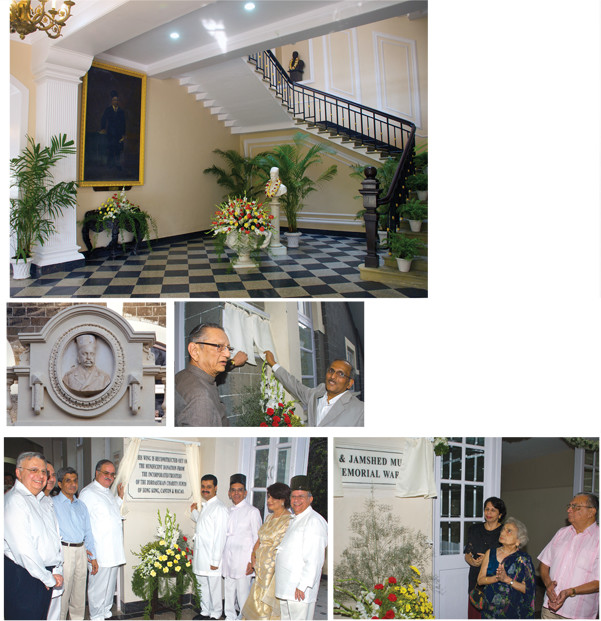
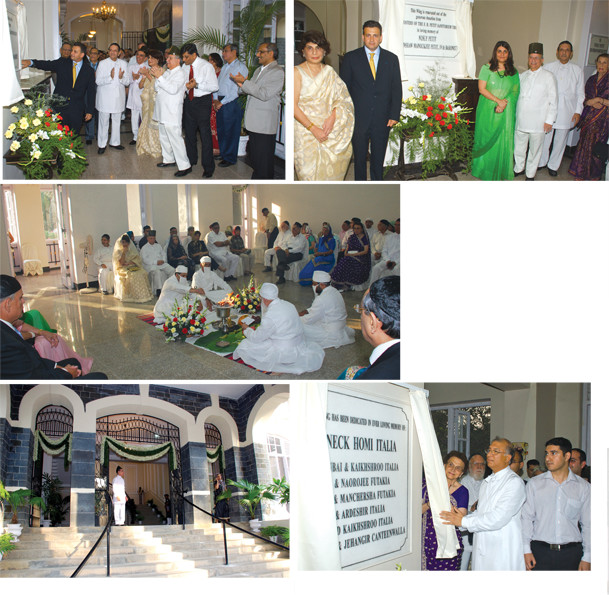
From top (L-R): The new foyer; Petit coat of arms; frieze of Bomanji Petit; inauguration of the various wards by donor trustees: Harenbhai Jokhakar and Dushyant Dalal; Kashmira Kapadia, Mehra Shroff and Noshir Avari; Keki Dadiseth, Noshir Kasad, Zarir Bhathena, Rustom Jokhi, Hector Mehta, Aban and Homa Petit; Aban Petit, Sir Dinshaw (5th Baronet) and Lady Petit, Homa Petit, Jamsheed Kanga and Dina Hakim; Sir Dinshaw unveiling the plaque; jashan in the conference room; the main entrance; Coomi and Homi Italia
The displaced physiotherapy department has moved further up the corridor and acquired a new look in the process. Six private cabins, airconditioned and with piped music, cater to paying patients whether from among the in-patients of the Hospital or from the wider Parsi community and are said to witness "quite a rush in the mornings.” Three cabins serve the needs of free and concessional patients. A gymnasium for orthopedics; facilities for neurology patients who have suffered strokes/paralysis and need to renew brain and body coordination; for cardio-thoracic and/or pulmonary rehabilitation as for example in asthma or heart disease; and facilities to make surgical patients mobile again form a part of the menu on offer. A new motorized tilt table for bed-ridden patients who tend to feel giddy was displayed to Parsiana by Zuber Patel, one of the nine physiotherapists working in the unit under Kalpana Vibhakar, head of the department.
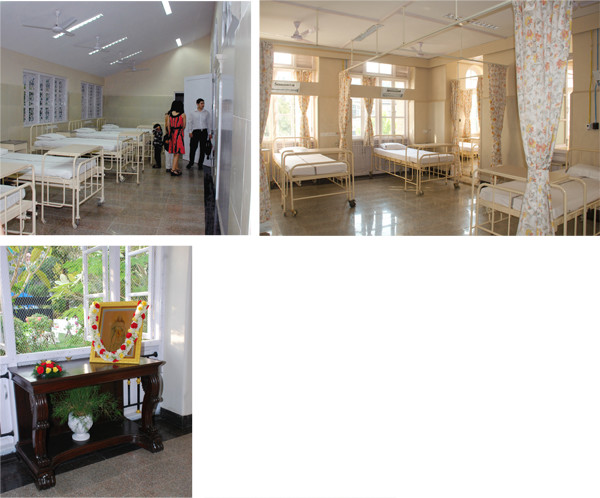
Top: Wadia Ward (left) and Italia Ward with curtains for privacy; (bottom) refurbished antique furniture in the corridor
Three other units have been carved out of the space between the physiotherapy department and the Jokhi Wing of the Hospital. A two-bed casualty department and procedure room provides for casualty cases irrespective of community, as per the directives of the Supreme Court. Such non-Parsi cases are not registered as in-patients but stabilized here before being admitted to a hospital of their choice. Small surgical procedures like minor surgery or the removal of stitches, etc are also done here.
Next to the casualty ward is a six-bed unit for the treatment of non-Parsi staff of the PGH, three beds for men and three for women. They are also served by the medical staff on duty at the casualty ward.
A small airconditioned and secured area houses the Hospital’s IT servers and completes the trio of units in this area.
Just beyond, at the end of the corridor before the Jokhi Wing, space has been carved out for a room for the deceased with a door opening into the rear compound whence the dead can be placed into a hearse.
The entire ground floor, renamed the Nusly Petit (Sir Dinshaw Petit, 4th Baronet) Wing, has been refurbished thanks to a donation from the trustees of the F. D. Petit Sanatorium Trust. Thanking Jeh (Sir Dinshaw Petit, 5th Baronet), PGH president Homa Petit described him in his welcome speech as "deeply wedded to the cause of helping the poor and needy; Jeh shuns publicity and in spite of his shy nature, he is universally liked and respected.” Jeh Petit, the chairman of the Sanatorium Trust and a member of the Hospital’s executive committee, spoke of his fondness for his cousins Homa and Aban Petit and how his father had "held the Hospital near and dear to his heart.”
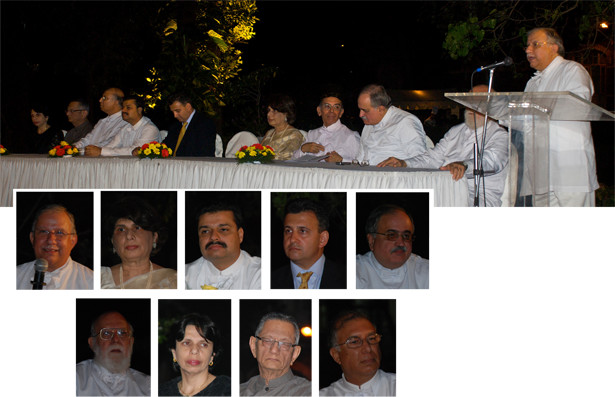
Above: Homa Petit thanking the donors. L to R (1st row): Homa and Aban Petit, Rustom Jokhi, Jeh Petit and Zarir Bhathena (2nd row): Ardeshir Vazifdar, Kashmira Kapadia, Harenbhai Jokhakar and Homi Italia
Hongkong Wing and Wadia Ward
The radical transformation of the Hospital is equally evident on the first floor where all the free wards are located, every bed sporting its own piped gas connection, procedure lights, etc. One of the major old vestiges was the ballroom of the Cumballa Hotel — as was the property donated by Bomanji Petit — where the administrative office had functioned for decades. The revamped area now comprises the geriatric ward with seven beds on either side of a central, sky-lit open area where the 14 inmates can congregate for gupsup (informal chat) and games. The old office had also functioned hitherto as a bridge to the Nurses Quarters so a new parallel bridge has been created to facilitate their movement between the Hospital and the hostel.
Renovated from the donation made by the executors of the will of the late Firoze Wadia, the geriatric ward has been named after the gent who bequeathed his shares (numbering between one and five) in 486 companies, as noted his executor, chartered accountant Harenbhai Jokhakar in a subsequent interview with Parsiana. The nursing expenses of the Firoze Wadia Ward is being met by annual donations from the Bai Maneckbai P. B. Jeejeebhoy Deed of Settlement Fund.
Wadia, a bachelor with a critical eye who died in his 60s in 1988, had charged Jokhakar, his original sole executor, to ensure that his name be commemorated in a Parsi institution for the medical relief of the community. The aging Jokhakar had donated a small amount from Wadia’s estate when the Bombay Parsi Punchayet (BPP) medical clinic in Gamadia Colony had been renovated in 2001 and had examined the possibility of making the donation to another facility for the community in Baroda or Surat but said he was unable to find anything of moment. In an aside to Parsiana, Jokha-kar said he had waited 21 years for the Petit Hospital to concretize Wadia’s injunction and, becoming nervous at the prospect of facing Wadia in the ‘other world’ with the task incomplete, had roped in his former article clerk, chartered accountant Dushyant Dalal, to ensure continuity! Homa Petit spoke of Wadia as "an outspoken person who would study the balance sheets of limited companies and have the courage to attend annual general meetings and point out discrepancies in the accounts, if any, to the management. He was a crusader for the shareholders’ rights.”
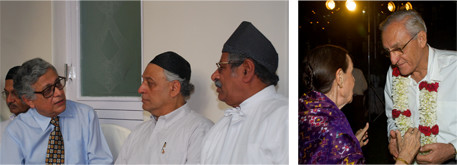
(L to R) Rusi Khambatta, Bomi Patel and Dinshaw Mehta; Dina Hakim and Cyrus Unwalla
When the Hospital’s operation theaters moved to the Jokhi Wing in 1995, the space had been converted into makeshift wards. The process has now been professionalized thanks to a donation from the Incorporated Trustees of the Zoroastrian Trust Funds of Hongkong, Canton and Macau and renamed the Hongkong Wing for the use of free male and female patients. The older wards on the first floor have also been upgraded and included in the Hongkong Wing.
The Hongkong trustees were represented at the inaugural by Rustom Jokhi. "The trustees have been one of the foremost well-wishers of the Hospital and over the years have donated generously to the Hospital… Rarely does one come across a more professional team of trustees and it is heartening to see that the next generation like Rustom are not only taking their place as trustees but are continuing in the same spirit of total dedication and professionalism,” acknowledged Homa Petit. Speaking on behalf of president Jal Shroff and his co-trustees, Jokhi noted that despite the global economic downturn they would continue to honor all their charity commitments and announced a further donation of Rs 1,00,00,000 for the maintenance of the Hongkong Wing.
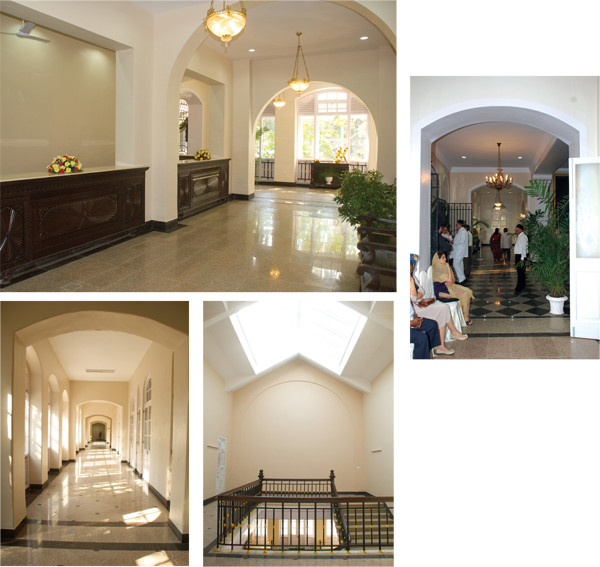
Clockwise from below: corridor of the Nusly Petit Wing: skylight over the grand staircase; corridor of the Italia Wing; registration and reports delivery desks
Italia Wing and Munsiff Ward
The Hospital’s initial ICU (intensive care unit) was on the second floor and when it shifted to the second floor of the Jokhi Wing in 1995, in its place a makeshift geriatric ward had functioned for some years. Now the spanking new Mani and Jamshed Munsiff Memorial Ward, though not functional yet, is expected to provide concessional treatment for 15 patients. Munsiff, a former director of ACC, was described by Homa Petit as an "astute administrator and gentleman who knew what he wanted (and had) unequivocally expressed a desire to donate his estate to the Hospital.” Responded Munsiff’s niece Kashmira Kapadia: "The dream of my uncle has been fulfilled!”
The rest of the second floor comprising blocks of three independent rooms sharing a bathroom for paying patients as well as wards for male and female concessional patients has been named the Maneck Homi Italia Wing. A resident of Vancouver and former president of the Zoroastrian Society of British Columbia, Homi Italia, according to Homa Petit, is "extremely shy… You cannot find a more simple, modest, unassuming person who shuns publicity but whose simplicity and genuineness strikes one immediately.” In his response Italia appreciated the heightened impact of the Hospital’s heritage structure as a result of the renovations, anticipating another award for the Hospital from Bombay’s Heritage Committee. He contributed a further Rs 2,00,00,000 towards a fund, the interest of which would be utilized for superspeciality tests and diagnoses for free and concessional patients conducted in centers outside the PGH as it is unviable for the Hospital to invest in the costly high tech diagnostic machines whose shelf life is restricted because technology is constantly evolving.
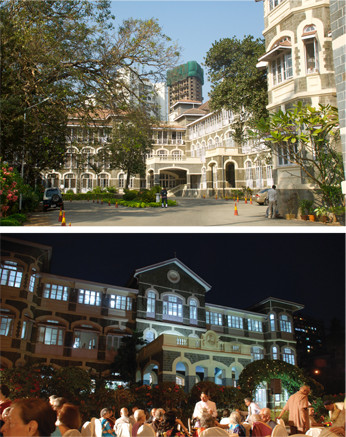
The Hospital’s main wing by day and lit up for the inaugural dinner;
Infrastructure: seen and unseen
Giving due credit to architect Rusi Khambatta who has once again used his ingenuity to simultaneously promote functionality and heighten heritage, Homa Petit also made a special mention of the "patience and dedication” of civil contractor Cyrus Unwalla, RCC specialist Cyrus Watchmaker ("the structure is firm thanks to his inputs”) and electrical contractor Kerman Mehta. He had a special word of recognition for his committee members and particularly the office bearers, Hector Mehta and Zarir Bhathena, the joint honorary secretaries. He mentioned committee member Bomi Bulsara and "his expertise in ferreting out the right supplier…,” as also Noshir Kasad, the representative of Italia, for "monitoring the project… and pushing the contractors, architects and others to meet deadlines.” Aban Petit’s meticulousness is reflected in the pro-ject’s muted elegance.
Several other Parsi entrepreneurs also contributed their expertise to the PGH free of cost on the inaugural day, as note Aban and Homa Petit: Bomi Patel and his sons of Superstar Video Labs took the pictures, audio and video; Kamal Kerawalla of Baimai Flora contributed the exquisite floral arrangements; Roxana Buharivala of F. H. Pavri and Sons provided chairs, tables and lights in the garden…
New underground cabling and wiring, new PCs and a new hospital management information system is said to add muscle to the Hospital’s administrative framework. Now, with total information about patients including test results, dates of admission and discharge, etc computerized, the Hospital is endeavoring to work towards a paperless operating system, says Malik. Patients’ X-rays are now available to the doctors on PCs at the nursing stations.
Back-up power on a 24-hour basis ensures that every important medical facility will continue to function even if the city’s power supply undergoes cataclysmic failure caused by an earthquake for example, assures Malik. Apart from a 30 KVA battery operated uninterrupted power supply for critical equipment like ventilators, operation theater lights, the blood bank, etc, the Hospital has acquired its own high tension sub-station of 11 kilo-watts with the technique to enable a saving of three to four lakh rupees a month on electricity usage, notes Malik.
Solar water heating adds to the Hospital’s fuel efficiency. A complete revamp of the water supply network with provisions for rainwater harvesting and three new bore wells shoring up the original single well on the premises ensure plentiful water for flushing and the garden, he tells us, adding that at a pinch, a reverse osmosis system is available for installation which can make the water potable.
Next on the cards is a renovation of the two-storeyed Nutrition Department Building, the relocation of the Blood Bank on the ground floor of the Jokhi Wing and renovation of the Nurses Quarters — hopefully in time for the Hospi-tal’s centenary celebration in 2012.
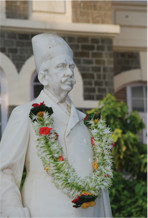
Bomanji Petit’s statue in the garden;
On the medical front
"We have deployed approximately 120 nursing staff for our 235 bedded (up from the original 218) Hospital with overall occupancy being approximately 80 percent. This ensures one staff nurse for each critical patient in ICU and for the wards the nursing staff to patients ratio is ensured as 1:4,” states Homa Petit. Indeed, every unit in the sub-divided wards has been provided with a nursing station, manned by one of the staff nurses, which is visible from the beds.
A significant gain for the Petit Hospital is the allotment of two seats by the Indian Medical Council for resident doctors wanting to qualify for their MD in orthopedics and medicine under DNB (Diploma of National Board). It is believed that this will help the Hospital enroll superior talent among the junior doctors. "Before you can be recognized for DNB an elaborate process is involved,” says Homa Petit. There are strict inspections, the hospital’s CEO and medical superintendent have to make presentations, the inspectors meet the panel of doctors, et al.
The National Board of Examination is an autonomous organization established by the Government of India, Ministry of Health and Family Welfare, to conduct high level and uniform standard of postgraduate and post doctoral examinations in the field of modern medicine and allied sciences, says Homa Petit. It awards the DNB in all disciplines. The Board accredits institutions for training including non-teaching private hospitals having adequate infrastructure, trained manpower and facilities for imparting high level of training.
PGH has been accredited by the National Board for Medicine as well as Orthopaedics, initially for three years, renewable at the end of the period.
After the candidate is selected, six-monthly assessments of the trainee as well as the Hospital are conducted by appraisers selected by the Board.
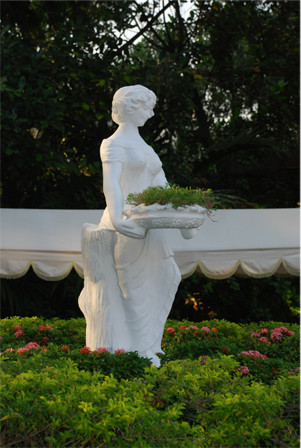
Statue in the PGH garden
The economics of charity
In his inaugural speech Homa Petit had noted, "Doctors and the community at large have rallied around the institution. In the present challenging economic and healthcare scenario it is essential to maintain our competitive edge and as part of this revitalizing process, upgradation and renovation was the first part. The upgradation started with the Jokhi Wing inaugurated in January 1995, followed by the A Wing inaugurated in January 2002 and now completed with the inauguration of the Main Wing today… The second part of the revitalization process is now for our honorary doctors to bring in the patients to the Hospital, so that the benefits of modernization, updated equipment and infrastructure can be taken advantage of by them… To meet with the challenge of paying for the poor (63 percent of PGH beds are for the free and concessional patients), the ball is also now in the court of the honorary doctors, for they must bring in their Parsi paying patients as well, and I am sure, you, our Honoraries, who are the wealth of the Hospital, will now see to it that all our departments and wards including surgical, diagnostic and for general medical care are filled up with paying patients as well as the poor and needy.” Says Homa Petit, "When we say completely free, it means that the free patients get free bed, free medicine, free diagnostics, free surgery, free food, and free nursing/doctor services and free blood bank facilities. So far as free diagnostics are concerned, even if a free patient has to undergo diagnostics which are not available in the Hospital, like C. T. Scan, MRI and other such superspecialities, the Hospital has an arrangement with Breach Candy Hospital and others, so that the free patients do not bear any cost of such C. T. Scan, MRI or superspeciality diagnostics, but the same is paid by the Hospital.”
The comforts of the A Wing — are well known and on par with other popular private hospitals. The perceived wisdom is that a higher use of the A Wing — said to have 70 percent occupancy, according to Petit — would help subsidize the costs of the free and concessional beds. "Low occupancy of the paying wards…places the burden of high overheads, costs of staff and maintenance which are not optimally utilized and these adversely affect the finances of the Hospital,” Homa Petit tells us.
Parsiana asked two physicians, two surgeons and a neurologist to explain why the community’s affluent patients prefer to go elsewhere. Speaking on condition of anonymity, all of them commended the facilities offered at the Petit Hospital — for average work but not for critical care as in coronary angiography or bypass or brain tumors as the required specialized equipment is not viable due to its restricted demand here. The other major hurdle is the demographics of the community which is not only dwindling in numbers and becoming increasingly geriatric but is fanning out into the distant suburbs where many small nursing homes provide adequate facilities without the need to spend hours commuting to south Bombay. Earlier no such conveniences were available and Parsis of all income groups made their way to the Petit Hospital.
Homa Petit’s statistics confirms the above: the average age of free/subsidized bed patients varies between 50 to 85 years whereas the age profile of the paying patients varies between 30 to 75 years. Through 2008, there were on average 19 deaths as against three births, per month, in the Hospital.
One of the doctors felt that the community’s upper classes had the notion, attributed to snobbery, that a certain hospital was a "British Hospital” and therefore "tip-top… There is no such superiority there.” On the other hand a patient in need of ICU can avail of superior staffing in another south Bombay hospital — both in terms of nursing staff and resident doctors — where the cost of the bed at Rs 70,000 per day ensures round-the-clock care. On the positive side the same doctor lists the good food at the Petit Hospital, the ample parking facility and easy accessibility — without spending precious time waiting for the elevator. He also noted that the PGH’s flexible visiting hours — so much a part of the institution and the community — is also a source of discomfort to some who prefer to spend minimal time with the patient and hence plump for the restricted timings at other hospitals.
On the other hand it was pointed out that even people with five lakh rupees of medical insurance opt to go into the lower priced sectors of the Petit Hospital like the ground and first floor of the A Wing or into the Main Wing rather than the second floor. "We book them into the second floor but when they come for admission and find that a room on the first floor (which is not airconditioned) is available, they change the booking,” notes a surgeon.
It was conceded that certain doctors do tend to levy steep charges. They can only do so on the second floor of the Petit Hospital. Furthermore, in other major hospitals in the city they may have a quota to fill and hence prefer to take their patients there. The PGH presently enforces no such quota. In the PGH their fees are capped according to the category of operation they perform or care they give as per the norms fixed by a committee which includes five honorary doctors and the Hospital’s CEO, inform the Petits.
In the words of noted physician Dr Farokh Udwadia, "It has been rightly pointed out that doctors should be more aware that the Hospital needs support.” The community can also help by realizing that each time they opt to undergo treatment at the Petit Hospital’s A Wing, second floor, they are enabling the Hospital to provide for other members of the community who are unable to help themselves…
◆ ◆ ◆
From the archive