
Bawa Musings
Healing our hospital
A transformational idea is about to resurrect The Parsee General Hospital
The Parsee General, as it is affectionately called, is facing an existential crisis. In an increasingly crowded industry, The B. D. Petit Parsee General Hospital (PGH) is unable to compete. Lacking diagnostic facilities like CAT (computerized axial tomography) scan and MRI (magnetic resonance imaging); not having the expensive infrastructure for disciplines like oncology, nephrology or nuclear cardiac medicine, it is shunned by many who have a mediclaim insurance cover. Compelled by its charitable charter to serve the economically weaker section at super subsidized rates, its losses are mounting. It cannot upgrade due to lack of funds and it cannot generate funds unless it upgrades. This vicious cycle has to be broken.
Many of us took our first breath here and saw many a loved one take their last. In community consciousness, the PGH occupies a special place. Despite the stench and mess at Doongerwadi, and the beckoning new cremate ni bungli (Worli Prayer Hall), many still yearn to depart from Kemps Corner. Similarly, if the facilities at PGH improve, many would prefer its comforting environs to other secular hospitals. This is its unique selling proposition which can be built upon.
Many of us took our first breath here and saw many a loved one take their last. In community consciousness, the PGH occupies a special place. Despite the stench and mess at Doongerwadi, and the beckoning new cremate ni bungli (Worli Prayer Hall), many still yearn to depart from Kemps Corner. Similarly, if the facilities at PGH improve, many would prefer its comforting environs to other secular hospitals. This is its unique selling proposition which can be built upon.
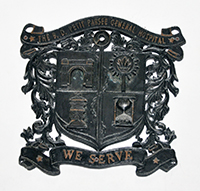
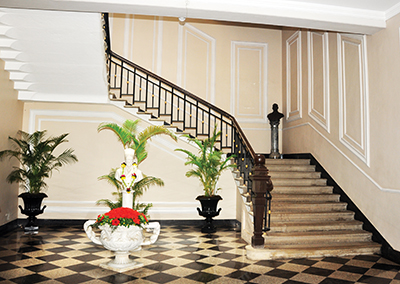
Emblem (above) and lobby of The B. D. Petit Parsee General Hospital
Even secular minded Parsis prefer Parsi doctors. Legends like Dr Farokh Udwadia and Dr Rusi Soonawalla occupy a position only slightly lesser than the Ameshaspands (angels). A ‘Parsi-only’ hospital is, therefore, a great marketing proposition. Parsi food, even from a dietician’s tray, can be a great morale booster during an illness. Where else will you get sev and ravo on Jamshedi Navroz, instead of batata poha and upma? Political correctness apart, many also prefer Parsi co-patients; though they don’t really mind non Parsi nurses and wardboys. Parsipanu pulsating in the corridors of the PGH can be half the cure. Its more relaxed atmosphere, like no restrictions on visiting hours (Behram, you can visit me at midnight, no problem, dikra) is an added attraction. No need to smuggle gher nu bhonu past prying security guards (although it was "nil by mouth,” I walloped Tehmi’s kolmi ni curry last night, the poor pathologist was aghast at my fasting sugar level). We knew of a seriously ill cousin who would hop across the street to have bhaiya ni bhelpuri at Scandal Point and nonchalantly get back into bed.
We recollect a wife being asked by the judge of the Parsi Matrimonial Court as to how she first met her husband; and the reply was that it was on the verandah of the PGH. Indeed, a great meeting place.
However, in an age where hospitals advertise on FM radio about a single day laser surgery at cutthroat rates, it is nearly impossible to attract patients if they have to ambulance it out to another hospital even for an MRI (O Khodayji, Silla’s bed is empty! What suddenly happened? Don’t worry, she has gone to Breach Candy for a CAT scan). Only those Parsis who simply cannot afford another hospital occupy the free or highly subsidized beds, and often overstay for obvious reasons, while the nursing home and private rooms often lie vacant. Even a public charity must run its business on commercial lines so that it can plough back the profits to subsidize the free facilities.
PGH occupies extremely valuable real estate in India, if not Asia. The trustees of the Bombay Parsi Punchayet (BPP) are the legal owners of the land and buildings, while an elected managing committee has the right to manage the Hospital. The trust deed directs that it will be a communal, and not a secular, institution. Due to this, it is commercially unviable to invest in expensive diagnostic machines like MRI, as there are not many Parsi users of such a facility, due to our declining numbers. In the past, when the PGH was at its peak and there was not much competition, any suggestion to make it secular was regarded as blasphemy. Dr Hormusji Mehta, its legendary and colorful chief for many years (he was seen trying to hypnotize a rather nervous rooster in his cabin), suspicious that the then authoritarian chief minister of Bombay, Morarji Desai, was wanting PGH to turn secular, deftly prevented Desai from entering the Hospital building by telling him about the sudden outbreak of viral meningitis in the premises. Mehta’s booming voice would reverberate across the PGH corridors, as he threatened to summon the ‘Gamdevi’ (police) to evict a faith healer trying to remove a brain tumor by non-surgical means. Mehta, a former police surgeon and an expert toxicologist, ran PGH in its golden period, in a high-handed but highly efficient manner; though he was vilified in a campaign run by The Bombay Samachar in the mid 1960s, accusing him of all sorts of things including using PGH bedsheets and towels at home.
After years of meandering, the present administration led by the indefatigable Homa Petit, direct descendant of the settlor, has come up with a transformational idea. Build a state-of-the-art hospital, alongside the PGH, for secular use while retaining the Parsi only character of the PGH. The business plan is to utilize the profits of the new hospital to subsidize the charitable activities of PGH. More critically, PGH patients will be able to avail of the latest diagnostic facilities on priority basis and at subsidized rates. This will open the door for paying Parsi patients to patronize PGH once again. The gods appear to be smiling on Petit’s brave initiative. Jal and Pervin Shroff of Hong Kong have agreed to make a staggering donation of USD 22.5 million; the BPP trustees (that too, the earlier lot) miraculously agreed; and most of the regulatory approvals have come through. Many challenges remain, though. Project and time cost overrun, escalating cost of sophisticated medical equipment, the need to fund the balance project cost beyond the Shroffs’ donation, and most critically, the managerial capability to run the new hospital. Perhaps, a tie up with a leading healthcare chain may help. Ahura Mazda willing, this project when completed may well take the PGH back to its golden period, with even the affording Parsis preferring it as a hospital of choice.
When the first laser beam is used for a prostate surgery in the new hospital, old timers may nostalgically recall the not so apocryphal story of an old gentleman’s prostate being removed and the kidney tray being placed on the window sill (those days the operation theater in PGH was not air conditioned) and a crow swooping on the prostate, intending to relish it from a nearby tree top, with frenzied nurses and wardboys praying for the bird to drop the severed gland so that it could be displayed to the patient’s anxious relatives.
Berjis M. Desai, senior partner of J. Sagar Associates, advocates and solicitors, is a writer and community activist.
◆ ◆ ◆
From the archive