
Zoroastrians Abroad
Life in the Canadian tundra
Their professional commitments draw the Panthaky family to different parts of the world
Jai Panthaky’s eyes twinkled a greeting from her hospital bed. The diminutive lady from Udvada who had spurred and supported her architect husband Noshir to accept an assignment in Zambia and then in the Canadian tundra saw her heart attack on the eve of her homeward flight to Toronto as a chance to meet up with the friends and relatives whom she had missed out during this visit to India after 23 years! In their own way the Panthakys demonstrate the fabled adventurousness of earlier generations of Parsis who pioneered their niche in various locales around the world.
When the eastern and central part of Canada’s vast North West Territories (NWT) was ceded by the federal government to the original Inuit people ("Eskimo” is now considered a derogatory term) after 30+ years of negotiation, they renamed it Nunavut, meaning "our land,” Noshir explained the genesis of his unique venture. Yellowknife had been and continues as the capital of the remaining NWT. From April 1, 1999 however Iqaluit further north became the capital of Nunavut whose area according to Noshir comprises one-fifth of Canada and includes the Baffin Islands, the fourth largest in the world. With permafrost or solid ice two feet below the ground and extending perhaps to 100 ft or more, houses and offices are constructed on stilts, not directly. There are no basements and the buildings are oil heated. With 10 months of winter when the sun rises around 8.30 a.m. and sets by 1.30 p.m. and two months of spring, summer (with 22 hours of daylight when tundra grass and flowers gladden the eye for two to three weeks) and autumn, "everything is white, covered in snow and ice; there are no trees, no grass; just mountains of ice and snow!” Noshir described his Arctic wonderland.
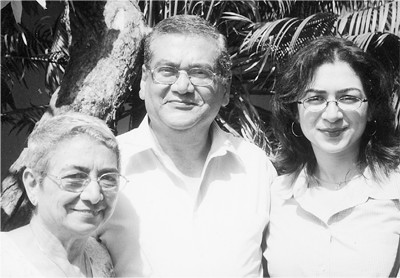
The Panthakys (from left): Jai, Noshir and Ruby Photo: Arnavaz S. Mama
For six-and-a-half years Noshir and Jai lived in a one-room apartment in Kujjawaq, the northernmost town of Quebec before the Hudson Bay, and in Iqaluit. There were no windows, only glass, the closed homes restricting cuisine to oven cookery. While Noshir, as project officer for the Nunavut administration, was occupied in creating infrastructure like hospitals, schools, medical centers, trucking centers, etc, Jai busied herself with work at the daycare center and took up large cross-stitch embroidery, mind games and crossword puzzles to pass her time. Stamp and coin collecting, Indian and Western classical music were interests they shared.
Iqaluit had one main road, called Ring Road, two shops and no cinema until much later. "When we went the population was 3,700. And when we left (to return to Toronto) it was 5,500. It was a joke that the whole population of Iqaluit would fit in one Toronto highrise!” laughed Noshir. All consumer items including food are flown in from southern Canada, especially Quebec and "during blizzards everything is suspended. You can’t go out. You’d be frozen to death.”
The total Nunavut population of about 25,000, according to Noshir’s estimate, is comprised of small towns (called communities) of 100 to 1,000 people. There were four schools and one hospital in the entire territory. Stone cairns, in the shape of a man, called inukshuks, show direction in the bewildering terrain.
The Canadian federal government in Ottawa bears 90 percent of the cost of running the country’s three native territories: Yukon, NWT and Nunavut, says Noshir. The Inuit, who speak Inuktiut and consume a lot of raw fish and caribou in their diet, lost the art of igloo making when the government moved them into houses. With Germans, Scandinavians and US Americans spending thousands of tourist dollars to see "the last remaining unspoilt place on earth,” tourism is the upcoming industry. The Panthakys describe the Inuit as "very nice people, always smiling.” With a social background of joint families there was no beggary in evidence.
An alumnus of Bombay’s St Xavier’s School and Siddharth College, Noshir graduated with a five-year course from the Academy of Architecture. After 11 years in the profession in India, spent at Hindustan Construction, the engineering and contracting firm of the Walchand Group, Bharat Tiles and some independent experience, Noshir with Jai (née Patel) and their son Phiroze (currently a software engineer with IBM), agreed to do a seven-year stint in Zambia at the invitation of his brother. Their daughter Ruby was born there in 1972.
The couple, who have three brothers and a sister also settled in North America, applied for immigration to both USA and Canada and succeeded in getting both but opted for Canada, arriving in Windsor, the automotive capital of Canada, in 1978, where Noshir found a job with a private architectural firm. The acute recession of late 1980s-early 90s saw the firm disintegrate and the family moved to Toronto where Noshir, working on his own, opted for the Ontario government’s course on facilities planning and Jai, a scion of Udvada’s King’s Hotel whom Noshir describes as a very modest but excellent cook ("her malido and batasa are well-known!”), kept the home fires burning with her culinary skills.
Noshir’s was among the last of the 300 applications for the one or two positions advertised by the NWT. After a few weeks he was interviewed over the phone by four different people. Some weeks of silence thereafter a phone call summoned him for a personal interview. In the course of his four-hour flight via Montreal, he took photographs of the mountains of snow and ice to show Jai and learned that the average temperature in that part of the world hovered around -35°C. He returned and "told Jai, ‘aapréthi kai rehvai nahi (we can’t possibly live there).’ But Jai said, ‘You knocked on the door and it’s been opened!’” Noshir wanted to finish his facilities planning course but the people at NWT refused to wait. Packing his bags, equipped with sunglasses and heavy boots, Noshir says he set out for Kujjawaq where Jai joined him later.
By 1998 the economic scenario had improved and after a spell of violent diarrhoea which required him to be flown by mediplane to Ottawa for 11 days of intensive care, Noshir returned to private practice in Toronto in October 2000.
Parsiana’s first contact with the intrepid Panthakys came as a chance encounter with the tall, fair Ruby in Delhi’s Mengusi Dharamshala. A lawyer with a passionate dedication to human rights, she was enjoying her six-month tenure as junior professional consultant with the Delhi arm of the United Nations High Commission for Refugees (UNHCR), interviewing refugees from Afghanistan, Sudan, Iran and Myanmar to determine how they fit into the UN Convention on Refugees. Depending on the reports of Ruby and her teammates, the officers would proceed to assess the cases. Once selected for refugee status, individuals are issued refugee certificates which grant them UNHCR protection, financial assistance for their children’s education, the acquisition of new skills and legal protection if they fall foul of Indian law, Ruby informed us. This refugee certificate needs to be annu-ally renewed.
Sometimes, says Ruby, the refugees let their certificates lapse. Such cases "need to be reinstated depending on their legal behavior. Sometimes they go back to the country of origin. If they could have stayed there, did they need to come back?” are some of the facets of refugee life examined by the UNHCR, notes Ruby. The solutions, she says, vary between voluntary repatriation, integration into local society or resettlement in a third country.
The varied languages of the refugees often require interpreters. While Africans generally speak English, refugees of Afghan, Burmese, Russian extraction are helped along by compatriots who have settled in India and speak Hindi. According to Ruby, the majority of refugees in India are urban and generally integrate well into the local society.
An LLB from the University of Windsor with a BSc in psychology, political science and criminology from the University of Toronto, Ruby was always keen to work with the UN in international law and specifically human rights law. Since Canada is "over represented in the UN at the beginner’s level,” Ruby’s determined striving led the UN Association of Canada to find this six-month placement for her with the UNHCR in India which was looking for a junior lawyer. Remarking that she was the only Parsi there Ruby broke into a dimpled smile as she noted, "It was like applying for law school all over again!”
The six-month stint in Delhi had Ruby deeply enthused with the job but unhappy with the way "autorickshaws try to cheat you” and she didn’t like "the way men leer at you” on the street. But her colleagues have been "great” and Indian hospitality has lived up to her best expectations though she finds "the contrasts between wealth and poverty shocking because they are so blatant.” Nonetheless Ruby feels she has gained something: "I thought I was always tolerant but... I’ve become more tolerant, widened my perspectives.” As for the Delhi dharamshala, once she had got used to the idea of bucket baths and calling for hot water in the morning, she enjoyed the safety, economy and central location of the site vis-à-vis her place of work. "It’s the best place for a single woman in Delhi,” she believes.
Enjoying her hobbies of drawing, sketching and painting, Ruby had at one stage wanted to go into architecture but the thought of "too much maths” put her off and she decided to stick with social sciences at which she was "always better.”
Her parents had joined her in Delhi so that they could tour India together. Ending their India visit in Bombay, the Panthakys hope to go back to Toronto next month. Then, says Ruby, she will resume her search for a job in an international human rights organization.
◆ ◆ ◆
From the archive