
Adventure
Daring, dauntless duo – III Glaciers and avalanches
Nightmarish mountain ascents and dangerous descents along icy slopes were compensated for by the breathtaking landscapes of Ladakh
A century ago, Nanabhai Davar and his wife undertook an arduous nine-month journey to Ladakh via Kashmir. Their experiences were published as a series of articles in a Gujarati newspaper and later in the form of a book in Gujarati, Vichitra Ladakhmaa Tran Maasni Manjal or Three Months’ Sojourn in Wondrous Ladakh. In this three-part series writer Aban Mukherji retells the Davars’ travels and travails. The first part, "The woman who returned alive” (Parsiana, October 21-November 6, 2023) described Davar’s (unnamed) wife’s indomitable spirit on the couple’s arduous trek. The second part, "Perilous paths and passes” (Parsiana, November 21-December 6, 2023) dwelt on how, after narrowly escaping frostbite and braving areas which the locals referred to as the "graveyards of mules” and "charnel house of ponies,” the Davars finally reached the Nubra Valley.
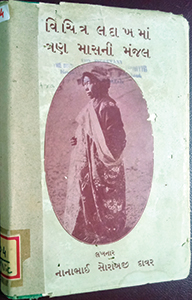
Cover of Gujarati travelog Photo: Trustees, The K. R. Cama Oriental Institute, Bombay
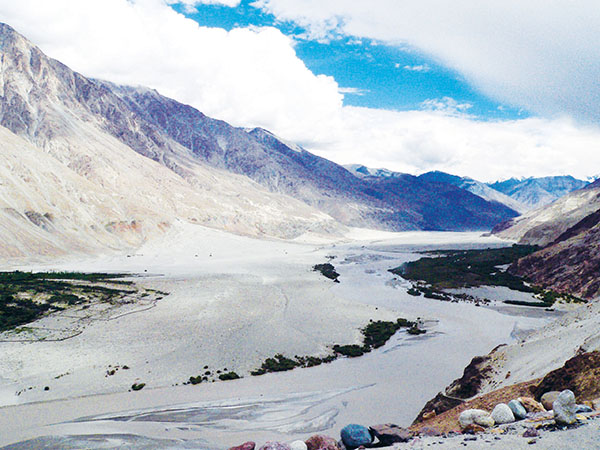
Shyok River bank Contemporary photo to reflect the terrain
Soon after the Davars began their trek to the dangerous Saser Pass, their road was blocked by frozen ice. The climb was difficult. The mules would slip and slide on the ice and their hooves would get stuck in the cracks.
It was so bitterly cold that Nanabhai’s teeth began to chatter uncontrollably, and his fingers and toes became quite numb. There was a terrible pain in his chest. But his wife was full of grit and determination. Her enthusiasm and optimism were remarkable. She encouraged her husband every step of the way. Holding the reins of her pony, she walked beside him, buoying up his spirits. "The climb will soon be over. The sun will rise and bring us its welcoming heat. Please take my coat if you are feeling very cold,” she said to him.
As they continued further, they found an avalanche had blocked their way with a wall of ice that needed to be breached with axes to forge a way through the barrier. Later they descended to the banks of a little frozen lake that resembled a well, banked on all sides by walls of ice. They could see slabs of ice resting on the frozen surface. This was Brongo Chang, the "Graveyards of mules,” so named because these poor creatures would drop dead like ninepins due to extreme cold and exhaustion. Their carcasses could be seen lying all over the area.
The Davars had to negotiate a very steep slope, hugging the mountain wall, single file, with boulders obstructing their path. The space between the rocks was filled with snow and the road was full of puddles of melted ice. Rocks continuously tumbled down the mountain sides and each step was taken with a prayer on the lips.
In the middle of this nightmare climb Nanabhai experienced agonizing spasms of pain in his legs and feet. He collapsed on the snow covered ground, certain that frost bite was setting in as it is always preceded by unbearable pain in the affected limb, followed by numbness. Eventually, the affected part would drop off.
The syce was very concerned and vigorously massaged Nanabhai’s feet, insisting that the gentleman should wear his sturdy warm felt boots over which chaplis (a kind of sandal) were tied. Thanks to the syce’s timely aid, Nanabhai managed to hobble along, but the animal carcasses around them did nothing to lift their spirits. After another descent, they began the climb to the "real Saser.” Milk white snow sparkled in the sunlight. The path was covered with wet mud and bloodstains. The Ladakhis have a peculiar custom. To relieve the pressure on the lungs of their pack animals they rush at them with pointed spears and pierce their nostrils to make the blood flow. This, according to them, saves the animals from collapsing. Despite this harsh measure, many animals succumb to the unbearable conditions.
When the Davars’ entourage reached the top of Saser Pass all they could see was row upon row of snow covered peaks. Their descent was equally perilous as the path wove through huge boulders, the cracks filled with melted ice, the dead bodies of mules and ponies jutting out of them.
The travelers reached Saser Brangsa at the base of the Pass, 15,200 ft above sea level, known as the "Charnel House (chamber in which bodies or bones are deposited) of Ponies.” They could see 25-30 skeletons, some with the skin still sticking to the carcasses, others a heap of bleached bones. Starvation, a punishing climb and exhaustion had caused these animal deaths. The Davars also came across skeletons of men who had fallen on the way, which had been covered with stones by their companions. The stench was unbearable, but this was the only site where they could rest.
Many Yarkandi nomads too used this place to recuperate from their 30-day journey, allowing their pack animals to rest before scaling Saser in the opposite direction. "The Yarkandis,” Davar writes, "are tall and of a strong build; fair and rosy cheeked, brave, kindly and hospitable by nature, known to share their food and shelter with all who are in need. They are followers of Islam and their womenfolk are in purdah. They wear knee length, bandhgala (closed neck) coats made of quilted material. On their heads they wear round woolen caps lined with fur and their legs are covered in knee-length boots.” According to Davar, they resemble Russians.
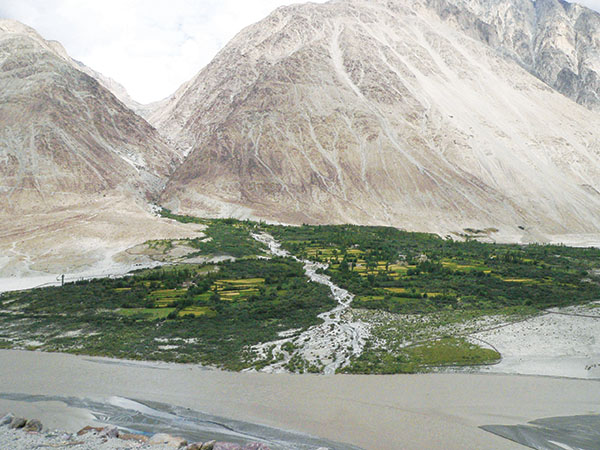
Overview of Khalsar Contemporary photo to reflect the terrain
From Saser Brangsa the Davars had to cross the Shyok River (a tributary of the Indus River that flows through northern Ladakh) twice. Due to the melted snow the river had risen and the travelers had to ride their mules through knee deep water, holding on tight all the while praying for God’s help to cross over safely. At some places the water was belly-high, and the animals often stumbled on the rock strewn river bed. The first crossing proved easier as the river was wide and shallow, but the next one was very difficult as the waters ran deep and the river was narrow.
They reached Aktash on the other side of the river. The name signifies "white stone” as a huge white boulder can be seen there. As they proceeded further, flanked by the Aktash Glacier, their path was obstructed by an avalanche of snow that had got stuck on the slope. The party rested under the shelter of its overhang and built a fire from dry twigs to make soup. The tinned food came in handy. The temperature was eight degrees below freezing point. They could hear ice crack with booming sounds like cannonballs being fired.
Wending their way along the side of the Aktash Glacier the travelers finally reached its end and began walking along the banks of the Shyok River, which is known as the river of death. As the River was frozen, it was easy to walk over it. Soon huge boulders began to fall all around them. Their guide urged them to walk faster, but the poor lady was able to manage merely a snail’s pace. Exasperated, a porter forcibly picked her up and carried her on his back, leaping from one rock to another with the agility of a monkey.
They reached the Kichik (small) Khumdan Glacier at 7 a.m. on July 28. This Glacier resembled a semicircle, extending from the summit of the mountain till its base, both its extremities resting at their feet. On the rounded part of the Glacier there were lots of thin needle-like snow towers. Some of the pinnacles resembled fingers. Between the two points of the Glacier, a lake had formed from melted snow. It was semi-frozen with blocks of ice floating on its surface.
In 1931 Kichik Khumdan was the source of the Shyok River. From here it would move towards Aktash Glacier, accumulating the waters of numerous avalanches to fill and swell into the mighty Shyok.
After a brief halt the travelers began to walk on the original bed of the Shyok River, flanked by tall mountains. The stones and rocks of the river bed had been made smooth by erosion. In 1929 the Khumdan Glacier or Shyok Dam, a natural geophysical feature, had burst and the Davars prayed that it would not happen again while they were there! Earlier, in 1923, the Khumdan Glacier in the upper Shyok River had broken with the might of the water confined behind it. The Shyok suddenly came down in a flood in late October, sweeping away the great suspension bridge at Tirit over the middle Shyok, nearly 100 miles from the Khumdan Glacier. In 1932 the Khumdan Glacier again broke, causing floods. A runner had to be sent across to Saser La to warn the people of Khalsar about the impending floods (Himalayan Journal, Vol 2 of 1930 and Vol 5 of 1935).
At 11:30 a.m., on July 28, the Davars finally reached their destination — the mighty Shyok Dam-Khumdan Glacier. Like Kichik Khumdan, Shyok Dam is semicircular in appearance, but 10 times bigger. Most glaciers flow down from the summit of the mountains but this one had filled and blocked the area between two mountains; one of its two snouts had stretched all the way to a third mountain and encircled the original Shyok River. Actually, the first source of the Shyok was the 30-mile-long Remo Glacier, but only a few years before the Davars visited the site the Khumdan Glacier had lengthened to dam the river water, transforming it into a lake. This gives us an idea of how huge the glacier was.
The Davars stood in the area between the two snouts (end of glacier where melting occurs) of the glacier which was made up of several tall, 10-12 storied ice towers, with the lake in the semicircular area below. Chunks of melting ice tumbled down the slopes. Some of this water would seep underground to meet the waters of Kichik Khumdan.
It was not possible for the Davars to climb the glacier as they lacked the necessary equipment but they were supremely happy to have reached this majestic and spectacular site and took lots of photographs.
All too soon it was time to bid farewell to this wondrous place. Expressing heartfelt thanks to God they began their return journey back to Leh.
They reached Leh in August 1931, and from there returned to Srinagar where they rested for a few months before proceeding to Bombay in February 1932 via Rawalpindi.
It was a magical journey — a journey accomplished in spite of almost insurmountable odds, thanks to the insistence of an amazingly intrepid woman.
Harish Kapadia, the renowned mountaineer, points out that things have changed drastically since the Davars traversed the land in 1931. The areas mentioned in this article are now easy to access. "A motorable road reaches Saser La and passes from the adjoining valley to the Khumdan Lake.” For 30 years now the army has been conducting regular sorties from there. Concluded
◆ ◆ ◆
From the archive