
Institutions
A place to practice
The new Bombay Parsi Punchayet polyclinic at Gamadia Colony provides premises to 18 young doctors
The opening of the Rustomji N. Gamadia Polyclinic of the Bombay Parsi Punchayet (BPP) marks the advent of a new phase in the Punchayet activities. While the provision of medical facilities and help for medical education have been part of its long-standing activities, facilities where young medicos can practice their dearly acquired skills have been elusive in space-starved Bombay. An array of medical specialties — gynecology, homeopathy, dentistry, dermatology, radiology, ENT, pathology, psychology and veterinary surgery — are now available at a single venue in Bombay’s centrally located Tardeo area within the Gamadia Colony.
After a traditional thanksgiving jashan performed by panthaky Parvez Madon and priests of the S. F. Jokhi Agiary, BPP chairman Jamshed Guzder cut the ceremonial ribbon on October 25, 2001. The low slung structure which once functioned as the Industrial Center and Godrej Press has been revamped by architect Sam Rao and civil contractor Cyrus Unwala into 18 consulting rooms of unequal size to meet the space and finance specifications of the doctors with a large waiting room in common. The two veterinarians have been provided with external entrances for their four-footed patients. Punchayet Chief Executive Officer (CEO) Behram Dastur mentioned to Parsiana that the refurbishing cost the BPP approximately Rs 75 lakhs. Involved with the governmental/municipal aspects of the project was BPP trustee Dinshaw Mehta.
While Guzder thanked Ahura Mazda that the project had "come to fruition,” BPP trustee Dadi Engineer noted that it had taken a number of years to take final shape and indicated that the trustees were also thinking in terms of providing such occupational facilities to other budding professionals like accountants, architects and lawyers.
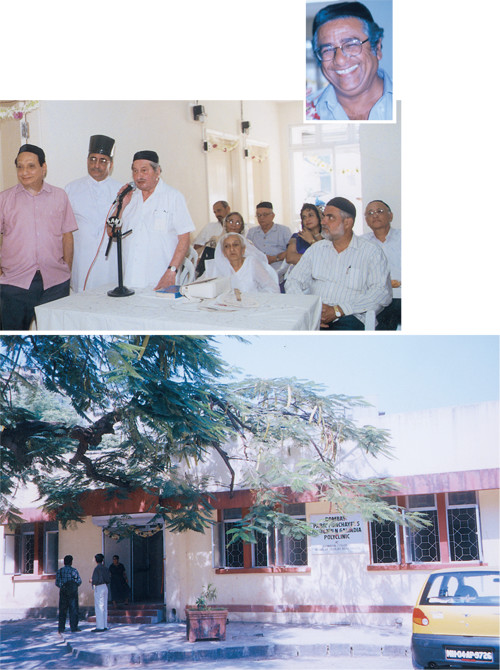
The face of the polyclinic and Mehta who enabled it to materialize (Photos: Arnavaz Mama). Below (from left): Engineer, Dastur, Guzder, Silloo Kavarana, Tirandaz and Fali Poncha — crediting the achievers
The opening of the polyclinic and the establishment of the Venture Capital Fund under BPP aegis demarcates the current social service trends which are veering away from the giving of doles to the provision of facilities for self-employment, remarked BPP trustee Rustom Tirandaz. He also noted that the BPP had taken charge of the Bhabha Sanatorium at Bandra on the urging of its family trustee Khurshedji Bhabha.
Though Behram Gamadia, scion of the family that has endowed the Gamadia Colony, was present on the occasion, he disavowed any family contribution to the Polyclinic beyond a "no objection” certification from his father Rustom to former BPP chairman Dr Aspi Golwalla.
The BPP has appointed Homi Mullan as the Polyclinic’s administrator. An independent energy and environmental consultant with awareness of biomedical management and consultancy, thanks to a long innings with J. N. Marshall and Company at its many locations, Mullan had also garnered managerial experience at Raychem and Xicon.
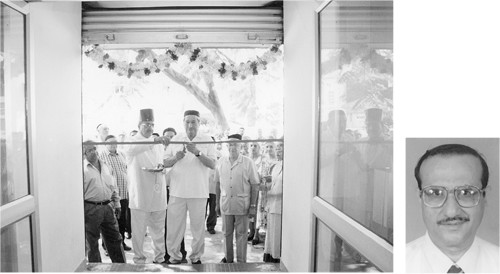
Guzder cutting the ceremonial ribbon aided by Dastur. Below: administrator Mullan
About 38 finalists were screened by the BPP’s trustees and CEO before allocating the 18 cubicles. Younger and more need-based applicants generally scored over established names and those who already had their own clinics, noted Dastur in a chat with Parsiana. He also informed us that maintenance costs of a capital and administrative nature would be borne by the BPP from the service charges levied on the incumbents while other costs like personal telephones, etc would accrue to the individuals concerned.
Unable to absorb the large recurring losses of the Industrial Institute and Godrej Press, the Punchayet had reluctantly closed the establishment with effect from January 1, 1987. The moribund property was left on the back burner for nearly eight years until the new thinking crystallized in favor of setting up a polyclinic in 1995, by which time Mehta was a part of the BPP board. He said he was assigned the arduous task of getting the requisite municipal and governmental permissions for the change of user from a printing press to a polyclinic.
The task was compounded by the fact that the original factory permit was nowhere to be found. Mehta explained that the Bombay Municipal Corporation (BMC) factory inspector needs to authorize a closure licence which requires a no objection certificate and cancellation of the original permit issued by the BMC’s factory department. It was only at the end of 1999/early 2000 that this was acquired thanks to Dinshaw Mehta and his brother, corporator Noshir Mehta’s concerted efforts. Thereafter they had to pursue permissions for change of user through the government’s urban land ceiling and area planning departments.
Once the official paperwork was satisfactorily completed, the physical rehabilitation of the property was taken in hand — the end of a project for Mehta, the fulfilling of a dream for young medical professionals on the threshold of their careers.
◆ ◆ ◆
From the archive