
In Memoriam
Well with Wadia
Died: Dr Sarosh Ratanji Wadia, 91, senior homeopath who was instrumental in founding the Bombay Homoeopathic Medical College, on June 15, 2001 at Bombay’s Northcote Nursing Home following cardiac arrest.
A qualified allopathic doctor, Wadia’s chronic asthma hindered his professional performance until Dr Burjorebehram’s sustained homeopathic treatment cured him of his illness. His faith in homeopathy established, Wadia devoted the rest of his life to healing patients with homeopathic medicine, a change his patients reportedly did not welcome initially.
Since there was no college in Bombay teaching homeopathy until the middle of the last century, Wadia had to tutor himself in this branch of alternative medicine. Impressed with this science, he opted to pursue the subject overseas, earning a fellowship of the British Homoeopathic Faculty and a diplomate in homoeo therapeutics from the American Institute of Homoeopathy, according to his bio data. On his return to Bombay he started his independent practice whilst simultaneously working towards his goal of setting up the Bombay Homoeopathic Medical College which was then housed in the Sion Hospital until it was shifted to Vile Parle several years later. Initially the students were offered a diploma course until Wadia convinced the government to convert it into a degree course.
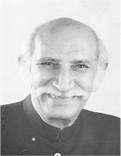
Wadia: faith in homeopathy
"His passing away is an irreparable loss to our institution,” noted Dr Asmita Parikh, honorary secretary of The Homoeopathic Education Society (HES) which runs the College. Referring to him as the "seniormost homeopath of the HES,” she added that he was "a public figure in many ways.” The "great loss to the homeopathic community” was also expressed by Dr Pankaj Dave, principal of the Dr V. H. Dave Homoeopathic Medical College and Smt S. I. Patel (I) Homoeopathic Hospital in Anand, Gujarat.
A respected lecturer, he was professor emeritus at the homeopathic colleges in Bombay, Surat and Anand and was also examiner in various board examinations. His own education was at the Alfred High School in Bhuj after which he joined Bombay’s Wilson College. Past president of the Indian Institute of Homeopathic Physicians, Wadia had served on the Government of India’s homeopathic advisory committee as also on the first pharmacopia committee. He was the first homeopath to be nominated as president of the Bombay Homoeopathic Board and then twice to the Maharashtra Homoeopathic Board, mentions his curriculum vitae.
Having presented several papers at international homeopathic conferences, Wadia had been honored with a bronze medal at the International Homoeopathic Medical Congress at Brussels in 1972. He had been appointed as vice president for India of the International Homoeopathic Medical League, Geneva and was invited to Iran to organize a homeopathy department at the Tabriz University.
"He has been the vital force for many homeopaths,” wrote Dr Farida Talati who having worked with him at different dispensaries acknowledged that she had been "inspired by him to do more for the poor and at the same time for homeopathy.” She mentioned how he was "very humble, understanding and patient towards his patients...He started many charitable dispensaries in different Parsi colonies and saw that even non-Parsis came there and got the benefit of his free services...He published many booklets in simple language for his patients and lay people...”
Besides homeopathy, he also authored booklets on the poet Firdausi and parliamentarian Dadabhai Naoroji. "Both these booklets are now my prized possessions,” stated Rati Wadia, erstwhile principal of Queen Mary School, who was also his patient. "Every time I had a migraine attack I used to run to him and the miraculous relief after a few doses had to be experienced to be believed,” she noted in her tribute in the Jam-e-Jamshed. "He treated thousands of patients from his clinic at Colaba and later from his home...I shall miss him deeply — his gentleness, soft caring voice and smile, his positive approach to life and the confidence he (instilled) in us that nothing was wrong and we would be perfectly fine.”
"From this unassuming and dignified gentleman we learnt a lot about the world, and he would put us totally at ease if anyone in the family...had any kind of physical ailment. In his own matured way he always wanted great leaders to be a model for the Indian youth and...the younger generation would benefit by reading such books which in his philanthropic way he would distribute free. Not only a noble thought but a real Zoroastrian in the true sense of the word,” noted Pesi Muncherji, editor of the Baroda Parsi Panchayat’s Zend newsletter.
"Dr Wadia was a constant at the K. R. Cama Oriental Institute in the past and we have been missing his presence for quite sometime now but he has always been fondly remembered,” conveyed Homai Modi, trustee and honorary secretary of The K. R. Cama Oriental Institute. Referring to his "good interest in community affairs,” Dr Meher Master-Moos, president of Zoroastrian College, mentioned, "He was a great help on the Rahnumae Sabha and the Ratheshtar Mandal of which he was president...”
The socially committed and politically conscious Wadia had served as member of the Bombay Municipal Corporation (BMC) from 1952-61 when he would regularly go round his ward, ensure that it was kept clean and listen to the grievances of the public, it was reported by Talati. In 1953 he was the chairman of the BMC Medical Relief and Public Health Committee, she wrote. Also active on the community political scene, in 1954 he was elected to the Bombay Parsi Punchayet (BPP) Anjuman Committee as a member of Sau Nu Mandal. He was one of the committee members appointed by the Parsi Federal Council in 1956 to suggest reforms in the BPP’s electoral scheme.
It was during this decade that he had struck a rapport with eminent solicitor Nadir Modi who referred to his "cherished friend” as "a dedicated and humane doctor and a very fine human being.” The Federation of Parsi Zoroastrian Anjumans of India had conferred on him its excellence award and as noted Lt Gen Adi Sethna, president of The Delhi Parsi Anjuman, of the renowned homeopath, "He was a great social worker and had a burning zeal for remembering and honoring our ancient heroes.”
The dedicated doctor is survived by his wife Daulat, sons Dinyar and Dr Rashid, and brother Dara.
◆ ◆ ◆
From the archive