
Cover Story
“The mandate is clear”
Incoming Bombay Parsi Punchayet chairman Dinshaw Mehta says the community has chosen orthodox representatives with a purpose
"I have forwarded my hand in friendship to one and all, to start with a new beginning, put the past behind us. Let’s hope it’s reciprocated.”
Having earned his position as chairman of the Bombay Parsi Punchayet (BPP) at the start of his third seven-year term, Dinshaw Mehta’s words were gracious, his tone sincere. Reviled verbally and in the Press for over two years, the attacks gathering intensity over the electoral campaign, he acknowledged the hurt, especially when attacked by "friends.”
The community has stood by its "most hardworking trustee,” in the words of his supporters, giving him the highest votes with the exception of social worker Arnavaz Mistry. But Mehta displayed no bravado when Parsiana interviewed him on November 5, 2008. Instead, it was business as usual, with Parsiana waiting while Mehta interviewed flat-seekers and an architect’s appointment was positioned cheek by jowl with our own. In 2001, after his first reelection, this reporter had been dispatched in 15 minutes. The only difference this time was that Parsiana’s string of questions entailed half-an-hour despite the rapid response!
Mehta oozes raw energy, brimming with impatience and a hint of irascibility — in sharp contrast to the laid-back image of the BPP and the genteel trustees who have presided over it. At their first board meeting the previous day the new board of trustees decided to hold the Tenth World Zoroastrian Congress in Bombay in 2013 and the moribund Federation of Parsi Zoroastrian Anju-mans of India may be revived: "We will probably call a meeting in January,” Mehta noted. But any question of a representative world body would be limited to Parsi/Irani Zoroastrians only and "it will have to have the BPP as the apex trust in the forefront. Any talk of an only-Zoroastrian world body is taboo as far as I am concerned.”
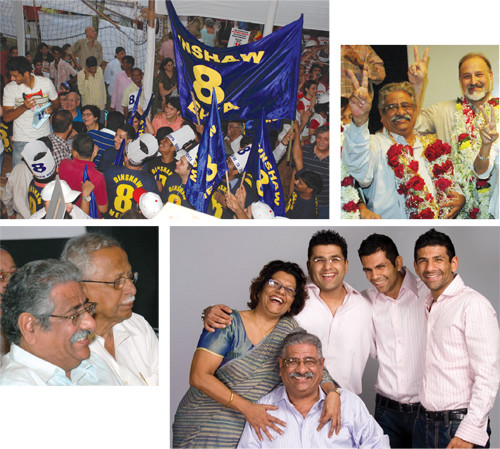
Top left: Dinshaw Mehta supporters at the Dadar polling center Below: Mehta and Khojeste Mistree after the announcement of results Photo courtesy: Vishwanathan Salian, Afternoon Despatch & Courier; (Bottom left) Mehta and election president Rustom Hormuzdiyar at the counting venue. (Right) Wife Pansy, Mehta (seated) with sons Viraf, Darayus and Hormuz
At the hustings he had promised more homes for the aged. A move is afoot to convert a part of the Bhabha Sanatorium in Bandra into one such home that, according to Mehta, will house about 100 inmates. The architect awaiting his turn with Mehta had come with some plans for redesigning the old institution. Exercising them was the question how to separate the ladies and gents wings, according to Mehta. Another community property he hopes to convert to similar usage in the longer term is Tehmulji’s Parsi Lying-in Hospital where plans and problems are more complex.
But the main thrust of the new administration is two-fold: to wipe off the waiting list for housing and to ameliorate the life of the poor. "Our main thrust will be on poverty. The number of poor people we saw in this election was an eye-opener. The amount of poverty is astounding!” Mehta iterates. His answer to the problem is an increase in the size of the doles and the amounts devoted to educational and medical help.
According to Mehta, the fact that all the members of the new team are orthodox/traditionalist adds to the strength of the team, its common ground: "We have to live up to the traditionalist mandate. It’s very clear that’s why the community has elected us. (Trustee elect) Noshir Dadrawala is the most orthodox member of the AFP (Adult Franchise for Progress) team. The mandate is very clear.” (The AFP, despite its declaration that its interest in the BPP was wholly secular, seemed to have been viewed by the community as a liberal body in religious terms.)
Mehta however lays to rest the fear in liberal minds that the BPP will become a fundamentalist body. "We will be traditional but we will not be like the Taliban!” his face creases in a laugh that, in the past, used to be Mehta’s familiar facial expression. "We will accept the children of Parsi fathers. We are more practical.”
No portfolios have yet been allocated to the incoming board of trustees. "Yesterday was our first meeting. We will have to revamp committees and sub-committees. Except for Rustom Tirandaz (who had served one term as BPP trustee from 1995 to 2002) for the others it’s a learning experience.”
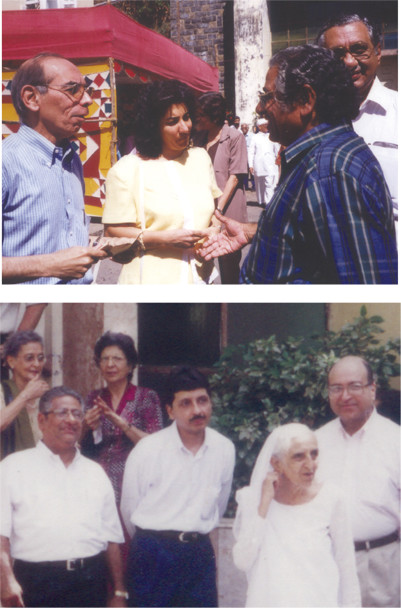
(Top) Mehta greeting Hector Mehta at his 2001 trusteeship election, friend Khushroo Byramjee behind Mehta. (Above) Mehta with friends and supporters Maneck Davar, Silloo and Farrokh Kavarana at Silloo’s BPP trusteeship reelection
Mehta, both respected and derided for his "encyclopedic” knowledge of community housing, acknowledges that "it will be difficult even in seven years” to wipe out the waiting list for community accommodation. "We will try to be very fast. But the sanctioning of plans is a big deterrent. Twenty-six permissions are required from statutory bodies before you can even start building.” In the next breath his ambition gets the better of him: "We hope to clear the list and create additional stock, bring Parsis from all over into the baugs.” Would it not lead to more ghettoi-zation? we counter. But to Mehta that is the only way for Parsis to meet each other, create matrimonial alliances within the community to head off the increasing number of intercommunal marriages. In his manifesto Mehta had stated, "I am a firm believer that if our declining numbers are to be arrested, it is imperative to prevent our youth marrying outside the community.” According to him Nowroz Baug leads in the number of marriages it cele-brates within its ambit. Apart from that, there are "very few young people in the colonies,” he notes, adding, "It’s time to bring young people into the colony culture.”
As a newly elected trustee in 1994
While electioneering Mehta had stated that if reelected, he would convert all leave and license agreements into tenancies. What then happens to the deposits taken by the BPP? Would they be returned and taken back as pugree? we wondered. But Mehta says his statement did not refer to persons who had bought the flats. It only concerned those under the merit rating scheme who would be spared the hassle of renewing their license every five years. Those who had given money and purchased flats would continue to be licensees.
In his younger days
And the auctioning of flats will continue as "commercialization of charity was what was fought at the election. The community has said the tenant has the right to encash his tenancy,” avers Mehta.
In the months preceding the election the BPP had ceded around 90 flats to those on the waiting list for housing under pressure from the Alert Zoroastrians’ Association (AZA) at the charity commissioner’s court. "We will be reviewing these allotments,” says Mehta, noting that they had been "done under threat of clause 41D of the Bombay Public Trusts Act.” He says the BPP will stand by those that are fair, adding, "Others we will take back to the charity commissioner.”
The BPP’s housing repair bill has generally been high with the aging building stock. According to Mehta buildings in the older baugs like Nowroz Baug are "dilapidated.” In his campaign speeches he had mentioned that the old board of trustees had been averse to the idea of redevelopment due to the decline in the size of the community (Mehta said that they had argued that there will be more flats than Parsis in Bombay in the years to come), but now he noted, "Wherever possible we will go for redevelopment and reconstruction” instead of repair. In his manifesto Mehta had noted that 350 families live in these dilapidated buildings which have a built-up area of 3,13,822 sq ft. "Under the MHADA scheme (we) can redevelop the existing buildings to provide an extra 650 flats with an additional FSI of 3,87,742 sq ft” apart from the 350 families who would be re-housed in new buildings.
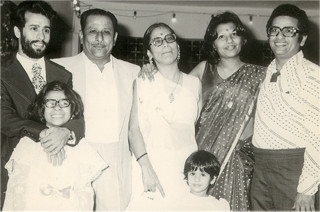
Mehta (top and above, far right) with (L to R) brother Noshir, sister Anahita, parents Rusi and Dhun, sister Pari and Pansy, circa 1980s
"Under the rules MHADA is entitled to a certain percentage of flats created under the excess FSI,” he explained to Parsiana. "But, like Hilla Towers did, we can buy them back and sell them to Parsis. If this can be done at Hilla Towers, why can’t our other baugs develop on the same lines?” he queried. The reasoning for Nowroz Baug holds good for the redevelopment of Contractor Baug where according to his manifesto Mehta expects the creation of 390 more flats, 340 new flats in Dadar Parsi Colony, 200 additional flats in Bharucha Baug, etc. The cost of the proposed construction, the subsidization of rents and maintenance of buildings would be sourced from the proposed ownership building in Godrej Baug together with the current refundable security deposit scheme, states the manifesto.
The redevelopment of the Parsi Lying-in Hospital as a hospital cum senior citizens’ home depends on the renewal of its lease, Mehta informs us. He says it expired a few years back but could not be specific as he was not on its committee where trustees Minoo Shroff, Dinshaw Tamboly and Maneck Engineer represented the Punchayet. "If we (the BPP office) can develop and shift into Tehmulji’s — I don’t know if we can do that — then we’ll give these premises back (to the J. J. School),” he says in the context of the tussle for space between the BPP and the School where the matter is in court. If not, the court will decide the issue, he notes.
There was a time when the BPP held quarterly press conferences, we remind him in the context of the poll assurances for transparency made by him and the World Alliance of Parsi Irani Zarthoshtis (WAPIZ). Would they be revived? Mehta’s response was an unequivocal affirmative. He also added that plans for "a general body meeting (in this case a samast anjuman meeting in place of the old anjuman committee) at least once a year,” were on his mind. In response to our query Mehta spoke of the need to make the BPP Review "more issue-based with less photographs. We must come out with our side of the story as the Parsi Press gives a jaundiced view,” he noted though he said he had not really applied his mind to it.
The antagonism between Mehta and solicitor Berjis Desai — a formerly inseparable duo of community activists, political strategists and business partners — is the stuff of a novel. According to Mehta they parted company over their contrasting views about Doongerwadi "though he denies it. He wanted a cremate ni bungli (a bungli for the four-day funerary prayers for those who opt for cremation instead of dakhmenashini). It’s like opening the door (recognizing other modes of disposal for the Zoroastrian dead). The trust deed is very clear (it cannot be done). It is unlikely that the court will uphold (their plea),” adds Mehta referring to the mandate sought from the Bombay High Court by former BPP chairman Dr Aspi Golwalla, Tata Chemicals managing director Homi Khusrokhan, and former municipal commissioner and BPP trustee Jamsheed Kanga on behalf of community members who feel that the dakhmas are no longer functioning as they should and alternative modes of disposal are called for.
An alumnus of Bombay’s St Xavier’s School and College and holding a master of science degree from the University Department of Chemical Technology — "the number one college before the IITs came up”-- Mehta’s only interest apart from his foundry business, the Punchayet/community and family (his vivacious wife Pansy, sons Viraf, Hormuz and Darayus) is cricket. Continuing a tradition, his sons were his campaign managers during the BPP elections even as he had honed his voting and electioneering skills as his father Rusi’s chief election agent throughout the latter’s long and highly respected innings as a Bombay municipal corporator. The experience "made us more savvy,” he notes. For Mehta it also opened the door of seasoned professionals at the Bombay Municipal Corporation (BMC), created "excellent relations” with its officers. "Just taking my father’s name gets things done. At A Ward I just had to go and speak to them about my father. The reassessment of shops in Cusrow Baug was set aside. At times nothing works, but at others, something gets done.” He would "probably have gone into municipal and legislative politics” had his brother Noshir not been equally interested. In the event Dinshaw joined the CER (Committee for Electoral Rights). There has been no looking back…
◆ ◆ ◆
From the archive