
Music
The world in their voice
Coomi Wadia and the Paranjoti Academy Chorus once again win accolades at international level
Their repertoire covers an expressive and expansive scale — from the majestic music of Bach, Beethoven or Handel, to the soul and syncopation of the Negro spiritual, the rhythms of the Indian raag and taal, chansons from around the world in changing tone and tempi. In keeping with their motto "International harmony through international music,” the Paranjoti Academy Chorus sings in 22 languages — from Latin, German or Polish to Filipino, Konkani or Sanskrit.
On the podium stands Coomi Wadia — the conductor and driving force behind the Chorus for the past 34 years. Short of stature, sari elegantly pleated, a string of pearls adorning her neck, Wadia weaves together the subtleties of sound with softly choreographed movements of her hands, eyes and composed body language. Elaborating on the joys of music-making, Wadia says she finds the Chorus’ foreign tours, be it for competitions or choir festivals, immensely satisfying. "My ability as a musician and the Paranjoti Academy Chorus’ ability to work hard is put to the test. There are no aunties, uncles and friends of the singers in the audience there. Nor do foreign audiences make any allowance for the fact that your choir is from India or any other distant land, singing music that is essentially western. They take you on a par. If you’re good, they applaud spontaneously. If not, they slash you!” The ultimate high note for both conductor and singers is of course a standing ovation. Winning the third prize from among 21 finalists from Ireland, Russia, Argentina, Poland, etc at the XLVII International Competition of Polyphony and Habaneras in Torrevieja on the Spanish Riviera in August last year, Wadia states that the choir received standing ovations in every concert and at the end of each encore as well. "The reception to every kind of music we sing is tremendous,” she says.
Invited to participate in the XVIII Choral Festival at Segorbe in an ancient Gothic cathedral in Spain, the Chorus then moved on to Valencia and to France where they engaged in concerts and workshops with over 3,500 participants at the XVII International Choral Festival ‘Choralies’ in Lyon, in the ancient Roman ruins of Vaison la Romaine. Scheduled to give three concerts in three days the public demand was so great that an additional performance was squeezed in to accommodate those who clamored to hear the group from India. "I have known conductors who say they will not give more than one concert in three days. We gave two concerts in one day, and the second concert did not suffer,” smiles Wadia.
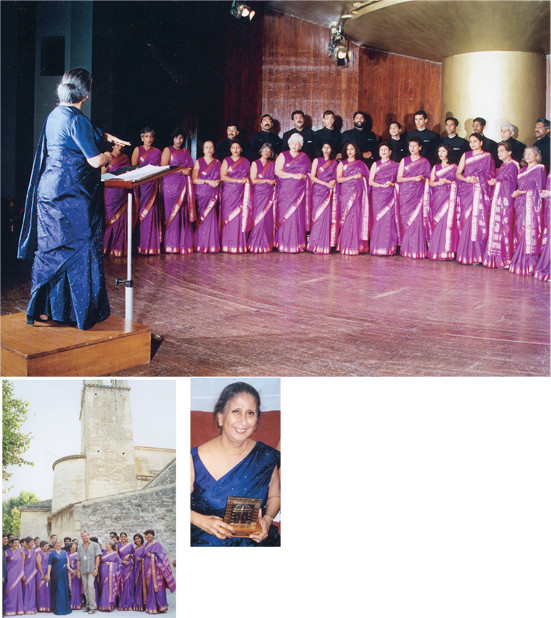
Conductor and choir on stage at the Tata Theatre (top); outside an ancient cathedral in Europe; (far left); Wadia with the Torrevieja competition’s third prize
Quickly adjusting to the acoustics of cavernous concert halls, the high rafters of magnificent cathedrals, small church cupolas or ‘dead’ auditoriums where the sound does not gel, Wadia explains that the singers need to hear each other to maintain the delicate equilibrium between the sopranos and altos, tenors and basses, to take entries in polyphony (music with two or more independent melodic parts sounded together), to adjust dynamic, tonal levels. "Otherwise we feel we are singing in a vacuum,” she elaborates. "Coomi may exhort us to sing more legato (smoothly), or more staccato (crisply), as required,” explains Chorus member Perin Jesia who first joined the ensemble way back in 1958, when Wadia herself was a soprano in the choir originally founded by conductor/composer Dr Victor Paranjoti who was for several years the deputy director-general of All India Radio and the principal music critic for The Times of India. "Even at the international level, our standard is as good as the next choir, often much higher!” says Jesia. Opines Cynthia Thyle who has been with the Chorus, albeit with breaks, since 1969: "Our strengths are Coomi’s inputs and our response to her. Musically, she is so talented, sensitive to the nuances of the composition. If we are showing signs of nerves, she calms us down. You just have to follow her every step of the way.”
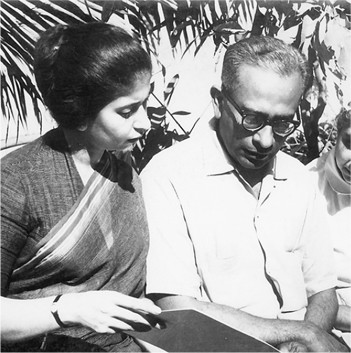
A young Coomi with Paranjoti
Bonding together as an ensemble are the young and the not-so-young, not products of conservatoires, not professional musicians but a motley group of accountants, architects, web designers, housewives and even a trainee pilot, many of whom cannot even read a note of music! "All I ask for from my singers is a good ear and a willingness to work. There are people with good voices and people with average voices and they form a good choir. I do not require a trained voice. Singers have come to me raw and have become leaders in their line,” Wadia points out. Of course, there are some who join drawn only by the magnet of foreign tours. "I don’t see their faces after that!” she laughs. Long-timers with the Chorus, with breaks for marriage, the arrival of babies, work commitments, etc, are Jesia, Thyle, Freny Peddar, Homai Dandiwalla, Donald Michael, Mario Derek Lobo, Mehroo Kotval, Rusy Shroff and many others. "The Paranjoti Chorus is so hugely important in my life that I travel from my office at Goregaon to the J. B. Petit High School for Girls at Fort where practices are held two evenings a week. Just before a tour rehearsals may go on for the entire day. But I love it. My closest friends are in the choir and I really do not see myself singing with any other chorus,” asserts businesswoman Serena Jacob.
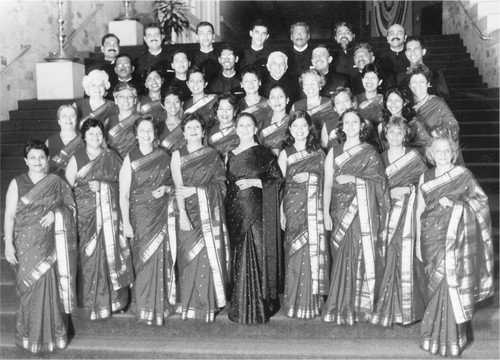
The winning choir
The choir’s several tours have seen it perform in Europe, USA, Egypt, Lebanon, Japan and the Philippines, as well as in major Indian cities. At the IX International Choral Song Festival in Poland in 1974, they secured the first prize for overall musical excellence; in 1977 they won silver medals in the categories of polyphony/classical as well as folk songs at Tolosa in Spain.
With Bombay having a ‘sister city’ status with Yokohama and Stuttgart, the German festival in 1981 was made even more memorable by the fact that Wadia was selected, from among 13 German and international conductors, to conduct the grand finale, with over 700 singers and instrumentalists. The "Voices for Hospices,” (Bombay, 1977) an international event when the Messiah by Handel was sung on the same day all over the world by over 200 choirs; the World Festival of Sacred Music in 2000 in Bangalore; an entire program of Bach in Bombay with guest artistes Dilshad Billimoria (Posnock) (flute), Farhad Billimoria (violin), Zarin Ghadialy-Hodiwala (contralto) and other soloists; recording for radio and television stations in India and abroad — conductor and choir take it all in their stride.
But amidst the fortissimos (crescendos) and the diminuendos (decresendos) come the quavering realities of raising funds for shows and tours. "We had just started our quest for advertisers and sponsors for our tour last year when the Gujarat earthquake struck on January 26. But God is great. He always helps us,” believes Wadia who begins her day with prayer and meditation, even before her morning cuppa. She graciously acknowledges the "tremendous family support, without which I wouldn’t have gone beyond my first year as a conductor.” Husband Nariman sang for long years with the Paranjoti Chorus till his bypass surgery in 1997. "Nariman is a very fine critic of my work,” she declares. His choral composition Ja-lakamaladala is dedicated to his wife and narrates in Gujarati an incident from the life of Lord Krishna as a child. Nariman was with the family firm, K. Wadia Jewellers, till he branched out in 1989 to become a consultant for jewelry techniques, including the setting up of factories for the jewelry export trade.
Their 32-year-old son Sorab cut his musical teeth with the Chorus, singing with them from when he was a schoolboy in Bombay. Honing his artistic accomplishments at the Peabody School of Music in Baltimore, Sorab did his masters in piano and voice in the USA and now seeks to make his mark abroad as a tenor in opera, auditioning for roles and traveling where opportunity beckons. Sustaining the family bond, Sorab joined the Paranjoti Chorus in Austria last year, fine-tuning the singers individually and collectively with vocal exercises, breathing techniques, etc. "Sorab is the type of person who inspires and challenges you. It is wonderful to see him at this (international) level,” commends Peddar. With music score availability restricted to a couple of shops in Bombay, "Sorab selects music suitable for the choir and sends it to me from abroad,” says his mother. Sorab performed the first movement of Sergei Rachmaninoff’s Piano Concerto No. 2 with the World Zoroastrian Orchestra at the Seventh World Zoroastrian Congress in Houston in December 2000.
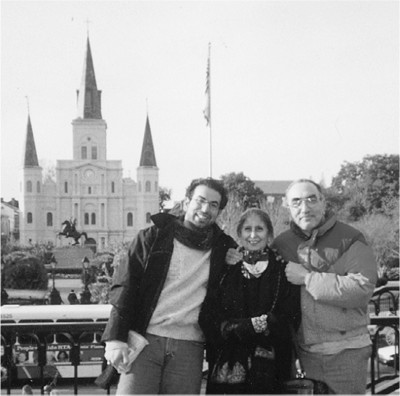
With Sorab (left) and Nariman in New Orleans
Coomi’s path to the podium began fortuitously enough when a piano was gifted to her family by a friend who intended to purchase a grand piano for his own daughter. "I was around nine at the time, studying in J. B. Petit School. I owe a lot to pianist and piano teacher Khorshed Screwvala who gave me piano lessons free for years as my mother Aloo could not afford the fees,” recalls Coomi. Father Rustom Umrigar had passed away and the early years were tough. She soon became an accomplished pianist, obtaining both the Associate (ATCL) and the Licentiate (LTCL) from the Trinity College of Music, London.
In 1950 at age 16 she joined Paranjoti’s choir, first known as BALOS (Bombay Amateur Light Opera Sabha), then as the Paranjoti Chorus from 1960 onwards. The following year saw the choir’s first concert tour of Europe, independent of the Bombay Madrigal Singers’ Organisation, under whose auspices it had originally been founded. "Paranjoti was a great conductor. Though I was a singer with the choir, I would prepare other singers for their part, take rehearsals when he could not, etc, but he never actually taught me conducting,” notes Coomi who is a graduate in graphic art from the Sir J. J. School of Art.
Paranjoti died at the age of 61 of a sudden heart attack in 1967, throwing the Chorus into turmoil, with more than one aspirant to the podium. The majority elected Coomi as the conductor, some walked out; but a brief four months later the choir gave a public performance under Coomi’s baton. "We had to quickly tell the public that the choir hadn’t collapsed!” With no formal training in conducting, it was literally a case of sink or soar, she smiles. It was two foreign tours and almost 12 years later that she took a 15-day summer course in conducting abroad. "Unnecessary acrobatics, shaking the head and body are not required. They detract from the music. I use small gestures, which have been highly appreciated, as we sing a capella (without accompaniment). While conducting an orchestra stronger gestures may be required as the musicians are concentrating on the notes in front of them,” she elucidates.
Coomi has studied and worked under well-known conductor, Helmuth Rilling and the last tour saw contemporary composers, Lithuanian Vytautas Miskinis and Argentinian Nestor Zadoff, present her with some of their choral compositions/arrangements in appreciation of the choir’s excellent rendition. Modern music, sometimes atonal, is very interesting but difficult to interpret, she remarks. Well-known Indian composer Vanraj Bhatia, also hard to perform, has written three works especially for the Chorus. "At least one-third of the program on every concert tour consists of works by Indian composers — Victor Paranjoti, Vanraj Bhatia, Nariman Wadia, Abel D’Cruz...” states their souvenir. Pandit Ravi Shankar has also invited the choir to perform his compositions. "Our performance in 1980 at the Homi Bhabha Auditorium of Bach’s Mass in B Minor with some very talented (western) instrumentalists from Poona’s Rajneesh Ashram playing in the orchestra obtained rave reviews,” reports Jesia.
Invited to international symposia and workshops, Coomi has also officiated as a judge at singing competitions and festivals in Brazil, Poland and Ceylon. "Your inner self evolves with music. I feel I have matured as a person. My singers have found a great change in me,” asserts the conductress who does yoga, and terms herself a religious person. "I love going to Udvada. Being in the Iranshah alone at night, amidst the glow of the fire and the divas, is an uplifting experience.” Unnecessary rituals do not find favor, nor does the pushing and jostling in crowded agiaries and atash behrams on Pateti or Navroz! A staunch believer in the sudreh-kusti, Coomi remarks she had read about a high voltage crematorium in Germany which instantly reduces a dead body to ash. "Why cannot we bring such a crematorium to Bombay,” she queries, perturbed by the present controversies in the community. "If the solar concentrators fitted on the dakhmas work, that’s fine,” she adds.
With her musical odyssey spanning five decades, Coomi aims "to keep making music at the highest level possible. At the end of a concert I feel, not drained, but elated.” At the Chorus’ invitation or through its efforts choirs not only from sister cities Yokohama and Stuttgart but from Aachen (Germany), Poland and Spain have performed all over India. On concert tours abroad, east-west chords are harmonized not just through the colorful saris, Nehru jackets, folded hands (namastes) and Indian melodic motifs but through living with local hosts in their homes, imbibing the cadence of competing choirs... Says Shroff, "Coomi is very particular about detail — correct multi-lingual pronunciation, tone and timbre. Her level of excellence in music is hard to find in Bombay. Though we are not professional singers, she makes us feel like a professional choir,” cleansing from the soul the dust of everyday life.
◆ ◆ ◆
From the archive