
Politics and Policy
Pragmatism is unacceptable
The high priests and the orthodox groups castigate the BPP decision to provide a plot on Ambawadi as prayer hall for the souls of the buried and the cremated
We are "facing a battle between David and Goliath, a battle between the rich and powerful and the dispossessed (of the community), between friends and lovers of the Zoroastrian religion and those out to break them,” noted Dastur (Dr) Kaikhusroo JamaspAsa, High Priest of Bombay’s Anjuman Atash Behram, in the course of his presidential address at the public meeting summoned by the Save Doongerwadi Action Committee (SDAC) at Patkar Hall on December 28, 2001.
The meeting was called to protest the majority (6:1) decision of the Bombay Parsi Punchayet (BPP) trustees on November 6, 2001 to permit the Disposal of the Dead with Dignity — Action Group (DDD-AG) to build a prayer hall on 3,000 sq feet of Ambawadi grounds adjoining Doongerwadi for the post funeral prayers of those who opt for cremation or burial instead of dakhmenashini. The BPP resolution had given the SDAC a month’s time to contest the decision with the appropriate authorities.
The SDAC resolution, carried at the meet without dissent, seeks to prohibit present and future BPP trustees from "providing any facility whatsoever for any purpose/s which is/are antithetical to or against the tenets, practices and customs of the Zoroastrian religion, anywhere on the Doongerwadi complex and/or on any other property or premises under their control.”
The evening’s moderator Noshir Dadrawala refreshed the memory of the audience in the 750-seater Patkar Hall (where people were standing in the aisles) on the dakhmenashini issue which began with all seven trustees swearing an affidavit in its support in July 2000; the Samast Anjuman meet called by the BPP in December 2000 to acquaint the community with problems they faced at Doongerwadi viz slow decomposition of bodies due to a dearth of vultures and the consequent foul odor and the measures being taken to contain them including the use of ozone pumps to refresh the environment, the spraying of chemicals to aid quick disintegration of the bodies, the experiments with solar reflectors (since then, successfully implemented in two dakhmas) and a scheme to breed vultures in captivity.
However, in mid-February 2001 the BPP trustees announced their acquiescence to the DDD to use the existing bunglis for the funerary requirements of those who chose to by-pass the dakhmas. The DDD’s two other demands — that the BPP arrange for priests to perform the ceremonies and that the Punchayet organize a crematorium on the Doongerwadi grounds — were shot down by the trustees. Nonetheless the orthodox community was stridently critical of the BPP stand at a meet on February 23 also at Patkar Hall after which the hastily formed SDAC succeeded in browbeating the BPP to put its February decision "on hold.” A subsequent meet on April 21, 2001 at the Cowasji Framji Hall, attended and addressed by the high priests, had demanded that the BPP hold a samast anjuman meeting before reaching a conclusive decision on the issue. This "democratic solution,” as described by Dadrawala, was bypassed by the BPP even though "at election times the trustees had said they would abide by the advice of the high priests,” he observed. Noting that the November 6 decision was intimated to the SDAC on November 23 with the rider that the Committee had a mere month’s time to get an order from the court to hold in abeyance a decision on the 300-year-old institution of Doongerwadi, Dadrawala exclaimed "Is that fair?” The audience responded with cries of "shame!”
Describing the lawyers, doctors and surgeons comprising the DDD as "leading lights (who had)... held the BPP trustees at gunpoint (the DDD had threatened to move the court in pursuit of their own right as beneficiaries of the Doongerwadi property),” Dadrawala noted that had he been a trustee he’d have told them to "go now, do your worst.” The villainous DDD was reinterpreted to stand for "Disposal of the Dead with Dadagiri (bullying).”
Dadrawala, as did the speakers after him, underlined the flaw in the DDD concept of seeking a facility in the periphery of the dakhmas for their funerary requirements while arguing that dakhmenashini is a health hazard. Moreover, the orthodox view looks beyond the present to future fears. "We feel this is the first nail in the coffin (of dakhmenashini),” noted Dadrawala.
Thanking the DDD for uniting the various orthodox groups, he enunciated their action plan: The SDAC has been formed into a trust so that it can fight as an institution. Funds for a legal campaign were being sought in collection boxes and a donor prefering anonymity had already provided seed money, according to Dadrawala. Efforts were also underway to form a council of high priests, he noted.
"Truth is not negotiable. If we have to fight, we will. We are conscious, aware that they have the best doctors and solicitors on their side. But we have truth on our side, the high priests on our side and you on our side,” concluded Dadrawala. Rhetoric was the order of the day.
"Standing before you once again on an issue that has plagued our community for sometime now,” JamaspAsa reiterated his earlier plea for a samast anjuman meet (which only the BPP trustees are entitled to call) as "it would help them know what the community believes, not fall to pressure groups. The DDD is wanting change without considering its impact on the living or the soul of the dead. Fire is sacred. It is the son of Ahura Mazda, a yazata to which we offer kathi, sweet-smelling sukhad and frankincense. How can fire be given a dead body which is naso (decomposing matter)? It is antithetical to the Zoroastrian faith where a dakhma exists... The majority of the community continue to use our age-old system of disposal. Cremation is only favored by the ignorant but influential classes.”
Exempting "the lady,” (Silloo Kavarana) the Dastur lashed out at the "five BPP trustees” (Jamshed Guzder, Minoo Shroff, Dadi Engineer, Dinshaw Mehta and Dinshaw Tamboly) for having "sought to ignore learning and scholarship,” and referred to "derogatory statements” made at trustee meetings. "(It is) shocking that theirs’ is a mindset that seeks to break rather than strengthen our ancestors’ practices.” He compared them unfavorably with "BPP trustees in the past, men of substance (who) upheld traditions and practices of the faith (and) did not kowtow to the Tatas and Petits.” He spelt out his ire at the DDD as having "made no attempt to meet with or learn from the high priests.” Lambasting the DDD’s "pragmatism” JamaspAsa noted, "religion is sacred. It can’t change to suit some people. Among the DDD supporters are women who have married out of the community. Ten years ago they fought for the right to dakhmenashini. Today they are against dakhmenashini.”
Congratulating and thanking BPP dissenting trustee Rustom Tirandaz "for having defended orthodoxy against the trustees and the unjust demands of the DDD,” JamaspAsa emphasized that "cremation is wrong. ...The ceremonies are confusing for the soul. We must look at it holistically. The BPP trustees are answerable to the community. (We) know that it’s only a matter of time before other irreligious demands will lead to further demands under the guise of pragmatism.”
The high priest lashed out against "the black sheep in our athornan tola (priestly fraternity) who for the sake of money will sell their souls. They are unfit to be practising priests and to wear the saféd (white) pugree.” Describing the prayers of the priests who hold the contrary view as "not efficacious, meaningless,” JamaspAsa noted, "Therefore we have debarred them from practising and put up notices to debar them. Their actions merit total contempt; they will be ostracized from our midst.” Jamasp-Asa’s warring words brought the audience to its feet in a standing ovation at the end of his speech.
Castigating influential Parsis who had sown the seeds of discord, Dastur (Dr) Firoze Kotwal recalled how the sethias of yore had bought over lands surrounding Doongerwadi and bequeathed them to the community which should be used according to the deeds of trust. Comparing the Doongerwadi property to that of Muslim religious trusts known as waqfs, Kotwal noted in Gujarati that even in Iran where the law of succession is skewed in favor of the family member who has converted to Islam to the detriment of other Zoroastrian siblings, property willed to the waqf of the religious community is respected. "Our trustees whom we have elected to preserve this waqf property, they are the ones desecrating it,” he said.
Referring to the advent of the bunglis at Doongerwadi in the 20th century when ritual purity could not be maintained while transporting the body to Doongerwadi after the sachkar and geh sarna at home, Kotwal maintained that the bunglis were irretrievably wed to the dakhmas. He mockingly suggested that if the DDD has the money, it could build the intended bungli at Ambawadi and leave it for the use of those who opt for dakhmenashini.
Jestingly interpreting DDD to mean "Die and Destroy Doongerwadi,” Khshnoomist scholar Adi Doctor referred to the 500-year-old Rivayat of Cama Vohra to the effect that ceremonies performed for those who were cremated or buried have no religious sanctity or merit and do not reach the soul of the dead.
Like Shakespeare’s Mark Antony castigating the killers of Julius Caesar, Doctor referred to the BPP trustees as "honorable men.” To emphasize the sarcasm he then went on to narrate how past BPP trustees had helped the Deolali anjuman scotch the British government’s attempt to acquire part of the Deolali dakhma land in 1930 and again in 1937 had supported the Poona Parsee Panchayat in preventing the establishment of a Parsi cemetery sought by two influential Parsis there when the dakhmas were already in existence. "Where towers are not permitted, Parsis are buried. But from compulsion, not free will. Today’s trustees are singing a different tune... There is some nexus between the DDD and some BPP trustees — perhaps only one!... The AIMZ (Association of Intermarried Zoroastrians) is another nexus... The property belongs to the community. The trustees are misusing their authority.” From the revved up audience came shouts of "Ask them to resign,” "Throw them out.”
Doctor’s jibes did not stop with the trustees: "Behind the BPP drapes is the CEO (chief executive officer). He has not read three-fourths of a book but says he has done research.” Describing him as a "mischievous person,” Doctor referred to Behram Dastur’s 11-point memo presented to the executive council meeting of the Federation of Parsi Zoroastrian Anjumans of India in Mhow on November 19 and 20, 1999. Among much else, Dastur had recommended that the children of Parsi women should be allowed in the Punchayet’s Godavra Agiary in Bombay. Dastur’s concern for the community’s future needs had also prompted him to warn the BPP trustees in a memo about the dwindling number of nassessalars and the need to establish a corps of volunteers for the task in the years ahead. Doctor faulted Dastur for his projection of zero nassessalars by 2010 as the end result of a deliberate policy of not encouraging the children of nassessalars to remain in the profession. As the World Zoroastrian Orga-nisation (WZO) is educating them, they will not be available for such work, concluded Doctor. At the end of his remarks Doctor read out the resolution which was passed without dissent though Parsiana noticed a few people here and there who did not have their hands up.
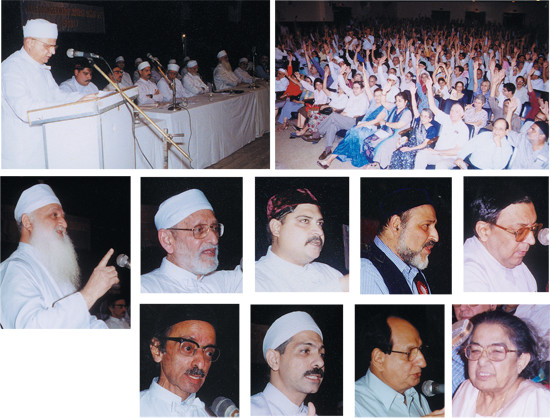
L to R (top): JamaspAsa and the audience affirming the resolution; (center) Kotwal, Unwala, Dadrawala, Mistree and Wania; (bottom) Doctor, Karanjia, Engineer and Bengalee (Photos: Adi Suder)
"We must strive to act and not just talk,” urged former BPP trustee and former vice chancellor of Bombay University Dr Mehroo Bengalee. "How can just six trustees, of whom not one is a religious scholar, at the behest of so called reformists, create such a turmoil and emotional agony in the entire Zoroastrian community?” asked the ailing Bengalee. "Can we not, as an intelligent community understand the ulterior motive of the evil-eyed group to somehow... usurp the property... the most precious possession of the community?” Though unable to stand, Bengalee noted firmly, "Act we must and immediately,” suggesting a program to pressurize the trustees to stick to the beaten path. "Awake Zoroastrians and put pressure on the trustees to fulfill their promise or else show your wrath and give them no peace at all. Let them know, we have reached the threshold of tolerance... Revolt we must and we will!” The audience approved Bengalee’s words with a standing ovation.
BPP trustee and its spokesman on the Doongerwadi issue, solicitor Dadi Engineer was a singularly embattled man that evening. Though fellow trustees Rustom Tirandaz and Dinshaw Mehta were present, an ideological gap separated the trio. Mehta, who had originally voted with the majority, changed sides after the meet as per his letter published in Jam-e-Jamshed (January 6, 2002). (According to the grapevine Kavarana has done likewise, but Kavarana told Parsiana she would abide by her decision as trustee, though personally she would opt for dakhme-nashini.) Dadrawala, driving home the unpopularity of the BPP decision after each speech, may have added to Engineer’s discomfort. Nonetheless he strode on stage to a chorus of boos to explain the thinking behind the BPP decision. Declaring himself "born and bred in sheer orthodoxy,” he asked, "Do you think all BPP trustees are reformists?” He referred to the genesis of the present impasse in the complaints from Spenta residents on the smells emanating from the dakhmas, the differences of opinion among scholars and priests regarding the various schemes, especially the stand-off between the aviarist lobby and the solar panelists. He referred to the Rs 1,000 per month stipend paid by the WZO to the nassessalars and related that when the WZO-UK amended its articles to ensure equal rights to non-Zoroastrian spouses, he had declared he would resign as president of WZO-India if the policy was applied here.
Engineer bravely defended the decision to seek counsel Rafiq Dada’s opinion as the opinions of the DDD and counsel Bomi Zaiwalla were in conflict. "Unfortunately, (Dada’s) opinion can be interpreted both ways,” he admitted. Describing himself as a solicitor for 45 years who had seen courts functioning at every level, Enginer voiced the trustees’ fear "if the matter goes to court before a non-Parsi judge.” Envisaging a scenario where photographs of the dakhmas’ innards would be produced, Engineer winced with embarrassed apprehension of the legal fraternity saying, "This enlightened community is doing this!” He asked the audience, "Do you sincerely think we want to be soori ni vachhé sopari (caught in a pincer)?” He promised to fight against a crematorium at Doongerwadi even if he was not a trustee.
But the restive audience, far from commiserating with Engineer’s dilemma, interrupted with boos and catcalls and had to be reminded several times by Dadrawala to remain quiet.
Dadrawala gave an instant rejoinder to Engineer’s plea of stench. "Stench exists (at the electric crematorium) at Chandanwadi also,” he remarked adding that along with the smell there was soot, pollution and environmental hazards there. As for photographs, the usual orthodox line was heard: "What do you expect to see inside a dakhma? A rose garden?” Dadrawala further noted, "If pictures of an exhumed body are produced with thousands of maggots, one may also have to demand for closure of Christian and Muslim cemeteries.” He urged Engineer to look beyond his seven years of trusteeship: "Where do you draw the line? The compromises you make today will lead to other compromises,” he noted, visualizing the DDD-AIMZ members as future BPP trustees. "If you clip their wings today, you will prevent this,” he advised. "(But) you would much prefer that we go to court than they go,” Dadrawala opined.
Ervad Ramiyar Karanjia, principal of the Dadar Athornan Madressa, was the only person that evening to describe the day of acrimony as "a day of sorrow.” According to Karanjia "one of the biggest lies is that dakhmenashini is a custom that can change.” He declared it to be "as important to us as atash behrams and agiaries, sudreh-kusti, the Gathas and Vendidad.” He too referred to the DDD’s agenda as a "conspiracy,” and looked for an "ulterior motive.” According to Karanjia, "The present trustees have blocked the front-door entry to a crematorium (at Doongerwadi) but they have not prevented its back-door entry.”
Zoroastrian Studies (ZS) founder Khojeste Mistree who is in the vanguard of the aviary project recounted how he had "begged the trustees to seek the opinion of the high priests” but was instead taken to Dada’s office where he presented the senior counsel with material to show that burial and cremation were anti-Zoroastrian practices. "Whether the faceless majority do not want change and the big shots want change, we have to go according to what is right in the religion,” declared Mistree.
Complaining that he gets no "proper media coverage on the aviary issue,” Mistree took the opportunity to share his insight with the audience: "What’s the point of the Punchayet saying that they have allowed one crore (for the aviary project) when I’ve told them that the cost is double?” Mistree said that he required support from the BPP but the trustees (Tirandaz and Mehta excepted) and the CEO are against the aviary. "The aviary project (needs to be) professionally managed. There can be no fifth columnists... whatever the cost, the Punchayet is well-off. (There is) no shortage of funds.”
Though there are 12,000 vultures in Rajasthan according to Mistree and hence obtaining a hundred for Doon-gerwadi would not be difficult, Mistree expressed his dismay at the circular from Behram Dastur regarding the need for volunteer nassessalars in 10 years’ time. "Lay people going into the dakhmas would be horrified... If there are no nassesalars, there will be no aviary and no dakhma system.” Referring to the ZS involvement with religious education at five Parsi schools, Mistree admitted that a number of students there are children of nassessalars, thereby endorsing Dastur’s basic observation that the children of the nassessalars are now being educated.
Though the high priests from Surat and Poona, Dasturs Noshirwan Dastoor and Dastur Hormuzdiar Dastoor, were also present, Bangalore’s Nadirshah Unwala was the only one to speak. "Dharam paisa thi véchaich (religion is being sold),” he averred, adding that the ancestors of the DDD members must have done a lot of bundagi (prayers) for their families to achieve positions of such influence and affluence. He noted that a non-Parsi former solicitor general of India has offered his services to fight the SDAC case at a concessional charge!
Currently riding the crest of orthodox popularity, Tirandaz greeted the "kom naa rakhevaalo ané kom naa wafaadaro” (the community’s protectors and warriors)” with some homespun philosophy, history and religion: "Lies have speed, truth has endurance. In the BPP senility is conquered by public relations (which is) a catastrophe for Parsi Zoroastrians. (Ours is) crystallized DNA, the product of the first civilizing force in mankind 5,000 years ago. At a time when men were eating men, Zarathushtra took his band and taught them to live among themselves... Not to escape but to carry for-ward the religion led our ancestors to come to India. They didn’t come to make money or careers but because they wan-ted to save future generations of Dinshaw Mehtas, Rustom Tirandazs, Jamshed Guzders, Dinshaw Tambolys...”
Most of the speakers at the three-and-a-half-hour talkathon had done their homework. The SDAC organizers had spared no pains: from the provision of bus service from and to the baugs; to a handy form for fellow travelers to declare whether they would provide financial, secretarial or administrative help, volunteer service or whatever; to the arrangement for audio/video recording of the evening’s events; to a note of thanks from the SDAC to its supporters in the Jam-e-Jamshed Weekly (January 6, 2002) regretting the lack of seating space. The SDAC convener Hoshang Wania, who proposed the vote of thanks at the end of the meet, and his team had organized the event with remarkable precision.
◆ ◆ ◆
From the archive