
Media
The Iranian Odyssey
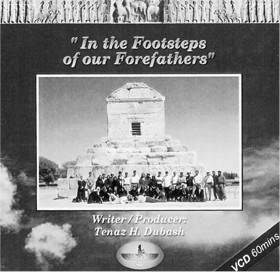
In the Footsteps of our Forefathers documents the journey of 34 young Zarathushtis in Iran
Four standing ovations at the Seventh World Zoroastrian Congress in Houston in December 2000 and two delighted housefulls in Bombay in November 2001. A heady start for a debutante filmmaker? Not quite. Tenaz Dubash is exhilarated and energized but she has her feet on the ground.
The hour-long In the Footsteps of our Forefathers, culled from 18 hours of footage shot on location as 34 North American Zoroastrian youths made their odyssey to Iran, involved nail biting suspense and backbreaking labor not to speak of a lost job and financial costs, recalls its producer-director-initiator Dubash.
The documentary traces the group’s travels through the mountains and deserts of Iran in search of their Zoroastrian roots. Despite much reading of Iran’s ancient history before the trip, Dubash found "Persepolis amazing... nothing had prepared us for it!” The group traversed the land from the Caspian coast to the Zoroastrian desert strongholds of Yazd and Kerman, from the epic grandeur of Mount Demavand to the subterranean wonders of the Ali Sadr Caves.
But the film is more than an eye-filling touristic record. Ever and anon the group pauses to visualize the links between the great monuments and themselves, to survey the Iranian Zoroastrian community that has maintained a quiet vigil over its heritage, especially the oases of the Pirs in the desert around Yazd. Many of these people are old, gnarled and poor, but their devotion to their land is palpable, which the group noticed, returning with a "deep sense of respect for those who stuck it out there,” as noted Dubash. The happy commingling that ensued as the youths participated in a navjote ceremony is an essay in the happiness that the young and the old can share, given the will, even when language is a barrier rather than a bond.
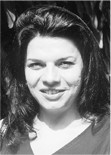
Dubash: in search of her roots Photo: Arnavaz S. Mama
The trip by the western youths was the brainchild of Laila Contractor of Pittsburg and Cyrus Fatakia of Los Angeles, informs Dubash. After Dubash had decided to join the group she felt that since she was going she could "bring back something to show for it.” She began her background research, "planning the content and formulating the structure of the film.” Other requirements involved a detailed budget for equipment, camera people and editing costs. Here, with hindsight, she says she floundered, relying on complimentary professional help from friends which slowed down the post-shooting progress of the film and led her to forego her full-time job as news writer with FOX TV network (without ever having budgeted a salary for herself) in order to complete the film in time for release at the Congress.
As Dubash was quick to point out at the World Zoroastrian Organisation (WZO) sponsored viewing of Footsteps at Bombay’s Homi J. H. Taleyarkhan Memorial Hall, the film records "just opinions — none of us are scholars.” Yet, the University of California at Berkeley is using the film for its Middle East Program, she noted in passing.
Fund-raising for Footsteps was not a problem. "Zarathushtis openly and generously supported the film,” noted Dubash, singling out the Zoroastrian Association of Metropolitan Chicago as "the most supportive association.” Funds and finance committee chair of the Federation of Zoroastrian Associations of North America (FEZANA) Dr Jerry Kheradi personally contributed $ 5,000 to her $ 20,000 budget, she recalls warmly.
What was more daunting was the prospect of dealing with officialdom in a country at loggerheads with the US. "I had never attempted to film a documentary in a foreign country where Americans had no political rights and where I did not speak the native language,” notes Dubash. The Iranian visas were acquired barely a fortnight before the scheduled departure. Only two members of the group spoke Farsi and the government permission to shoot film had to be applied for in the native language and was eventually obtained thanks to the Zoroastrian representative in the Iranian Majlis Dr Keikhosrow Dabestani, recalls Dubash. To cap it all, "the subject matter was religion and, as we all know, human beings can become fiercely dogmatic in their interpretation of religion. This affected the film, at all stages, in both positive and negative ways.”
The search for local technical assistance was equally difficult. With no qualified Zoroastrian media persons available, Dubash ended up with two cameramen, the primary one being Muslim, the secondary Zarathushti, but both coincidentally named Shahriar. The driver of their bus and the guide were both Zoroastrians.
Dubash found that the 34 members of her group represented an array of religious opinions. She says she restricted herself to five or six of the more articulate co-travelers "to avoid a mishmash of too many opinions.” But there were other challenges in store. In both Yazd and Kerman the more conservative members of the group were critical of the Muslim cameraman accompanying them. That is when Dubash says, "I separated myself and the two camera people from the group for two days, hired a taxi with a Zarathushti taxi driver, and explored Yazd, Kerman and the dakhmas myself. It was very challenging to be in front of the camera but was also extremely liberating to be away from the large group for two days. This was one of the few, and very rare, times in Iran that I had a true sense of ownership over the material I was working on.”
Eventually Footsteps notched a profit of $ 6,000 which was donated to FEZANA. Half of it was disbursed in India and half in Iran, says Dubash.
Dubash has been traveling since an early age. Born in Calcutta to Aloo (née Vania) and the late Hoshang Dubash, a marine engineer, she is the second of three siblings who shuttled between home and grandparents, completed her schooling in Delhi where her dad joined Kelvinator following a stint with Gammon India in Bombay after leaving the sea, informs a family source. The family migrated to the USA in 1982 and settled in Syracuse when Tenaz was 18. She proceeded to Cornell University where she had to accelerate her degree (BS in human development and family studies) as she was required to help support the family when Hoshang succumbed to a heart attack in 1985. But five years later she secured an MS in TV, radio and film from Syracuse University and began her climb up the media ladder starting from desk assistant, amassing experience as assistant to production manager, as coordinating producer/writer, as associate producer and news associate in stints with ABC, CNBC and FOX, among other broadcasting agencies.
Dubash says her elder sister Farida, married to Neville Divecha, is "a full-time mom” to two boys; her brother Jamshed with a masters in electronic engineering has worked with Compaq and Intel before starting his own business. Dubash "ever the nonconformist, thinks and does things for herself,” notes a family member.
Without a job in a recessionary economy Dubash has been coping with freelance work including medical writing. Footsteps has given her a yen for making documentaries independently, she says and she is toying with the idea of one on contemporary Zoroastrians like Zubin Mehta, Bapsi Sidhwa and the like. There is material aplenty. The feisty Dubash will surely find a way to record it on celluloid.
◆ ◆ ◆
From the archive