
Books
Life in the trenches
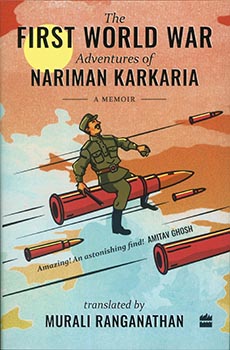
The First World War Adventures of Nariman Karkaria: A Memoir translated by Murali Ranganathan. Published in 2022 by HarperCollins Publishers, 4th floor, Tower A, Building No. 10, Phase II, DFL Cyber City, Gurugram 122002; website: www.harpercollins.co.in. Pp: xxv + 230. Price: Rs 599.
When the 15-year-old Navsari boy set off to seek his fortune in China in the second decade of the 20th century, did he know he would end up serving the British Army on three fronts during World War I? Nariman Karkaria’s memoirs are reportedly among the few that are available about Parsi — and indeed Indian — first-hand accounts of the Great War. Translated from the Gujarati 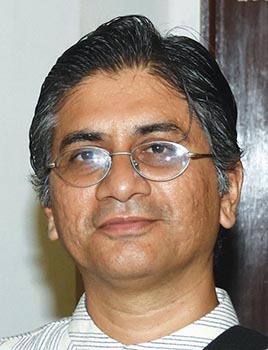 original by researcher Murali Ranganathan, The First World War Adventures of Nariman Karkaria: A Memoir, is in part a travelog and part a ringside view of the War. Despite Ranganathan’s caveat that Karkaria’s tale is best read in the original, the tome provides a great insight into the world of Karkaria, the maverick; his insights are wide, but not deep. No character other than Karkaria comes alive in the volume. The persons who help him in his early journeys are unnamed, as are his colleagues in the War effort. How he financed his travels remains largely unexplained.
Karkaria comes across as someone chafing at Navsari life. We are told that his urge to travel began as a teenager when he saw various vessels in Bombay harbor. Not enthused about being in training as a priest, the lad leaves home, makes his way to Bombay at age 15 and boards a Hong Kong bound vessel. Parsi hospitality sustains him in the colonial island. Next on the cards is a trip to China, a journey back to Navsari, again to China and onto the United Kingdom via China, Japan, Siberia, Russia and the Scandinavian countries.
All through, Karkaria observes the environment, customs and manners of the people he encounters. In Japan, he believes that "our dear dwarf Japanese have done wonders with their trains… Indian trains are not a patch on them.” He draws comparisons between a Russian wedding conducted "in the traditional rustic fashion” with the customs that match those observed in Navsari — the groom travelling to fetch the bride, et al. He notes that the priests who conduct weddings are "remunerated just like the dustoors in our villages who are offered eggs, bananas and pieces of meat for conducting minor rituals.”
The parsimonious Parsi in Karkaria compels him to make comparisons between prices of items in the lands he visits and back home in Navsari. "Do these people not have any feelings of guilt?” he asks, balking at "nine annas for a cup of tea and 12 for coffee” in Stockholm.
original by researcher Murali Ranganathan, The First World War Adventures of Nariman Karkaria: A Memoir, is in part a travelog and part a ringside view of the War. Despite Ranganathan’s caveat that Karkaria’s tale is best read in the original, the tome provides a great insight into the world of Karkaria, the maverick; his insights are wide, but not deep. No character other than Karkaria comes alive in the volume. The persons who help him in his early journeys are unnamed, as are his colleagues in the War effort. How he financed his travels remains largely unexplained. Karkaria comes across as someone chafing at Navsari life. We are told that his urge to travel began as a teenager when he saw various vessels in Bombay harbor. Not enthused about being in training as a priest, the lad leaves home, makes his way to Bombay at age 15 and boards a Hong Kong bound vessel. Parsi hospitality sustains him in the colonial island. Next on the cards is a trip to China, a journey back to Navsari, again to China and onto the United Kingdom via China, Japan, Siberia, Russia and the Scandinavian countries.
All through, Karkaria observes the environment, customs and manners of the people he encounters. In Japan, he believes that "our dear dwarf Japanese have done wonders with their trains… Indian trains are not a patch on them.” He draws comparisons between a Russian wedding conducted "in the traditional rustic fashion” with the customs that match those observed in Navsari — the groom travelling to fetch the bride, et al. He notes that the priests who conduct weddings are "remunerated just like the dustoors in our villages who are offered eggs, bananas and pieces of meat for conducting minor rituals.”
The parsimonious Parsi in Karkaria compels him to make comparisons between prices of items in the lands he visits and back home in Navsari. "Do these people not have any feelings of guilt?” he asks, balking at "nine annas for a cup of tea and 12 for coffee” in Stockholm.
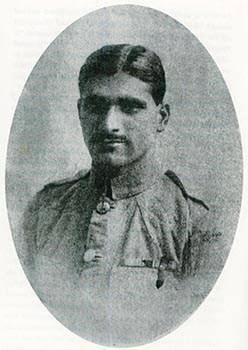
Above: Nariman Karkaria ; top : Murali Ranganathan
Karkaria’s recruitment into the 24th Middlesex Regiment of the British Army is made out to be smooth. Did he face any prejudices? We don’t know. Details of how the Regiment is structured follow. As do his descriptions of the War on the Western Front at Somme in France, in Egypt and in the Balkans. He graphically portrays life in the trenches, the food he ate, and interactions with local people.
 There are vivid descriptions of "the Germans who were hardly at any distance away from where we were” and of "staring death in the eye.” In the trenches, our hero encounters "war in the skies” when "the sky above us was crisscrossed by enemy planes.” Karkaria takes these hardships in his stride: "Since we could not wash ourselves for days on end, our bodies would break out in boils… The hair falling on our forehead, covered with sand and sweat, would stick to our skin…We had to take emergency action by shaving off the hair on the front of our heads immediately. Hardships notwithstanding, there was much merriment when "once in every eight or 15 days, orders would be issued that we were to go and wash our faces.” He notes that "singing with the band, we would march for about five miles with our towels and any clothes which had to be washed.” In the section "Desert Battles,” Karkaria also describes his admiration for the Turkish troops his Regiment encounters.
The lad finds himself in the eye of the storm in Somme — "Buffeted from all sides and terrorized by the incessant guns, there were many soldiers who felt it would be far better to emerge from the trenches and take a chance with the enemy gunfire.” Our hero was not one of those who emerged, for the book ends with his being driven "crazy with happiness” on seeing the Taj Mahal Hotel from the ship that brings him back to India at the end of the War!
Writer Amitav Ghosh is fulsome with his accolades for the tome in the Foreword. He calls it a unique work, "in the story that it tells, in the swashbuckling manner of its telling, and not the least, in the excellence of Murali’s translation.”
Go buy the book, it will be your personal time machine.
FARROKH JIJINA
◆ ◆ ◆
From the archive