
In Memoriam
Community chronicler
Died: Marzban Jamshedji Giara, 79, community researcher and author of nearly two score books and booklets documenting the contributions of Parsis and Zoroastrians; on November 3, 2022 at the Cama Convalescent Home in Bombay.
"Be a creator, not a spectator in life,” was the advice Marzban had received from his father Jamshedji. Give back to society what you have gained from it, advocated the father. Acting on this adjuration, Marzban took it upon himself to read, research and report on community stalwarts of yore and present day promising youth through his incessant writings.
The History of Holy Fire Iranshah and Udvada Gam was his last work to be released in April 2022. The 144-page hardbound book published by The WZO (World Zoroastrian Organisation) Trust Funds (WZOTF) was distributed free to community members. Besides information on the sacred fire and the village, it included Gujarati songs on Udvada and Iranshah transliterated into English, some tips for Parsi Zoroastrian pilgrims as also for priests/dharamshala managers.
Among his other recent works supported by WZOTF were Prominent Parsis of Navsari and Directory of Parsi Residents of Navsari. These three books were published while he and his wife Bapsy had taken up residence at the WZOTF Senior Citizens Centre in Navsari, recalled WZOTF chairman Dinshaw Tamboly who viewed the couple as "ideal residents, very well disciplined and cooperative.” From his base in Navsari, a steady stream of articles would be sent to Parsiana too, inducing us to undertake further research on diverse topics.
"Be a creator, not a spectator in life,” was the advice Marzban had received from his father Jamshedji. Give back to society what you have gained from it, advocated the father. Acting on this adjuration, Marzban took it upon himself to read, research and report on community stalwarts of yore and present day promising youth through his incessant writings.
The History of Holy Fire Iranshah and Udvada Gam was his last work to be released in April 2022. The 144-page hardbound book published by The WZO (World Zoroastrian Organisation) Trust Funds (WZOTF) was distributed free to community members. Besides information on the sacred fire and the village, it included Gujarati songs on Udvada and Iranshah transliterated into English, some tips for Parsi Zoroastrian pilgrims as also for priests/dharamshala managers.
Among his other recent works supported by WZOTF were Prominent Parsis of Navsari and Directory of Parsi Residents of Navsari. These three books were published while he and his wife Bapsy had taken up residence at the WZOTF Senior Citizens Centre in Navsari, recalled WZOTF chairman Dinshaw Tamboly who viewed the couple as "ideal residents, very well disciplined and cooperative.” From his base in Navsari, a steady stream of articles would be sent to Parsiana too, inducing us to undertake further research on diverse topics.
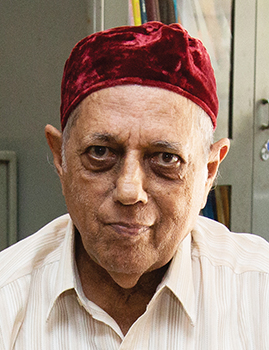
Marzban Giara: research and report
"What is the use of having money if there is no contentment? We are contented with what we have,” Giara had conveyed in an interview with this magazine nearly 25 years ago following the release of the first edition of his Global Directory of Zoroastrian Fire Temples (see "Shrines for the showcase,” Parsiana, April 1998). "Unless you check your expenses there is no end to greed,” believed the humble author.
After completing his graduation in chemistry and physics from Bombay’s Ruia College, Marzban worked for IBM World Trade Corporation, marketing computers and data center services. Later he was associated with International Data Management Pvt Ltd, formed by the employees of IBM, which took him to Madras for some years. Once he resigned from this job he chose to help Dr Bahman Surti to publish and distribute his multi-volume Shah Namah of Firdaosi in English prose. Bapsy gave up a lucrative job with ICICI (The Industrial Credit and Investment Corporation of India Ltd) following the birth of their son Zareer.
Frequently seen at community functions and conferences with books in hand, Marzban believed, "If Mohammed cannot come to the mountain, the mountain must go to Mohammed. I believe in taking books to the people…” His own publications, some authored, some compiled, and some translated from Gujarati to English and vice versa had made him a household name among the community. His initial spate of self-financed publications included Gujarati to English translations of Sant Dasturji Kookadaru, First Dastur Meherjirana, Jarthosti Gayan Sangrah, Our Zoroastrian Religion, as also other works like Words of Wisdom, Keys to Happy Family Life, The Navjote Guide, The Nirangdin. Following the 1998 release of the Global Directory of Zoroastrian Fire Temples, he published The Zoroastrian Pilgrim’s Guide, Parsi Statues, The Contribution of the Parsi Community during World War I, Valiant Parsis in War and Peace, All India Directory of Parsi Institutions…
Valuing the contributions of Bomanjee Byramjee Patell, "the great Parsi chronicler” who had compiled Parsee Prakash in 1888 to record the events connected with the growth of the Parsi community in western India, Marzban was equally grateful to "those pious athravans who preserved the Zoroastrian religion, tenets, prayers, rituals, ceremonies and scriptures in their pristine form over the centuries and sacrificed their lives to preserve the race and religion…
"Religion does not mean going to the fire temple or praying from a book, but living life according to the tenets (of the faith),” Marzban had reiterated during the Parsiana interview. He recalled the words of his mentor, Dastur Kaikhushru M. Kutar, whose navjote class he attended, that religion is "bread for daily use, not cakes for special occasions.” Describing himself as an "orthodox by training,” Marzban had clarified, "In today’s world nobody is orthodox. Everybody goes with the wind.” He was of the view that "religious institutions have been built by Parsi Zoroastrians for Parsi Zoroastrians. If you want to follow the faith, you should marry within the community. There should be no gender discrimination... Those who marry out should build and support their own institutions…”
After translating Ervad (Dr) Pehotan Peer’s 24 articles on "Vegetarianism from the viewpoint of Zoroastrianism” and attending a nature cure course, Marzban preferred to avoid a non-vegetarian diet.
It was Mazban’s formative years at the J. B. Vachha High School where he learnt Gujarati that helped him to undertake translation work. He then schooled at St Joseph’s High School, Wadala. Marzban and his sisters Vira and Maharukh were brought up in a thrifty household for Jamshedji, an electrical mechanical engineer, was unable to bring in a steady income. To supplement his earnings, their mother Homai and the children would sell different items from door to door.
A scouts master until the age of 50 years, Marzban believed the younger generation should be taught to shoulder responsibility. Past president of the J. N. Petit Library at Dadar, Marzban put to optimum use his membership of other associations like the Indo-American Society, British Council, The K. R. Cama Oriental Institute, Bombay Management Institute, Computer Society of India.
There is lack of leadership, accountability and transparency in the community, observed Marzban. Instead of dissipating energies on housing, the leadership should be concerned with career guidance, counselling services, marriage bureaus, publication of religious books, he advocated. He stressed, "Our community can only progress when our people are industrious and not dependent and subservient. Our charities have produced more beggars. The present leaders and the present generation are not willing to make any sacrifices unlike our wise and noble ancestors.”
The humble historian is survived by his wife Bapsy, son Zareer, and sisters Vira Sam Tantra and Maharukh Daraius Bulsara. P. G.
◆ ◆ ◆
From the archive