
History
“Missing, believed killed”
Twice, presumed to be dead, the Sergeant lived on to relate his harrowing and humorous experiences of World War I
When World War I broke out in the first week of August 1914, everyone thought the war would be over in three or four months and everyone wanted to enlist as early as possible. In those days, Indians were not being given the King’s Commission and the two Parsis, Nasli Padamjee and I, who were at Cambridge and enlisted, were given a polite run around for almost a month. We only understood afterwards that there was a confidential circular about not taking Indians in the combatant ranks.
Nasli went to London and sent me a telegram to go to 24, St. James Street, which was the recruiting office of the Middlesex Regiment and said I was a Parsi. I immediately went there, had my necessary medical examination and then to the attestation or swearing-in...
From the start of the training, the Sergeant’s word was law. In other words, you obey the orders first and then ask questions afterwards and it was fatal to try and cheek a Sergeant.
I recall the story of the Sergeant calling the roll—”Smith”— "Here, Sergeant;” "Robinson” — "Here, Sergeant;” — "Johnson” — "Here, Sergeant;” and then —”Montaig” (Montague) — No answer — "Montaig”—Again, no answer; — Then, for the third time the Sergeant bawled "Montaig” — This time, a weedy youth stepped out of the ranks and said, "If it’s me you mean, Sergeant, my name is Montague.” "Oh yeah Mr Blooming Montague,” remarked the Sergeant, "take two steps back into the ranks and take three days fattigew (fatigue).”
Nasli went to London and sent me a telegram to go to 24, St. James Street, which was the recruiting office of the Middlesex Regiment and said I was a Parsi. I immediately went there, had my necessary medical examination and then to the attestation or swearing-in...
From the start of the training, the Sergeant’s word was law. In other words, you obey the orders first and then ask questions afterwards and it was fatal to try and cheek a Sergeant.
I recall the story of the Sergeant calling the roll—”Smith”— "Here, Sergeant;” "Robinson” — "Here, Sergeant;” — "Johnson” — "Here, Sergeant;” and then —”Montaig” (Montague) — No answer — "Montaig”—Again, no answer; — Then, for the third time the Sergeant bawled "Montaig” — This time, a weedy youth stepped out of the ranks and said, "If it’s me you mean, Sergeant, my name is Montague.” "Oh yeah Mr Blooming Montague,” remarked the Sergeant, "take two steps back into the ranks and take three days fattigew (fatigue).”
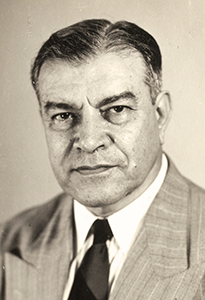
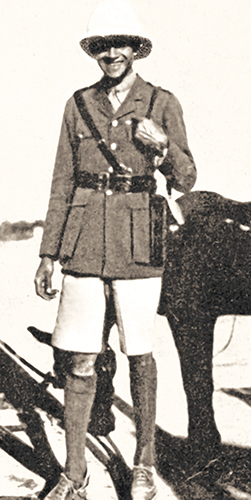
Karesasp Naoroji
Discipline kept on getting tighter as training was intensified and on Salisbury Plain I enjoyed the wonderful rank of Lance-Corporal (Temporarily Unpaid), which meant that in life I did everything from a Private to a Lance-Sergeant, but in case of death automatically reverted to Private for the purposes of pay and pension to the widow!...
From Salisbury Plain, we were sent to Folkstone and went aboard a boat for France. The sea was rather rough and as the Germans had torpedoed a Hospital Ship nearby, nobody was allowed on deck and we had to remain below. We were escorted by four destroyers and finally got to Boulogne. We were then marched up to a camp for the night and got into cattle-trucks and were pushed out towards the front and we got into the front rank trenches in Flanders near Le Bassee Canal. As the water level there is very high, all the trenches were built up with sand bags and bully beef tins! There was at least a foot or two of water in the trenches and we had to stand in them for 72 hours at a stretch. All the men had three pairs of socks and rubber thigh boots, but there was no place to sit and even a small doze at night had to be done standing. The water would occasionally freeze with a thin coating of ice and so we had to keep moving, until the most welcome ration of rum came round just before sunrise. If our worthy faddists of prohibition in Bombay had stood for a day or two in the trenches, they would have very quickly changed their minds. The rations for the troops in the trenches were uniformly good, but the transport through the water and mud-laden trenches was always difficult.
After a few months… I was promoted Full Sergeant and put in charge of a platoon. One of the first lectures that we got from our Guard’s Sergeant-Major began with "Now you fellers are Sergeants, always remember one thing. The Private is always wrong.” When I asked whether that was so even if the Private had done no wrong, he said, "You can always make him do wrong,” and told us to watch him. There was an inspection parade lined up with everyone standing to attention. He turns to one man, looks him up and down and says, "What do you mean by having mud on your putties?” The natural thing for the man to do was to look down. As soon as he did that, the Sergeant-Major said, "Stand up, you are standing to attention.” Then he turned to us and said, "If he had not looked down, I would have asked him if I was talking to a brick-wall.”
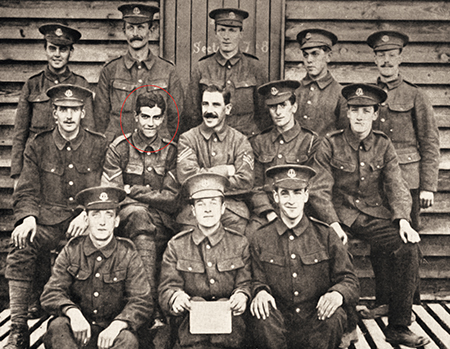
Karesasp Naoroji with comrades-in-arms
Photos: Tata Archives
While these things seemed hard, they seemed very necessary if strict discipline had to be maintained under conditions prevailing in the trenches and with the tough type of soldiers we had to deal with. When I was a Lance-Corporal, in my little section of nine men, I had at least three men who had "done time” for burglary, theft, rioting etc. But they were wonderful fellows. When we moved divisions, I went down as a Sergeant to see after their billets, blankets, etc and on my return I found that I had misplaced my mess tin which I had used for about eight or nine months. I immediately thought of my old squad and asked them if they had seen any missing mess tin. They said they hadn’t, but knew where it was. So I let them have quarter hour off from their P.T. and in less than 10 minutes they were back with four brand new mess tins. They picked the best one out and said it was mine!
On the Somme… a part of our work was to dig a mine which was to be blown up on the first of July. For this purpose we had to march four miles from the camp to the front line trenches and remove sand bags filled with earth in a tunnel. This work went on for 12 hours and then we were marched four miles back to the camp. I wish some of our present day labor leaders had been there.
On July 1, when our casualties were expected to be a hundred thousand during the week, we had 80,000 during the first day! We had been told that all the German trenches would be smashed up. We were to be the second line of attack and our objective was supposed to be 2,000 yards behind the German front line. Another regiment was to take the line. At 7.25 the big mine was blown up and at 7.30 we were over for the attack and found that our barbed wire wasn’t cut and we had to go through it. We were the first troops to reach the German front lines; in other words, the whole of the regiment on front had been wiped out and I had eight men left out of the 48. When I was shot through the arm and my hand was paralyzed, I went back to the front line and they took out the field dressing, which all troops carry, cut the sleeve and put the dressing on. Then I went to the advance dressing station. By that time the bandage was covered with blood. So they cut the sleeve of my shirt and coat further and found the other mark where the bullet had gone in. They then gave me a shot of anti-tetanus, put a large luggage label on me and I marched two miles to the nearest railway, where the cattle-trucks were rapidly filled up with the wounded.
We then went by train to Doullens which was the advance field hospital, where the rush of the wounded had almost overwhelmed them, and so there was no time to check whether any bone was broken. They therefore put a splint much longer than necessary and another luggage label was added and we were told to move on. I had to walk sideways because I could not risk somebody pushing against the elongated splint. As there was too much rush on the train, I went by bus for about 10 miles and was put into a hospital. All my clothes were burnt and I was put in a new pair of pyjamas and put to bed.
But I had to get up again in three or four hours and get into another bus and go to Le Touquet to another hospital run by the Duchess of Westminster. There I was again given a nice hot bath and changed. The uniform was burnt. The next morning a Major came up and asked whether I could walk. As I had long enough experience of the army to know that a question like that meant there was work to be done, I gave a noncommittal answer; at which he said "Could you walk to England?” at which I promptly jumped up and said "Yes, Sir.”
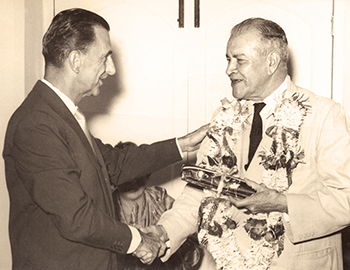
Karesasp Naoroji with J. R. D. Tata
We were then herded into third class carriages, 10 to a carriage at four in the afternoon to go either to Boulogne or Le Havre. We had no food or tea or coffee from four in the afternoon to eight o’clock the next morning. The third class carriages were taken up to the dock and we got up to a beautifully appointed hospital ship where we were given a large bowl of hot soup. After that I sat down near one of the funnels and must have gone right off to sleep there. When I woke up, the ship was still standing and I asked when we were leaving for England, and was told we were already at Southampton.
We were put in a very well appointed hospital train. When I asked about our destination, I was told either London or Newcastle and we actually landed at Berkhamstead ! I don’t remember very much, but woke up when given a very hot bath and scrubbed by a member of the St. John’s Ambulance Brigade at a very nice Voluntary Aid Detachment Hospital in the Golf Club of Bromborough in Cheshire. I was rather surprised that, though I had not given my name and other particulars, they said that I had already given them all particulars. When I insisted that I had said nothing they said that I had given my number PS 1024 correctly and I had given my name as Sergeant Nobbs. That was the name I was usually called by. It took quite a lot of persuasion to make them change it. I think that was probably when for the second time, I was reported "Missing, believed killed.” The first was some time in January 1916 when we had to attack a German mine crater and were held up for 24 hours before we could get back.
The War still had its lighter moments. We had a Corps Commander who was well known for his rather theatrical ways. He sent word one day that he was coming round to inspect the front line trenches. Everyone rushed around to get everything ship-shape, and in the confusion a Lance-Corporal got hold of the Company’s rum jar and drank himself silly. The problem was where to hide him during the General’s visit, as the old man had an uncanny habit of going into the most unlikely nooks and corners. Then somebody had a bright idea. They put him on a stretcher, covered him over with a white sheet and solemnly carried him out of the trenches. Everything went well until they came to the road crossing and there they met the General’s party. While everyone stood to attention and saluted, the General in a loud voice said — "I salute the glorious dead” at which moment "the glorious dead” sat up on his stretcher and asked what the old boy wanted. I shall draw a veil over what followed...
Edited excerpts from Karesasp A. D. Naoroji’s Reminiscences of World War I carried in the Tisco Review, Vol. 1, No. 2, 1965. On leaving the army in 1921, Karesasp, who was the grandson of the legendary Dadabhai Naoroji, joined Tata’s and was appointed secretary to R. D. Tata. Rising to the rank of director of Tata Industries and Tata Chemicals, and chairman of Lakme Limited, Karesasp retired from the board of Tata Industries in 1962.
◆ ◆ ◆
From the archive