
History
The Khambattas’ story
Khambhat flourished as a commercial hub for Parsis till the advent of Surat
While the year of the arrival of Parsis in Khambhat is hazy, it is certain that this town, about 90 kms from Ahmedabad in Gujarat, "was one of the first Parsi settlements,” noted Dr Meher Mistry, speaking on "Exploring Khambhat — An early Parsi settlement” at a virtual talk organized by The K. R. Cama Oriental Institute on September 30, 2021. A prominent port in medieval times, only one Parsi family remains in that town, she noted. "We can only make inferences from the dates in the Qisse-i Sanjan… there could have been economic factors behind the Zoroastrian migration from Iran…one possible date when Parsis settled in Khambhat is 1085 CE…it is possible there could have been independent landings in Khambhat (also known as Cambay) …this is noted in English and Dutch records,” said the historian, who heads the history department in Ramniranjan Jhunjhunwala College of arts, science and commerce. Mistry’s doctorate from the Asiatic Society of Bombay was on "A history of some Parsi settlements on the western coast of India (1600-1850) – A study of Bharuch, Ankleshwar and Khambhat.” "It is likely that Parsis prospered in maritime trade under the Solanki dynasty that ruled Khambhat,” Mistry noted.
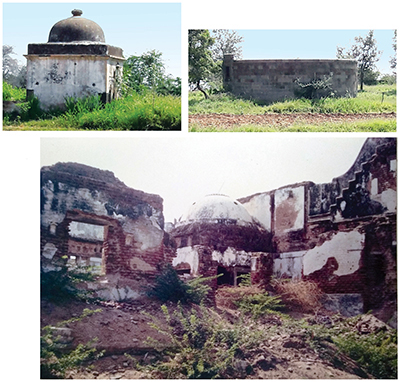
Clockwise from top l: Community land; dakhma;
ruins of fire temple Photos: Dr Meher Mistry
As is the case in other early Zoroastrian settlements, history prior to the 1300s CE is "very scant,” stated the historian. There is a possibility that Parsis could have been involved in rioting with the Muslims in Khambhat, c 1094-1143 CE according to records ascribed to 13th century writer Muhammed Ufi in Jawami-Ul-Hikayat, a collection of anecdotes in Persian. "Tarsas instigated infidels and attacked a mosque and killed 80 Muslims,” notes Ufi. However latter-day historian S. H. Hodiwala (1867-1944) "rejects the interpretation of Tarsas as fire worshippers,” noted Mistry, adding that they were surely involved in trade. "Available genealogy of six generations of one Chahil Sangan” indicates so, she stated. An Iranian scribe Mihirapan (Meherwan) Kaikhushro was invited by Sangan to Cambay in c 1323. The death anniversaries of two-to-three members of that family were observed on Fravardin roz, Adar mah, the day reserved for those whose exact roz of death is unknown, indicating they had ventured away from Khambhat for trade.
Priests and even traders from the town were in communication with Zoroastrian priests in Iran from 1478 CE onwards, stated Mistry. Khambhat is believed to be the location of the first stone dakhma in India, an "instruction” given in the Rivayats (communication between Zoroastrians in Iran and India) exchanged in that period. The earlier dakhmas that survived in Bharuch were made of brick. Prior to the exchange of the Rivayats, wooden biers were used in funerary ceremonies, which the Iranian priests asked to be changed to iron. "One Kama Bohra sent his brother (to Iran) to secure a Rivayat in 1523… Hirji Asa who built the dakhma, two wells and a fire temple may have been a family member of Kama Asa who played a major role in securing certain Rivayats,” noted Mistry. One resident Kaus Mahiyar is believed to be the "first and only instance” of a messenger not deputed by the Parsis of Gujarat who frequented Iran for commercial purposes but also posed questions to the priests there and brought back answers, stated Mistry. The Parsis of Khambhat are last mentioned in the Rivayat of 1681, stated the historian.
Community members find mention in the Sanskrit legend Kumarika Kshetra. A translation by one Capt Robertson states that as a result of an attack by Kalyan Rai, the ruler of Cambay on "the prosperous Parsi settlement of Cambay, no Parsi was to be seen.” "There may be a lot of dramatization in this statement, but the legend serves to illustrate Parsi involvement in trade,” noted Mistry.
With the emergence of Surat as a river port, many merchants migrated there and also to Bharuch. "Khambhat did not vanish…it became part of the hinterland of Surat.” While there is no evidence of Parsi trade with the Portuguese of the region, they became commodity brokers to the English and the Dutch at Khambhat,” observed Mistry.
Three names, Edulji Cowasji, Byramji Cowasji and Khurshedji Jamshedji Mody are prominent Khambatis even after the migration of Parsis to greener pastures. The Cowasjis "found themselves involved in tripartite struggles between the then Nawab Momin Khan I, the Marathas and the English.” Mody secured a post in the British residency at Poona and also became "Parsi subedar” of the Carnatic, a post he had to give up as the administration felt that would cause a conflict of interest. Cowasji’s descendants who continued as brokers, were appointed to the service of the Marathas "and were involved in intrigues against the British.” One descendant, Peshtonji Mody, constructed a new dakhma in Ralej near Khambhat in 1826 in memory of Edulji, noted Mistry. "Peshtonji had got an agiary built at Khambhat in 1844. This must be the same agiary whose ruins can be seen at Parsiwad” in the city, Mistry told Parsiana.
There were 200 Parsis in the town in 1775, some involved in agate polishing and in commissariat work; numbers were down to 107 in 1872. "The migration out of Khambhat was a gradual phenomenon… but the community played a role much beyond its numbers,” concluded the historian.
Honorary secretary of the Institute Dr Nawaz Mody, in her welcome address mentioned the long association Mistry has had with the organization. Mody also provided a vote of thanks.
◆ ◆ ◆
From the archive