
Professions
Designing woman
Family members share their memories of India’s first woman architect
Today’s architectural students need to know about their legacy.” This is the motivation for Tina Sutaria’s efforts to popularize, document and archive the works of her aunt Perin Mistri (1913-1989), widely known to be India’s first qualified woman architect and the first woman member of the Indian Institute of Architects. Sutaria is putting together approximately 5,500 items from Mistri’s legacy that include iconic drawings of the buildings she designed for her father Jamshedji Mistri’s firm Ditchburn, Mistri and Bhedwar (DMB). "I have the drawings made on paper… Some are deteriorating and have to be conserved first, before I can think of getting them digitized… Some renders are on Irish linen… I even have the high stools the staff of the firm sat on and executed their designs… I use them as bar stools,” she told Parsiana on October 4, 2021. "Whilst the process of restoration, conservation, digitizing and archiving this treasure trove of historical importance is extremely exciting, it is also daunting and we really hope to be able to gather enough funds to meet these expenses,” Sutaria told us. DMB was wound up a few years after Perin’s passing.
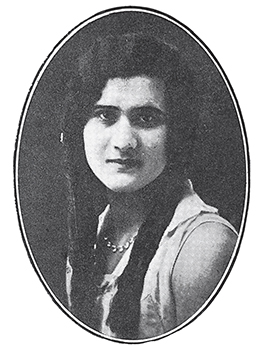 Perin, who retained her maiden name after her marriage to Ardeshir Bhiwandiwalla, was a "strong and very determined personality,” her son Dosu told Parsiana on October 9. "Whatever she did she did well or not at all. For example, if I were to be very honest, she was a lousy cook. But she was an accomplished musician and played the piano and the organ quite well.”
The son recalls that Perin’s favorite forms of architecture were factories and hospitals. "She designed textile mills, factories to produce printing ink, cable producing facilities and many others… She also enjoyed designing and building hospitals… She designed and built a fair number of schools.” Dosu stated that she built, to the best of his knowledge, only two residential homes. One for a relative of her father’s which was a job assigned to her as her first architectural venture. "The day she passed away, I was with her, and we were looking out of a hospital window (Jaslok) at the first house she built.” The second residence that she built was for a close friend just outside of Hyderabad.
Perin "won a couple of international awards for various designs… For the German engineering giant, Siemens, she built a cable factory with an innovatively designed roof from which heat escaped but copious amounts of light entered the building. For this design she won a German award.” Dosu narrated that the Belgians honored her for "saving” a hospital in Bombay. "One of the covenants on that property was that the original structure could not be demolished and if it were then the land would revert… She then devised a method of sandwiching the original walls between new walls and reinforced cement concrete, thereby enabling a complete new building to be built which is one of the leading maternity hospitals of our city.”
Chief architect for the Salvation Army hospitals in India and Africa, Perin was honored by being invited to Buckingham Palace for tea with Queen Elizabeth II, Dosu stated. "When Metro-Goldwyn-Mayer came to India they presented my mother with a design by their architects in Los Angeles. She accepted the design, made certain radical modifications and presented it back to the Americans. Every single one of her suggestions was incorporated in the (Metro) theater which stands today largely as designed and built by her.” She even designed and built a church (St Stephen’s, at Warden Road, subsequently re-designed and re-built). "Each and every project she took up was with equal fervor and zeal.
Perin, who retained her maiden name after her marriage to Ardeshir Bhiwandiwalla, was a "strong and very determined personality,” her son Dosu told Parsiana on October 9. "Whatever she did she did well or not at all. For example, if I were to be very honest, she was a lousy cook. But she was an accomplished musician and played the piano and the organ quite well.” The son recalls that Perin’s favorite forms of architecture were factories and hospitals. "She designed textile mills, factories to produce printing ink, cable producing facilities and many others… She also enjoyed designing and building hospitals… She designed and built a fair number of schools.” Dosu stated that she built, to the best of his knowledge, only two residential homes. One for a relative of her father’s which was a job assigned to her as her first architectural venture. "The day she passed away, I was with her, and we were looking out of a hospital window (Jaslok) at the first house she built.” The second residence that she built was for a close friend just outside of Hyderabad.
Perin "won a couple of international awards for various designs… For the German engineering giant, Siemens, she built a cable factory with an innovatively designed roof from which heat escaped but copious amounts of light entered the building. For this design she won a German award.” Dosu narrated that the Belgians honored her for "saving” a hospital in Bombay. "One of the covenants on that property was that the original structure could not be demolished and if it were then the land would revert… She then devised a method of sandwiching the original walls between new walls and reinforced cement concrete, thereby enabling a complete new building to be built which is one of the leading maternity hospitals of our city.”
Chief architect for the Salvation Army hospitals in India and Africa, Perin was honored by being invited to Buckingham Palace for tea with Queen Elizabeth II, Dosu stated. "When Metro-Goldwyn-Mayer came to India they presented my mother with a design by their architects in Los Angeles. She accepted the design, made certain radical modifications and presented it back to the Americans. Every single one of her suggestions was incorporated in the (Metro) theater which stands today largely as designed and built by her.” She even designed and built a church (St Stephen’s, at Warden Road, subsequently re-designed and re-built). "Each and every project she took up was with equal fervor and zeal.
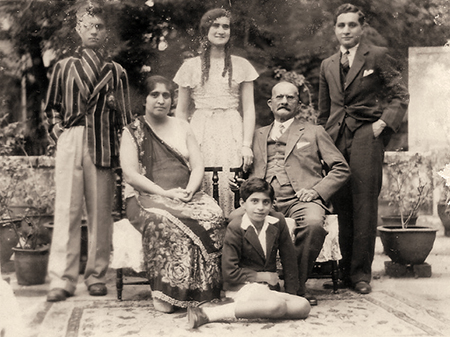
Top and above, standing center: Perin Mistri, with, from l, Mistri family:
Minocher (Minoo) and Cawas; seated, Bai Mai and Jamshedji;
seated on ground Tehmurasp Photo: Archives of Minocher Mistri
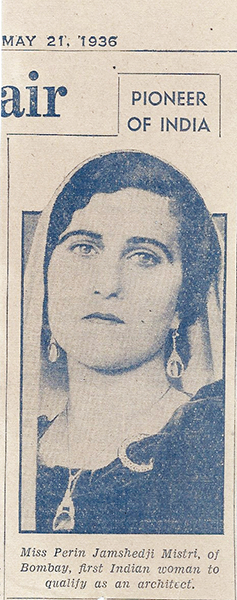
From a 1936 newspaper Photos: Archives of Minocher Mistri
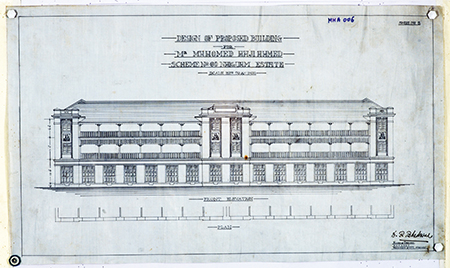
Ditchburn, Mistri and Bhedwar’s rendering on linen for Mohammed Haji Ahmed Building
"I guess being her son was not particularly easy and there was much that I would keep to myself and not discuss with either parent… I guess that came from the sense of independence that I saw in both my mother and my father… I would go off to school in the morning and come home after school with neither parent being home… I would then be left to my own devices for homework and other such matters until they returned… There was absolutely nothing wrong with the system; I didn’t feel in any way deprived. As a family, weekends were very important and we would do things together like going on picnics… So the balance between a successful architectural practice and a home or family was pretty much in place.” Fond of gardening, music "and generally having people around,” Perin would take the lead in enabling all to have a good time.
As a child Dosu would often accompany his mother on site visits. "I learnt a lot from the expert labor that she would employ… I would often spend many hours with her in the office watching her instruct engineers and draughtsmen producing drawings to her satisfaction. From this I learnt how to extract a sense of precision.”
After passing out of school, Perin was all set to study law. "But when her father realized that his eyesight was failing, he requested her to take up architecture so that their firm Mistri and Bhedwar would not die… She did so and enrolled at the Sir Jamsetjee Jejeebhoy (JJ) School of architecture… She then joined her father and, as she described it, became his eyes.”
In a comprehensive article, Artdeco Mumbai, a website dedicated to the style of architecture that was prevalent in the early years of Perin’s career, states Jamshedji founded the family firm Mistri and Bhedwar (which evolved into DMB). Perin’s younger architect brother Minoo, Sutaria’s father, went on to co-found the art and architecture magazine, Marg. "Although the three architects in the family had differing styles, an underlying sense of pragmatism, and unassuming focussed nature can be said to have been shared by all,” Sutaria told the website. Perin’s profile carried on the website of the Hecar Foundation that "seeks to educate the public about architecture” states that she completed her education in England before joining JJ in 1936, achieving fourth place among the 16 who passed the final exams.
"She was non-fussy, practical and straightforward,” Sutaria told The Times of India (ToI) on October 3, 2021. The ToI described Perin as "blue eyed, hockey-gardening-loving.” Sutaria added another dimension when talking to us. Perin was the founder president of the Indian branch of Soroptimist International, "a worldwide volunteer service organization for women who work for peace, and in particular to improve the lives of women and girls in local communities,” according to their website. The Kaiser-E-Hind of June 13, 1971 reported that "the club has started to carry out various schemes which will clean up the city, rid it of much of its nuisance and dirt.”
As stated Dosu, "She never spoke about her profession as being gender specific. To her it was just a natural phenomenon.”
◆ ◆ ◆
From the archive