
Events & Personalities
Not a diktat
"Do not treat my speech as a fatwa (diktat). I am not speaking on behalf of any one Atash Behram or panthak… I only say what is mentioned in the religious texts… To put it into practice or not, is in the hands of each individual priest,” said Dastur (Dr) Firoze Kotwal in his talk on "Significance of muktad ceremonies and prayers” on July 22, 2018. Organized under the Empowering Mobeds initiative of the WZO Trust Funds (WZOTF) and the Athornan Mandal at the Dadar Athornan Institute, the high priest lamented that "tamé gammé tèm fér laavo chho [you are making changes (in the prayers) at will].” The gathering of 96 included family members of priests, behdin pasbaans and students of the Institute.
Kotwal clarified that the word muktad was first used in the 12th century by scholar Neryosang Dhaval for remembering the departed [minoi jahan ma thi mookt thayela (those who have been released from the spiritual world)] who can shower their blessings on those who remember them, he stated.
Kotwal clarified that the word muktad was first used in the 12th century by scholar Neryosang Dhaval for remembering the departed [minoi jahan ma thi mookt thayela (those who have been released from the spiritual world)] who can shower their blessings on those who remember them, he stated.
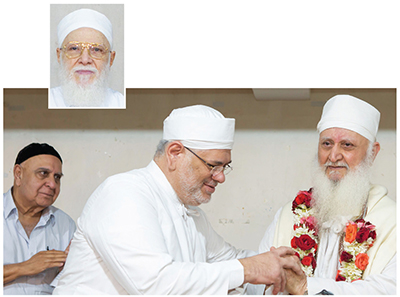
Above, from l: Dinshaw Tamboly looks on as Dastur Khurshed Dastoor felicitates
Dastur (Dr) Firoze Kotwal; inset: Ervad Asphandiar Dadachanji
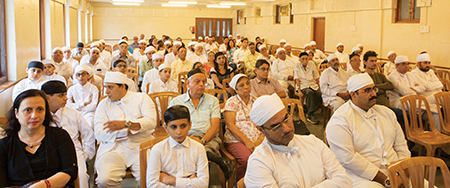
Audience: gaining knowledge on muktad ceremonies
"Fravardegan is a more apt word than muktad,” said Kotwal. Why was an 18-day period of muktad, the norm in India till a few decades ago, practiced only in certain fire temples in India today? Six "responsibilities” and two additional days of prayers were added to the original 10 days of muktad after the Zoroastrians came to India, he said. The six are: to take part in gahanbars; to remember the departed; to recite the Rapithvan prayers; to perform a jinde ravan ni kriya (ceremony for the living); to recite the Khorshed and Meher Nyaishes; to recite the Mah Bokhtar Nyaish. The high priest said that during the Gatha days, the holy books enjoin that one must recite 1,200 Yatha Ahu Vairyos daily.
While introducing Kotwal, chairman of WZOTF Dinshaw Tamboly called him the Dasturs’ Dastur. Dastur Khurshed Dastoor, whose idea it was to invite Kotwal, called him the "encyclopedia of the religion.” Dastoor noted that "Baddha pot potani marji é kriya karré chhè [everyone (the priests) performs ceremonies according to their will],” he said. Muktads performed at home, as is still the case in many residences in Gujarat and even in Bombay, "has its own charm, serenity and piousness... just offerings of milk, dates and pomegranates are adequate.”
Ervad Asphandiar Dadachanji, panthaky of Modi Sorabji Vatcha Gandhi Agiary said that priests must serve their behdins with humility ("namantayi thi”) and dedication ("parhezgari thi”) during the muktads. They need to offer succor to the behdins ("dhiraj aapvani”) and work with honesty to invoke the blessings of the departed.
After a vote of thanks by Ervad Firdaus Pavri, those assembled partook of a lunch sponsored by an anonymous well-wisher and catered by Ervad Nariman Dalal.
Formed in 1996, the objective of the alliance between WZOTF and the Mandal is to "encourage our young athornans to embrace mobedi as a full time profession by making it economically viable... also to inculcate in them the essential requisites for the class of mobeds needed by the community,” stated a write-up from Tamboly. The WZOTF-Athornan Mandal collaboration supported a total of 68 mobeds as of end December 2017, with monthly assistance ranging from Rs 800 to college going mobeds who perform regular ceremonies, to Rs 3,200 to full time priests performing higher liturgical ceremonies, stated the report. An additional Rs 500 is provided to those who meet any of these criteria: formally learn religion/Avesta language; graduate from any stream; serve as panthaky or boiwala in a mofussil area; exclusively perform higher liturgical ceremonies and train other mobeds; perform boi ceremonies in atash behrams or have physical disability. Forty of the 68 mobeds who are supported by the program work in Bombay, with 11 in Surat and six in Navsari. Two priests are supported in Dahanu, and one each in Amroli, Bangalore, Billimora, Deolali, Gandevi, Neemuch, Secunderabad, Valsad and Vapi.
◆ ◆ ◆
From the archive