
The forgotten liberal - II
Dorabji Bahadurji’s services were sought on subjects ranging from economics to bubonic plague
This article continues to narrate the efforts, largely forgotton, of barrister Dorabji Nasarvanji Bahadurji. In the first part ("The forgotten liberal - I,” Parsiana, March 7, 2018) we covered his involvement with Veer Nariman and Congress Party stalwarts.

Dorabji Bahadurji: no photo is traceable
In April 1931 the Indian National Congress under president Vallabhbhai Patel set up a select committee to scrutinize all financial dealings between Britain and India starting from the East India Company till 1858, and the British Government in India thereafter (The Indian National Congress, 1930-34. Being the resolutions passed by the Congress, the All India Congress Committee, and the working committee during the period between January 1930 to September 1934).
The select committee comprised lawyers Dorabji Bahadurji, Bhulabhai Desai and economists Khushal T. Shah and J. C. Kumarappa.
The method adopted by the economists was item-wise calculation of the cost (including wars) of 100+ years of British rule in India — and the justice and propriety of the huge burden laid at India’s door.
The committee concluded that Britain had indeed prospered to India’s detriment.
".... The (h)istory of British occupation of India, since the East India Company acquired political power, is a history of ever growing material gain in wealth and prestige to Great Britain.... Indian industries were destroyed or suppressed. India has become a market for the manufactures and products of Great Britain.” (Congress select committee on the financial obligations between Great Britain And India, Report Vol 1).
Justice and equity required transfer of all liabilities which had not benefited India to Great Britain. Indian money thus saved should be utilized only for Indian purposes, such as education, sanitation and national regeneration (Congress select committee on the financial obligations between Great Britain and India, Report Vol 1).
Repercussions: Such notions proved too radical for arch conservatives in Britain. Their fears were reflected in the Government of India Act of 1935 (which was rejected by the Congress Party), wherein the center retained complete control over taxation and revenue.
Borsad Plague Enquiry Report
At the center of this episode was the Congress party in Gujarat — personified in Patel, crowned "Sardar” after the successful Bardoli Satyagraha of 1928. At issue were Sardar’s allegations of Government incompetence, inadequacy and apathy in dealing with an epidemic of plague which hit Borsad taluka (Kheda district) in 1932-1935, resulting in hundreds of deaths.
On Patel’s initiative, a respected tropical medicine specialist of Bombay visited Borsad and surveyed the affected areas accompanied by Congress volunteers. He consulted with Dr Sahib Singh Sokhey of the Haffkine Institute at Bombay, and administered preventive inoculations and supervised disinfection and de-ratting operations. A Congress Plague Hospital was set up .
The non-official initiatives irked Government health authorities into publicly belittling and decrying the volunteers as amateurish, even dangerous.
Convinced that the Government was unwilling to remedy matters, and reacting to officialdom’s criticism of the volunteers, Sardar Patel requested Bahadurji to convene an independent committee consisting of two eminent Parsi physicians, Drs Munchershah D. Gilder, MD (London) (1883-1979) and Phiroz C. Bharucha, MD (London) (1881-1952), besides V. L. Mehta (1891-1964) as secretary. The enquiry committee was to go into Congress allegations against Government and Government counter-allegations. Utilizing publicly available documents the committee was to opine on:
the adequacy of the Government response to the epidemic;
the efficacy of medical work done by Congress workers;
preventive and curative measures for the guidance of volunteers in future similar situations.
The "Borsad Plague Enquiry Report” came out in October 1935. The conclusions were:
That the charges levelled by Government against Congress volunteers were unfounded;
The response of Government and local health authorities to the epidemic was belated, inadequate and unscientific. For example, a plague official was appointed only after several hundred people had died. No attempt was made by Government to isolate or inoculate immigrants from a plague-infected area, which resulted in new infections and several deaths;
Drs Gilder and Bharucha appended detailed preventive and curative measures for the guidance of volunteers.
The presence of Bahadurji in the Borsad Plague Enquiry Committee cemented the family’s connection with plague. His late brother Dr Kaikhusrao had earned a place in the Parsi pantheon of medical heroes for serving his community during the Bombay plague in the late 19th century. Additionally, the two medical members — Gilder and Bharucha — were on the first professorial staff at the Indians-only Seth G. S. Medical College.
The last years
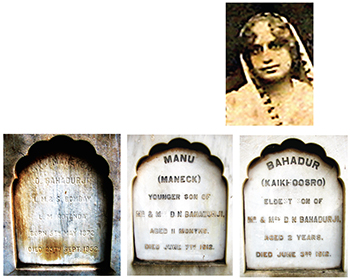
Turkhud family lore has it that Dorabji’s wife, Dr Manak (née Turkhud) became increasingly eccentric as she aged. She would be seen walking down to Chowpatty from the Bahadurji residence at Ridge Road, brandishing a tree branch (as related by Vijay Turkhud, a collateral descendant of Manak’s father Dr Atmaram Turkhud, to the author in 2017). Friends attributed the behavior to the heart-breaking loss of her infant sons, Bahadur (Kaikhoosro), aged two years and Manu (Maneck) aged 11 months, allegedly of snake bite, in June 1912. decades earlier.
Dr Manak herself died tragically at the age of 80, in a fire at the Bahadurji bungalow at Panchgani/Mahableshwar in 1952 (information given to the author of this article by the late Sumant B. Turkhud, 1920-2000, son of B. S. Turkhud who was executor of the will of Dorabji). A Prarthana Samajist to the end, her ashes are interred together with those of her babies, in the Turkhud family’s crypt in the Brahmo Samaj graveyard at Antop Hill.
Dorabji ceased legal practice by 1947. He would daily frequent the Bombay High Court library, but interacted little with colleagues. Vicaji Taraporevala’s Tales from The Bench and The Bar describes Dorabji vividly in these years of his life: "I was always intrigued by the aloofness of (Dorabji) Bahadurji .... I saw him enter the library every morning ... in an immaculately clean and well-pressed white suit... One could see the white waistcoat inside his jacket... and also glimpse the golden chain of his pocket watch...His shoes were mirror-polished... He would walk from the first to the second hall of the library, always in deep thought... He did about 10 such rounds and went home... (Due to the tragic events in his domestic life) his nature which was cold and reserved even earlier, became more frigid... Only his extraordinary will-power sustained him during the many long years of substantial practice.”
The end came for the lonely old man on February 12, 1956, at the age of 86 years.
That newspapers (nationalist as well as communal) such as The Bombay Chronicle and Jam-e-Jamshed respectively ignored his death comes as little surprise — the papers was staunchly pro-Nariman when the Patel-Nariman controversy of 1937 was playing out. No death notice or obituary appeared in The Times of India, except two lines on "the touching reference” to the late Barrister Bahadurji by Chief Justice M. C. Chagla (The Times of India, February 15, 1956).
The brief obituary in Parsi Prakash referred to Dorabji’s firmness of mind and decision on certain (unnamed) matters, and his thoroughness in professional work. Most importantly, the obituary did not mention that he was cremated a day after his death at the recently opened Municipal electric crematorium at Chandanwadi (Marine Lines) on February 13, 1956 (Parsi Prakash, 1956). It is only in connection with another Parsi cremation, that one learns in a footnote that Dorabji was the first Parsi to opt for it (Parsi Prakash, 1957).
 Interested in medicine related history, Dr Shubhada Pandya did her doctorate on the history of leprosy in 19th century Bombay. She worked as neurophysiologist under Drs Noshir Antia and Darab Dastur at the Grant Medical College.