
Books
Parsis and the plague
Room 000 – Narratives of the Bombay Plague by Kalpish Ratna (Kalpana Swaminathan and Ishrat Syed). Published in 2015 by Macmillan, an imprint of Pan Macmillan India, a division of Macmillan Publishers India Limited, 707, Kailash Building, 26, K. G. Marg, New Delhi 110001. Pp: 495. Price: Rs 599.
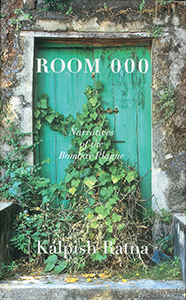 Wandering into a room numbered 000, behind a perpetually locked door in the old pharmacology building of the Grant Medical College named Petit Laboratory, the authors Kalpana Swaminathan and Ishrat Syed (who go by the composite name of Kalpish Ratna), "see” the men, including Dr Waldemar Haffkine, Khan Bahadur Dr Sir Nusserwanji Choksy, Dr Nusserwanji Surveyor and Dr Kaikhushroo Bahadurji who had worked there, a long time ago.
 The plague ran amok for nearly a decade scaring the commoner and the colonial administration alike. Room 000 depicts the efforts of the researchers and doctors who fought valiantly against and documented the tide and ebb of the disease equipped with scant knowledge of the fledgling science of bacteriology. Peripheral stories include those of care givers — both lay people and representatives of the Catholic Church. The bias against Indian doctors, and particularly towards the women in their ranks, and the hierarchy on "the Hill,” (Malabar Hill, home to the Raj bigwigs) comes to the forefront in a few narratives, as do colonial prejudices against "Asiaticks” and other non-English people.
The authors explain the relevance of the book in the epilogue: "Near the midpoint of the second decade of the 21st century, we’re exactly where these men were in 1896: facing epidemics of strange illnesses that we know nothing about.”
"All the patients whose stories have been documented in the book are real, as are the doctors,” Swaminathan, pediatric surgeon turned writer states in a meeting with Parsiana at a suburban coffee shop on August 1, 2015. The 495-page docu-novel "is bursting with Parsis,” she continues.
The duo of Swaminathan and Syed spent four years researching the official documents and personal memoirs from the Wellcome Library in London, the National Archives in Delhi, the Hebrew Library in Jerusalem and Plague Commission reports. Co-author Syed, pediatric and general surgeon, is also an accomplished photographer concerned with the ravages on nature. While each narrative in Room 000 is a stand-alone story in itself, some personalities like Choksy, Surveyor and Bahadurji are recurring leading lights, as are Haffkine who discovered a vaccine for the disease, as well as certain colonial administrators. Swaminathan believes that one can dip into the narratives in no particular order.
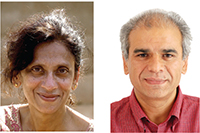
Drs Kalpana Swaminathan and Ishrat Syed
It is clear that the hero of the war on the disease is Choksy, physician in charge of Arthur Road Hospital and Mahratta Hospital during the epidemic years, "who recorded every detail of more than 4,000 cases of plague.” The doctor’s determination is evident in the early years of the disease from this statement: "Plague is a serious disease. Nine out of 10 may die. My job is to save the 10th man.” Swaminathan is unequivocal in her adulation of Choksy: he had integrity, she avers. "He approached the disease with total objectivity. He observed, he documented what he observed and went about his work with no other concern.” Calling him a true man of science, "this walking compendium on the plague” has a ward named after him in Arthur Road Hospital, but Swaminathan bemoans that "none of the students working there have ever heard of him.”
Surveyor, physician and bacteriologist at J. J. Hospital, who isolated the plague bacillus from the first known patient of the illness is a stalwart in the war against the killer disease "about whom very little is known, except for the notes he left behind.” He is portrayed as an assiduous researcher who kept copious notes of his work at Room 000, first independently, and then under Haffkine. The bacteriologist wrote to The Times of India in September 1896 giving details of his pioneering work during the early course of the epidemic. The letter was published but the name of another Japanese researcher he had alluded to, appeared with a typographical error which mortified Surveyor! The researcher is present on the sidelines when the Russo-Jewish Haffkine injects himself with the newly developed vaccine for the first time. Readers are told by way of a footnote that he was forced to retire from plague work in February 1897 on account of ill health.
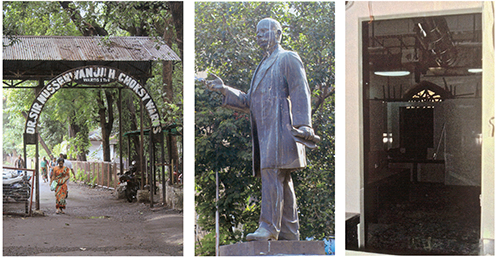
L to r: Wards at Arthur Road Hospital; statue of Dr Accacio Viegas; Room 000
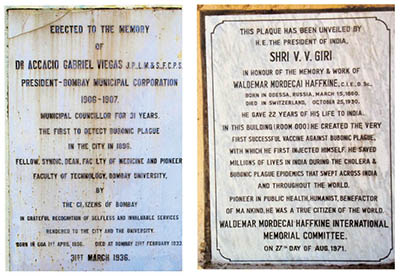
Left: Dr Viegas plaque in downtown Bombay
Right: Waldemar Haffkine plaque at J. J. Hospital
Bahadurji, Gilchrist scholar and the first Indian to earn an MD from the UK in addition to his Indian qualifications, features prominently in the narrative "The Dying Detective.” He is referred to as a "prodigy, brilliant scholar, nationalist, malcontent and troublemaker.” Working to administer a new serum discovered in Florence, Italy by an Italian-German team of professors, Bahadurji refuses the serum when he contracts the disease, which ultimately claims his life.
"Everything stopped. Except the words drumming in her brain: ‘Khushrooh has the plague. Septicaemic plague. He’s bleeding from his mouth, from his eyes. There are purple bruises on his neck... Khushrooh is going to die.’” The essence of these words sums up the agony of anyone who would have watched over even one of the six million persons who died of the plague in India between 1898 and 1908. In this case, the vocalizer of the anguish is Manek Turkhad, recent woman graduate of Grant Medical College volunteering for plague duty at Arthur Road Hospital and Khushrooh is Bahadurji, physician at the Parsi Fever Hospital.
This is also the narrative in which readers are introduced to the deceased Meherbai Wadia through her mother Pirojabai. Readers are informed that Meherbai, writer of a "cook book with more than 2,000 recipes, 76 types of achaar, 60 ways of cooking an egg, 15 kinds of omelettes, 57 cakes, 17 cheesecakes...” was among Bahadurji’s first patients in the Parsi Fever Hospital. Pirojabai dedicated subsequent editions of Meherbai’s cookbook to Bahadurji with glowing words about his care and concern for the dying Meherbai. Bahadurji is depicted as gazing fondly at Meherbai’s photograph on her first death anniversary, and being comforted by Turkhad. Swaminathan, who is now well into the research for her next book on things culinary, confirms that Meherbai’s cookbook was indeed Vividh Vani, the must-have tome for young Parsi brides in the early part of the 20th century.
The narrative "Victoria Lodge” describes the spread of the illness to the relatively plague free Parsi areas of Bombay. O. V. Muller, who set up a plague hospital for "servants of the Sahibs,” named this diaspora "The Parsi Plague Current.” The fictional Aimai Bandukwala, the wealthy Rast Goftar reading matriarch of a large family has a unique way of dealing with the disease: either abandon the patients, if they were her servants, or despatch them to sundry acquaintances in disease free areas, if they were her children. The scheming woman’s misdeeds are discovered by Rao Bahadur Tatya Lakshman of the Indian Police following the demise of Mary, an abandoned family retainer, near Dukkar Gully.
-9.jpg)
Dr Kaikhushroo Bahadurji
Seth Sorabjee Damaunwala, the grandee who facilitated Haffkine’s work in the far flung outposts of Bombay province and Dr Kalapesi, assistant to Haffkine, who innoculated over 800 people between Nani Daman and Moti Daman are other worthies mentioned in the book. Damaunwala, who is party to exposing Bandukwala’s misdeeds, bows out of the book with these threatening words to her: "I will tell the Punchayet; the law must take its course.”
Appropriately, the first narrative titled "The Sunday Gentleman” is centered on Dr Accacio Viegas who diagnosed the first case of plague among his patients "in a maze of tenements built across a reticulum of open drains” (Vor Gaddi) in what was to become an epidemic, and set the colonial administration in motion. It was Viegas’s findings placed before the standing committee of the municipal corporation that sparked off a telegram from Lord Sandhurst, the governor of Bombay to Lord Elgin, the governor general of India notifying him of the outbreak of plague.
Haffkine, the taciturn, stern faced man with the research institute in Bombay named after him (its precursor was the Bombay Plague Laboratory, situated first in Room 000 and then "on the Hill”) is depicted as a sensitive man prone sometimes to self doubt and misgivings. Requisitioned by the colonial government from the Pasteur Institute in France to assist against the war against the disease, he spent 22 years of his life in India.
The efforts of the colonial government, sometimes ham-handed (lime spraying, searches by the Durham Light Infantry and painting red circles on afflicted houses) but generally well meaning (setting up of 43 hospitals to take care of the sick), are documented with fairness.
Slightly heavy-handed at times, Room 000 appears somewhat whimsical in the choice of the Arthur Conan Doyle style Holmesian titles for the narratives. A missing table of contents and cast of characters are minor flaws in a tome of this magnitude.
Kalpish Ratna have previously published four novels and three works of non-fiction, mostly focussing on medical history and on the city of Bombay. Swaminathan had delivered a lecture on Dr Buck Ruxton, a Parsi doctor practicing in UK in the early years of the 20th century, titled "High Crime and Misdemeanour in Medicine,” at the K. R. Cama Oriental Institute (see "Crime and punishment,” Parsiana, August 7, 2015).
◆ ◆ ◆
From the archive