
History
Discovering and documenting
Early British scholars worked tirelessly to uncover India’s rich heritage
Most of us who pass by the Asiatic Society Building in Bombay are struck by the impressive sparkling white structure with a flight of elegant steps and marvellous Grecian columns. But many may not know of the intrepid work done by so many British Orientalists and the importance of the Asiatic Society of Bombay and particularly of Calcutta in rediscovering India’s classical heritage. It was appropriate that Dr Zareer Masani, who has a DPhil from Oxford University and who is the author of several books on India (as well as a personal memoir) delivered the 12th Dr Mani Kamerkar Endowment Lecture, at the Durbar Hall of the Asiatic Society of Bombay. Masani made a fascinating presentation to "challenge the notion that the British were only out to subjugate Indians and colonize Indian minds, that orientalism was merely a mode of cultural appropriation and the colonial gaze was all about annexation.”
Masani presented several British Orientalists who, in spite of full-time jobs, worked tirelessly to rediscover the Hindu and Buddhist past which had so far been neglected and much of which had been destroyed by erstwhile rulers. He started with two slides: William Hodge’s painting of a Hindu temple in 1780 and Thomas Daniel’s Akbar’s tomb at Sikandra. Both were painted before the Raj and illustrate the tremendous curiosity and fascination with Indian culture with no thought of imperial colonization or conquests.
Masani presented several British Orientalists who, in spite of full-time jobs, worked tirelessly to rediscover the Hindu and Buddhist past which had so far been neglected and much of which had been destroyed by erstwhile rulers. He started with two slides: William Hodge’s painting of a Hindu temple in 1780 and Thomas Daniel’s Akbar’s tomb at Sikandra. Both were painted before the Raj and illustrate the tremendous curiosity and fascination with Indian culture with no thought of imperial colonization or conquests.
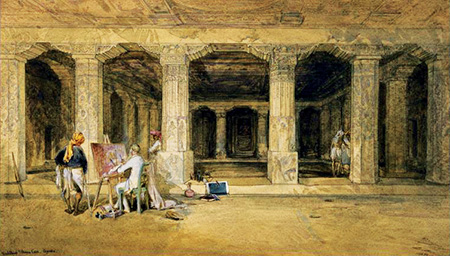
Maj Robert Gill painting in the Ajanta caves
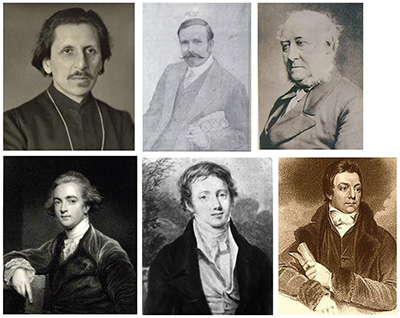
From l (top row): Ananda Coomaraswamy, Ernest Havell, Sir Walter Elliot;
(2nd row): Sir William Jones, James Prinsep, Henry Salt
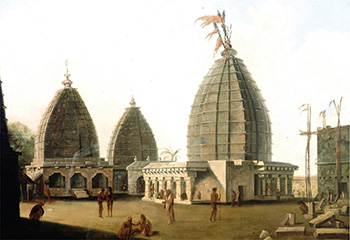
William Hodge’s painting of a Hindu temple
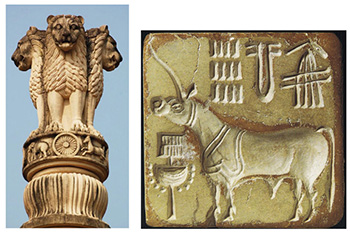
(L) Ashoka Pillar; Harappan bull
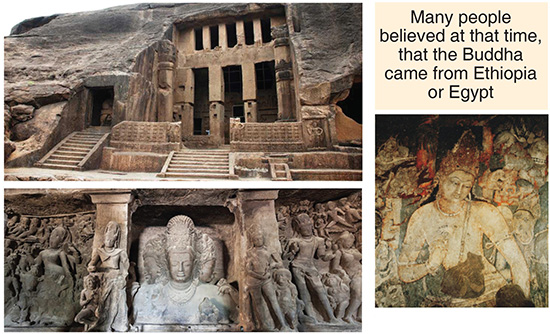
Clockwise from top: Kanheri caves, Ajanta caves, Elephanta caves: magnificent sculptures and frescoes
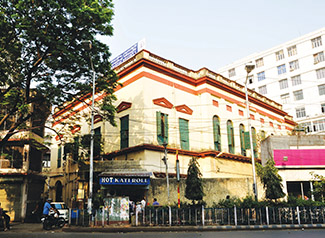
Asiatic Society of Calcutta
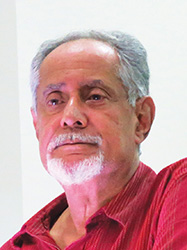
Dr Zareer Masani
Sir William Jones was brought to Calcutta by de facto governor-general Warren Hastings. Though by profession he was a judge at the Calcutta Supreme Court, he was an Orientalist, a philologist, a student of Greek, Latin and Persian and a polymath; he was responsible for the establishment of the Asiatic Society of Calcutta in 1784. It was an organization with some government support but assisted by an army of enthusiastic local British volunteers who scoured the countryside for classical antiquities. "William Jones learnt Sanskrit with great difficulty as most of the Brahmins refused to teach non-Brahmins, let alone a foreigner; but he and his wife continued their studies for a decade.” He mentioned in a letter that "Sanskrit was more perfect than Greek, more copious than Latin, and more exquisitely refined than either.” Masani drew our attention to the fact that the first translation of the Gita was supported by the Asiatic Society of Calcutta. It was through Jones’ efforts that the date of Chandragupta Maurya’s reign was established, and working back from there, the dates for the Buddha. Many people believed at that time that the Buddha came from Ethiopia or Egypt.
Jones was followed by James Prinsep, another polymath, who, though employed at the Benares Mint, spent his free time in discovering India’s heritage. It was he who collated the details from various Ashoka Pillars which were discovered all over the subcontinent. Initially, these were attributed to Alexander and the Greeks. It was thanks to Prinsep’s efforts that the Brahmi script was deciphered by comparing identical inscriptions on various pillars. It should be remembered that all this work was carried out in addition to his regular duties at the Mint. It was little wonder that, with these pressures, he almost went insane and was shipped back to England where he died soon after.
Much work was also done on monuments. Mahabalipuram was discovered in the 1770s; Elephanta was another similar example of a cave temple carved out of rock. The Kanheri caves were discovered by Henry Salt in 1806. The magnificent sculptures were covered with stucco as the Portuguese used it as a church. The Ajanta frescoes were discovered accidentally by a young British cavalry officer John Smith who was on a hunting expedition. He intrepidly explored the caves which were inhabited by tigers and Bhils. As the frescoes were deteriorating, an artist by the name of Maj Robert Gill spent 27 years painting them; these were exhibited at the exhibition at the Crystal Palace where they were subsequently destroyed in the fire. His work was continued by John Griffiths who persevered for another 13 years.
Gen Alexander Cunningham was another British polymath who travelled all over India and who is considered the father of Indian archeology. In 1834, he excavated the stupa at Sanchi and proved that Buddhism had been prevalent in India for several centuries. Masani wryly remarked that "the British Orientalists had to fight a constant battle with the natives who insisted on using the old excavated stones for new constructions and dwelling places.” Cunningham retired from the army in 1861 but continued to pursue his passion for archeology. He set up the Archeological Survey of India and discovered Taxila and Harappa. "Since Hindu erotic art was an obstacle to government funding, Cunningham concentrated on Buddhist art,” said Masani. His last major discovery was the Bharhut stupa which was full of Mauryan Buddhist treasures, which were sent to the Calcutta museum. Cunningham wrote in his diary that though there were large crowds, "...few natives of India have any belief in disinterested excavations for the discovery of ancient buildings...their only idea of such excavations is that they are really intended as a search for hidden treasure.”
The discoveries of the great art historian Ernest Havell were more aesthetic than archeological. It was he who pointed out that Indian art was stylized and conceptual and not naturalistic. Masani drew our attention to the fact that in Indian art there was no effort to portray muscle and bone as in Greco-Roman art. "The emphasis was on spirituality rather than individuality. Even animals were represented more by their essence rather than their anatomy.”
Masani ended his presentation by posing the question of cultural ownership. Sir Walter Elliot, a civil servant with the Madras Presidency, excavated the Amaravati ruins and took some of the finest sculptures to the Madras museum from where some were shipped to the British Museum. The Elliot Marbles, as they are called are kept in a special climate-controlled gallery in the British Museum where they are studied by people from all over the world. The Amaravati sculptures left behind in the Madras Museum are, on the other hand, languishing in one of its least visited rooms. The Archaeological Survey of India has, nonetheless, been demanding the return of the Elliot Marbles, on similar grounds to Greek demands for the return of the Elgin Marbles. Who, Masani asked his audience, really has the stronger claim to ownership?
◆ ◆ ◆
From the archive