
Mission and motivation
Some successful entrepreneurs are inspired to pursue selfless causes that can benefit society
Creating, providing, building, preserving, impacting. These positive words woven into the subjects of the presentations made by the guest speakers at the global meet of the World Zarathushti Chamber of Commerce (WZCC) indicated that entrepreneurs seek to make constructive yet unconventional contributions to society. For the audience assembled at the Clarks Exotica Convention Resort on December 15 and 16, 2017, the speakers invited by the Bangalore chapter provided varied insights.
"We were always ahead of time,” declared the gutsy Dr Villoo Morawala-Patell, founder of Avesthagen Limited, who has been pursuing the Avestagenome project with vigor since 2007-08. Having raised Rs 400 crores in equity and convinced that "I had all the technologies,” she set up her subsidiaries dealing with food, pharma and population genetics that contribute to continuous and path-breaking innovations in predictive, preventive and personalized healthcare.
The Avestagenome study that she initiated to compile a genealogical and medical database of the Parsi community has resulted in an impressive data bank, she stated. "This is a totally made in India project.” Noticing the higher incidence of cerebral stroke, breast and prostate cancer among Parsis she was keen to "study the interplay of multiple genes.”
Her project set out to identify the biomarkers in this endogamous community through gene sequencing. The camps that she organized in different cities collected nine tubes of blood samples (of which two will be frozen for life) from each of the 4,437 volunteer subjects. Her critics consider the Rs 15 crores she spent on the project as having been "burnt,” she candidly announced.
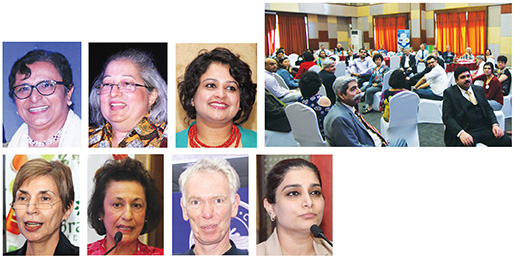
"Genome is the basis of precision medicine,” she impressed upon the gathering. "The aim is global cure through precision medicine,” she summarized the objective of her project and the subject of her highly technical and scientific presentation.
The 65 pages of social data collected from each individual who participated in this study is "integral to the outcome of this project,” stated Morawala-Patell who alluded to Parsis as the "group of refugees that emerged as nation builders in this country.” Convinced that Parsis as an ethnic race are "unique,” she believes that the population nearest to them would be the Caucasian (originally belonging to the region between the Black and Caspian Seas; part of the traditional boundary between Europe and Asia — The Free Dictionary).
"Data started pouring out from the fifth year onwards, bringing the focus on four disease areas.” Their pilot study on breast cancer among Parsis, Morawala-Patell hopes, will become the basis for drug discovery. Anticipating "at least 10 novel pharmaceutical discoveries” to emerge from this study, she added that "we are continuing to build our data base.” Expecting her scientific study to contribute to precision and preventive medicine, the scientist announced, "Any diagnostic marker would be given free to the Parsi community. This research can be mined for the next 100 years.”
Competitors for Avestagenome are the Icelandic genome study and the 1,000 genome project. She indicated the scale of their work and her plans to collaborate with other major global genome players.
"She has sucked a lot of Parsi blood,” jested the master of ceremonies Shereyar Vakil who described her presentation "as high as the planes flying over us.” Clarks Exotica being in the vicinity of the Bangalore airport, there was incessant movement of air traffic over their property.
Building a platform
Able to persevere and convert "every liability into an asset,” Bangalore based Diana Bharucha, founder and managing trustee of Kinder Trust traced her journey from a successful garment exporter to social service in her talk on "Building a platform for those in need.” Described at one time as "the garbage queen of India,” she sought to minimize waste and encourage others to be conscious of their ecology by planting 1,300 trees in the Nilgiris in Coonoor and replacing plastic with cloth bags.
The welcome kit for the delegates attending the WZCC proceedings had been placed in a cloth bag provided by Kinder Trust that has a tailoring unit to promote self employment. Formed in 2017 to support the needy, the Kinder Trust also organizes greening initiatives.
Able to stitch clothes since she was 12 years old, from a home sewing business to chocolate making, Bharucha has demonstrated her entrepreneurial skills. Even the ballpoint pen in the kit was unusual, for instead of the ink refill being placed in a plastic case, it was rolled in paper and the lower end of the refill had a seed that had the potential to grow into a plant if the user planted it in soil instead of throwing it away as junk.
Whether it is the cause of stray dogs or taking care of destitute and differently abled people or teaching English to the disadvantaged, the "dynamite Diana” has been endeavoring to empower the disadvantaged.
Giving blankets to the destitute, building toilets for schools for underprivileged children, planning a pediatric health camp in Kotagiri in the Nilgiris, interacting with orphans, organizing spectacles for those with vision problems, facilitating the marital union of a handicapped couple, teaming up with Dr Hirji Adenwalla’s Smile Train to rehabilitate patients suffering from cleft lip deformities are just some of her Trust’s accomplishments as shown in an audiovisual presentation.
Bharucha’s next concern is organizing a vehicle to ferry retarded children and those with cerebral palsy from the bus stand to the daycare school which is two kilometers away and hence a deterrent for the families. She was hopeful some samaritan from the WZCC would contribute towards this cause knowing that the vehicle can also double up as an emergency vehicle for those living on the hilly terrain.
Impacting through entrepreneurship
To introduce the WZCC delegates to "a great example of social entrepreneurship,” guest speaker Pronita Saxena was invited to share her experiences on "Impact through entrepreneurship: why we started Citizengage.” According to her, "Social entrepreneurship is a movement” involving customers, community champions, industry leaders and financiers.
Realizing that 85% of India’s waste is recyclable yet 90% sits in landfills, she set about being a "cross industry connector” by approaching restaurants and gated societies in the upmarket Domlur locality of Bangalore. "Today we manage 900 tons of waste in Domlur, lighting up a park with biogas,” she mentioned. Their clients are largely from the hospitality industry and include online kitchens and even the armed forces. She is now considering approaching airlines, the fast moving consumer goods and manufacturing sectors and grocery stores. "Large brands have little data on post-consumer waste,” she pointed out.
Her entry into social entrepreneurship "evolved, it was not planned.” She referred to the mission, opportunity and motivation that led her to make an impact. Saxena remembered her early days when as a child of seven she was traveling by car and a beggar child tapped on the window. Unconsciously she winced prompting her mother to explain to her that "It is sheer luck that you are sitting on this side of the window and not the other.” That scene remained with her over the years and prompted her to start thinking on how she could contribute to equalizing opportunities. She worked for a nongovernmental organization and studied law. "Law does not mean anything to people who are facing injustice,” she soon realized.
In 2010 when China had surpassed every country in creating wind energy, she realized the import of clean energy; saw how consumers would be given financial incentives for not turning on electricity. That taught her "We can do a lot with alternative management; change lives.” But when trying to bring about reforms, those holding power, with vested interests in maintaining the current status quo, may not favor change. At such times, community activism can counter those seeking political mileage, she recommended.
Preserving Zoroastrian values
According to Zoroastrian theology, those blessed with "materialistic wealth have a social obligation to put it to good use,” reminded guest speaker Dr Rashna Writer in her talk on "Entrepreneurial Social Conscience as a Means of Zoroastrian Self-preservation.” A political scientist and analyst with a doctorate in international relations and senior advisor at the London School of Economics, she clarified at the outset, "I am not an entrepreneur.” Her intellectual quest to understand her roots has taken her on a journey where she studied many religious and historical texts.
Parsis enjoyed a primary position during British rule and almost all trade went through Parsi hands. "They were canny enough to use commercial possibilities that opened up.” In 1805, Parsis owned 18 companies, Hindus, five, and the British, nine. While the British were making fortunes in Calcutta, the Parsis were doing so in Bombay. With well-established Parsis standing as guarantors, the seed capital for early industrial enterprise was raised. Their generosity led to the establishment of many charitable institutions. In fact, the Parsi contribution to the Muslim Khilafat movement was larger than that from the Muslims.
With the establishment of the Bombay Parsi Punchayet in 1728, a constitution and infrastructure was put in place, orphans and the destitute were taken care of. This inspired community members to initiate gahanbars and found baugs. Such altruistic motives reinforced the community identity and was equally indicative of the Parsi mindset.
In 1854, the Society for the Amelioration of Condition of Zoroastrians in Persia was formed by Manekji Hataria to assist the less fortunate Zoroastrians in Iran. Within three years Zoroastrian schools were founded. Hitherto, the population of 7,158 Zoroastrians in Yazd, Kerman, Shiraz and Tehran regions of Iran had been denied education. Hundred orphan girls were given in marriage to boys settled in Bombay. The jezia tax was finally abolished in 1882. The men preferred to move away from agriculture. From contractors, they became bankers. "There is a long tradition of self help within the community. It is an established practice embedded in Zoroastrian ethos,” reminded Writer. The elders created a network and infrastructure as demanded by the times they lived in.
Entrepreneurs are important for they take financial risks to bring ideas to the market. Historical knowledge helps us better manage affairs, stated Writer who observed the "nature and composition of the community has changed. New national dynasties have emerged.” British Zoroastrians are different from those in America or Australia although "an underlying similarity may be assumed.”
Having lived in the UK for most of her life, she knows that an old people’s home is a worthy concept that needs to be implemented and duplicated in the diaspora. A part of the wealth that is generated should be invested in the future of the community, reiterated Writer. "Remind the world of who we are… Succeeding in business is a means to achieving a better world.”
With darbe mehrs and community centers established in the diaspora, "the tradition of giving is continuing in North America,” Writer was reminded by US members. Even in Bangalore one Zoroastrian lady donated a piece of land on which an old age home will be built once funds are forthcoming, stated Bangalore Anjuman president Air Chief Marshal Fali Major (retd).
When Cyrus Dhabhar of Bangalore enquired, "Do we have a universal definition of Zoroastrian or is it lost?” Writer responded that in the context of "being a recognizable Zoroastrian, India has played a colossal role. In the history of Zoroastrians, more Iranians had settled in China but in 864 AD the Chinese government proscribed all foreign religions. There is a challenge going forward as in the diaspora we are too dynamic. We may have integrity in our DNA but I’m concerned about the dilution of our identity. How precisely are we going to work to reinforce our identity as Zoroastrians?”
"As budding entrepreneurs, what two things should we take and what two things should we not take from our ancestors?” enquired Yazad Patel of Bangalore. According to Writer, "Leadership potential and value for human life, coupled with generosity, warmth and industry” were worth emulating. Knowing that we "lost our empire though infighting, with the Arabs getting a walk-in,” she responded, "Stay away from Parsi politics. You feel very, very despondent when you read certain things.”
Gaining insights
Zoroastrian values were reinforced at the post lunch session when Zerbanoo Gifford of UK’s Asha Centre referred to "big-heartedness, generosity, tolerance and love for everybody as qualities that define a Zoroastrian” and "infighting as a weakness we should stop... We should be behaving properly, promoting our community and our youth,” she urged. Impressed with the young Zoroastrians who spend a weekend at the Asha Centre every year, she referred to their "passion. They are exceptional and we should invest in them.” She then referred to the Asha Centre hosting the World Zoroastrian Youth Leaders forum in March 2018 saying, "It is important to invest in them. What they need is confidence.”
She further observed, "One of the qualities we have is a sense of defiance. Defiance to be the best. We believe in justice and fight for others’ justice.” When Jamsetji Tata was told he would never be able to produce steel, he persevered and today Tatas are the largest business house in England.
Her colleague from the Asha Centre, Adrian Locher, then proceeded to conduct a series of interactive exercises, role play and self reflection to help participants gain insights into the dynamics of team leadership.
Outlining educational friendship
Kanika Choudhary as a special envoy to the ambassador of Pennsylvania made a fleeting presentation ahead of the evening address by Dr Peter Garland, executive vice chancellor of the Pennsylvania State System of Higher Education (PASSHE) (see "A journey and a destination,” Parsiana, February 7, 2018). In her brief address on "Outlining the friendship between PASSHE and the WZCC,” she hoped the mutual relationship between the two organizations would facilitate access to educational institutes and some Parsis would avail of the entrepreneurship courses offered by PASSHE.
Having studied in a Parsi school in Bombay for 12 years, to Choudhary, the alphabet P stood "for Parsi, for Pennsylvania and for Petit which educated me.” She thanked the community "for contributing to the nation and thank you for your stellar ethnicity,” concluding, "Hopefully in my next life I will be born a Parsi.”
Dr Ferzaan Engineer’s talk on "Creating model cancer hospitals in India” has been covered in "Creating Cytecare” (see pg 86).