
ART
The historic prints
Old prints of Bombay acquainted the West with India
Thanks to the generosity of Pauline and Roy Rohatgi as also Pheroza and Jamshyd Godrej the Prince of Wales (PoW) Museum of Western India (since renamed Chhatrapati Shivaji Maharaj Vastu Sangrahalaya) now houses the second largest collection of prints of India outside of the Victoria Memorial (which still retains its colonial name) in Calcutta. An exhibition titled "Bombay to Mumbai: Door of the East with its face to the West” marked the inauguration of the new Prints Gallery in the Museum on January 29, 2015. The Rohatgis and the Godrejs between them had donated 250 prints to the PoW.
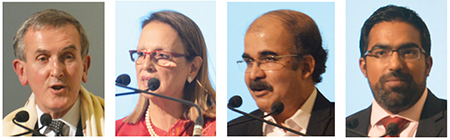
Above, l to r: Neil MacGregor, Pheroza Godrej, Sabyasachi Mukherjee and Kumar Iyer
Addressing the gathering, Pheroza stated that her friend, co-donor and co-curator Pauline was "crestfallen” as she could not attend the event, being unwell; she had suffered a stroke some years earlier and more recently a "mishap.”A video of the function would be sent to her and she was expected to visit Bombay end February.
Pheroza thanked the Godrej family members who had turned up in large numbers for the inauguration and made special mention of the support received from her husband Jamshyd. The PoW director general and secretary Sabyasachi Mukherjee termed Pheroza "the driving force behind the Gallery” and described her as "an authority on Indian art.” She had started and runs the 43-year-old Cymroza Art Gallery.
The British deputy high commissioner in Bombay Kumar Iyer noted the commission had been "working together” with the PoW authorities since the loan of the Cyrus Cylinder from the British Museum around 13 months ago. Noting the change in the name of the PoW and other landmarks, Iyer stated that though the nomenclature may change, "history never changes. It is constant.” One must work to "preserve it and keep it accessible to everyone” so that "one might not forget the lessons learned” from it.
Neil MacGregor, the director of the British Museum in London, while terming the PoW "a wonderful institution,” referred to the "magnificent job done by them in restoring prints.” As they are drawn on paper, they are "fragile.”
"Before Bollywood and curry…for most Europeans, all they knew about India was from the prints…in those days there was no (worldwide) web,” said the articulate speaker. However, by 1870 "so many Indians were living in England” that they had deemed the Thames a sacred river.
While mentioning that the Egyptians’ "gift to humanity” was the bureaucracy, MacGregor narrated the story of an Egyptian mummy loaned to a museum in India. When the time came to return the embalmed body, the government authorities stated that under Indian law the export of mummies was prohibited! After many frantic phone calls by the museum directors and others to the higher authorities the mummy was returned to the loaners.
MacGregor also spoke about an educative project, "the history of the world in a 100 objects... We’ll take one moment (in time) and see what (is/was) happening all over the world,” at that specific period.
"Cultures keep being changed, enriched, revived by contact with other cultures,” he observed. For example, the Moghul emperor Akbar and his experiment with bringing heads of various religions together was historic. "The whole world was amazed by Akbar’s court” which was liberal.
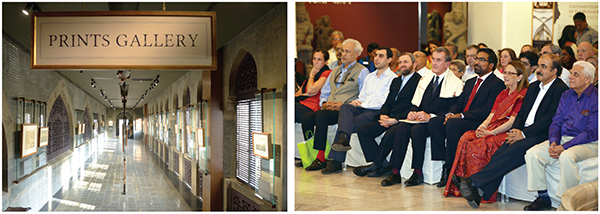
A view of the gallery and the audience
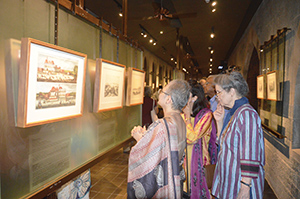
Invitees at the opening.
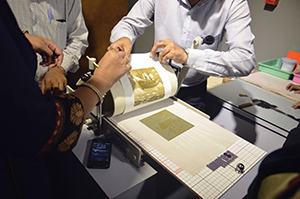
Printing demonstration of images
"Nineteenth century Bombay was not like any other,” he observed. It started local and became an important state, cosmopolitan in nature. The prints on display reveal that unique past to viewers.
In a write-up accompanying the announcement of the Gallery, Pauline and Pheroza noted, "The city of Bombay (now Mumbai) owes its origin to the Portuguese who established a fortress on Bombay island in the 16th century. Within a few years, in 1668, these islands were leased by King Charles to the East India Company. Bombay’s importance as a trading center grew rapidly, and the Bombay Presidency encompassed parts of present day Maharashtra, Gujarat, Karnataka and Sindh (Pakistan). Company servants, envoys, merchants, missionaries and explorers were among the early European travelers to India. Many of them were deeply interested in aspects of Indian culture and the historic, religious and social traditions of the country. Many of these travelers wrote illuminating descriptions of their journeys in diaries, letters and chronicles.
Some of the more enlightening narratives were published, among which were the journals of Sir Thomas Roe (the English ambassador to Mughal Emperor Jehangir’s court), the books by the Dutch missionary Philip Baldaeus and the Italian adventurer Niccolao Manucci who settled in Madras which contain vivid firsthand observations of India. Several of these volumes, and many others by equally perceptive pioneers, were illustrated with woodcuts and engravings. These prints were based upon drawings and maps, probably made by the authors themselves or their fellow-travellers. Sometimes, however, they derived from prints already published. Although some of the topographical illustrations were accurate, much was left to the engravers’ imagination, and fanciful embellishments occurred in many of these early prints.”
◆ ◆ ◆
From the archive