
Health
Getting entangled
A new therapy to calm minds based on drawing intricate patterns is gaining appeal
Poona’s Jehangir Hospital is pioneering an unusual and creative form of therapy among its medical and non-medical staff. Since last November, groups of 12 to 25 Hospital employees as well as Poonaites from all walks of life have been gathering in the Hospital’s auditorium for a few hours in the afternoon to learn the Zentangle Method, which is "a life skill, and a simple metaphor for life in a complex and busy world.” The therapeutic Tangleations sessions at the Hospital are conducted by Lady Jasmine Jehangir and her sister Binaifer Karanjia who themselves learnt the Zentangle Method from its creators, Rick Roberts and Maria Thomas, who are based in Massachusetts in the US. Jehangir and Karanjia are among the only 12 certified Zentangle teachers in India.
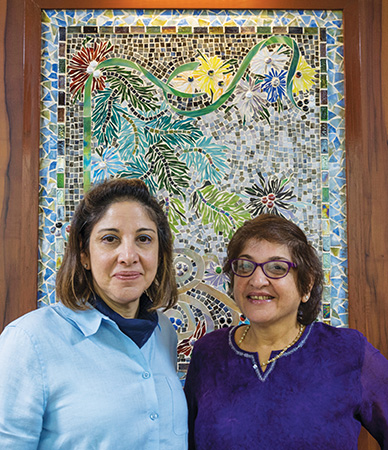
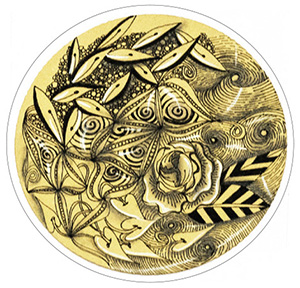
Lady Jasmine Jehangir (left) and Binaifer Karanjia with a Zentangle creation (r) Photos: Jehangir Jehangir
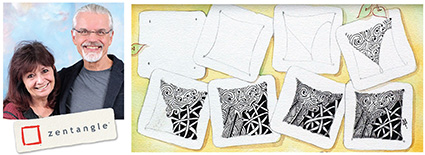
Maria Thomas and Rick Roberts, creators of Zentangle as a means for creative fulfilment Photos: Zentangle.com
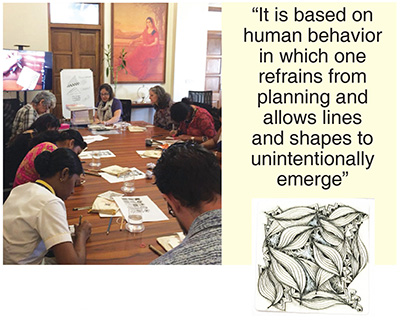
Therapeutic Tangleations session at Jehangir Hospital
For its growing band of practitioners the world over, Zentangle is more than just an easy-to-learn, relaxing and fun way to create beautiful images by drawing structured patterns. "Zentangle is a form of therapy that is closely linked to life,” says Karanjia. "It has many life-enhancing benefits, such as calming the mind, improving concentration, helping with anger and pain management, boosting self-esteem, stimulating creativity and enhancing productivity. Zentangle’s mantra that ‘anything is possible, one stroke at a time’ sums up its simple yet profound philosophy.”
"You don’t have to be an artist to attend these classes,” Jehangir adds. "Anyone who can use a pencil and pen can create beautiful drawings with the Zentangle Method. Anyone who can draw its five basic strokes — a dot, a line, a curve, an S shape and an orb — can create Zentangle art. It’s as simple as that. The focus is on the process, not on the outcome. It’s a way to create beautiful designs that relaxes you and makes you feel good. It is a great stress-buster.”
All you need to create eye-catching Zentangle designs are 3.5” x 3.5” squares of high quality cotton-based paper, two archival quality Sakura pens, one graphite pencil and a blending stub for shading. In keeping with Zentangle’s philosophy, no erasers are used. As its creators Roberts and Thomas explain, "In life there is no eraser, and so it is in Zentangle. There are only experiences. Use them; make them work. There are no mistakes. Whatever occurs, even though it cannot be unsaid, uncut, or undrawn, is an opportunity for new insights, new understandings, and new tangles… We designed the Zentangle Method as a ‘forgiving’ art form with little or no worry about the outcome. We have enough things in life that invite worry without Zentangle art being one of them.”
Watching a Tangleations workshop in progress, it becomes evident that the students — be they Jehangir Hospital staff or Poona-based students, office goers, care givers and others — have embraced the Zentangle philosophy and are relaxed and completely focused on the square tile on the table in front of them and on the pen in their hand. The step-by-step instructions given by Karanjia and Jehangir are the same for the entire group, but what emerges at the end of the class is an extraordinary mélange of prints and designs when the tiles drawn by the participants are placed edge to edge to create a unique mosaic. No two designs have ever been the same!
Roberts and Thomas initially focused on Zentangle as an outlet for creativity. They did not anticipate their invention’s additional soothing and healing side effects. In The Book of Zentangle they speculate, "This may be because the Zentangle Method addresses an imbalance in today’s world — that most people rarely express their own creativity. Instead, they just absorb the creativity of others. A Zentangle practice enables and encourages a creative flow and focus. We think this may explain some of the amazing stories of therapeutic side effects that people describe.”
Karanjia adds, "Zentangle’s repetitive strokes in a de-structured pattern puts the mind into a state of deep focus or flow. Scientific studies show that the mind does become calm and the frontal lobes of the brain are completely absorbed when drawing Zentangle patterns. The parietal lobe, which gives you a sense of time and space, shuts off, putting a practitioner into an almost meditative state.”
Dr Sanjay Phadke, a senior consultant of neuropsychiatry at Jehangir Hospital, who has studied the effects of Zentangle on the human brain notes, "Drawing tangles involves creation of focus and disengagement from ongoing intrusive thoughts and emotions, and leads to a pleasant flow experience as the practice gets better. Zentangle’s applicability across age groups and even for those with limited mobility or physical energy makes it an attractive candidate for therapy in several patient groups.”
Writing on psychologytoday.com Cathay Malchiodi who has authored books on art therapy and serves on the American Art Therapy Association’s board of directors, states: "Zentangle has become an international phenomenon that now has applications in stress therapy and even motivational training. Zentangle itself may be relatively new, but the basic principles involved are as old as the history of art. It includes ritual and mirrors the symbols, designs and patterns of numerous cultures from ancient through present times. It is based on a human behavior in which one refrains from planning and allows lines and shapes to unintentionally emerge.”
The zentangle.com website notes the Zentangle founders used to sell prints of Thomas’ botanical illustrations at art fairs. Thomas would inscribe each botanical for her customers. As customers watched her lettering appear on the page they exclaimed how they wished they could do what she did. Then, without missing a beat, they gave all the reasons why they couldn’t . . . not enough time, talent, space, money, etc. But the duo were struck by their deep yearning to experience their own creative fulfilment.
"Sometime later, on a quiet Saturday afternoon in the fall of 2003, Roberts interrupted Thomas in her studio as she added patterns to the background of a large gilded letter. Thomas described feelings of selflessness, timelessness, effortlessness and a rich immersion in what she was doing — all classic aspects of a flow state. Roberts, who had practiced meditation for many years, said, ‘You’re describing meditation.’
"As Roberts and Thomas discussed what had just happened, they noted that the patterns behind the gold-leafed letter were simple to draw, unlike the precise letter forms. Then they remembered all those people who yearned to be creative, yet could not invest the time necessary to become an accomplished lettering artist. Maybe they would enjoy learning how to draw these patterns...
"Although we liked the word ‘tangle’ to describe our new method of drawing patterns, we played with words that rhymed with tangle. One of us said ‘Zentangle.’ All at once, we both exclaimed, ‘That’s it!’”
To date, Karanjia and Jehangir who have taught the Zentangle Method to over 150 Hospital personnel and others, vouch for its calming and relaxing effects. Press reports about the success of Tangleation’s program in Jehangir Hospital have roused the interest of information technology companies and the human resources departments of multinationals in Poona and also in Goa and Jaipur. The idea is catching on that getting into a tangle may actually be good for you.
◆ ◆ ◆
From the archive