
Alternatives to allopathy
The Beramji’s Hospital has popularized acupressure and acupuncture treatment for multiple ailments
Last month Rumi was appointed first president of the newly constituted Acupuncture Council of Maharashtra. After West Bengal, the second state in India to recognize acupuncture officially is Maharashtra. Founder member of the Association of the Acupuncture Science Practitioners, Rumi struggled for nearly four years, liaising with the education minister Dr Vijaykumar Gavit, before acupuncture was deemed a separate system of medicine in 2016. The Association will guide the Council to develop courses of international repute (see "Acupuncture recognition,” Events and Personalities, Parsiana, March 7, 2016). It can, in future, also start outpatients’ departments in hospitals. The couple wants to change the scarcity of trained faculty and establish a permanent location for training and treating.
Internationally, 80 countries have a board for regulating acupuncture. Even the World Health Organization acknowledges this system. It is reportedly the second most recognized practice after allopathy. USA, UK, Germany, France, Australia and Canada have legalized its practice. Hong Kong, Korea, Singapore and of course China have it as an established practice, among other eastern countries, the couple tells us.
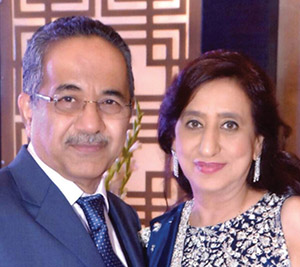
Drs Rumi and Yasmin Beramji
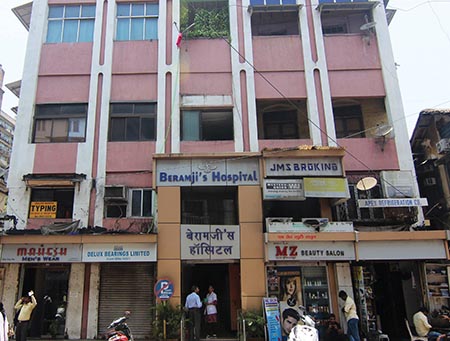
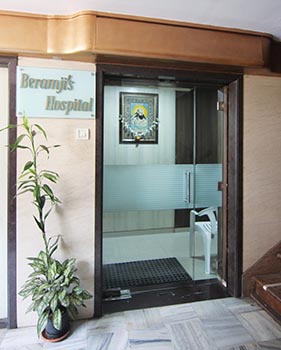
Entrance of Beramji’s Hospital
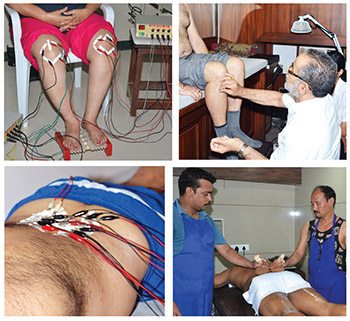
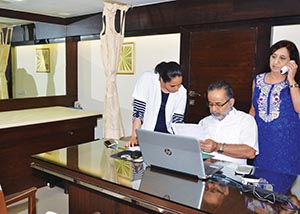
In their consulting room: (l to r) Dimple Mehta, Drs Rumi and Yasmin
From allopathy to acupuncture
Rumi’s spine treatment earned him recognition from China where he was invited to share this knowledge. Most patients (50%) come to Beramji’s for spine treatment — whether paralysis, sciatica or other affiliated diseases; some (40%) for knees — osteoarthritis or cartilage wear, etc; 10% for other ailments like frozen shoulder, tennis elbow. Cross-consultation facilities are also available.
For Kerala massage they use oils from that state of repute. Ultrasound is administered not with paraffin oil as is the norm, but with specific herbal oils from Kerala. Rumi says that the effect is far superior and penetration much better. They have also made a compact disc on "How to avoid backache” offering proactive guidelines and curative tips for back health. Testimonials abound in it.
"I believe myself to be a healer who has no boundary. Healing through any mode, I encourage it and study it,” says Rumi. The journey into alternate therapy from allopathic treatment started when a doctor walked into their clinic and spoke highly of acupressure and acupuncture. At the clinic just then there was a young boy with asthma taking heavy steroids. Rumi knew he was critical and threw the drop-in doctor this challenge. Acupuncture treatment worked and the Beramjis were amazed at the progress of the young patient. Fortuitously, Rumi read about Goculdas Tejpal Hospital conducting a course in acupuncture. Both husband and wife completed this course. Rumi narrates how another paralytic patient arrived at his clinic. The improved condition of this patient with acupuncture treatment convinced the two of its efficacy. In another orthopedic case referred to him, the patient was going into kidney failure with heavy use of pain killers. This was the couple’s first case of successful cure without drugs, they state. In the early 1990s, more patients arrived seeking acupuncture treatment.
In 2000, they converted their Girgaum nursing home into an acupuncture hospital, their unique selling proposition being treatment sans drugs, only external intervention. The same year they bought 52 acres of land near Karjat to pursue their dream of a holistic center called Satya Health Farm. Two secular friends, who were not doctors, became partners in this venture. The couple packed in an 18-hour day and Rumi was spreading himself thin between two locations, wide apart. Yasmin took her mother’s role seriously and did not commute every day. Rumi suffered a cardiac arrest in 2002. The Karjat property was consequently sold three years later and all energies focused on the hospital at Girgaum.
"I’m fine today… because of my mental fanaticism,” declares Rumi. He appreciates Yasmin’s support in all his plans and erratic decisions. One day a friend walked into their hospital declaring he was going to start his own nursing home. On an impulse Rumi told him to take all the surgical equipment from Beramji’s as he was determined to promote the alternative medicine center. His friends thought this was insane and were shocked that he was converting a thriving practice into an unknown stream of acupuncture and acupressure. One of them told him he was committing suicide. Yasmin, though, was rock solid behind him, supporting him through all his ups and downs — financial, medical and personal. He calls her "his shadow.”
Yasmin (née Banker) narrates how they were laboratory partners since their surnames followed each other in the class register. "Rumi was very shy and would do all the experiments by himself – including weighing chemicals and taking readings in physics experiments. After a few days I felt emboldened to tell him that I also would like to do the experiments… Both were very studious so we hardly met outside of college.”
Yasmin branched off to study pediatrics at the Seth Gordhandas Sunderdas Medical College and KEM (King Edward Memorial) Hospital whilst Rumi completed his MBBS at Topiwala National Medical College & B. Y. L. Nair Charitable Hospital. He secured admission for Master of Surgery due to his excellent grades but due to financial circumstances was unable to complete it.
The duo came close again when Yasmin gave tuitions to Rumi’s cousin who came to Bombay from Bulsar. After marriage, they started Beramji’s Hospital in Girgaum in 1977. Their current location was bought with loans of Rs 50,000 each from two Parsi friends. Even today they are partners. It took 10 years to put Beramji’s on its feet and to return the loans. They originally only occupied the first floor, where visiting doctors on their panel offered consultations in gynecology, gastroenterology, orthopedics, neurosurgery, general surgery. They had patients from all over the country and abroad, especially United Arab Emirates and Africa.
Beramji’s was among the first two private clinics to have been granted government accreditation for MTP (Medical Termination of Pregnancy). Seeing abortions done by quacks in unhygienic conditions, Rumi convinced the Bombay Municipal Corporation to introduce a Family Planning Certificate which the clinic obtained. A board was put up announcing termination for Rs 65, with anesthesia!
Now spread over four floors with facilities for overnight stay for relatives of outstation patients, Rumi assures us that Beramji’s Hospital was nowhere close to its current avatar. Rooms were curtained off. "We have faced lots of hurdles. Yasmin and I have swept the floors before patients came in as we would not have anything but a spic and span place.” They also practiced at a medical center nearby where they were paid 50 paise per patient in the mid ’70s. The Hospital runs training sessions for staff most Saturdays whether in service orientation, hygiene, medical practices, updating skills or even customer behavior. Rumi says, "When a patient walks in we are the last two to be seen, the dirt first. The impression about the Hospital is already made by then.”
The couple, both aged 65 years, applauds the dedication of their staff, most of whom have been with them for over five years — Coover Contractor has spent 21 years with them, Niloufer Panthaky, 20, Swati Jadhav has been a nurse for 18 years and Dimple Mehta, a physiotherapist for eight years. Eighty percent of their staff is female. Their son Shahzad who studied in the US and is said to be India’s only trained acupuncturist, runs his own clinic in Santa Cruz. He visits the Girgaum Hospital twice a week. Recently married to Priyanka Pardiwala of Bulsar, his clinic is called Beramji’s Acupuncture Centre.
Staunch Zoroastrians, a large tapestry of Zoroaster greets you at the entrance of the Hospital. Their consulting room has a divo and feng shui running water. Yasmin is opposed to the Bombay Parsi Punchayet giving free housing to anyone, her contention being that Parsis should not have a sense of entitlement and must value what they get. "What is wrong if they have to go to Vasai to live?” She recalled that father-in-law Fardun came from Sanjan where the family owned land, but was compelled to drive a taxi on arrival in Bombay. He then drove a BEST bus which he thought would be more remunerative. To secure a better life for his three children he invested his savings in buying taxis. Rumi’s sister Dinaz Wadia is today a special audiotherapist treating patients suffering from cerebral palsy and second sister, Jasmine Bastani, is a homemaker. Yasmin has a sister, Nergish Charna, who retired as principal of Elphinstone College and brother Rustom who retired from a nationalized bank, commissioned to unravel bank frauds for the Central Bureau of Investigation.
At the outset of their practice, the Beramjis willingly extended credit to patients who said they were "unable to pay,” but on the advice of a well-meaning Income Tax (IT) officer they have discontinued this practice and now offer "free” consultation rather than show amounts in their annual returns as recoverable and raise the suspicion of the IT department.
The dedicated couple has adopted for their motto: "serve humanity.” Seeking refuge in medicine, Rumi reveals that he originally wanted to be an engineer and join the National Aeronautics and Space Administration in the USA. "Kaka’s (paternal uncle) death was a turning point in my life.” He passed away in the night for want of immediate medical attention. Fardun went into depression and the family lost everything as there was no earning member. Rumi was then 16 years old. Deliberating on his future course when walking his dog with an old trusted family driver, Rumi acknowledges the counsel he received from the "learned” driver: "Har ék aadmi ko dacter ki zarurat hoti hai. Engineer ki nahi (Every man is in need of a doctor not an engineer).”