
Sports
Novy’s stories and statistics
As ESPN-STAR expert commentator, Novy Kapadia captured for South Asian viewers the magic of the FIFA World Cup
For Delhi’s Novy Kapadia, it was destination Germany for the 18th FIFA World Cup 2006 in June/July. As expert commentator for ESPN-Star Sports, speaking from their studios in Singapore for the earlier rounds and from the stadiums in Stuttgart, Dortmund, Munich and Berlin for the semi-finals and final, Kapadia and his co-commentators captured for viewers in faraway India, Pakistan, Afghanistan, Nepal, Sri Lanka, Bangladesh and Maldives the magic of the 31-day tournament.
Kapadia, a lover of English literature, deputy proctor of the University of Delhi, reader in the department of English, SGTB Khalsa College, author of several books on literature and sports, was commentating not in English but in Hindi!
"To be involved in the first-ever South Asia specific Hindi commentary of the World Cup tournament was a special honor for me. It was also a tribute to my football knowledge and expertise as a commentator when, for the same organization (ESPN-Star) and other TV channels I am known and recognized as an English commentator,” Kapadia says. On the commentary team with Kapadia were the experienced Ghaus Mohammed and newcomer Sunil Taneja, bringing alive to the die-hard football fan in Bengal or Goa or the newcomer watching in the Hindi heartland the tactics and the tears, the twinkling feet of rising stars or the passion and perseverance of ageing football warriors, the passing of the ball and often the buck in what is not just a sport but a billion-dollar industry!
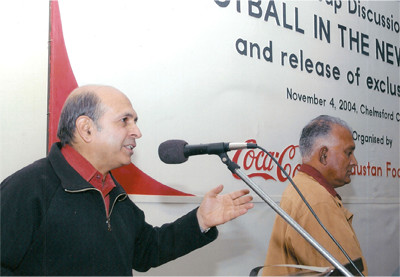
Novy Kapadia: storehouse of sports knowledge
"I used my experience of four previous World Cups to share anecdotes about previous events, like what German coach Juergen Klinsmann did as a player in the 1990 (Italy), 1994 (USA) and 1998 (France) World Cups or what Brazil’s coach Carlos Alberto Parreira did as coach in the ’94 tournament. A TV commentator’s role is to add to the pictures, rather than describe the pictures. That is the major difference between TV and radio commentary. On TV, viewers can see the action and so you must speak of what is not obvious, Kapadia explains. "I had to provide the technical expertise, give predictions about tactics (four-four-two, four-five-one formation, use of a sweeper back or a flat back four) and style of play (long ball, short passes, packed defence, open play, etc). In serious commentary, however, gossip about a player’s love life or girl friends is not permitted,” he adds.
With the 32-team, 64-match, 147-goal marathon event being covered live and with the time zone difference between Germany and Singapore, sleepless nights were a part of the job! Requiring quick and accurate identification and the correct pronunciation of tongue-twisting names of players, bench strength and referees, "you spend the whole month reading about football, from newspapers, magazines and above all the internet which is now a real boon. In the World Cups that I covered earlier, background information was gleaned by talking to senior journalists or former players who came to stadiums. The internet boom and FIFA’s excellent website www. fifa.com or those of ESPN-Star Sports and BBC have made the jobs of commentators much easier.”
With astronomical sums being paid by clubs and countries for feet flying down the flanks, satiny midfield play or steely defense, "we had to give viewers in S. Asia a feel of the big money involved in organizing a World Cup. We talked about players’ salaries or transfer fees (French star Zinedine Zidane moved in 2001 from Juventus to Real Madrid for a phenomenal $ 65 million!) or price of tickets — the minimum price being Rs 20,000 for a semi-final, Rs 30,000 for the final and other such things.”
While Kapadia has been an ESPN-Star Sports English commentator since 1996-97, the BBC World Service, Zee Sports, NDTV (24 x 7), Headlines Today, CNN-IBN, Ten Sports, Sahara Samay, Channel 7 and the state-run Doordarshan have also channeled his expertise, not just for football, but for hockey tournaments, five Asian Games, three Olympics, several European championships, the recent Melbourne Commonwealth Games and the Republic Day and Independence Day celebrations as well!
Prolific with the pen too, Kapadia’s eight literary publications include 16th century English love poetry, critical
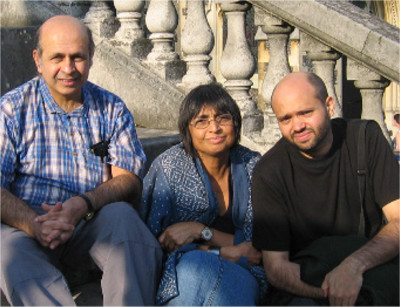
Novy Kapadia (left) with sister Bunny Page and nephew Jonathan
Photo: Timothy Page
editions/introductions of Jane Eyre and Sidney, Spenser and Donne, Parsi fiction, the novels of Bapsi Sidhwa… He has authored a lengthy chapter entitled "A Sporting Tradition: Winning Accolades” in Volume IV of Enduring Legacy, Parsis of the 20th century, edited by Navaz B. Mody. Covering Parsi achievers over a period of 100 years in athletics, boxing, cycling, horse racing, martial arts, motor sports, swimming, weightlifting, yachting, archery, basketball, women’s hockey, billiards and snooker, rowing, shooting, squash, badminton, table tennis and tennis, Kapadia writes about sports administrators/organizers as well!
With football his focus, Kapadia has published four books – three in England and one in Calcutta. He is the editor since 1983 of Durand Football Journal, India’s only comprehensive football annual. Sports consultant and editor with the Limca Book of Records since 1992, he has been for the last 24 years the Delhi correspondent for The Telegraph of Calcutta and has contributed to the Business Standard, The Economic Times, Hindustan Times, India Abroad News Service, etc. His article "The Other Side of the Medal” won him the very first Wills Award for Excellence in Sports Journalism in 1986.
Novy’s great-grandfather Navroze Kapadia was the first Parsi to settle in Delhi in the early 1880s when he moved there with his family from Bharuch in Gujarat, Novy relates. Growing up in a north Indian ethos, "my conversational Hindi is good, though I have barely written in the language since school days,” says the St Stephen’s College alumnus who has an MPhil in English literature.
A veritable storehouse of statistics and stories, Kapadia informs us that Indian football stars like Baichung Bhutia, S. Venkatesh, Mahesh Gawli and Alvito D’Cunha are paid in the range of Rs 15-25 million per annum! The annual budgets of the top National Football League Clubs like Mahindra United, East Bengal, Mohun Bagan and Dempo range from Rs 20-35 million! But Indian football is yet to kickoff on the international stage, with India never having qualified for the World Cup finals and, since 1960, not qualified for the Olympics either, despite annual grants from FIFA for the development of the game. Vote bank politics, imperfect passes by state associations, no systematic youth development, arbitrary selection, inadequate fitness levels have all been the bane of Indian football, rues Kapadia.
While the Tata Football Academy (TFA), with a set-up of 25,000 sq ft amidst the greenery of Jamshedpur, has been up and running since 1987, the All India Football Federation’s national football academy is still on the anvil. As per their website, the TFA takes in budding footballers in the age group 14-16 years and provides a four-year residential training course, with free board and lodge, free education, medical, clothing, kit, etc as well as a stipend. Several of the country’s leading footballers are products of TFA.
With New Delhi scheduled to hold the Commonwealth Games in 2010 and India looking to hold future world sporting events, the lessons to be learnt are several, Kapadia believes. Overall, World Cup 2006 was one of the best ever, he opines, with excellent press, policing, transport and other arrangements. While flag-waving, face-painted fans from all nations thronged the stadiums, "large screens were put up in picturesque spots like the market square, in lush green gardens or near rivers, with food and beer on sale, in a carnival and picnic-like atmosphere. On the day of the finals, huge screens were put up near the historic Brandenberg Gate (in Berlin) and nearly 1,00,000 people assembled there to watch. German fans who in previous years would feel embarrassed at overt shows of nationalism, as it was a throwback to the Nazi notions of superiority, this time shed such inhibitions.” Yet when Germany lost to Italy in the semi final, there was no rancor or violence. "For me, a special memory of this World Cup is how the German fans, after the initial disappointment of losing, mingled freely with the Italian fans (in a sport known for hooliganism and trouble-making). Creditably, football has conquered the perils of aggressive nationalism and fanatical identification with the national team,” Kapadia asserts.
◆ ◆ ◆
From the archive